“Sometimes Common Sense Does Prevail”

Those words were spoken by Missouri Governor Mike Parson about the agreement struck with Kansas to end some aspects of the economic incentives border war. It also sums up my feelings upon learning that the Kansas City Tax Increment Financing Commission voted against recommending a subsidy for another hotel downtown.

The city council may still approve the subsidies, which will require 9 of 13 votes to pass. As The Star noted, however,

The [Commission] vote reflects a growing skepticism about the value [of] local economic development subsidies. During his campaign earlier this year, new Mayor Quinton Lucas was frequently critical of incentives for new development, particularly for luxury projects or those in prospering areas like downtown.

We hope that common sense will again prevail and that city leaders will start saying no to more proposals to spend public money on private developments.


More Proof that Missouri’s LIHTC Doesn’t Work

The numbers are in: Missouri’s low-income housing tax credit (LIHTC) program fails to deliver. The program was supposed to increase the amount of available affordable housing across the state. But reports from the Missouri Housing Development Commission (MHDC) show that Missouri’s LIHTC program simply wasn’t working.

Each year, the federal government allocates funds for the LIHTC program, and historically Missouri has matched each dollar. In 2017, Missouri’s governor halted the state’s portion of the program after multiple reports showed glaring problems. The pause in state credit issuance allows policymakers to look back and determine whether the state’s LIHTC program ever had a meaningful impact. 

According to project approval data from the MHDC, there was little change in federal LIHTC applications in 2018, the first full year without the state’s LIHTC program. Projects can vary in size so it’s important to look at the number of units being subsidized. Last year more than 2,200 units were funded solely by the federal LIHTC program, which exceeds the average over the previous four years (where Missouri was matching each federal dollar) by more than 400. This indicates that project developers still believe there is money to be made on low-income housing. In short, the program was zeroed out and nothing changed.

The LIHTC program essentially functions as a way to help finance construction. Eliminating Missouri’s contribution may have simply changed the way developers choose to make their profits. For example, the MHDC data show a large increase in approved LIHTC rehabilitation projects for 2018, but a small decline for new construction. There is also a sharp increase in the estimated average cost per unit of approved new construction projects. The point being, as long as a project remains profitable, developers will find a way to make it happen, no matter what they tell Missouri policymakers.

Despite the overblown claims of the negative consequences from eliminating Missouri’s LIHTC program, the state’s affordable housing landscape appears to be moving in the right direction. If policymakers want to save Missouri taxpayers millions of dollars and strike a blow against crony capitalism, it appears there is no greater opportunity than leaving LIHTC behind.


Incentives Will Never End Unless City Leaders Say No

Waddell & Reed was just granted $62 million in state subsidies, but apparently that is not enough; now they want more. Kevin Hardy at The Kansas City Star reports:

The company is seeking a major property tax abatement to move into a new office tower in downtown Kansas City, according to economic development documents posted online . . . The agenda for Wednesday’s meeting of the Enhanced Enterprise Zone Board, which is under the umbrella of the Kansas City Economic Development Corporation, (EDC) shows Waddell & Reed plans to occupy a build-to-suit high-rise that will “add to the skyline in Kansas City.” The company plans to make a nearly $90 million capital investment, which includes about $80 million in lease and improvement costs and about $10 million in personal property investment.

Hardy’s piece goes on to detail the other subsidies sought by developers for downtown office space, such as the awful Strata proposal. The election of a supposedly incentive-skeptic mayor has not slowed down the demand for public money for private development. At a recent meeting of the Missouri Economic Development Financing Association, it was made clear that despite all the research showing incentives don’t deliver as promised and are viewed negatively by taxpayers, the organization sees no need to seek any changes or reforms.

City leaders need to do more than complain about incentives or say they “don’t pass the smell test.” They need to say no. Repeatedly. Only then will developers get the message.


Overregulated Food Trucks

Food from a truck just tastes better, right? Grabbing a treat and enjoying the weather can make for a great day. It’s too bad that St. Louis food trucks continue to be bogged down with operating restrictions.

Several years ago, Show-Me Institute’s Patrick Ishmael discussed the overregulation of food trucks, with emphasis on the then-new food truck map that outlines the numerous no-park zones for food trucks within the Downtown Vending District. So, years later, have we seen food trucks gain substantial freedoms in the market?

Unfortunately, and perhaps unsurprisingly, no.

The map mentioned above is still in effect and places a large barrier between food trucks and success in the market. As the map shows, food trucks cannot set up within 200 feet of a restaurant or in the stadium or conference center areas. Though this map may be a little outdated in terms of restaurant placement, the rules are still in place and still very restrictive. These regulations make large parts of the “vending district” off-limits to food trucks. According to the city’s vending rules and regulations, trucks must stop serving by 11 p.m., cutting off access to late-night crowds after a concert or hockey game.

St. Louis ranked 12th out of 20 cities in the U.S. Chamber of Commerce Foundation’s report on regulatory burdens for opening and operating food trucks in 2017. Much of this low ranking is attributed to what Ishmael pointed to years ago: operational limitations.

Food trucks are still bogged down with regulatory restrictions that make it much harder to succeed. If we want more success stories like Balkan Treat Box, the popular food truck that grew into an award-winning brick-and-mortar hotspot, we need to give food trucks the freedom to meet our ever-increasing demand for delicious, on-the-go food.


Missouri in the Middle on Regulations

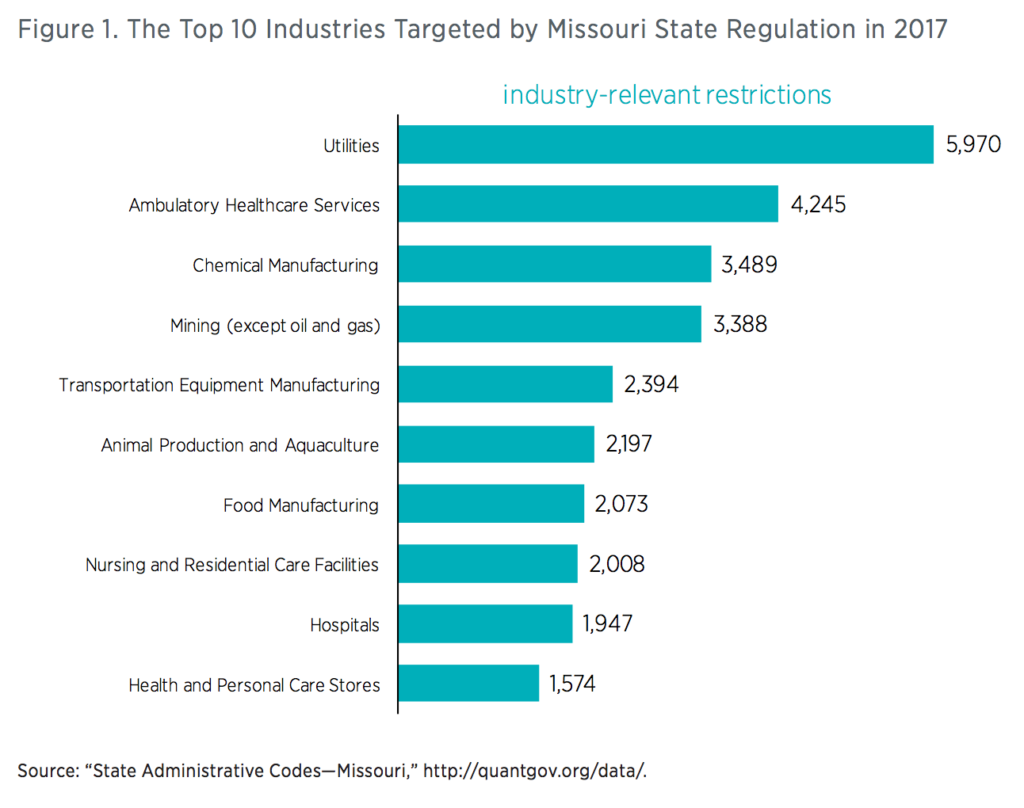
According to a dataset from a new project released by the Mercatus Center at George Mason University, Missouri is ranked 22nd in regulatory restrictions overall.

The Mercatus project to analyze state-level regulation is a continuation of the state-level analysis on regulations conducted in Missouri for the No Mo Red Tape campaign initiated under Gov. Greitens. Mercatus says of the effort,

Mercatus researchers Patrick McLaughlin and Oliver Sherouse created QuantGov, an open-source policy analytics platform designed to help create greater understanding and analysis of the breadth of government actions. The platform allows researchers to quickly and effectively examine bodies of text using some of the latest advances from data science, such as machine-learning and other artificial intelligence technology.

The top-regulated industries in Missouri are utilities followed by ambulatory health care and chemical manufacturing. Only three other states bordering Missouri have utility regulation in their top ten, and they are much further down on the list (Kentucky 7th, Tennessee 7th, Iowa 8th). It would be interesting to learn why Missouri regulated utilities so much more than our neighbors and the degree to which that might be driving up utility rates in Missouri.

Regulation graph

While this study does not explicitly make the link, it is generally understood that regulation drives up cost. The difficult work is to determine which regulations are necessary and what costs are reasonable. Researchers and policymakers looking for more efficient ways to regulate may find this data useful.


Fight for 15 . . . Hours Per Week?

Activists have spent years trying to persuade lawmakers to raise the minimum wage to $15. In a possible effort to get ahead of the curve, the retail giant Target decided to voluntarily raise its minimum wage to $15 an hour. Who could object to that?

It turns out, Target workers themselves.

After Target raised its employees’ wages, Target then proceeded to cut their hours. A CNN story highlighted the workers’ frustration.

“I got that dollar raise but I’m getting $200 less in my paycheck. I have no idea how I’m going to pay for rent or buy food,” one worker commented.

Workers didn’t just lose hours—some lost benefits. Target employees must average 30 hours per week to qualify for health insurance benefits. But the reduction in hours worked pushed some employees below 30 hours, costing them health care benefits. The negative impact of such a policy was predictable.

The vast majority of people earning the minimum wage are not trying to live solely on that wage. The typical minimum wage worker is someone who is under 25, still in college, working part time, and living in a family well above poverty. According to a 2017 Government Accountability Office report, only 13 percent of households with someone earning between $7.25 and $12 per hour were in poverty.

Raising the minimum wage benefits some lucky teenagers at the expense of the working poor. Show-Me Institute analysts have discussed this problem many times before, most recently regarding Missouri’s decision to raise the state’s minimum wage to $12 per hour by 2023.

Perhaps Target’s situation will help people see that the negative consequences of minimum wage increases are more than theoretical. Policies targeted specifically at the desired recipients, like the earned-income tax credit, are more effective at incentivizing hard work than a one-size-fits-all policy.

If we want to help the working poor, raising the minimum wage is simply not the way to do it.


More Hotels; Fewer Taxes

Despite the fact that Kansas City just held an election in which the city’s profligate use of tax subsidies played a major role, the city council is at it again. This time, the council is using its public borrowing power to help developers avoid the taxes that all other Kansas Citians are expected to pay. To add insult to injury, the goal is to build something Kansas City may already have too much of: hotels.

First, let’s make clear that the hotel market in Kansas City is already crowded. The Kansas City Star made this point just a few months ago, and it’s something developers themselves admit. It’s so bad that the city’s tourism board is asking for more public funding to help sell rooms to address the fear that too many hotels will reduce hotel rates (as hotels compete for guests). In short, problems created by subsidizing hotel construction resulting in foregone tax revenue are to be solved by directing even more of the remaining tax dollars toward subsidizing hotel sales departments. If you think this is crazy, it gets worse.

Despite all this, some Kansas City Councilmembers want to offer more tax breaks to build two hotels near Country Club Plaza. (Regarding a crowded hotel market, the immediate area around the plaza area is already served by 12 hotels.) Specifically, the plan this time around is to have taxpayers underwrite $80 million in bond debt. With Chapter 100 bonds, the property taxes may end up being abated as long as the bonds are outstanding. This means that for up to 20 years, there may be no property taxes paid on the projects—taxes that might otherwise be used for police, public safety, and roads.

Twenty years is a long time to abate property taxes. Back in 2004, the council passed an ordinance in which it agreed, “Bonds will be issued for a term not to exceed 10 years. Bonds issued for personal property shall have a term limited to the life of the personal property, but not to exceed 10 years.” This new effort, however, just waives that 10-year limit. Laissez les bons temps rouler!

Mayor Quinton Lucas told KCTV5 News,

There is no money coming from taxpayer sources to directly fund this. The question on the bond obligation is to what extent is the city pledging its full faith in credit in connection with the lending?

The first claim is misleading at the very least. The project doesn’t use existing taxpayer sources, but it may abate or redirect the taxes that would have been paid but for this ordinance. It’s a distinction without a difference. As for the second part, that is a whole other consideration: If the project goes belly up and no taxes are being redirected to bond payments, will bondholders come after the City of Kansas City, the folks who issued the bonds? This is not an easily resolved question.

If hoteliers want to invest their own resources in Kansas City—and themselves reap the rewards—that is welcome. If they agree with VisitKC that the market is already saturated and choose not to invest, that is understandable. But taxpayers should not be asked to go without so that one more developer, one more well-heeled lobbyist or one more connected attorney can earn a few bucks selling Kansas City what we may already have too much of.


Support Us

The work of the Show-Me Institute would not be possible without the generous support of people who are inspired by the vision of liberty and free enterprise. We hope you will join our efforts and become a Show-Me Institute sponsor.

Donate
Man on Horse Charging