Missouri School Funding Workshop: Location and Parking Details

Event Details: 

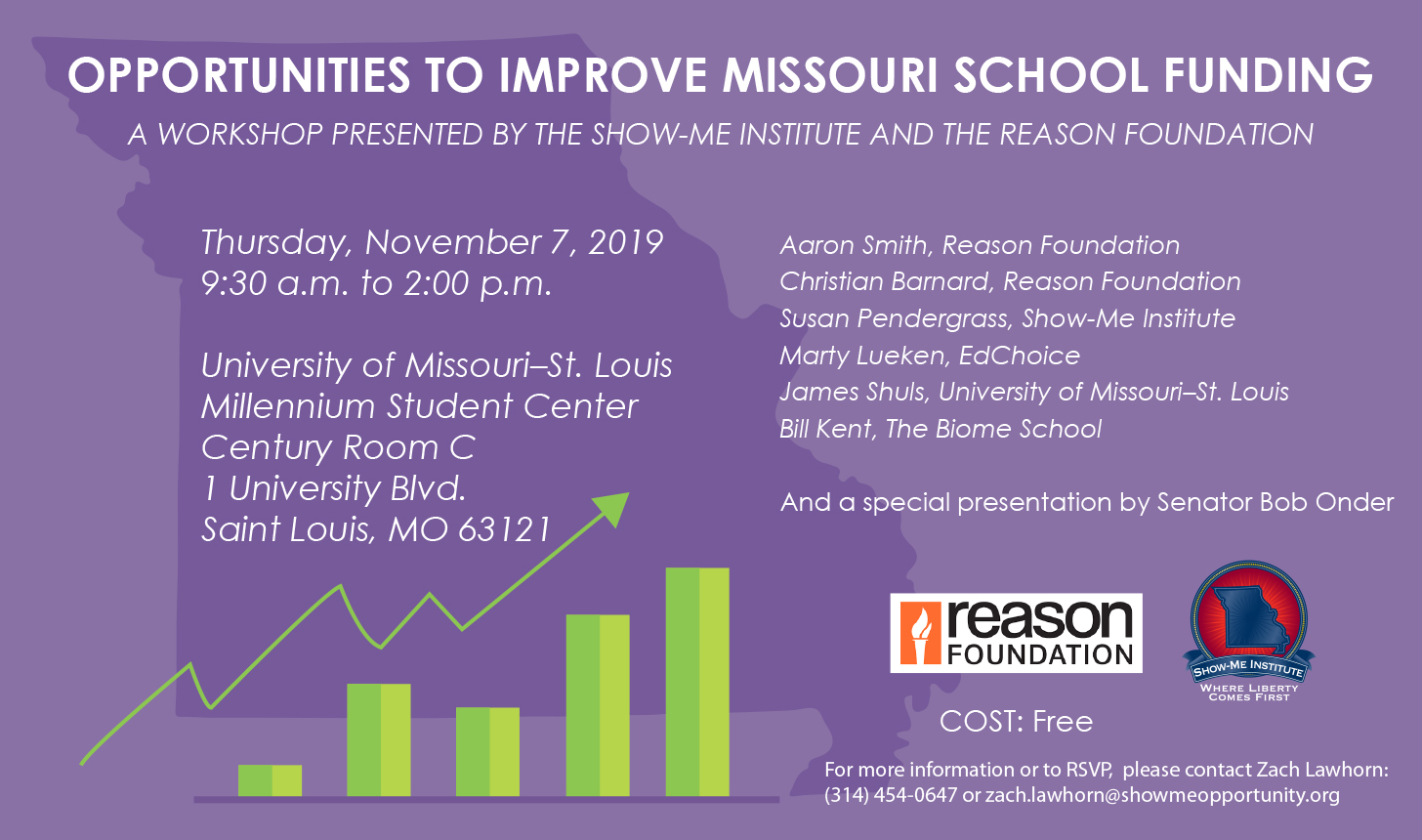
School finance policy is a foundational component of public education that directly affects all of Missouri’s students and classrooms.

In the 2017–18 school year, just over $12.5 billion dollars were spent on public education in Missouri. Approximately one-third of this was financed from state coffers via a funding formula that distributes state dollars to each of the 518 school districts in the state. There are still significant cracks in the foundation of the formula that must be addressed. This workshop highlights these problems and provides recommendations for student-centered reforms that promote fairness, transparency, and local autonomy. School finance policy is more than just complex formulas and calculations—it’s a foundational component of public education that directly affects all of Missouri’s students and classrooms.

RSVP HERE: https://www.eventbrite.com/e/76345500447

LOCATION

University of Missouri-St. Louis

Millennium Student Center

Century Room C

1 University Blvd.

Saint Louis, MO 63121


PARKING

Millennium Student Center Garage North at 26 Arnold B Grobman Dr, St. Louis, MO 63121


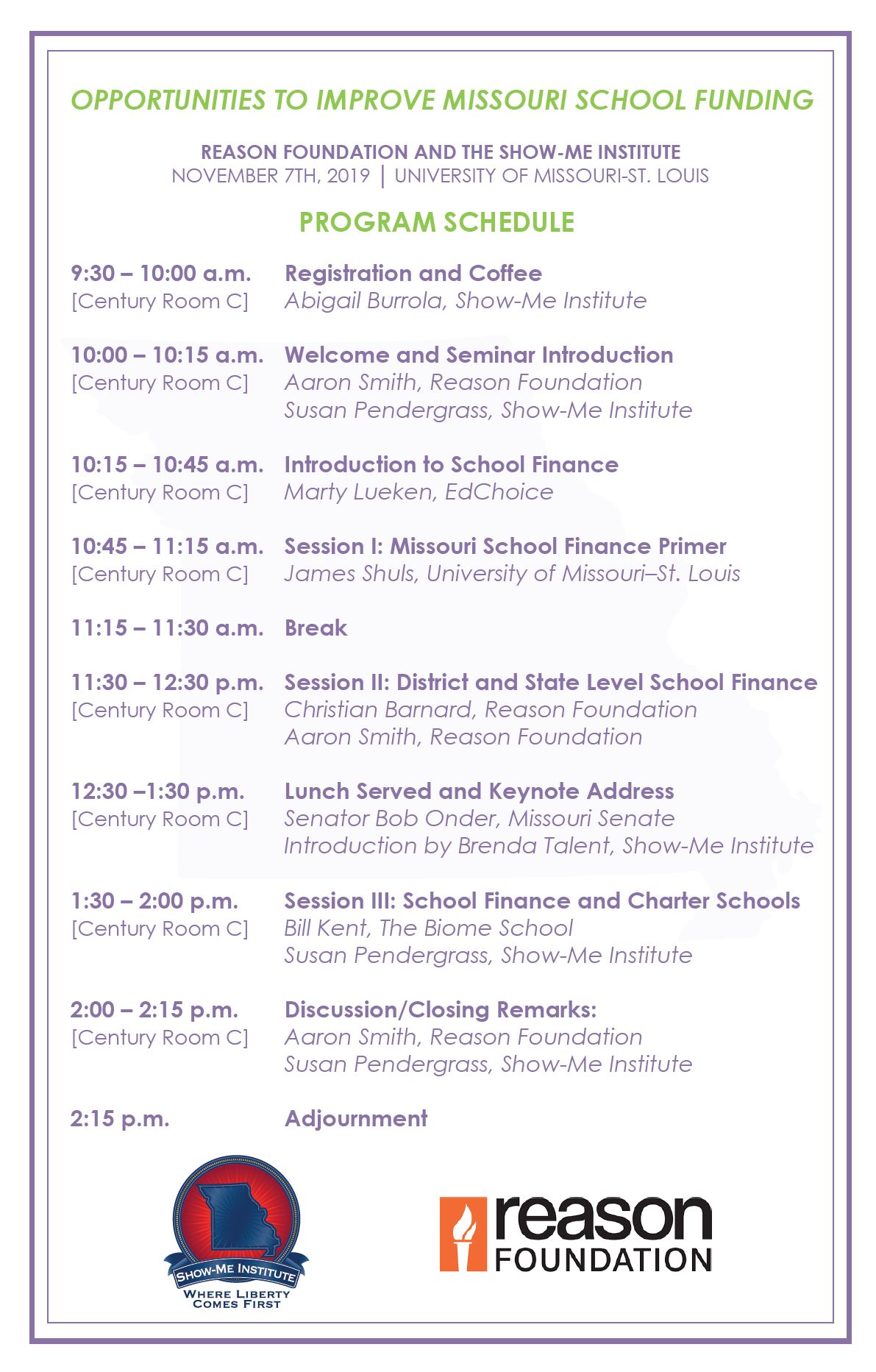
Workshop program

Free Lecture: Cato Institute’s Michael Tanner on How to Bring Wealth to America’s Poor

Event Details: 

Some 38 million people, nearly one in eight, live in poverty in today’s America as liberals and conservatives spar predictably over solutions – government assistance versus pulling yourself up by your bootstraps. Researcher and writer Michael Tanner wants to draw from both sides.

Tanner, a senior fellow at the libertarian Cato Institute and a National Review online columnist, explores the issue in a discussion of his book The Inclusive Economy. His remedy is not more government intervention in spending or redistribution but rather a series of actions that address the racism, gender discrimination, and economic dislocation feeding poverty. They range from criminal justice reform to greater educational flexibility and the elimination of savings barriers for the poor.

We’re hosting this event in both St. Louis and Kansas City.

To RSVP for St. Louis, click here

To RSVP for Kansas City, click here

USDA Deal Is Great for Port KC, Less Great for KC Taxpayers

The announcement that the USDA has chosen a location in Kansas City, Missouri was met with satisfaction by political leaders in Missouri. Port KC, the Kansas City port authority, also seems satisfied—and it stands to make a killing.

The USDA office is moving into 805 Pennsylvania, a piece of land designated an Advanced Industrial Manufacturing (AIM) Zone by Port KC. According to state statute, this designation allows 50 percent of the state withholding tax collected from the new jobs to be redirected to the USDA, totaling just over $26 million dollars, per The Kansas City Star. To offset the cost of developing the site for a new employer, Port KC is allowed to charge an administrative fee of 20%, which comes to $6 million dollars in this case.

But wait, there is another subsidy for the project, this time coming from Kansas City taxpayers. From the Star:

On top of that, Kansas City could offer up to $6 million through the redirection of 75% of city taxes, according to a document outlining the local and Port KC incentives obtained by The Star. The Kansas City Council would have to vote to approve the redirection of local taxes for the USDA relocation; an ordinance is expected within weeks.

“City taxes” and “local taxes” are euphemisms for the earnings tax, as there will be precious little other tax generated at the USDA site. Kansas City leaders, who argue breathlessly that the earnings tax is such a vital source of income for things like public safety, are willing to forgo $6 million of earnings tax revenue for the USDA.

There is a better way. If city leadership wanted to protect Kansas City taxpayers from losing vital tax dollars, council members would demand—and Port KC would agree—to waive its administrative fee, which is coincidentally the same amount that city taxpayers are being asked to give up. Without such a demand by the city council, however, this deal includes a transfer of millions of dollars from Kansas City taxpayers into Port KC’s pocket.


The Latest Show-Me Institute Podcast

On this episode of The Show-Me Institute Podcast, Dr. Susan Pendergrass is joined by Crosby Kemper III. They discus the past, present and future of Kansas City. Topics include: Kansas City’s business climate, economic development, education, local tax rates, and the relocation of two federal agencies from D.C. to K.C.  

Listen on Apple Podcasts

Listen on SoundCloud


Should Ten Percent Be a Passing Grade?

Educational options continue to be scarce in Missouri. The Missouri Course Access Program (MOCAP) could increase opportunities for students by giving them the option to take online courses in place of traditional schooling. However, school districts are not committing to the program as they should.

According to the law that was passed by the state legislature and signed by the governor in 2018, every school district is required to inform families about their right to participate in MOCAP. It should be made clear in the “parent handbook, registration documents, and featured on the home page” of the district website. However, a majority of the districts are not complying with the law.

Only 57 out of the 556 school districts and charter schools in Missouri provided information about MOCAP on their websites. Of the 57 districts that do have this information posted online, only a handful made it easily accessible. Dallas County R-I is one of these outliers; it announced the program on the front page and link to a particularly informative explanation. But most websites bury the information. For example, Plato R-V only has a one-sentence message at the very bottom of the page in a hard-to-read gray font and provides no link to further information.

Ninety percent of Missouri districts are not complying with the requirement at all. MOCAP passed into law 18 months ago, and that should have been plenty of time to update websites and inform parents. Show-Me Institute analysts have written about instances of districts attempting to block students from using MOCAP, and the problem persists.

Online options can be a haven for students who face complicated medical situations, bullying, or have specific academic needs. MOCAP can also provide the opportunity for students to take classes that their local district doesn’t offer.

However, families can only reap the benefits of educational opportunities if they are aware of their options. MOCAP should be celebrated, but implementation is key. Every district should have this information on its homepage so that families who can benefit from course access are aware of the opportunity.


“Sometimes Common Sense Does Prevail”

Those words were spoken by Missouri Governor Mike Parson about the agreement struck with Kansas to end some aspects of the economic incentives border war. It also sums up my feelings upon learning that the Kansas City Tax Increment Financing Commission voted against recommending a subsidy for another hotel downtown.

The city council may still approve the subsidies, which will require 9 of 13 votes to pass. As The Star noted, however,

The [Commission] vote reflects a growing skepticism about the value [of] local economic development subsidies. During his campaign earlier this year, new Mayor Quinton Lucas was frequently critical of incentives for new development, particularly for luxury projects or those in prospering areas like downtown.

We hope that common sense will again prevail and that city leaders will start saying no to more proposals to spend public money on private developments.


More Proof that Missouri’s LIHTC Doesn’t Work

The numbers are in: Missouri’s low-income housing tax credit (LIHTC) program fails to deliver. The program was supposed to increase the amount of available affordable housing across the state. But reports from the Missouri Housing Development Commission (MHDC) show that Missouri’s LIHTC program simply wasn’t working.

Each year, the federal government allocates funds for the LIHTC program, and historically Missouri has matched each dollar. In 2017, Missouri’s governor halted the state’s portion of the program after multiple reports showed glaring problems. The pause in state credit issuance allows policymakers to look back and determine whether the state’s LIHTC program ever had a meaningful impact. 

According to project approval data from the MHDC, there was little change in federal LIHTC applications in 2018, the first full year without the state’s LIHTC program. Projects can vary in size so it’s important to look at the number of units being subsidized. Last year more than 2,200 units were funded solely by the federal LIHTC program, which exceeds the average over the previous four years (where Missouri was matching each federal dollar) by more than 400. This indicates that project developers still believe there is money to be made on low-income housing. In short, the program was zeroed out and nothing changed.

The LIHTC program essentially functions as a way to help finance construction. Eliminating Missouri’s contribution may have simply changed the way developers choose to make their profits. For example, the MHDC data show a large increase in approved LIHTC rehabilitation projects for 2018, but a small decline for new construction. There is also a sharp increase in the estimated average cost per unit of approved new construction projects. The point being, as long as a project remains profitable, developers will find a way to make it happen, no matter what they tell Missouri policymakers.

Despite the overblown claims of the negative consequences from eliminating Missouri’s LIHTC program, the state’s affordable housing landscape appears to be moving in the right direction. If policymakers want to save Missouri taxpayers millions of dollars and strike a blow against crony capitalism, it appears there is no greater opportunity than leaving LIHTC behind.


Support Us

The work of the Show-Me Institute would not be possible without the generous support of people who are inspired by the vision of liberty and free enterprise. We hope you will join our efforts and become a Show-Me Institute sponsor.

Donate
Man on Horse Charging