Not All Funds and Games

The federal Highway Trust Fund (FHTF) is in jeopardy, and that could mean bad news for Missouri’s roads and bridges.

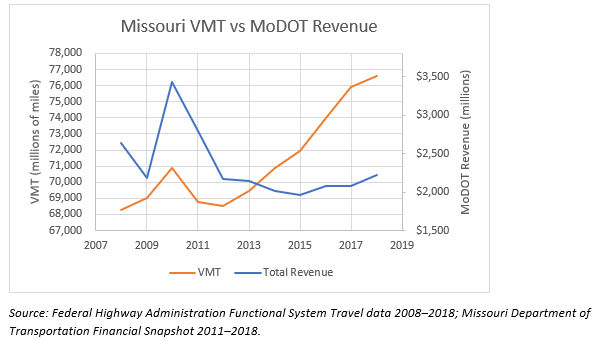
You may never have heard of the FHTF before, but the Missouri Department of Transportation (MoDOT) relies heavily on it. Forty-two percent of MoDOT’s budget is federal money, the bulk of which comes from the FHTF (page 7).

This pattern of dependency is not a reliable way to maintain our transportation infrastructure.

The FHTF, funded mostly by federal fuel taxes, faces looming solvency problems, especially as the federal gasoline tax is unlikely to budge. Since 2004 Missouri has benefited from the fund, at times receiving $1.45 for every $1 contributed. According to the latest information, Missouri gets $1.14 for every $1 contributed..

MoDOT recognizes this dependency problem (page 14). A solution? User fees like tolling or gas taxes, which are the fairest way to ensure those who use the roads most pay their fair share for upkeep. Most states employ some form of tolling, and many others index their fuel tax rates in some way to ensure the revenue keeps up with the economy.

By relying more on a system that collects revenue based on use, Missouri could mitigate the pitfalls of federal dependency and the need to push costs into the future by issuing bonds.

Federal grants awarded to Missouri this year illustrate how the problems of federal dependency and pushing costs into the future are related. Missouri received $100 million from the federal government to repair bridges, which triggered $300 million in state bonds to supplement those repairs. Those bonds will now need to be paid off down the road.

Federal money certainly helps MoDOT with budget issues in the near term, but it does not address the more serious problem of MoDOT’s long-term solvency. Missouri needs more robust  user fees if it wants to create sustainable funding for our infrastructure maintenance.


Show-Me Gets Results? PortKC to Refund Taxpayers

Back on November 4, I recommended Kansas City City Council members curtail the $6 million administrative fee that PortKC would collect as part of the deal to bring the USDA to Kansas City. Two days later the city council’s Finance, Governance and Public Safety Committee did exactly that, revising the related ordinance to reduce the city’s subsidy from $6 million to $1.6 million.

To review, there were two offerings to get the USDA to relocate to Kansas City, Missouri. The first was a state subsidy that allowed half of the withholdings tax paid to the state to be used to offset the costs of preparing the new site. Under the statutes relevant to the particular incentive package being used, 20 percent, amounting to $6 million, was to be paid to PortKC in administrative fees.

The second subsidy (unrelated to the first) redirected local Kansas City taxes to the project. This amount also happened to total to about $6 million. So rather than have local taxpayers give up all that money, the city council simply directed PortKC to forgo some of its administrative fee so that Kansas City taxpayers didn’t have to cough up as much. The amount given to the USDA is the same, but PortKC’s windfall is dramatically reduced.

Monday, Steve Vockrodt reported in The Kansas City Star that PortKC followed suit, albeit begrudgingly:

Last month the Kansas City Council passed an ordinance that reduced by about $4 million what the city would contribute to the USDA incentive package. In turn, the Port Authority felt compelled to cut the $6 million it had counted on from the AIM Zone by $4 million to make up the difference and keep the USDA interested in relocating to Kansas City.

This is a victory for Kansas City taxpayers and a necessary limitation placed on PortKC. Back in August I called for further restrictions to be placed on PortKC’s authority and jurisdiction. This is a good start, but more should be forthcoming.

If You Build It, Will They Come?

Imagine that today you are put in charge of running MetroLink. In your first day on the job, this is what you learn:

  • Operating revenue is not close to covering expenses—MetroLink’s parent organization, Metro Transit (which also includes MetroBus and Call-A-Ride), covers only about 18 percent of its expenses with fares from riders. The rest of the revenue comes from local, state, and federal subsidies.
  • Ridership is down by over 20 percent since 2014, so the revenue picture isn’t getting better.
  • The primary reason people don’t want to ride MetroLink is that they don’t feel safe. A comprehensive study of MetroLink’s performance released earlier this year found that 71 percent of people surveyed cited security concerns as their biggest criticism of MetroLink (page 4).

So, given that MetroLink is (1) solidly dependent on subsidies for the foreseeable future, because (2) ridership is declining, because (3) riders fear for their safety, what would you prioritize?

Would you decide to build nine more miles of MetroLink for almost $700 million?

Back in the real world, this is what Metro intends to do, apparently missing the point that if people don’t feel safe riding MetroLink, they’re not going to feel safer just because it covers more ground.

Violent crimes on the MetroLink—defined as homicide, shootings, aggravated assault, and rape—numbered 197 during 2017. Proportionally, there were 1.4 violent crimes per 100,000 boardings in 2017. From January to October in 2018, violent MetroLink crimes in St. Louis declined 12 percent according to the head of the city’s MetroLink police unit, although it is unknown if this trend also held system-wide.

Metro justifiably believes that the safety perception spurred the 11 percent drop in ridership between 2017 and 2018, and recently approved a plan that would allow them to hire off-duty sheriff’s deputies for extra security. But should we assume that the recent dip in violent-crime numbers will repair MetroLink’s image and bring riders back? Or would it be smarter to wait and see if the positive trend continues before sinking $700 million into a massive expansion?

Even if people eventually feel safe riding MetroLink, the wisdom of adding another line is open to many questions. This much should be clear, though: MetroLink should not be laying more track when people don’t even want to ride what they already have.

The data are here! The data are here!

For me, Christmas came early this year. On December 12, the Missouri Department of Elementary and Secondary Education (DESE) released, for the first time, detailed data about spending at the school level for all Missouri schools. Before this, spending data were only released for districts as whole. Now we can finally see how districts distribute funds to their schools and how much they keep for the central office. Equally interesting, we can compare spending among schools in the same district with their student demographics and their performance. I know not everyone will be as geeked out by this as I am, but I’ve been anxiously awaiting these numbers and the conversations that I hope they spur.

DESE released tables for each district that show, on the left side, the spending per student in each school building and, on the right side, the district-wide spending per student on the district’s central office. Both sides should raise a number of questions.

For an example on the left (school-building) side, consider Columbia. Two schools—Midway Heights Elementary and John Ridgeway Elementary—look very similar:

  • Midway Heights has 212 students (84 percent White, 24 percent qualifying for free or reduced-price lunch) and John Ridgeway has 234 students (74 percent White, 13 percent qualifying for free or reduced-price lunch).
  •  Each spent about $2 million in 2018–19 at the building level (before central office costs)
  • But at Midway Heights, 72 percent of the students scored at grade level in English/Language Arts (ELA) in 2018-19, compared to 57 percent at John Ridgeway. In math, the numbers were 82 percent for Midway Heights and 59 percent at John Ridgeway.

So what’s going on? I don’t know, but we now have the data to ask the question. One school seems to be getting a higher return on investment, and it’s worthwhile to figure out why.

Now let’s look at the right (district-office) side for two school districts of similar size—Brentwood (755 students) and Marionville R-IX (757 students).

  • Marionville has four schools and Brentwood has three.
  • Brentwood spends $5,100 per student—nearly 30 percent of their total expenditures—for their central office. Marionville, on the other hand, spent just $1,900 per student (about 20 percent of their total) on their central office. For the record, Marionville has more than twice the number of low-income students than Brentwood.
  • Yet, just like their size and unlike their spending, their test results are fairly similar. At both middle schools, 58 percent of students scored on grade level in ELA in 2018-19. Brentwood High School did better than Marionville’s, but Marionville still scored well above the state average.

Why do some schools have much higher test scores for the same investment and similar students? Why do some districts have nearly triple the central office costs of others of similar size? There are so many questions raised by these data. I look forward to digging in more, and I hope that local stakeholders across the state will do so as well.

‘Tis the Season . . . of Free-Market Activity!

The holiday shopping season is the perfect playground for market forces. Voluntary exchange for mutual benefit (in other words, shopping) is the driving force behind the market, allowing us to buy things that we can’t produce ourselves. As you’re out enjoying the wintry weather this holiday season, be on the lookout for these free-market concepts:

Competition: Each product is competing for a spot on your shopping list, and each store is competing for your business. Stores have big sales and new products and advertisements appear to try to win your business. Searching for the best deals among stores is the epitome of a competitive marketplace.

Entrepreneurship: Ever see a new product and think, “Wow, that’s a good idea”? Well, someone before you had that exact thought, and they turned it into reality. Your shopping list is full of the results of entrepreneurial ventures, and your holiday purchases will help determine which ones are successful.

Options: An overwhelming number of options is perhaps both the best and worst part of holiday shopping, but we’re lucky that the free market gives us all these choices. Entrepreneurs have the freedom to pursue new ideas, stores have the opportunity to try and outdo competitors, and shoppers have the option to buy the products they want. And if you want to avoid the chaos of the season, you can choose to shop online!

Holiday shopping would be pretty lackluster without these (and other) free-market concepts. As I’ve said before, products find their way to your home through these concepts, so remember the free market when you’re checking things off your list this year.

The End of History as We (No Longer) Know It : A New Year’s Day Reflection

Imagine you are in a car accident on New Year’s Eve. Like Jason Bourne in The Bourne Identity, you wake up to a strange new reality: You don’t know who you are, where you are, and what you have done in your time on earth. That’s how the new year begins for you.

Surely, it would be a giant shock to discover your memory was gone.

To be cut adrift from your own past is, literally, to lose your own life in the midst of living it. Suddenly, you have no friends, no background, no identity. You have lost any sense of meaning and purpose of the life you once led. And how can you even begin to think about the future if you don’t know your own past?

But what if we as nation were to wake up one day in the same condition—destitute of any knowledge or understanding who we are as a people and what was going on at different stages in the long and eventful history of our country?

If not yet there, we may be fast approaching that state.

“We’ve been raising several generations of young Americans who are, by and large, historically illiterate,” says David McCullough, two-time winner of the Pulitzer Prize for history. As someone who has lectured at scores of colleges and universities across the country, he adds, “I know how much these young people – even at the most esteemed institutions of higher learning—don’t know. It’s shocking.”

By way of example, he tells the story of being approached by a college sophomore at a top Midwestern University who told him, “Until I heard your talk this morning, I never realized the original colonies are all on the East Coast.” “McCullough thought, “What have we been doing so wrong that this obviously bright young woman would get this far and not know that?”

In The Nation’s Report Card: U.S. History 2010, the U.S. Department of Education found that only 12 percent of high school seniors performed well enough to be rated “proficient” in their knowledge of the rudiments of U.S. history. To put that another way, 88 percent of high school seniors flunked the minimum proficiency rating, and only two percent correctly answered a question about the Supreme Court’s landmark decision in Brown vs. Board of Education.

When speaking in different forums about the dangers of historical illiteracy, McCullough puts “gratitude” high on his list of the many “benefits to history.” “Every day, we’re all enjoying freedoms and aspects of life that we would never have had if it weren’t for those who figure importantly in history.” And again he says: “I think that America has come further in giving opportunity to the best that’s in human nature than any other country ever in history.”

Yes, we ought to be grateful. At the same time, we ought to be keenly aware of the great danger to the good life that we are living posed by collectivist thinking – the kind of thinking that is the deadly enemy of individual liberty and the idea that people should be free to lead their own lives as they choose as long as they don’t impose upon the same freedoms of other people.

Metaphorically speaking, no country—not even the United States—is an island, entire in itself. In order to understand our own history, we also have to understand world history and how other people have coped in dealing with some of the same problems that we have faced in our own country.

Today, most Americans under the age of 40 are unaware of the millions upon millions of people murdered or starved to death by communist regimes around the world over the past century. They just have no idea.

Why? At both the high school and university levels, the true history of Marxist-inspired socialism isn’t being taught—or, if it is, it is being taught in a sanitized fashion to glosses over the enormous crimes against humanity committed by Vladimir Lenin, Joseph Stalin, Mao Zedong, Pol Pot, and other communist leaders.

In the hands of gifted historians like David McCullough—the author of best-selling books on Harry Truman, John Adams, and the Wright Brothers—stories of historical figures and important events tell us more about ourselves than we guessed possible.

In both our schools and our homes, we need to upgrade the teaching (and learning) of history. It really should be an eye-opening experience—something that makes us more aware of who we are and what we are capable of doing as a people and a nation.

Highest and Lowest Spending Schools in the St. Louis Area

When Congress updated No Child Left Behind (NCLB) with the Every Student Succeeds Act (ESSA) in 2015, many hailed the new legislation for increasing transparency and reducing the federal government’s role in education (though it still plays a pretty big role). Among other things, ESSA required states to report how much money is spent at the school level. In the past, finances were only calculated for school districts. District-level reporting often masked significant differences among schools within a district. On December 12, the Missouri Department of Elementary and Secondary education released the school-level spending data.

In the coming weeks, Susan Pendergrass and others at the Show-Me Institute will dive deeper into the numbers. For now, I want to take a quick look at the data to show the schools in the St. Louis area (St. Louis City, St. Louis County, and St. Charles County) with the highest and lowest spending. I display the top and bottom ten high schools and elementary schools.

High school spending

Elementary School Spending

For a similar report on Columbia, Missouri, schools, check out the Columbia Missourian.

Clunk, Clunk, Clunk Goes the Trolley

After 13 months of operation, the Loop Trolley will be shutting down on December 29 due to a lack of money. Trolley advocates hope it can re-open next year under new management, but this could mark the end of the line for a project beset by problems from the very beginning.

The Loop Trolley Company treasurer admitted to the St. Louis Post Dispatch that the Trolley’s “capability to continue on with funding through sales tax and fares … does not look any better and is not going to look any better.”

As Show-Me Institute analysts noted for years, the trolley was a bad idea, despite the vocal support of a few backers. If there was a market for a trolley, private investors should have been the ones to fund it. Instead, the Delmar Loop visitors who don’t seem very interested in riding the trolley were forced to pay extra taxes.

So is this the end of the line for the Trolley? The Bi-State Development Agency, or Metro in common parlance, met Tuesday and is considering taking over the trolley to avoid jeopardizing future federal transportation grants.

The overall failure here is staggering. Twenty years. Fifty-one million dollars. Nine delays. Closed businesses. Dismal ridership. Broken promises.

If this is the legacy of the Loop Trolley, perhaps at the very least it can serve as a warning. Forcing a project on people that do not want it, no matter how much taxpayer money you can get, is simply not a good idea.


St. Louis is Doing a “Poor” Job with Local Taxing Districts

“Poor” is never the rating you want. Unfortunately, that’s what St. Louis got in a recent audit of the city’s local taxing districts. The audit found that “in the areas audited, the overall performance of this entity was Poor” and the city needs to “significantly improve operations.”

Local taxing districts are political subdivisions that fund specific improvements and services through taxes and fees, so taxpayers should be concerned by this bad rating. The government is taking and distributing hard-earned taxpayer money through these districts, but is it doing so responsibly?

Here are the findings as summarized on page 2 of the audit report:

Findings

So, is St. Louis responsibly taking and distributing taxpayer money? The answer is no.

The state auditor found serious problems with the creation and implementation of local taxing districts. These districts take a lot of taxpayer money each year. According to the report, CIDs bring in approximately $10 million each year, and in the last fiscal year TDDs brought in $3.8 million. This is bad news for taxpayers; the last thing we want is the city playing fast and loose with our money.  

Show-Me analysts have long been critical of special taxing districts in Missouri. There have been calls for reform of these districts in the past. While it’s great that more attention is being given to this problem, the time for reform is long overdue. When it comes to handling taxpayer dollars, the city needs to be doing a lot better than “poor.”


Support Us

The work of the Show-Me Institute would not be possible without the generous support of people who are inspired by the vision of liberty and free enterprise. We hope you will join our efforts and become a Show-Me Institute sponsor.

Donate
Man on Horse Charging