An Update on Economic Development Policy in Kansas City

No sooner had Show-Me Institute published “Some Positive Signs on Economic Development Incentives in Kansas City” than one of the points of optimism fell away. What does this mean for reform in Kansas City?

The Strata project—in which the taxpayers of Kansas City were asked to invest $63 million in public subsidies for a $132 million office tower with no known tenants—was flawed from the start. I previously  noted that some of the claims regarding the need for the project were false, and even the mayor said, “Strata should fail.”

The city council reworked the deal, reducing the public incentive to $36 million, indicating that the developers’ initial claims for the need for public investment were questionable all along. The mayor still opposed the new deal, but the subsidy was approved by the council on a 7–4 vote.

Activists opposing the deal demanded that the mayor veto the measure, which would have required 8 votes of the council to override. Despite voting against the measure, the mayor chose not to veto it. Why not? Why didn’t the mayor exercise his power to try to stop something he says he is against?

Research indicates that economic development incentives such as these do not change behavior in 75 percent of cases. Even those in charge of the city’s economic development policy concede the benefits are “extremely difficult to quantify.” If policymakers want to protect taxpayers from wasteful subsidies, they must start saying no.


Kansas City’s Economic Development Corporation Is in Need of Overhaul

The Economic Development Corporation of Kansas City (EDC) seems unable to provide meaningful assistance to city leaders regarding economic development policy. While questions about its efficacy have swirled for years, recent reports suggest the organization needs a top-to-bottom overhaul.

The EDC’s primary job seems to be the promotion of economic development subsidies in Kansas City. It lobbies on behalf of such subsidies before the city council and is funded largely through fees collected on projects that are approved to receive taxpayer subsidies. Nothing is wrong with any of that, in a vacuum.

The problem is that the EDC is also funded out of the city’s general fund to provide staffing assistance to the city’s several economic development agencies, such as the Tax Increment Financing (TIF) Commission, the Planned Industrial Expansion Authority (PIEA), and the Land Clearance for Redevelopment Authority (LCRA). The EDC even assists PortKC, which many fear is facilitating and approving subsidies that elected leaders would oppose. It is important to note that the members of these commissions and authorities are not paid and are free to vote as they see fit. But the staff they depend upon for advice and council have a financial interest in every vote. The more subsidies these agencies hand out, the fatter the EDC’s bottom line—and the EDC’s budget has doubled since 2000.

In 2015, for example, $1 million of the EDC’s $5 million organizational budget was funded through the Kansas City general fund, but $3 million came from fees the EDC received from the TIFs it approved. So the EDC is getting three times more money from TIF projects than from the general fund.

Show-Me Institute analysts have published concerns about this before, and others—including those at the Kansas City Business Journal—have as well. Steve Vockrodt and Steve Roberts wrote this in the Business Journal back in 2010:

Among the options the EDC executive committee has explored are consolidating boards that deal with tax incentives—the Tax Increment Financing Commission, Land Clearance for Redevelopment Authority and others—and having the city finance the agency to remove the potential for conflict that exists because the EDC is partly financed by revenue and fees from development projects.

The manifestations of the EDC’s conflict of interest are numerous. Consider the following:

  • Back in 2015 members of the TIF Commission were so frustrated with the lack of financial transparency and professional services that they threatened leaving the EDC. Mayor James and the city council intervened and changed the process. TIF recipients now pay fees to city hall instead of the EDC, and financial reporting and auditing of TIF projects is now contracted out, instead of being handled by the EDC.
  • The EDC apparently adheres to no long-term vision of what is best for Kansas City. Instead, it merely acts to assess each developer request as they are submitted. The EDC’s online application form suggests no particular policy goals that subsidies are meant to achieve, only that “Applications will be reviewed by EDC staff to determine the best course of action.” The recent discovery that at least one hotel was seeking a subsidy to protect itself from the overdevelopment of hotels suggests that no one at the EDC is taking a long-term view.
  • The recent Strata deal—in which developers claimed a downtown office tower project was infeasible without public subsidies—was reworked by the city council to dramatically reduce overall subsidies and remove them completely for the tower itself. One wonders whether the EDC is capable and willing  to substantively vet developer applications for subsidies.
  • Back in 2017 when Kansas City was trying to measure the value of its economic development policies, the then-CEO of the EDC wrote to the city hall staffer overseeing the study:

We need a report that explains and supports the city’s economic development policy in the context of local and regional competition. Such a report would be helpful in dealing with the KCMO Library and citizen petitioners interfering with an orderly eco-devo policy.

Kansas City spends at least $175 million each year on economic development subsidies. The organization charged with helping city leaders discern good subsidies from bad has demonstrated it is not up to the task, not looking out for the interests of Kansas City, and possessing an attitude of self-preservation that creates significant conflicts of interest. The EDC’s role should be significantly reformed or discarded altogether.


St. Louis Ranks Poorly in Ease of Doing Business Study

Missouri and Missouri cities have ranked poorly in several business and policy rankings. Missouri’s position relative to other cities and states is important because of constant competition for businesses and residents. A new study out of Arizona State University adds to this research, suggesting that government officials could do a lot more to make St. Louis a competitive place for entrepreneurs.

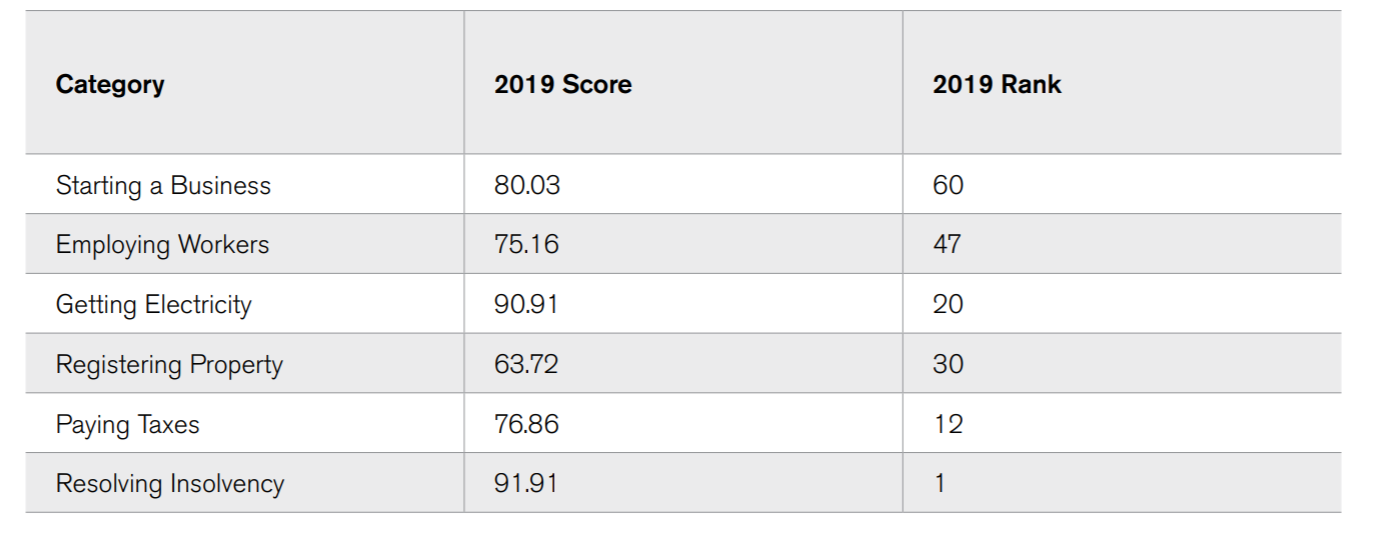
The study, published by ASU’s Center for the Study of Economic Liberty, ranks St. Louis 31 out of 115 cities in North America in regulatory competitiveness. That ranking doesn’t seem half bad, but 31 out of the 66 U.S. cities included in the study isn’t great. Among American cities, St. Louis is just middling.

The table below shows how St. Louis fares in the various categories. St. Louis ranks 12 overall in “Paying Taxes,” but sales taxes are not included in the scoring. Anyone who’s shopped in the city knows how steep the city’s sales taxes are; St. Louis’s ranking would likely be lower if they were included. In addition, “resolving insolvency” is a ranking where all American cities are tied for first place, so not much should be made of that stat in this context.

Business ranking table

In two critically important categories, St. Louis is less than impressive, ranking 60 in “Starting a Business” and 47 in “Employing Workers.” These scores incorporate regulatory costs to business owners, including compliance fees for mandatory procedures and wage regulations like overtime requirements and probationary periods. As our low rankings indicate, starting and staffing a business is a costly and onerous process in St. Louis—and that’s not the inviting economic environment that we want.

Policymakers must recognize that all business regulations carry costs for business owners, and St. Louis’s costs are too high. 46 other major U.S. cities have found less costly ways to meet their public policy objectives for employing workers. And St. Louis was outranked by cities in the U.S., Canada, and Mexico when it came to ease of starting a business!

All this suggests that St. Louis has a lot of room for improvement when it comes to business regulations. Policy changes like lowering licensing requirements, taxes, or procedural costs are just a few things that may get St. Louis a better ranking. Without reform, St. Louis will continue to be mired in mediocrity.


How Not to Argue for Special Taxing Districts

My colleague Patrick Tuohey and I recently had the pleasure of presenting our research on special taxing districts (like CIDs and TDDs) to the St. Charles County Council. That body is considering an ordinance that would require merchants within a CID to post a placard notifying shoppers that they’ll be subject to an additional special sales tax.

We weren’t the only ones present to speak though. A development official from the City of St. Charles also came prepared to present his viewpoint, and he was generally in favor of CIDs. But the arguments he marshaled were so unpersuasive I didn’t know if he took the whole hearing thing seriously or not.

Here, in outline, is what he said in support of allowing CIDs to collect sales taxes without notification to taxpayers.

“CIDs have been used to subsidize projects that many felt were important.”

The basic idea is that CIDs can make certain developments feasible, so they’re good, and we shouldn’t require merchants to post placards notifying shoppers that they’ll be subject to an extra sales tax.

But, of course, whether or not CIDs are powerful development tools has no clear logical connection to whether taxpayers should be given information on their existence. Grand theft auto is a powerful method for obtaining vehicles, and has been used to obtain vehicles that many couldn’t afford to purchase on their own. But this doesn’t mean grand theft auto is permissible or prudent, and it doesn’t bear on whether or not would-be victims of grand theft auto should know about the chances of losing their cars. The bottom line is that the efficacy of a development tool isn’t germane to the question of whether or not taxpayers should know about it.

“If merchants are required to notify shoppers of additional CID taxes, it will make it too hard for developers to find tenants.”

If I apply for a CID in order to build a shopping center, the ordinance being considered would require that I tell would-be tenants of my property that they must post a sign that says something to the effect of “You’re paying extra taxes here.” The concern is that this would dissuade shoppers from patronizing a business, and so would cripple developers’ ability to land tenants for their properties. And if there are no tenants to sign leases, then there just won’t be any new development.

Here is what such an argument boils down to: Letting taxpayers know what tax rate they’re subject to is (allegedly) bad for business, and since we want business to do well, we shouldn’t let taxpayers know what tax rate they’re subject to.

But it just isn’t the job of taxpayers to make life easy for businesses. And it certainly is government’s job to make sure taxpayers are being treated fairly and not being taken advantage of. The importance of honesty isn’t diminished by the profit one can make through deceit. Moreover, developers using another type of special taxing district known as a transportation development district are already required to post additional sales tax notices (though they often fail to do so), and they don’t seem to have any trouble getting tenants. What’s different about CIDs that would make such notices overly burdensome?

It takes some chutzpah to argue that it’s better for everyone if you are allowed to tax people without their knowledge.  Instead of being upfront and simply charging tenants an amount that makes the investment in a property worthwhile, developers are going through the rigmarole of forming a district and collecting a tax. It’s easy to see why a developer would want to have the government collect a tax from consumers and pass it along to the developer as profit. What’s harder to understand is why the government would want to play along.


 

Will Missouri Reform Its Health Insurance Regulations in 2020?

Over the last few years, I have talked at length about the importance of choice in health care. One of the fatal flaws of the Affordable Care Act (ACA) is that it doubled down on a broken status quo when it came to private insurance—bundling together services millions of Americans don’t need, and then requiring practically all Americans purchase those products, including young and healthy Americans who rarely use health care services.

Providing health care for the most vulnerable Americans is a laudable goal, but making countless other Americans financially vulnerable in the process by dramatically increasing their insurance costs is not a result that should be celebrated.

Health insurance should not, at its core, be a maintenance plan. It should be insurance. And it should hardly ever be one size fits all. Unfortunately, limited flexibility in insurance plans was and is a signature feature of ACA plans.

It’s why short-term medical (STM) insurance plans are an important component of a fully functional health insurance marketplace. STM plans provide less coverage, but have much lower premiums than the more comprehensive and maintenance oriented ACA packages.

The importance of STM plans is why I hope that Missouri legislators will continue talking about these plans in 2020 and reforming the law to comport with the STM reforms pushed at the federal level last year, which would mean extending the terms of such plans to a new one year maximum. For several years now, I have supported greater liberalization of Missouri’s health insurance markets, including but not limited to its STM insurance market. Along with Certificate of Need reform, Missouri policymakers have two attainable health reform options that they can pursue immediately and without further federal action.


Why Are Public Pensions Often Underfunded?

Defined-benefit pension systems are essentially promises. The government promises a specific benefit to beneficiaries when they retire. You would think that these plan participants would want their pension system to be fully funded (that it would have enough money to cover the anticipated future benefits). Why then are public pensions so often underfunded?  This occurs even when pension plan participants serve on the governing boards. This suggests that plan managers and beneficiaries want to keep the plans underfunded. But why?

In a recent article in the journal Perspectives on Politics, Sarah Anzia and Terry Moe examine whether pension plans that have pension beneficiaries serving on the board are more likely to underfund their pension systems. In the paper, they explain the logic behind underfunded pensions:

Another basic feature of pension politics is that public workers and their unions have incentives to support the chronic underfunding of their own pensions. Due to state statutes, constitutions, and judicial decisions, pensions promised by state politicians are backed by strong legal protections almost everywhere; and public workers thus know they will eventually get what they are promised even if their pension plans are currently underfunded. Indeed, because full funding on a regular schedule would be tremendously costly for state (and local) budgets— crowding out other services, forcing higher taxes, making the true costs of pensions painfully transparent to citizens —public workers and their unions have incentives to prefer that their pension plans be underfunded. Underfunding enables the fiscal illusion that pension benefits are much less expensive than they really are. If public workers and their unions want increasingly generous benefits in future years, they need to convince the public that these benefits are not costly to provide. At the same time, underfunding keeps employee contributions to their own pension funds at low levels; and by keeping contributions by their employers down, they are freeing up public money for other government services, keeping public workers employed—and providing funds for their own salaries and raises.

Each of Missouri’s three teacher pension systems (Kansas City, St. Louis, and Public School & Education Employee Retirement Systems of Missouri (PSRS)) have board members who are also members of the pension system. In St. Louis, the system is currently funded at 78.1%, the lowest funded ratio since 1992. Kansas City’s funded ratio is just 66.2%. PSRS, the system which covers teachers throughout the rest of the state, has the highest-funded ratio, 84.4%. These figures, of course, rely on the pension plan’s rosy assumptions. More conservative (and arguably more realistic) estimates put the funded ratios for each of the plans below 60%.

Overall, support among teachers for Missouri’s teacher pension systems is high. But would teachers continue to support the pension plan if they had to increase their contributions to fully fund their plan? 


Support Us

The work of the Show-Me Institute would not be possible without the generous support of people who are inspired by the vision of liberty and free enterprise. We hope you will join our efforts and become a Show-Me Institute sponsor.

Donate
Man on Horse Charging