Workforce Development for Rural Missouri

Workforce development is a hot topic in Missouri right now. The governor deemed the issue important enough to give it prominent mention in his state of the state speech. One critical component of workforce development is ensuring that students from rural high schools are prepared to enter the workforce and get good jobs. Graduation follow-up data from the Missouri Department of Elementary and Secondary Education (DESE) can tell us what high school graduates from rural districts do after graduation, and this data can direct workforce development efforts.

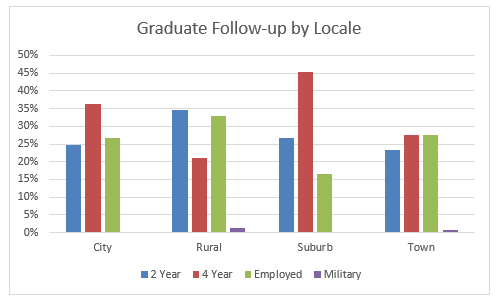
After graduation, districts and schools follow up with their graduates to see what they’re currently doing, and then DESE compiles the data. I connected the DESE data with the federal data set that labels each district with different locale types, ranging from big cities to remote rural areas. You can see the results in the graph at the top of this post (the data may not add up to 100 percent due to data privacy and inability to contact all students).  

Looking at the 2018 data, 33 percent of rural district students entered employment and 35 percent enrolled in a 2-year college following graduation, both of which were the highest percentages for each category out of all locales. On the other hand, rural schools had 21 percent of its students attend a 4-year college or university, the lowest percentage out of all locales.

Workforce preparation for rural communities, thus, should have a strong focus on preparing students for high-demand, well-paying jobs they can enter soon after graduation. This could mean students taking the proper classes and having access to the credentials and skills training they need to be set up for a successful career immediately. Taking job-specific courses or earning college credit during high school should also be an option to help bridge students from high school to technical school.

Missouri needs to consider the data when planning for workforce development. There are good jobs available to Missourians, and the state needs to make sure students are ready to fill them.


The Latest Episode of the Show-Me Institute Podcast

https://soundcloud.com/show-me-institute/smi-podcast-its-right-because-its-right-corey-deangelis

We celebrated National School Choice Week on the SMI podcast with Corey DeAngelis. In this episode, Corey and Dr. Susan Pendergrass discuss the moral case for school choice, educational freedom in rural areas, and more.

Corey DeAngelis is the director of school choice at the Reason Foundation. He is also an adjunct scholar at the Cato Institute.


Occupational Licensing Reform Is on the Move

Today, the Missouri House passed two pieces of occupational licensing legislation. Both are worthwhile, but one would make Missouri a reform leader on the national level.

The first, HB 1511, would allow for out-of-state licenses held by military spouses to be accepted here in Missouri. This has been a popular reform in recent years, and already every state, including Missouri, has some version of reciprocity for military spouses in place.

The real game-changer is the second bill, HB 2046, which would allow for this sort of licensing reciprocity for anyone. This means that someone who holds a valid occupational license in good standing from another state could come to Missouri and qualify for the same license here with few or no administrative burdens.

This bill would have a plethora of positive effects on Missouri. It would make the state a much more attractive place to relocate by eliminating the over-burdensome requirements for re-licensing a worker. But it also should offer consumers greater choice and competition in the market for all kinds of services, including health care.

Occupational licensing burdens workers and the economy. As Show-Me analysts have written and testified, reducing government barriers to work is good for workers, consumers, and the state economy. Many other states are considering licensing legislation like this, and this bill would help Missouri become a more competitive and attractive state for consumers and professionals alike.


New Path to Medicaid Block Grants

Today, the federal government released long-awaited guidance for states interested in block granting federal Medicaid funding. This marks a significant development on the health care policy front, and is an opportunity for states interested in new approaches to reining in Medicaid’s runaway spending.

As I’ve written before, the way that Medicaid is funded plays an important role in explaining the program’s growth. The status quo encourages states to spend as much as possible to receive more matching funds from the federal government. One of the best ways to improve the program and simultaneously contain costs would be to abandon the open-ended funding structure, and instead provide states with a yearly lump sum (block grant) payment of federal funding.

Show-Me Institute analysts have written about the benefits of Medicaid block grants for years, but until today no such proposal had ever received federal support. The new federal guidance indicates the current administration is serious about giving states more flexibility in deciding how to best administer their Medicaid programs. Unfortunately, there may be a serious weakness in the guidance provided today. It appears block grants may be limited to states that have already expanded Medicaid.

How the federal government treats Tennessee’s application will be telling. Tennessee, which has not expanded Medicaid, submitted a waiver application for block grants months ago. As Missouri has also not expanded Medicaid, the reception to Tennessee’s application should provide clues as to the likelihood of Missouri being able to successfully apply with a similar proposal.

Today’s guidance may offer a new path for Missouri’s policymakers who are serious about addressing Medicaid’s cost problem; the question is whether they will be ready to seize the opportunity.


Charter Schools and Civil Society in Kansas City

After a nine-month tour of America in 1831, French political scientist Alexis de Tocqueville published Democracy in America, a volume that remains one of the best descriptions of American civic and political life.

De Tocqueville focused much of his analysis on America’s civil society, the tapestry of voluntary organizations that citizens put together to unite themselves and solve problems. He wrote:

“In the United States, as soon as several inhabitants have taken an opinion or an idea they wish to promote in society, they seek each other out and unite together once they have made contact. From that moment, they are no longer isolated but have become a power seen from afar whose activities serve as an example and whose words are heeded.”

I have a paper out with Washington, D.C.’s R Street Institute exploring the role the civil society has played in Kansas City’s charter schooling sector. While the traditional public school district has struggled with legitimacy and engagement over the past three decades (enrollment has  been on the decline, and KCPS struggles to recruit enough candidates to make school board elections competitive), charter schools have been an outgrowth of the community, reflecting their needs, values, and desires.

In the paper, I briefly explain the roles of local philanthropists in founding and supporting high-performing charter schools, of civic organizations like the Guadalupe Centers in creating schools geared towards the needs of specific communities, and of parent groups in recruiting potential school operators to create the types of schools that they want.

The charter sector in Kansas City is not perfect, but it is built on a sturdy foundation. Somewhere, Alexis de Tocqueville is smiling.


Is There a 1984 in Our Future? A Super Bowl Reflection

What was the greatest Super Bowl commercial of all time?

With Super Sunday just around corner, we will cite the Apple commercial that introduced the Apple Macintosh personal computer in January 1984. It had the punch line: “You’ll see why 1984 won’t be like Nineteen Eighty-Four.”

That was an allusion to the dystopian future described in George Orwell’s book, 1984. The ad opens with a lone woman on the run. She bursts into an auditorium, where Big Brother—speaking not in person, but from a towering television screen—is haranguing a frightened mass of people. Then, spinning like a top, she hurls a sledgehammer at the figure on the screen. It flies high and right. Big Brother is silenced. The voice-over followed.

In this 60-second spot that aired during Super Bowl XVIII, the first Macintosh ad captured the one thing that an all-powerful or monolithic state cannot easily afford to tolerate. That is, any real expression of individual freedom and initiative.

We believe that is a timely message not just on the eve of another Super Bowl, but still more in the context of the current debate over economic and public policies.

Following a long period of stagnation, the U.S. economy has come roaring back to life. We now have full employment, a booming stock market, and rising wages for most workers, including the lowest paid.

How did that happen? Fast answer: Over the past three years, the free market became a whole lot freer.

In its first year in office, the current administration delivered on its promise of sweeping regulatory relief. Suddenly, the regulatory state, which had expanded by leaps and bounds during the previous administration, began to contract . . . and that has continued, as a result of major changes in policy and direction at the Environmental Protection Agency, the Labor Department, the Department of Health and Human Services, and other arms of government.

Then came the biggest tax cuts and tax reforms since the Reagan era. With the passage of the Tax Cuts and Jobs Act of 2017, the administration lowered income taxes across the board and left more money in the pockets of individuals and business entities alike.

So, we are now living in the best of times economically. How could anyone argue otherwise? But they can—and are. Never mind what the numbers say.

Among leaders on the Left, there is a broad consensus that we are living not in the best of times, but in the most desperate of times—almost as if we were back in the early years of the Great Depression, when industrial production plunged, unemployment soared, and more than a quarter of the population was without any income at all.

In the badly mistaken belief that capitalism and free enterprise have run amok, they are promoting economic policies and ideas that are diametrically opposed to those that got us where we are today.

With little disagreement between them, these same leaders want free college, free health care for all, universal child care, and the banning of fossil fuels as part of a many-splendored Green New Deal—and they don’t appear to care what anything costs or what the adverse impact may be on ordinary people.

Apart from the astronomically high price tags associated with all of these programs—which would quickly bring the economy to a shuddering halt if any serious attempt were made to implement them—it is worth thinking about the underlying message that the leaders who are espousing this great agglomeration of multi-trillion-dollar programs want to send to the American people.

The real take-away message comes down to this:

·         “If you or any of your children want to go to college, don’t worry about being able to afford the college tuition. We’ll take care of the problem for you.”

·         “If you’re worried about health care, don’t think you have to buy health insurance or do anything else. We’ll take care of you.”

·         “Got young children at home and want to go to work? We’ll take care of the kids, too.”


If all that sounds too good to be true, it’s because it is too good to be true. Someone has to pay for college tuition—and all the other freebies—and that can only mean higher taxes on working people at all levels of income.

As George Orwell, the author of 1984, understood very well, a free people who stop taking care of themselves and rely on the state to do everything for them make a very bad bargain. It is one of the insights you find on almost every page of his book.

When people cease to make their own plans—and trust government to make decisions for them in more and more areas of their lives—they commit the error of failing to make full use of their capacities as individual human beings. In failing to make the most of their own gifts and talents, and their own dreams and aspirations, they sell themselves short . . . and lead less-fulfilling lives.

How prophetic was Orwell’s book? Not that this was the author’s intention, but how well did the book foretell the future of socialism in his native country—this being Britain in the first few years after World War II?

The British elections in mid-1945 marked a major turning point—not only sweeping Winston Churchill and a Tory-led government out of office, but also standing as an unquestioned affirmation of the desire of most of the British electorate to bring a new government to power that was fully committed to socialism.

So how did things work out in Britain during the three and a half decades when socialism, as opposed to free-market capitalism, was the prevailing mode of government—a period lasting from 1945 to 1979, when Margaret Thatcher came to power?

Socialist Britain did not become a police state. But it did undergo a metamorphosis. It changed from a powerful and dynamic country into the perennial “sick man of Europe,” reeling from one financial crisis to another in a sustained period of economic stagnation and decline. It became a country obsessed with issues of job security and income redistribution as different groups competed with one another in trying to wring more favors out of an increasingly improvident state. There was little or no new business formation—none of the spark provided by people like Steve Jobs and products like the first Macintosh computer.

Even the Labor Party could see the futility of its centralized, interventionist approach. Jim Callaghan, the last Labor prime minister before Thatcher, admitted in Parliament: “Let me say that of course there has been a fall in peoples’ standard of life. It has fallen this year and will fall again next year.”

Fortunately, Thatcher supplied the leadership that was necessary to pull Britain out of the decades-long decline that began with the wrong turn that it took at the end of World War II.

Is there any possibility that we as a country could make the same mistake that Britain made in 1945?

The danger is there. It is time to throw another hammer—or sledge-hammer—into the works of another historic wrong turn—this time involving the United States.

This does not require heroic action on the part of a solitary individual. But it does require a willingness on the part of many people to play the same kind of role within their own group of friends and relatives that Thatcher played in Britain—in stressing the paramount importance of individual freedom and initiative in securing the future we want for ourselves and future generations.

The MLS Deal Keeps Getting Better for Taxpayers

Recent news that the owners of a new Major League Soccer franchise in St. Louis will not be getting $40 million in state tax credits is welcome. They may receive a smaller amount, perhaps as low as $5.7 million. While this is still an unnecessary amount of public participation in a private matter, it represents a better deal for statewide taxpayers.

Back in July, my colleague Graham Renz wasn’t thrilled with the proposed deal, but conceded that it was better than what taxpayers had been offered in 2017. That deal involved public subsidies and set-asides worth $120 million; the current deal’s public cost was about $40 million in local subsidies plus the $30 million in state-issued tax credits. If the tax credits are reduced as the St. Louis Post-Dispatch suggests, the total value of all the incentives may be closer to $52 million. That is a lot, but less than what has been considered previously.

Both deals were promoted at the time as the best deal taxpayers could get. We know now that wasn’t true. The owners of the new franchise stand to make a lot of money from this deal. While city and state officials should welcome investment in the area, they don’t need to put public funds at stake. Just ask Stan Kroenke, who is investing about $1.6 billion of his own money to build a sports complex in Los Angeles using only privately raised funds.

The lesson here for public officials at every level is that there is almost always a better deal to be had. In fact, if you want to protect taxpayers, the best deal might be no deal at all.


Stop the Charade: Public Schools Are Not Value Neutral

In a recent article on the front page of the New York Times, Dana Goldstein explained how textbook companies selectively omit or add information to history textbooks for sale in Texas and California. Goldstein writes, “The books have the same publisher. They credit the same authors. But they are customized for students in different states, and their contents sometimes diverge in ways that reflect the nation’s deepest partisan divides.”

This occurs largely because California and Texas require school districts to purchase textbooks that have been approved by the state board of education. The Education Commission of the States reports that 20 states have similar policies.

What Goldstein’s article makes clear is that values are transmitted via the texts we assign children to read. In California, the texts are more open to portraying individuals with various sexual orientations. In Texas, they discuss legal and illegal immigration. Far from being value-neutral, the text schools assign children and the lessons teachers teach can be laden with values.

In this case, we can see the values when we compare one state to another. Missouri, however, does not have a state textbook adoption process. As such, schools can choose the books they think best align with state standards. Many are ditching textbooks altogether in favor of teacher curated reading materials and online resources. My 8th– and 9th-grader, for example, do not bring any textbooks home. Everything is online.

In this system, how can parents figure out what values are embedded in the curriculum that is being taught to their children? We can’t.

This is why we need school choice. With a robust system of school choice, which includes traditional public schools, magnet schools, public charter schools, and private schools, we can stop the charade. We can stop pretending that there is such a thing as the value-neutral school. We can be more upfront about what we want for our children and what our school community believes.


They’re Back! Film Tax Credits Haunt the Missouri Legislature

Like a horror film bogeyman, legislation creating film tax credits is back! Both HB2027 and HB1767 attempt to set up tax credits to benefit people who make films in Missouri. The bills are not identical in their language, but both vie for the name “Show Missouri Film and Digital Media Act.”

Film tax credits are a bad idea for Missouri, as my colleagues and I have written previously. The Missouri Legislature itself condemned them in 2010, saying the credit serves, “too narrow of an industry and fails to provide a positive return on investment to the state.” A study of film tax credits in Tennessee found “over 40 percent of films that receive grants made less at the box office than they received in incentives.”

Now we have a report from the state auditor of Georgia—the place supporters of film tax credits here in Missouri hold up as a model—and it isn’t good. According to The Atlanta Journal-Constitution, the report states: “The economic benefits of Georgia’s popular and lucrative film tax credit have been greatly inflated, a new audit says, and past estimates have not considered what would have happened if the state had instead spent the money on things such as education or health care.”

The just-released report from the Georgia Department of Audits and Accounts is more specific:

The economic activity generated by the film tax credit does not generate sufficient additional revenue to offset the credit, even after considering tourism and studio construction. In 2016, the film tax credit resulted in a net revenue loss to the state estimated at $602 million. The state’s return on investment for the credit was 10 cents for each dollar, though local governments received an additional return of 11 cents in revenue.

No serious legislator interested in protecting tax funds or reducing waste and fraud ought to consider reinstating film tax credits in Missouri.


Support Us

The work of the Show-Me Institute would not be possible without the generous support of people who are inspired by the vision of liberty and free enterprise. We hope you will join our efforts and become a Show-Me Institute sponsor.

Donate
Man on Horse Charging