The Absolute Worst Time to Ask for a Stadium Incentive Package

In a sea of coverage about health care and social-distancing measures, there is a big outlier in St. Louis news coverage. The St. Louis Post-Dispatch reported that the owners of St. Louis’s Major League Soccer (MLS) franchise received an incentive package to help finance a stadium downtown. The Missouri Development Finance Board approved $5.7 million in tax credits, which is much less than the $30 million originally sought, but honestly, is now the time to be giving away government funds?

Show-Me researchers might argue there is never a good time for government handouts such as this one, but times like these should add even greater scrutiny to government actions. We need to be disciplined about government priorities and reel in needless spending on projects that ought to be privately financed. This deal means that the government will lose out on $5.7 million it could otherwise spend on the needs of Missourians, and maybe more if the stadium garners additional subsidies in the coming years. We can all probably think of a few uses for that money right now.

Sure, the soccer stadium may give us hope for a time when social distancing is a thing of the past, but private endeavors shouldn’t be funded with government incentives. It’s unfair that some developers get tax credits while others pay in full; the government is again picking winners and losers, and this time the owners of the MLS franchise are the winners and taxpayers are the losers. If a project such as this needs government assistance to be built, then maybe it isn’t such a good idea in the first place.

Whether or not you support assistance to the soccer stadium, the question remains: Is this really the time to be carving out special deals for wealthy team ownership when our attention should be focused on so many basic needs?

 

The Kansas City Budget Amid Coronavirus

The City Council of Kansas City is currently debating its 2020–2021 budget. Mayor Quinton Lucas had suggested some worthwhile cuts but abandoned them pretty quickly. That was before the full weight of the coronavirus became evident. Now it is time for those cuts—and a whole host of other cuts—to be considered again.

Goldman Sachs predicts the United States gross domestic product (GDP) will shrink by a quarter. Thousands of people in the Kansas City region are losing their jobs, and the mayor just issued a shelter-in-place order. City revenue is about to plummet. We can safely say that revenues from the earnings tax and sales taxes will decline significantly.

Who knows what sort of bailout will be available to cities, if any. But this is not a time to be funding a film office whose function is to subsidize the likes of Netflix. Kansas City has been a high tax city for years. And not satisfied with spending those revenues, we have continued to increase our public debt. This may be a time of reckoning.

A city council that convenes online and votes virtually out of concern for a global pandemic must demonstrate that it truly understands the difference between basic, necessary services and those things that are merely nice to have. Is Visit KC, the city’s convention and visitors bureau, necessary in the next few months? Is the streetcar? Is the Economic Development Corporation (EDCKC) a vital need in the next quarter? The city council should act as they have asked Kansas City residents to act, supporting only “essential services.” Everything else, for now, needs to be set aside.


On the Road Again

The concept of transportation user fees should not be controversial. It’s the same principle that applies to everyday transactions—the more of something you consume, the more you pay for it.

While people might not think of roads as something to “consume,” the same concept applies. We pay for roads through gasoline taxes, vehicle sales taxes, and license fees. However, over the past decade, we’ve “consumed” a lot more road in Missouri than we’ve paid for.

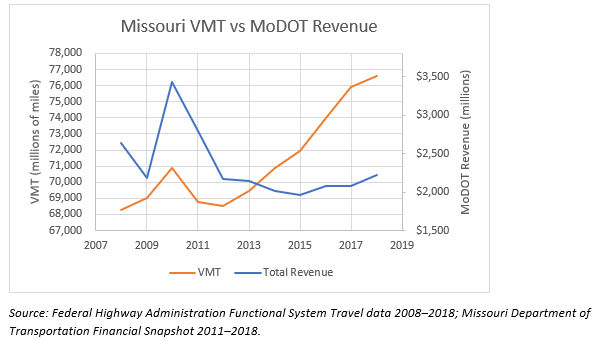
The Federal Highway Association tracks the usage of Missouri roads, measured with vehicle miles traveled (VMT). Between 2008–2018, Missouri’s VMT increased 12% while the Missouri Department of Transportation’s (MoDOT) budget declined by 15%. The divergence in trends can be seen in the graph below.

Gas tax graph

Federal stimulus money and bonds provided the financial buoy from 2008 to 2011, both of which were used quickly and the latter of which required repayment. Increasing maintenance costs and MoDOT’s shrinking budget has taken its toll on Missouri’s road quality; the 21st Century Missouri Transportation System Task Force described Missouri’s roads as “deteriorating.”

Other than the federal government, MoDOT’s main source of funding is the fuel tax. The fuel tax has remained at 17 cents per gallon since 1996 despite inflation reducing the real value of the tax. Moreover, the revenue that has been collected has not kept pace with the increase in road usage. Between 2008–2018, fuel tax revenue declined by 0.5 percent.

So how do we fix this?

Several other states have indexed their fuel taxes to some measure, whether that be inflation, state GDP growth, or highway construction costs. Such indexing ensures that fuel tax revenue automatically adjusts to the pace at which the rest of the economy grows, rather than being stuck at a static level.

As “consumption” of Missouri’s roads increases, the question of how to pay for needed infrastructure improvements will not disappear. The fuel tax is an effective method of funding road maintenance, and indexing it to a measure that reflects road usage or costs of upkeep could help ensure Missouri’s roads and bridges are kept in good condition.


Trends in Industry Credentials Show Missouri Has Room to Grow

As a general rule, the more data available, the better. That rule certainly applies to Missouri’s workforce. In particular, more data about Industry-Recognized Credentials (IRCs) could help inform how best to improve Missouri’s workforce. IRCs are credentials that validate a student’s specific job skills. Some jobs even require an IRC; passing the Certified Nursing Aide Exam is required to become a Certified Nursing Assistant.

I’ve written  previously about IRC attainment in Missouri, using data from 2017 and 2018 that the Show-Me Institute obtained through a data request. These data were useful because IRC attainment was broken out  by district and school, allowing for a detailed analysis of where in the state specific IRCs are earned and how that could support local economies.

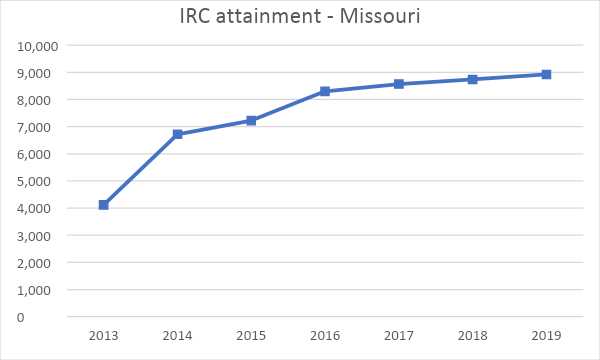
However, documents from the Career and Technical Education (CTE) advisory council meeting in October 2019 contained IRC attainment data from 2013–2019. These data can provide further context, such as what IRCs students have earned over the years and which IRCs are growing in popularity, as well as overall attainment trends. The data show that IRC attainment spiked from 2013 to 2016, and has since slowly increased.

IRC graph

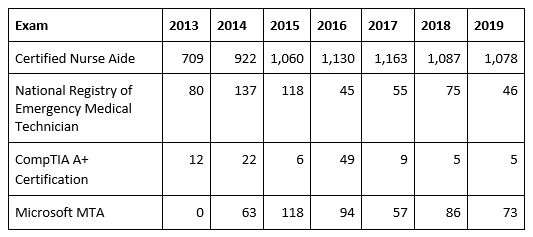
But this trend doesn’t hold true for all IRCs, including some IRCs for jobs that are in demand in Missouri, such as the CompTIA credential for technology jobs. The chart below shows that some IRCs have actually experienced a decline in attainment in recent years. This should be cause for concern since Missouri needs more students graduating with in-demand credentials, not fewer. To help encourage more high schoolers to earn an IRC, Missouri should consider implementing an IRC bonus pay program. An IRC bonus pay program would give a small bonus to a teacher for each student of theirs who passes an IRC exam.

These data can call to attention the gap between the economy’s need for IRCs and the low attainment of IRCs for Missouri high school students. Missouri should be trying to strengthen its workforce, and IRCs can be an effective way to do that. 

IRC table

Banning Fracking? Oh Frack No!

Prominent politicians and activists have called for a ban on fracking, the process by which America produces most of its oil and natural gas. Opponents of fracking claim it does more harm than good to Americans and the environment.

While fracking has changed the energy landscape in the United States, these changes have been for the better. Fracking has numerous benefits; it lowers energy prices which benefits consumers, it replaces coal with natural gas which lowers emissions and air pollution, and it increases energy production which strengthens America’s influence around the world. Despite the controversy, fracking is clearly a boon to the United States.

I address these matters in more detail in a recent op-ed posted at Real Clear Energy.


Is This the New Normal?

Oh, for the halcyon days when parents had to sue to get their children access to virtual education in Missouri. Due to the coronavirus, more than 80 percent of K–12 students in the United States became homeschooled in less than a week, including students in more than 400 districts in Missouri.

Schools and districts are grappling with spring standardized testing. The U.S. Department of Education has issued guidance allowing states to request a waiver for submitting test results this year. The Missouri Department of Elementary and Secondary Education (DESE) has already changed the Annual Performance Report metric to count attendance as only “reportable,” not “scorable.” There’s plenty more to figure out in this ongoing process.

One thing that gives me confidence is classic American ingenuity. No one saw this coming a year ago, but the ideas to make this new normal livable are rolling in. My colleague, Lindsey Burke of the Heritage Foundation, has compiled an excellent list of resources for parents with school-aged children at home for weeks. The College Board is figuring out how AP students can take their spring exams at home. Harvard Business Review has compiled tips for working parents dealing with school closures. Experts on education policy are offering their services pro bono to districts trying to craft a strategy. This is just a small sample of the efforts in the education sphere right now to find the best way to serve children in the midst of a pandemic.

If there’s a silver lining, it’s that we can continue to generate and use these great ideas going forward. There is now absolutely no reason for Missouri school boards to resist alternate learning environments. We can think hard about building standards and accountability systems that are flexible and focus on how much each student is learning, rather than giving points for average daily attendance. We can trust parents to be truly involved in their children’s education. We didn’t expect this pandemic and we don’t know what’s coming next. So let’s use this as an opportunity to build a smarter education system for Missouri students.

Not Your Kids, Not Your Money

Consider this a public service announcement: Public school districts do not own the children who live within their borders. And they don’t “lose” money when students living within their borders choose something other than their assigned public school. They simply do not educate the child or receive funding for educating them.

Fortunately, the Missouri Senate Government Reform Committee seems to agree. Although it still has a ways to go, Senate Bill 996 has passed out of committee and will hopefully be considered by the full Senate soon. This bill changes the way funding works for full-time virtual education students. Rather than have state funding go to the students’ home school district and then back out to the virtual program, funding would simply go from the state to the virtual program. Makes sense, right?

Of course, the usual opponents showed up to testify against the bill. It was called an attempt to privatize education and make a profit from Missouri students. An opponent of the bill from the Missouri School Boards’ Association asked: “. . . who is making sure these providers are doing right by our students?” Well, that would be the parents of the students who choose full-time virtual education over their assigned public school. Recall that this is not a passive move—students aren’t assigned to full-time virtual schools. Rather, it is an active choice by these parents and students. When someone makes a choice that is outside the mainstream, it is usually a conscious and informed decision to find something that works for them.

For more than 95 percent of the public school students in Missouri, full-time virtual education is the only public option other than their assigned public school. In the two years since the Missouri legislature passed and the governor signed the bill making full-time virtual education possible, there have been numerous examples of bad behavior on the part of public school districts intended to prevent kids from entering full-time virtual programs. Far too many parents have had to lawyer up in order to exercise their legal right to this option for their children.

In 2020, conducting school, business, or personal obligations online is no longer novel or threatening. In fact, there are circumstances that have revealed it as a very necessary approach when in-person communication isn’t possible. Missouri public school districts and their school boards need to realize that the future of public education does not look like the past. Parents want options, and we should be willing to make sure they have them.

Arizona State License Portability Study Highlights Reciprocity Benefits

As my colleague Patrick Ishmael has written, the Missouri legislature is considering bills on occupational licensing reciprocity. In short, a state that adopts “universal” or “unilateral” licensing reciprocity is one that accepts the licenses of qualified professionals from other states without requiring an extensive, and potentially duplicative, relicensing process of its own. Accepting qualified professionals in this manner expands the pool of providers of these goods and services and puts downward pressure on prices thanks to greater competition. Under present circumstances, such an expansion of supply is not only preferable—it’s necessary to support public health.

States, including Missouri, have adopted other licensing policies, including the establishment of interstate “compacts” and agreements between and among states that provide some reciprocity features, but a recent paper out of Arizona State University’s Center for the Study of Economic Liberty highlights the downfalls of that and other forms of licensing portability. The paper argues that broad-based occupational licensing reciprocity is a better way to “open the broadest avenues to opportunity for the most workers in the shortest amount of time,” and although interstate compacts and multistate licenses increase license portability, they take a lot of work to set up and only provide portability for specific professions within the states that join.

A better alternative to our current system is the one we propose: broad-based licensing reciprocity. As the ASU paper explains:

Unlike compacts, universal licensing reciprocity can: 

  1. be broad-based and cover a wide range of workers; and, 
  2. encourage competition between states in terms of the requirements to obtain a license — or even whether a state should mandate an occupational license at all. 

Broad-based licensing reciprocity is a better route for portability reform as it avoids the pitfalls of our current system and enhances economic opportunity and competition. Hopefully the continued research in favor of licensing reciprocity will lead to favorable legislation that increases opportunities for workers.

Charter Schools Can Help More Students Get to College

Charter schools in Missouri have demonstrated the ability to outperform traditional public schools, and yet it is nearly impossible to open a charter school in most parts of the state. This comes at the cost of potentially higher academic achievement and college attendance for Missouri students. A new study on the Knowledge is Power Program (KIPP)—a charter school network that operates schools across the country—found that students enrolled in KIPP middle schools are more likely to eventually attend college than those who don’t.

The study examined 13 KIPP middle schools that had more applicants than seats available, so researchers were able to track the kids who got into the KIPP schools and those that didn’t. The groups of students are comparable because they all applied to KIPP schools, and thus have similar qualities like motivation and parental support. The results show that students enrolled in KIPP middle schools were 13 percent more likely to enroll in a 4–year college than students who did not. The study states that “the impact of attending a KIPP school would be almost large enough to erase the nationwide racial disparity in college enrollment rates.”

Nationally, KIPP has 242 schools and serves more than 100,000 students. St. Louis currently has six KIPP schools, including two middle schools and a high school. Kansas City has just two, including one middle school. There are so many more disadvantaged students outside of St. Louis and Kansas City who could benefit from a high-performing charter school like a KIPP school. Under Missouri’s current charter school laws, only the three percent of Missouri students in the St. Louis City or Kansas City school districts even have the option to apply for lottery admissions to KIPP schools. Charter school expansion could bring effective schools to students all over the state, giving students in urban and rural areas access to quality education.

Support Us

The work of the Show-Me Institute would not be possible without the generous support of people who are inspired by the vision of liberty and free enterprise. We hope you will join our efforts and become a Show-Me Institute sponsor.

Donate
Man on Horse Charging