What the Heck Is Happening Out There?

In the midst of a pandemic, it’s hard to say exactly what’s going on. But here is a bit of what is going on in public education. Nationally, just about every public school is closed—some for another week or so and some until the end of the year. In Missouri, some districts are closed until localized social distance orders are lifted (April 22nd for St. Louis City and County), while others are on extended spring breaks. The governor has ordered that all schools remain closed until at least April 6th.

At the state level, eight governors have issued executive orders, proclamations or initiated coronavirus task forces. At least seven state education departments have offered statewide guidance, with California’s being an excellent example. Missouri’s Department of Elementary and Secondary Education (DESE) has a webpage with information related to COVID-19. DESE has also issued administrative guidance to all superintendents regarding school funding, attendance waivers, and the cancelation of Missouri Assessment Program (MAP) testing. Links to information on virtual instruction are provided, but it is left up to districts and schools to determine whether they will use them. Two of the statewide virtual learning programs, Launch and the Missouri Virtual Academy, currently only say that short term-enrollment is “possibly available.”

The Center on Reinventing Public Education (CRPE) at the University of Washington has been painstakingly building a database of district COVID-19 responses. The plans range from detailed and specific like Miami’s “comprehensive district learning plan that includes online learning curricula and teacher support, technology device and WiFi access provision, and supplemental resources for special populations” to simple and broad, like districts in Pennsylvania that have essentially cancelled school for the rest of the school year. St. Louis Public Schools doesn’t appear to have much of a plan right now. It is “considering” sending homework assignments to students through the mail, the approach that Kansas City Public Schools is also adopting.

So, what does all of this mean? We’re in uncharted territory and everyone is creating their own map. Districts and states that were prepared will have a much easier time providing their students an actual education. Florida, for example, already requires every high school student to take at least one of their courses online and is currently providing $200 stipends to the first 10,000 teachers who pass their virtual education training program. Those that have not embraced virtual education, like Missouri, are either going to have to figure it out very quickly or punt until the end of the school year.

The Show-Me Institute will be monitoring it all very closely and looking for best practices and lessons learned for when we eventually emerge from this crisis.


 

Audit the Kansas City Water Department

Water rates in Kansas City may soon go up, according to two ordinances just passed out of the city council’s Finance, Governance and Public Safety Committee. Ordinance 200168 would increase water rates by five percent and Ordinance 200169 would increase sewer rates by two and a half percent. These are just the most recent increases in a years-long spike in city-run utility costs.

A 2017 KCPT documentary detailed the effect of the increases in water rates—240 percent since 2000—on many Kansas Citians, and the apparent inability—or unwillingness—of local leadership to do anything about it. All of this is due to a settlement with the EPA, which cited Kansas City for multiple violations of the Clean Water Act and forced the city to agree to extensive upgrades to its water and sewer system.

Taking the violations and the need to address them at face value, it is still fair to ask what is going on with the water department. How is it spending its money and are there opportunities to be more efficient? Here there might be an opportunity. In its 2019 endorsement of Quinton Lucas’s mayoral effort, The Kansas City Star editorial board quoted Lucas as saying at a prior candidate debate, “I’m not just open to a conversation on a state audit; I think we need a state audit of the water department.” This is welcome, especially since the previous mayor denied requests by the Missouri State Auditor to conduct an audit of the water department.

It may very well be that the city-run water department is a model of efficiency and that these frequent increases are necessary. If that is the case, there may be other opportunities to address rising costs in a way that does not so burden those among us who are at the most risk of losing service. Mayor Lucas, the city council, and indeed those at the water department should all welcome an audit, be it by the Missouri State Auditor, a private and completely independent firm, or both.


COVID-19 Highlights Need for Telehealth

As confirmed cases of coronavirus across Missouri continue to climb, there are concerns that the coming influx of patients may overwhelm our state’s hospitals and clinics. But even with the obvious focus on COVID-19, many people still need access to health care even though their illnesses may be less pressing. One tool that could help ease the burden on our hospitals and clinics is telehealth.

Telehealth (or telemedicine) refers to the practice of receiving health care remotely using telecommunication technologies. Telehealth allows patients to access a doctor or provider through their phone or computer in instances where physical interaction is not required. Accessing services remotely would have the dual benefit of reducing the strain on Missouri’s health care infrastructure while also allowing higher-risk individuals to stay at home to avoid potentially contracting the coronavirus. Unfortunately, there are various laws and regulations preventing telehealth from being more widely used.

Most forms of health coverage, including Medicare and Medicaid, cover telehealth services in at least some circumstances. But the restrictions placed on where telehealth services may be accessed and who can provide them have drastically limited the potential benefits. For example, providers must be licensed to practice in the state where the patient is located. This causes problems in areas that closely border another state, and also limits the number of providers able to help across the country, as the current demand for health care varies greatly from state to state.

Additionally, payers such as Medicare restrict access to most telehealth services by requiring the patient live in a geographically underserved area AND that the services be accessed at a limited list of locations. In many cases, the approved locations for accessing care are either doctor’s offices or hospitals, which defeats much of the purpose of telehealth. This means that elderly Medicare recipients who live in higher population areas (which are the areas that have thus far been hardest hit by COVID-19) may not ever be eligible to receive care through telehealth services. And even if these patients were eligible, they would need to potentially expose themselves to the virus by going to a clinic or hospital to receive the care instead of accessing it remotely. Both of these restrictions make accessing health care services harder than it needs to be.

There is some good news, though. This week, Governor Parson announced that he will be waiving regulations that restrict providers from other states from using telehealth to treat Missourians. The federal government appears to be following suit by signaling it may attempt to make telehealth more accessible. Coronavirus has emphasized the need for laws governing health care to not discriminate based on geography. Allowing patients to receive care remotely represents an important step that could both improve health outcomes and contain COVID-19. State and federal policymakers should move swiftly because these changes cannot come soon enough.


The Absolute Worst Time to Ask for a Stadium Incentive Package

In a sea of coverage about health care and social-distancing measures, there is a big outlier in St. Louis news coverage. The St. Louis Post-Dispatch reported that the owners of St. Louis’s Major League Soccer (MLS) franchise received an incentive package to help finance a stadium downtown. The Missouri Development Finance Board approved $5.7 million in tax credits, which is much less than the $30 million originally sought, but honestly, is now the time to be giving away government funds?

Show-Me researchers might argue there is never a good time for government handouts such as this one, but times like these should add even greater scrutiny to government actions. We need to be disciplined about government priorities and reel in needless spending on projects that ought to be privately financed. This deal means that the government will lose out on $5.7 million it could otherwise spend on the needs of Missourians, and maybe more if the stadium garners additional subsidies in the coming years. We can all probably think of a few uses for that money right now.

Sure, the soccer stadium may give us hope for a time when social distancing is a thing of the past, but private endeavors shouldn’t be funded with government incentives. It’s unfair that some developers get tax credits while others pay in full; the government is again picking winners and losers, and this time the owners of the MLS franchise are the winners and taxpayers are the losers. If a project such as this needs government assistance to be built, then maybe it isn’t such a good idea in the first place.

Whether or not you support assistance to the soccer stadium, the question remains: Is this really the time to be carving out special deals for wealthy team ownership when our attention should be focused on so many basic needs?


The Kansas City Budget Amid Coronavirus

The City Council of Kansas City is currently debating its 2020–2021 budget. Mayor Quinton Lucas had suggested some worthwhile cuts but abandoned them pretty quickly. That was before the full weight of the coronavirus became evident. Now it is time for those cuts—and a whole host of other cuts—to be considered again.

Goldman Sachs predicts the United States gross domestic product (GDP) will shrink by a quarter. Thousands of people in the Kansas City region are losing their jobs, and the mayor just issued a shelter-in-place order. City revenue is about to plummet. We can safely say that revenues from the earnings tax and sales taxes will decline significantly.

Who knows what sort of bailout will be available to cities, if any. But this is not a time to be funding a film office whose function is to subsidize the likes of Netflix. Kansas City has been a high tax city for years. And not satisfied with spending those revenues, we have continued to increase our public debt. This may be a time of reckoning.

A city council that convenes online and votes virtually out of concern for a global pandemic must demonstrate that it truly understands the difference between basic, necessary services and those things that are merely nice to have. Is Visit KC, the city’s convention and visitors bureau, necessary in the next few months? Is the streetcar? Is the Economic Development Corporation (EDCKC) a vital need in the next quarter? The city council should act as they have asked Kansas City residents to act, supporting only “essential services.” Everything else, for now, needs to be set aside.


On the Road Again

The concept of transportation user fees should not be controversial. It’s the same principle that applies to everyday transactions—the more of something you consume, the more you pay for it.

While people might not think of roads as something to “consume,” the same concept applies. We pay for roads through gasoline taxes, vehicle sales taxes, and license fees. However, over the past decade, we’ve “consumed” a lot more road in Missouri than we’ve paid for.

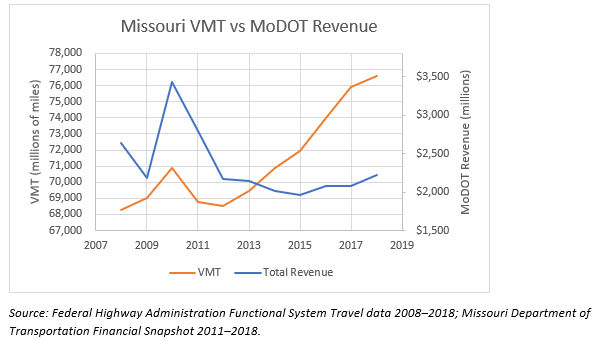
The Federal Highway Association tracks the usage of Missouri roads, measured with vehicle miles traveled (VMT). Between 2008–2018, Missouri’s VMT increased 12% while the Missouri Department of Transportation’s (MoDOT) budget declined by 15%. The divergence in trends can be seen in the graph below.

Gas tax graph

Federal stimulus money and bonds provided the financial buoy from 2008 to 2011, both of which were used quickly and the latter of which required repayment. Increasing maintenance costs and MoDOT’s shrinking budget has taken its toll on Missouri’s road quality; the 21st Century Missouri Transportation System Task Force described Missouri’s roads as “deteriorating.”

Other than the federal government, MoDOT’s main source of funding is the fuel tax. The fuel tax has remained at 17 cents per gallon since 1996 despite inflation reducing the real value of the tax. Moreover, the revenue that has been collected has not kept pace with the increase in road usage. Between 2008–2018, fuel tax revenue declined by 0.5 percent.

So how do we fix this?

Several other states have indexed their fuel taxes to some measure, whether that be inflation, state GDP growth, or highway construction costs. Such indexing ensures that fuel tax revenue automatically adjusts to the pace at which the rest of the economy grows, rather than being stuck at a static level.

As “consumption” of Missouri’s roads increases, the question of how to pay for needed infrastructure improvements will not disappear. The fuel tax is an effective method of funding road maintenance, and indexing it to a measure that reflects road usage or costs of upkeep could help ensure Missouri’s roads and bridges are kept in good condition.


Trends in Industry Credentials Show Missouri Has Room to Grow

As a general rule, the more data available, the better. That rule certainly applies to Missouri’s workforce. In particular, more data about Industry-Recognized Credentials (IRCs) could help inform how best to improve Missouri’s workforce. IRCs are credentials that validate a student’s specific job skills. Some jobs even require an IRC; passing the Certified Nursing Aide Exam is required to become a Certified Nursing Assistant.

I’ve written  previously about IRC attainment in Missouri, using data from 2017 and 2018 that the Show-Me Institute obtained through a data request. These data were useful because IRC attainment was broken out  by district and school, allowing for a detailed analysis of where in the state specific IRCs are earned and how that could support local economies.

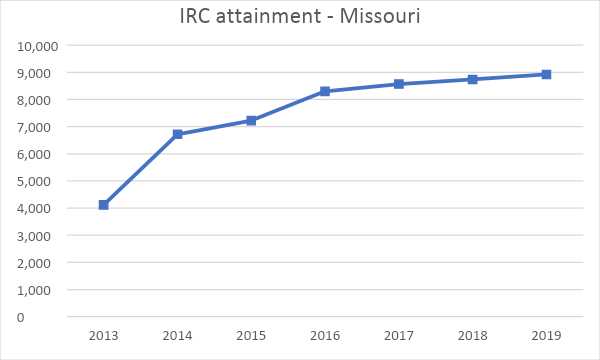
However, documents from the Career and Technical Education (CTE) advisory council meeting in October 2019 contained IRC attainment data from 2013–2019. These data can provide further context, such as what IRCs students have earned over the years and which IRCs are growing in popularity, as well as overall attainment trends. The data show that IRC attainment spiked from 2013 to 2016, and has since slowly increased.

IRC graph

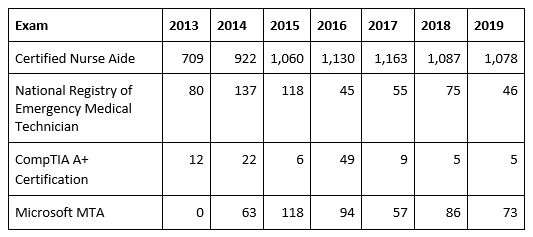
But this trend doesn’t hold true for all IRCs, including some IRCs for jobs that are in demand in Missouri, such as the CompTIA credential for technology jobs. The chart below shows that some IRCs have actually experienced a decline in attainment in recent years. This should be cause for concern since Missouri needs more students graduating with in-demand credentials, not fewer. To help encourage more high schoolers to earn an IRC, Missouri should consider implementing an IRC bonus pay program. An IRC bonus pay program would give a small bonus to a teacher for each student of theirs who passes an IRC exam.

These data can call to attention the gap between the economy’s need for IRCs and the low attainment of IRCs for Missouri high school students. Missouri should be trying to strengthen its workforce, and IRCs can be an effective way to do that. 

IRC table

Banning Fracking? Oh Frack No!

Prominent politicians and activists have called for a ban on fracking, the process by which America produces most of its oil and natural gas. Opponents of fracking claim it does more harm than good to Americans and the environment.

While fracking has changed the energy landscape in the United States, these changes have been for the better. Fracking has numerous benefits; it lowers energy prices which benefits consumers, it replaces coal with natural gas which lowers emissions and air pollution, and it increases energy production which strengthens America’s influence around the world. Despite the controversy, fracking is clearly a boon to the United States.

I address these matters in more detail in a recent op-ed posted at Real Clear Energy.


Support Us

The work of the Show-Me Institute would not be possible without the generous support of people who are inspired by the vision of liberty and free enterprise. We hope you will join our efforts and become a Show-Me Institute sponsor.

Donate
Man on Horse Charging