Fingers Crossed

If a crisis doesn’t create a person’s character, but reveals it, then the same can be said of organizations. An overnight switch to all-virtual education has spurred those with resolve to find innovative ways to educate children. And do you know what the cool thing is? If an idea includes virtual learning, then it’s technically available to anyone with an internet connection.

The Florida Virtual School (FLVS) has been serving public, private, and homeschooled students in the United States and abroad for decades. It recently increased its capacity to 2.7 million students. FLVS is geared up to serve all Florida students and is available to discuss options with out of state districts and schools. Similarly, the Uncommon Schools charter school network in New York quickly created a high-quality online learning option for its students. But it then went a step further and made the online option completely publicly available. That means any student with internet access can fully access a program created by a network with student proficiency rates at or near 100 percent. Sal Khan, creator of the Khan Academy, made his platform open and free as well.

Let’s cross our fingers that parents and students in some of Missouri’s shuttered districts—like Parkway, Joplin and the very low-performing Riverview Gardens—magically find these resources and use them. They will be doing so without their district’s guidance or support. And let’s think about whether Missouri public school students should be able to enroll in top notch programs in other states even after the pandemic. We now know that education can happen outside of public school buildings. The providers of high-quality education should reap the rewards of that effort, not the closest public school building to a child’s address.


 

More Policies to Fight COVID-19

Missouri is inching closer toward the peak of its coronavirus outbreak, and there is still work to be done to ensure the state is ready when that day comes. The priority for policymakers should be ensuring that the state has the resources to provide care for every Missourian that needs it.

Governor Parson has already taken two important steps to prepare Missouri’s health care supply for the coming surge in demand. A little more than a week ago, he waived multiple regulations that were preventing able providers from caring for Missourians. But as my colleague Patrick Ishmael and I have outlined, more action is needed to respond to COVID-19.

The next step is to allow providers to care for their patients to the full extent of their training. For example, if there were a shortage of doctors, and a nurse, medical student, or pharmacist could capably provide a service that had traditionally been delivered by a physician, the law should allow it. Reforming Missouri’s scope of practice laws would expand the state’s capacity to deliver medical services in a crunch. The governor has made some progress on scope of practice issues already by waiving the 75-mile requirement for APRNs and their collaborating physicians, but further steps, like appropriately allowing pharmacists to prescribe some medications, should be pursued.

Policymakers should also consider reducing the government-imposed barriers that are limiting available health care resources. Specifically, Missouri’s certificate of need (CON)laws (laws that require health care providers obtain government approval before opening health care facilities) hamper the response to COVID-19 by making it more difficult to build new (temporary or permanent) facilities. Missouri should follow the lead of the at least 18 other states that have suspended some portion of their CON laws in response to the coronavirus. Abolishing these barriers permanently would allow hospitals or other providers to build the facilities they believe communities need—not just the ones the government says the community should have.

Finally, the public health crisis and resulting economic downturn have highlighted the need for increased access to affordable health coverage. As many Missourians deal with the loss of their employer-sponsored health coverage and other income, it is essential they have access to a range of insurance options. Reforming state regulations on traditional coverage plans and also extending the duration of short-term medical plans would help ensure that Missourians have access to coverage that meets their needs while helping to mitigate financial risk.

Missouri will likely continue seeing increased need for health care resources over the coming few weeks, and there are policy responses that can help weather the storm. Here’s to hoping Missouri’s elected officials rise to the occasion by making the regulatory and legislative changes needed to help protect our state’s residents during this trying time.


One Fewer Option for School Districts

Missouri school districts are trying to figure out how to support learning amidst school closures due to the coronavirus pandemic. While some districts are transitioning to remote learning, others are not, and the districts that aren’t adopting remote learning will need to figure out how to make up for lost learning time.

Hopefully by late summer, the pandemic will be controlled enough for students to start the next school year normally. One idea for districts attempting to make up the lost time would be to start the next school year earlier. Unfortunately, the mandated start date law from 2019 would make this impossible.

Last year, a law passed limiting when school districts could start the school year in the hopes of advancing tourism with a few extra weeks of summer vacation. Putting tourism ahead of education was a bad idea in the first place, and there were other concerns with the law, such as a later start date perpetuating the academic summer slide. The law is an example of why we should be careful about taking away local control from schools, even for seemingly trivial matters such as school start dates. For districts that are not transitioning to remote learning, they have few options to make up the lost weeks, and this law eliminates one feasible option.

The coronavirus pandemic has highlighted the importance of flexibility in education policy. Local control can give districts the flexibility to properly respond to student needs.


Local Government Wanting a Stimulus Check? Publish Your Checkbook

After state and local government officials across the country abruptly shut down the economy last month to combat the coronavirus pandemic, Congress quickly passed a “stimulus” package. That package included not only money for individuals and small businesses, but also support for state and local government. For the private individuals and businesses who lost their incomes as a result of government action, compensation was appropriate.

But if local governments are going to receive taxpayer money to support their continued operation, they should be required to report all of their spending as a condition of that support. The simplest way to accomplish this would be for Congress to pass a law instituting the requirement, and if rumors hold true the vehicle for such an update may be yet another stimulus package. But the principle is one we’ve articulated again and again: If local government can take your money, it should tell you how it spent the money. We are all Federal taxpayers, and as Federal taxpayers, we have a right to know exactly how our money is being used in our own state and across the country.

Accordingly, local governments receiving this money should be required to report their spending in a machine-readable format. Local governments already keep these accounting records; it is appropriate those records are made public.

Parental Support in a Pandemic

The coronavirus pandemic is exposing the true condition of education across the United States. Many schools and districts have quickly transitioned to meaningful and measurable virtual education. In places that were not prepared for a crisis, the responsibility for figuring out how and when to educate students has been punted from the state departments of education, to the districts, to the schools, to the teachers and, ultimately, to parents.

In Missouri, the Department of Elementary and Secondary Education (DESE) has not provided clear guidance to school districts beyond “schools should focus on whatever alternative methods of instruction best support students.” DESE’s COVID-19 information website focuses largely on calculating average daily attendance, school finances, and serving students with special needs. By contrast, the New Mexico Public Education Department (PED) is requiring each district to create Continuous Learning Plans with minimum required minutes of instruction each day, based on grade level.

Local control is all well and good, except when it includes the local option of not teaching students at all. Some Missouri districts are advising schools and teachers that have already set up a virtual platform, like Microsoft Teams, to go ahead and use them. What about those that haven’t? Florida is offering $200 stipends to teachers who complete virtual instruction training. What is Missouri doing to equip all teachers?

It is undoubtedly overwhelming to millions of parents to become homeschoolers overnight. It is insufficient to simply point them to a webpage with “resources.” It is inequitable to have students whose teachers who were already leaning into the use of technology continue to receive instruction while others get little or none.

Next fall, when schools and teachers complain about how far students have fallen behind, we need to ask our public education leaders why we weren’t better prepared to serve all students in a crisis.


Telephone Town Hall: Economic Recovery After a Pandemic with Andy Puzder

On April 3, 2020 the Show-Me Institute hosted a Telephone Town Hall on economic recovery after a pandemic with guest speakers Andy Puzder and Senator Jim Talent. You can listen to the full discussion here:

https://soundcloud.com/show-me-institute/telephone-town-hall-economic-recovery-after-a-pandemic-with-andy-puzder/s-JQaHUYtYTbz


How Are School Districts Responding to COVID-19?

It’s about the third Monday since nearly every school building in the United States was closed, and yet most large school districts are still struggling to generate any learning at all for their students. We’re all learning as we go here, but there is an enormous risk of student learning loss if districts don’t start rolling out more solid guidance.

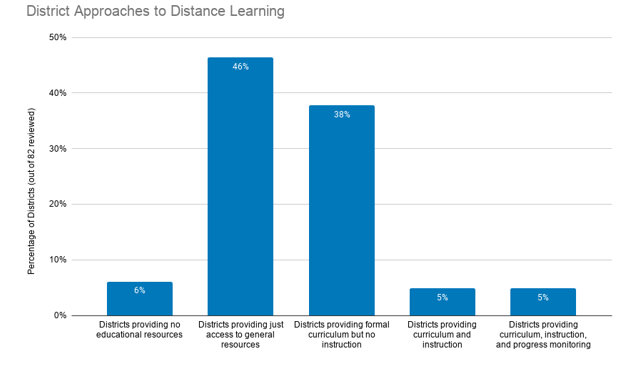
The Center for Reinventing Public Education (CRPE) at the University of Washington has created a database of the COVID-19 plans being developed by 82 large districts. Here are the plans thus far. 

School district graph

St. Louis City and Kansas City are in the second column. They have some links to additional resources on their websites and they are mailing homework assignments to their students or distributing them with student meals. They plan on having video instruction in the “coming weeks,” and they’re developing calendars to pace assignments over 10 days. In other words, much of the burden falls on parents to figure out what to do.

We need every Missouri school district to be answering these big questions: How will students receive instruction? Will their assignments be graded? Will students automatically advance to the next grade? Will high school seniors automatically graduate? Will there be summer school to make up for lost days? If there is little or no online instruction offered, what should teachers be doing?

Fortunately, there are plenty of good examples for districts to follow. Success Academy, a highly effective charter school network in New York City, has teachers calling each of their students at least twice per day. They have provided plain answers to parents’ most pressing questions. The Springfield Public School District in Missouri is giving parents some solid guidance and has set up an online learning system for parents. There are countless examples of varying quality. Sadly, the most vulnerable students are the ones who will really fall through the cracks if we don’t demand high-quality, engaged solutions from each and every school district.


Show-Me Institute Submits Comments to Public Service Commission

I recently submitted comments to the Public Service Commission about an upcoming hearing regarding rules on promotional practices undertaken by utilities.

What are promotional practices, and why does this matter?

Imagine that your power company wants to invest in an electric vehicle charging station in your area. They might have to bump up rates a bit in order to finance construction, but once the station was up and running it would be a win-win for electric vehicle owners and the utility.

But if you’re happy with your gas-powered car, it’s a different story. It’s not like you can just switch power companies. How is it fair for some of the money you pay for electricity every month to go towards a charging station that will make the power company more profitable, but won’t do anything at all for you?

Promotional practices are activities a utility undertakes to encourage some form of action by ratepayers. In the example above, the promotional practice is building the charging station, as the utility is trying to use it to encourage people to switch to electric vehicles. Or it could be something as straightforward as a gas company paying a cash bonus to anyone who replaces their electric stove with a gas stove.

Right now, the rules governing what expenses utilities can pass on to their customers are a mess. For instance, consider an educational program about energy efficiency that benefits all ratepayers. Such a campaign does not meet the current definition of “promotional practice.” Why not?

We have an opportunity to change the rules so that they make sense. If utility companies and their shareholders want to launch a promotion, they should be allowed to—as long as they, and not the ratepayers, foot the bill. Some of the red tape can even be removed along the way.

These and other matters relating to promotional practices are up for discussion at the Public Service Commission. The comments I submitted outline rule changes that would introduce more fairness and market discipline into the state’s utility monopoly system. You can read them here.


Support Us

The work of the Show-Me Institute would not be possible without the generous support of people who are inspired by the vision of liberty and free enterprise. We hope you will join our efforts and become a Show-Me Institute sponsor.

Donate
Man on Horse Charging