Telephone Town Hall: Economic Recovery After a Pandemic with Andy Puzder

On April 3, 2020 the Show-Me Institute hosted a Telephone Town Hall on economic recovery after a pandemic with guest speakers Andy Puzder and Senator Jim Talent. You can listen to the full discussion here:

https://soundcloud.com/show-me-institute/telephone-town-hall-economic-recovery-after-a-pandemic-with-andy-puzder/s-JQaHUYtYTbz


How Are School Districts Responding to COVID-19?

It’s about the third Monday since nearly every school building in the United States was closed, and yet most large school districts are still struggling to generate any learning at all for their students. We’re all learning as we go here, but there is an enormous risk of student learning loss if districts don’t start rolling out more solid guidance.

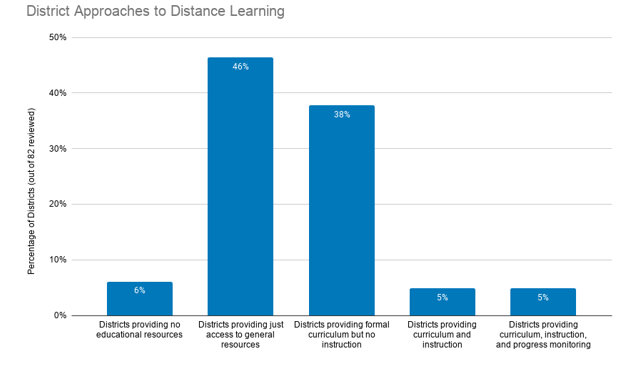
The Center for Reinventing Public Education (CRPE) at the University of Washington has created a database of the COVID-19 plans being developed by 82 large districts. Here are the plans thus far. 

School district graph

St. Louis City and Kansas City are in the second column. They have some links to additional resources on their websites and they are mailing homework assignments to their students or distributing them with student meals. They plan on having video instruction in the “coming weeks,” and they’re developing calendars to pace assignments over 10 days. In other words, much of the burden falls on parents to figure out what to do.

We need every Missouri school district to be answering these big questions: How will students receive instruction? Will their assignments be graded? Will students automatically advance to the next grade? Will high school seniors automatically graduate? Will there be summer school to make up for lost days? If there is little or no online instruction offered, what should teachers be doing?

Fortunately, there are plenty of good examples for districts to follow. Success Academy, a highly effective charter school network in New York City, has teachers calling each of their students at least twice per day. They have provided plain answers to parents’ most pressing questions. The Springfield Public School District in Missouri is giving parents some solid guidance and has set up an online learning system for parents. There are countless examples of varying quality. Sadly, the most vulnerable students are the ones who will really fall through the cracks if we don’t demand high-quality, engaged solutions from each and every school district.


Show-Me Institute Submits Comments to Public Service Commission

I recently submitted comments to the Public Service Commission about an upcoming hearing regarding rules on promotional practices undertaken by utilities.

What are promotional practices, and why does this matter?

Imagine that your power company wants to invest in an electric vehicle charging station in your area. They might have to bump up rates a bit in order to finance construction, but once the station was up and running it would be a win-win for electric vehicle owners and the utility.

But if you’re happy with your gas-powered car, it’s a different story. It’s not like you can just switch power companies. How is it fair for some of the money you pay for electricity every month to go towards a charging station that will make the power company more profitable, but won’t do anything at all for you?

Promotional practices are activities a utility undertakes to encourage some form of action by ratepayers. In the example above, the promotional practice is building the charging station, as the utility is trying to use it to encourage people to switch to electric vehicles. Or it could be something as straightforward as a gas company paying a cash bonus to anyone who replaces their electric stove with a gas stove.

Right now, the rules governing what expenses utilities can pass on to their customers are a mess. For instance, consider an educational program about energy efficiency that benefits all ratepayers. Such a campaign does not meet the current definition of “promotional practice.” Why not?

We have an opportunity to change the rules so that they make sense. If utility companies and their shareholders want to launch a promotion, they should be allowed to—as long as they, and not the ratepayers, foot the bill. Some of the red tape can even be removed along the way.

These and other matters relating to promotional practices are up for discussion at the Public Service Commission. The comments I submitted outline rule changes that would introduce more fairness and market discipline into the state’s utility monopoly system. You can read them here.


Homeschooling, Centralized Education, and Bastiat

As my family and I practice social distancing, I’ve decided to take time to read some of the “must-read” authors in the free-market or classical liberal tradition. First up is Frédéric Bastiat. Many of his thoughts are salient for issues we are facing today.

Bastiat (1801–1850) was a French economist. In his most prominent essay, What is Seen and What is Not Seen, he explained how policymakers often tout the immediate effects of a policy but ignore what might have happened without the policy—what is not seen. This would later be known as the concept of “opportunity cost.” Whether discussing tax subsidies for sporting stadiums, tax-increment financing for development in flood plains, or a host of other issues, policy analysts at Show-Me Institute regularly follow in the tradition of Bastiat by explaining what is not seen.

In another of his popular essays, The Law, Bastiat explains that “the law is justice.” The purpose of the law is not to bestow rights or benefits on members of society, but instead: “Its function is to prevent the rights of one person from interfering with the rights of another.” His ideas on property rights and the purpose of the law help form the foundation of the classical liberal tradition.

Lately, I have been particularly intrigued by his essay Justice and Fraternity. I am an educator by trade. My bachelor’s and master’s degrees are in elementary education and my Ph.D. is in education policy. I have been a classroom teacher in public schools and I currently teach university classes for aspiring principals and superintendents. Through my experiences, I have developed some specific views on the purpose of education and what constitutes great teaching. Often, I find these views are not shared by others. Indeed, there are many ideas on the matter that are often incongruous with one another. This is one of the reasons I am so supportive of school choice; it allows individuals to explore the type of education they view as the best.

Others, however, are not sold on school choice. They believe the state should dictate what and how students learn. Oh, they may not say this directly, but consider what they propose. They want the government to dictate which schools children will attend. They want those schools to be accountable to government agencies and financed by funds from the government. They want the government to certify teachers who will teach  government-approved content standards. In short, they want a heavily regulated and centralized system of education.

Now let’s suppose that there is one best way to educate students. Bastiat suggests in Justice and Fraternity that the best way to discover this one best way is through a decentralized system:

Obviously, if people could agree on the best possible kind of education, in regard to both content and method, a uniform system of public instruction would be preferable, since error would, in that case, be necessarily excluded by law. But as long as such a criterion has not been found, as long as the legislator and the Minister of Public Education do not carry on their persons an unquestionable sign of infallibility, the true method has the best chance of being discovered and of displacing the others if room is left for diversity, trial and error, experimentation, and individual efforts guided by a self-regarding interest in the outcome—in a word, where there is freedom. The chances are worst in a uniform system of education established by decree, for in such a system error is permanent, universal, and irremediable. Therefore, those who, in the name of fraternity, demand that the law determine what shall be taught and impose this on everyone should realize that they are running the risk of having the law direct and impose the teaching of nothing but error; for legal interdiction can pervert the truth by perverting the minds that believe they have possession of it.

There are two important points made here. First, that the rational self-interest of diverse groups of individuals is better suited to discover the best way to educate students, or at the very least to satisfy the desires of the most individuals. Second, instituting one method from on high via government agencies is a surefire way to mandate error. At present, we do not have the magical education bullet that will meet the needs of every child. Therefore, a centrally imposed system will by its very nature force some students into a system that doesn’t work for them.

Think about this as we move forward in the coming months. As schools remain closed, parents throughout the country will be taking on the new role of home educator. They will, undoubtedly be working to find the system that works best for them. These parents will need the support of teachers and schools, but they are most likely to find that system through their own trial and error. They do not need a government order that forces every family to conform to the same routines.  

In my estimation, some of Bastiat’s essays should be required reading for high school economics students. Maybe I should work to impose that view on others. 

 

Census Estimates Show St. Louis Population Falling . . . Again

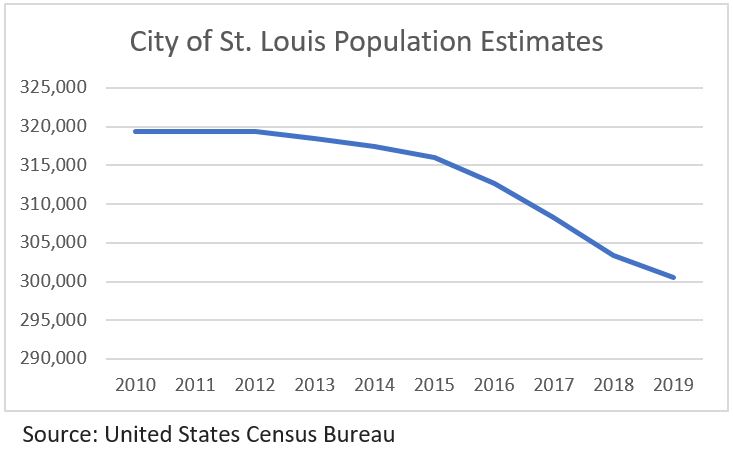
While the world is facing a whole new set of problems with the COVID-19 crisis, the city of St. Louis continues to struggle with a problem it has had for years: population decline. The U.S. Census Bureau released new population estimates for 2019 and St. Louis hasn’t done so well in the past year, or the past decade for that matter. Could local policies be negatively affecting St. Louis’s population growth?

According to the new estimates, the city of St. Louis is getting close to dropping below 300,000 residents. The city’s 2019 population estimate is 300,576, down by over 2,800 from 2018. This isn’t a new occurrence, but rather a continuing trend—the city’s population has fallen by nearly 6% since 2010, shown in the graph below.  St. Louis County also lost population, dropping by 1,014 from 2018 to 2019.

Graph of Missouri population

Other areas of Missouri are not experiencing this same trend. Right outside of the St. Louis area, St. Charles passed the 400,000 mark, adding 3,242 people in 2019. Many other areas also experienced growth, including Clay, Greene, and Jackson counties.

Though we can’t know for certain why people are moving out of St. Louis, Show-Me Institute researchers have written on population trends before, and much of what has been said still holds true. Policies that promote success and freedom for people and businesses can attract residents while those that place onerous burdens can deter.

Things like an earnings tax on residents and workers, high sales taxes, and stringent business regulations can create an unwelcoming environment. Additionally, poor school performance, high crime rates, and failed public projects can make St. Louis an unattractive option.  If we want to reverse the trend, policymakers will need to address these issues. The sooner, the better.

Governor Approves Waivers Expanding Health Care Supply, Including License Reciprocity

Yesterday, on National Doctors’ Day no less, Missouri’s Governor took two big steps to bolster the state’s coronavirus response. The first grants license reciprocity for doctors from other states, which will immediately allow them to begin treating Missourians. The newly waived regulation applies to telemedicine as well, meaning that physicians in other states can now offer support to Missourians remotely. The second removes the onerous requirement that doctors collaborating with advanced practice registered nurses (APRNs) be located within 75 miles of each other. Taken together, these measures greatly expand the ability of our nation’s health care providers to treat Missourians as our state deals with the COVID-19 outbreak.

My colleagues and I have written extensively about how Missouri could increase access to health care. One of the most crucial steps in a pandemic is allowing every competent health care professional from around the country that is willing to help in Missouri the ability to do so. License reciprocity does just that. Physicians from Illinois, Kansas, and elsewhere can now come to the Show-Me State—both physically and virtually—and begin their important work.

Waiving the distance requirement for collaborating physicians and APRNs will also significantly improve access to care. Previously, for APRNs to prescribe and treat patients in Missouri, they had to collaborate with a licensed physician that was within 75 miles. As the number of Missouri counties with positive coronavirus cases increases by the day, allowing health care providers to move around and serve each corner of the state without restriction is paramount. This change will both help contain the virus and improve access to care across Missouri.

Perhaps the biggest concern with the coronavirus outbreak is that it could overwhelm Missouri’s health care system, and it is good news that the governor has acted quickly to better prepare our state. But this is just the beginning, and there are still a variety of areas where removing unnecessary government barriers would strengthen Missouri’s response. The Show-Me Institute will keep shining a light on these important policy changes as our state navigates these trying times.


How Can We Make Sure Missouri Students Can Still Learn?

At the start of the school year, no one expected a pandemic to put the school year on hold. But now all of the state’s districts and charter schools are temporarily closed. While some students may not get any schooling before the start of the next school year, others are transitioning to online learning. As schools have closed, there has been a wave of concern regarding student’s ability to access technology such as computers or quality internet in order to continue learning online.

The best way to address this concern would be via an emergency tax-credit scholarship program. This tax-credit scholarship program could function much like a regular tax-credit scholarship program. Individuals and businesses donate to a scholarship-granting organization (SGO), and the SGO distributes the money to students who qualify based on the program requirements (the attached infographic has more detail on how the funding works). An emergency tax-credit scholarship could be awarded in cases such as the current pandemic, or in other cases such as natural disasters or even when individual families go through crisis.

Unfortunately, it seems very unlikely this type of program will pass this year. This is an important lesson about being proactive. If Missouri already had a tax-credit scholarship program, it would have been much easier to get kids the help they needed in a crisis. Instead, schools and districts are left scrambling to try and make something work without the resources required.

Tax-credit scholarships would help give families the ability to purchase the materials students need to keep learning even if it’s not in a traditional brick and mortar school. Lack of access to the internet or a computer are real barriers to learning for many students, but tax-credit scholarships could help fill that gap. Missouri can better prepare for unforeseen circumstances if only we would get a little creative.


Support Us

The work of the Show-Me Institute would not be possible without the generous support of people who are inspired by the vision of liberty and free enterprise. We hope you will join our efforts and become a Show-Me Institute sponsor.

Donate
Man on Horse Charging