Dear Mr. President: No More State and Local Bailouts

The Show-Me Institute isn’t typically one to join “coalitions” or issue open letters to officials, but the public debate on a proposed second round of coronavirus-related bailouts to state and local governments deserves a plain response.

There should be no further state bailouts. None.

Please do not offer bailouts. Please do not entertain them. The story of American governance over the last half-century has been one of a growing parent-child relationship between the federal and state governments. This relationship is predicated on the expectation of financial support for states in both ordinary and extraordinary times. American states were meant to be sovereigns, not trust fund babies protected from the consequences of their individual actions by the federal government

Now is the time for states to move out of the federal government’s basement and openly reject a new round of bailouts. If they don’t, the federal government needs to kick the deadbeats out by declining to deliver one. The federal government should not prevent states from receiving a needed education on the consequences of their policy decisions.

No. Bailouts.

Further “stimulus” to the private sector, whether it be to businesses or workers directly, should similarly cease. But the increasingly subsidiary federal-state relationship deserves immediate attention, and immediate rejection. Every state, including Missouri, needs to stop its extraordinary reliance on federal money, and the right time to start the detox process is now.

No bailouts. It’s time for the states to grow up.


There Oughta Be A Law: If Walmart is Essential, Small Retailers Are Too

As the coronavirus pandemic accelerated this spring, governments across the country clamped down dramatically on businesses and associations of all kinds. Churches were closed. Restaurants were reduced to carryout, if they were lucky. Other locally owned stores were reduced to even less than “carryout,” often forced to only sell their wares online. Some will make it through the year; others won’t.

But you know who’s doing just fine? Box stores like Walmart and Home Depot and online giants like Amazon. For those massive commercial players, coronavirus evolved into a windfall so great that some of these businesses had to shorten their hours or delay shipping packages.

You know who else is doing just fine? Gun stores, but not because of the goodness of local officials’ hearts. Under Missouri law:

The state, any political subdivision, or any person shall not prohibit or restrict the lawful possession, transfer, sale, transportation, storage, display, or use of firearms or ammunition during an emergency.

Despite attempts to temporarily shut down gun shops around the country, local officials in Missouri largely resigned themselves to applying social distancing guidelines rather uniformly against gun retailers, from Cabela’s to tiny mom and pop gun shops. The purpose of Missouri’s gun law—protecting individuals’ Second Amendment rights—is straightforward. But the effect of the law was to level the playing field between big and small gun retailers, which stands in stark contrast to how local officials treated other small businesses.

Small gun shops could stay open as legally “essential.” But what about small businesses that sold candles, or sporting equipment, or anything else that Walmart and a cadre of other protected operators sold throughout the pandemic? Those small businesses did not get to enjoy the protections of state law, were often deemed “inessential” by local officials and were shut down—in some cases for months.

That’s wrong.

If Walmart can stay open and sell, say, candles, Missouri’s locally owned candle makers should be able to stay open. There is no reason to believe that small businesses can’t undertake rational social distancing and cleaning practices that large retailers have used throughout this pandemic.

How do we know this? Because local gun shops did it. Missouri law should reflect this reality for all small businesses and ensure that Missouri’s entrepreneurs aren’t the victims of disparate treatment by panicked local bureaucrats.

And Missouri should come back into special session and pass a law that makes this clear: If Walmart is essential, all of Walmart’s competitors should legally be, as well. Whether this requires the creation of a brand new statute or can be achieved by expanding the section that already protects gun retailers, it doesn’t matter. What’s important is that legislators act now—before another round of the pandemic hits, and before local businesses can be victimized a second time by inequitable and uneven local public health enforcement.


Missouri Needs Education Leadership Now More Than Ever

The past spring, much of Missouri turned into an education desert of homework packets, learning “opportunities,” and optional enrichment suggestions for children. Soon, very soon, it will be time to turn the education spigot back on. Who will lead us out of this desert? This is going to be a challenge for many of Missouri’s small, rural districts and as much as everyone loves local control, these districts are going to need real leadership from the Missouri Department of Elementary and Secondary Education (DESE).

Unfortunately, that leadership is conspicuously missing. The DESE website has a link to the Show Me Strong Recovery Plan that makes no mention of education. If you dig deeper, you’ll find that DESE and the Department of Health and Social Services hosted an hour-long webinar on reopening that you could watch. The companion pdf has one slide on reopening that mostly focuses on attendance and funding.

What should DESE be doing? Maybe follow the lead of Nebraska. The Launch Nebraska project, has very specific guidance on school governance, operations, and technology targeted to both district leaders or school leaders. Maybe pick up some pointers from the Alaska Smart Start 2020 restart and reentry guidance that has separate suggestions for low-risk, medium-risk, and high-risk districts. Maybe set up a website like Iowa’s Return-to-Learn Support page with deliverables and timelines. Maybe read through Florida’s 143-page pdf titled Reopening Florida’s Schools and the CARES Act regarding closing achievement gaps and creating safe spaces for learning.

Unprecedented challenges in education require more than a webinar video and a slide in a PowerPoint. Having looked at the websites of over 400 Missouri school districts, I can attest that, based on what they were able to do last spring, districts are going to need real guidance and leadership. What type of staffing guidance should they develop? How will they deal with parents who don’t like their plan? How should they deal with teachers who don’t like their plan? How, specifically, should they address the social and emotional needs of students? What should they implement immediately to address learning loss?

There is no reason to make 520 school districts create 520 reopening plans. If the state education agency in Missouri is little more than a clearinghouse of links and information from other sources, then it may be time to rethink its structure and its existence.


About That Border War Truce . . .

Last fall, there was much rejoicing about the effort by Missouri Governor Mike Parson and Kansas Governor Laura Kelly to end the economic development border war between the two states. I was skeptical and said so at the time. Specifically, I worried important terms of the truce had not been defined, and as a result there was a lot of wiggle room. What I hadn’t anticipated was the number of “grandfathered” deals.

First was the $100 million Waddell & Reed deal, supposedly under negotiation prior to the truce, in which the company captured corporate tax incentives for itself by exposing its employees to higher income taxes. Now we learn of another deal for BlueScope, which is seeking perhaps as much as $20 million worth of incentives from Kansas to hop across the state line. The company is playing the states against each other. According to The Kansas City Star, Kansas City and Missouri are taking the bait:

All told, the company could receive about $14 million from Missouri and Kansas City to remain in the West Bottoms and add 15 jobs per year. That also includes $5.6 million from the state and a sales tax exemption on construction materials for improvements to the building.

Supporters of such business subsidies argue that this round of incentives won’t affect the various taxing jurisdictions. But they are wrong. As a representative for the Kansas City Public School District noted, the existing incentives are set to expire in 2022, meaning BlueScope would finally be paying its full tax burden. This new deal extends a 75 percent tax exemption for over a decade, thus robbing schools of funds they would otherwise receive. This gives the lie to the claim by then–Mayor Sly James that incentives are good because “when the incentives roll off then the tax base rises.” What if they never fully roll off?

Such incentives don’t live up to their claims of creating jobs or spurring investment. Kansas City has no business extending tax breaks when the city is already looking to cut five percent of its budget due to the economic hit of COVID-19. If BlueScope wants to leave, the city ought to let them go.

Local Wind Farm Project Highlights Electricity Generation Tradeoffs

The cancelation of a wind farm project in Barry County highlights the tradeoffs involved in green energy.

The power producer Invenergy canceled plans for a wind farm after the city of Monett expressed concerns over the turbines’ effects on its regional airport.

But what do wind turbines have to do with airplanes? Wind turbines can create turbulence several miles away from their site, generating hazards for general aviation airplanes and airports. Additionally, the turbulence created from wind turbines can pose problems for radar scanning and airplane communication systems, while the sheer height of some turbines can obstruct flights if they are located close to an airport.

Local naturalists also expressed concern that turbines would jeopardize eagles and an endangered bat species. The conflict between green energy and wildlife conservation has raged for years. Wind energy plants have come under serious scrutiny for killing hundreds of thousands of birds (including protected birds of prey) and bats annually. Many wind energy companies consider precise wildlife casualty details to be a trade secret and have sued to block their public release.

This tug-of-war is emblematic of a struggle developing nationwide between energy planners and local communities. Some communities welcome wind energy development, while others like Buchanan County have banned it entirely. In the Northeastern United States, many developers are building wind energy projects in the state of New York, where the governor created a rule that allows the governor’s office to override local opposition to wind energy project locations. Many communities have declared themselves “sanctuary towns” in opposition and plan to refuse such projects.

As I wrote earlier, land use is an important part of energy production and cannot be overlooked. Green energy is not free energy, as each energy source has its own set of tradeoffs.


Attention Parents

Currently, Section 161.670 of the Revised Statutes of Missouri (part of a course access law passed in 2018) requires that parents of students who wish to enroll in the Missouri Course Access Program (MOCAP) request and receive permission from their local school district first. In the first two years after passage of this law, dozens of parents have been denied this permission and some have had to hire attorneys to get it. Districts were reluctant to give up students or funding to virtual education.

 With every public school in the state shut down and every student expected to learn virtually (if at all), we need to make immediate changes.

 Click on the link below to learn more about MOCAP.


What Type of Education Will Parents Want in the Fall?

Recent polling has found that parents are considering different options for their children for this coming school year. Due to COVID-19, some parents are rethinking traditional brick and mortar education. Because of the pandemic, health and safety are at the forefront of parent’s minds.

The American Federation for Children found that 40 percent of parents nationally say they are more likely to homeschool or virtual school their children once lockdowns are over. A poll from USA Today found that 6 in 10 parents are likely to consider at-home learning options for their children, and 3 in 10 are “very likely” to do that.

Public School Options also polled parents and found that parents are largely concerned about safety for their child this fall. More than two-thirds of parents are concerned about whether or not they can safely send their children to school when schools reopen. Over 40 percent of parents in the survey are considering online options for their children.

In Missouri, the Columbia Public Schools District surveyed its community and found that roughly half of parents wanted to remain online and half wanted to return to the school building in the fall. The district is now offering families the option to choose online classes for the fall.

There are ways to keep students safe while still giving them a quality education. Safe Student Scholarships are one option that I’ve discussed before, but there are others. Of course, the coronavirus situation could change by the time school starts, and parents could change their minds. But right now, parents are clearly indicating they want more options. While Missouri has previously resisted online education, it finally might be time for the supply of online offerings to meet the demand.


Missouri Doesn’t Rely on Property Taxes as Much as Other States. Is That a Problem?

According to Tax Foundation data, Missouri doesn’t rely on property taxes for revenue as heavily as other states do. Our state ranked 32nd in property tax collection as a percentage of state and local tax collection in fiscal year 2017. This may seem like a good thing—lower property taxes for Missourians, right? Unfortunately, it’s not that simple. Relying less on property taxes means that Missouri is relying more on income and sales taxes, which could be hurting our state’s growth.  

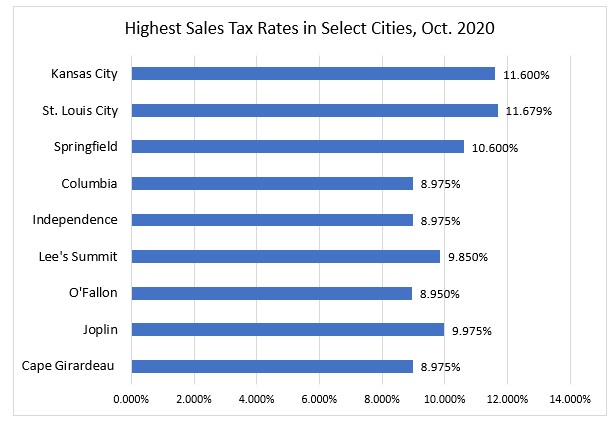
Missouri ranked 14th and 18th in 2017 for income and sales tax collection as a percentage of state and local tax collection, respectively. I’m sure many Missourians can believe those rankings; with earnings taxes in our major cities and special taxing districts piled up across the state, we pay a lot of income and sales taxes. Though all taxes mean money out of our pockets, they don’t all have the same effects on economic growth.

Research (including research from SMI) shows that income and sales taxes have a larger negative effect on economic growth than property taxes. Income and sales taxes distort decisions related to working and spending, two huge drivers of economic growth. Decisions on property tend to be more permanent; a 3 percent increase in sales taxes may make you spend less at the store, but a 3 percent increase in property taxes probably won’t make you sell your house. This is why property taxes tend to distort the market less.

Revenue from income and sales taxes also tends to be more volatile than revenue from other kinds of taxes. During economic downturns (and especially during an economic shutdown), income and sales tax collections will fall quite a bit as people lose their jobs and have less money to spend. We won’t necessarily see such a large decrease in property tax revenue due to the same reason discussed above; it’s harder to make quick, short-term decisions about big investments like property. This is bad news if government-funded programs and services rely heavily on income and sales taxes for revenue.

It’s important to understand how our taxing decisions affect the overall growth of our state. Relying on income and sales taxes creates problems, and other states seem to be clued into this. It may be time to think about shifting toward property taxes and away from income and sales taxes in order to stay competitive with other states and promote economic growth in Missouri.


A Small Step Forward, But Let’s Take the Leap

Last week, Governor Parson extended some of the regulatory waivers put in place by previous executive orders. Instead of expiring on June 15th, a few of the waivers will now expire on August 28th, and others will remain waived until December 31st unless otherwise specified.

Show-Me Institute researchers have spoken favorably of these regulatory waivers. These waivers have allowed us to better respond to the COVID-19 crisis and have reduced the burden on scores of workers and businesses during these trying times.

The question that I’ve been asking for months comes back to mind: If we don’t need these regulations for the rest of the year—which would bring us to about 9 months without these regulations—do we need them at all? Extending these regulatory waivers is a great first step, but lawmakers should take the leap and make these waivers permanent.


Support Us

The work of the Show-Me Institute would not be possible without the generous support of people who are inspired by the vision of liberty and free enterprise. We hope you will join our efforts and become a Show-Me Institute sponsor.

Donate
Man on Horse Charging