

Join us on Tuesday, December 8 at 11:00 AM as Show-Me Institute researchers unveil the 2021 Blueprint for Missouri during a live virtual town hall.
Special Session a Reminder of Budgetary Troubles

Missouri is still dealing with COVID-19, and the hole in the state’s budget is only getting deeper. Last week, the state legislature began its second special session of the year, and it is expected that this session will add more than a billion dollars to the budget. This new funding is on top of the record-setting $30-billion spending plan approved roughly six months ago. While most of this soon to be approved funding will come from the federal government, the extraordinary session offers an important reminder of the trouble that lies ahead.
The pandemic has already taken a serious toll on our government’s budget. The virus, combined with lockdowns and other restrictions placed on businesses, has drastically decreased economic activity, which in turn has lowered state and local tax revenues. For the fiscal year that ended on June 30th, Missouri’s collected 6.6 percent less in revenues than it did the year before. And this year, the governor has already restricted more than $400 million in state spending, indicating his budget staff believes the decline in tax revenues will persist for some time.
Over the past eight months, Missouri has been unable to spend hundreds of millions in state tax dollars that otherwise would have gone toward priorities such as education and public safety. At the same time, the cost of other state programs has increased as a result of the virus. It is true that some of these issues have been temporarily alleviated by generous federal relief efforts. But federal support cannot fill the hole created by COVID-19 for every state priority (the federal government places restrictions on where the money can be spent). More importantly, this funding is a short-term solution to a long-term problem.
Missouri was unprepared for the current situation in large part because state spending has been growing for years. We must also realize that it’s becoming increasingly likely the virus will be defeated before tax revenues return to pre-pandemic levels. For that reason, it’s time to start thinking about how our elected officials will respond once the state’s budget is no longer being propped up by federal aid.
In the coming months, Missouri’s policymakers should consider every option that could help contain the state’s runaway spending trajectory and shrink the size of government to match the revenue projections of the years ahead. There’s no doubt the task will be difficult, but it’s all but certain the cost of acting now will be lower than if we wait until it’s too late.
A Charter School for Normandy?

The Normandy School District might be getting its first charter school. That is, unless a coterie of local functionaries scupper the plan. The Post-Dispatch has all of the details.
Two paragraphs in the Post-Dispatch story are worth highlighting:
Normandy schools have not been fully accredited for the last decade and are under the control of the Missouri Board of Elementary and Secondary Education. Starting in 2013, the district paid tuition and transportation for about 1,000 students to transfer to higher-performing districts, as allowed under state law. The district nearly went bankrupt after spending $35 million on the transfer program. It returned to provisional accreditation in 2017, effectively ending the transfer program.
The district’s test scores still rank as lowest in the state, with 15% of students proficient in English and 7% proficient in math in 2019. There have been recent improvements, including the graduation rate at Normandy High rising from 53% in 2013 to 78% in 2019.
Families are already voting with their feet. Normandy has been shedding students, either through the transfer program or now just the old fashioned way (the Post-Dispatch reports elsewhere in the story that enrollment in the district is down 316 students, or 11 percent, this school year).
It is the school board of this district that approved a resolution last month expressing its “complete discontentment” with the Missouri Charter School Commission’s process of soliciting and developing a charter school in the district, as the board wanted to be included more in the process. Why on earth should a district that has manifestly failed to educate its students or even keep its financial house in order have any say on a new school that is coming in to try and do better? Lunacy.
And it is the civic leaders quoted in the story who believe that this district should have a monopoly on education provision within the boundaries of the Normandy School District. Also lunacy.
The question has to be asked of these leaders: How can you, in good conscience, look into the eyes of the children of Normandy and tell them that they don’t deserve a different option? Why must they stay tethered to a district that has been foundering for longer than they have been alive? Would you accept this for your own children?
What About the other 80 Percent of Missourians?

About 30 percent of Missourians, age 25 and older, have a bachelor’s degree or higher. It’s estimated that about 60 percent of Missouri students graduate from college with student loan debt. So per a very rough calculation, about 18 percent of Missourians have student loan debt. That lines up pretty well with the national average of around 22 percent.
While starting your career with $25,000 plus in student loan debt can create challenges, these are somewhat offset by the higher earnings a college degree holder can expect. Yet, once again, student loan debt forgiveness is being floated as an economic policy. Let’s be clear: This relief is directed at the one in five Missourians who can expect significantly higher earnings over their lifetimes. Everyone else is left with nothing except picking up the tab. What about car loans? What about credit card debt?
This is a textbook example of a regressive tax; relief for higher earners at the expense of lower earners. Expensive government giveaways create bad precedent. They incentivize bad behaviors. And, like it or not, they have to be paid for at some point. Sorry to be a Grinch, but don’t ask Santa to forgive your student loans.
For more on this topic, click here to listen to our podcast with the Cato Institute’s Neal McCluskey:
What is an Education Savings Account (ESA)?

SMI Podcast – Bad with Money: The Decline of Financial Literacy in America
On this episode of The Show-Me Institute Podcast, Dr. Susan Pendergrass is joined by John Pelletier. They discuss the lack of real-world financial education in American schools, what some states are doing well, and the issues with the gamification of investing by tools like Robinhood.
John Pelletier is the director of the Center for Financial Literacy at Champlain College in Burlington Vermont.
The Show-Me Institute Podcast is produced by Show-Me Opportunity.
New Report Highlights Dangers of Kicking Missouri’s Infrastructure Funding Can Down the Road

Missouri’s roads are more than just a convenience—they’re an economic asset.
According to the most recent data from 2011, roughly $711 billion worth of freight crosses Missouri each year, and this is projected to increase to $1.2 trillion by 2030. More than 83,500 Missourians work transportation and warehousing jobs, and more than half of Missouri’s economy is affected through freight movement or systems.
However, according to a new study by the Missouri Chamber of Commerce, this vital part of Missouri’s economy is in danger of falling into disrepair. Missouri’s transportation infrastructure, specifically roads and bridges, is aging rapidly. Traditional methods of funding are inadequate to maintain current systems, let alone provide enhancements.
Missouri’s fuel tax of 17.4 cents per gallon has not been raised since 1996. Due to inflation, 17 cents then are worth 8 cents now. Additionally, vehicle registration fees were last increased in 1980, and a dollar in 1980 is worth about 30 cents today. Together, these two revenue sources make up nearly 40 percent of the Missouri Department of Transportation’s total road budget (and 65 percent of in-state revenue, once federal reimbursement is considered). As a result, $745 million in high-priority road needs go unfunded each year.
According to the Chamber of Commerce report, this funding crisis “is the biggest roadblock preventing the state from reaching our logistics potential.”
To start closing the gap in Missouri’s road funding, the Chamber of Commerce report recommends exploring tolling and also indexing the state fuel tax and registration fees to inflation. These measures would help keep funding sources up to date in terms of purchasing power and start to close the funding gap as well as keep a “user pays” principle.
While these methods are not always the best ways to match road damage to payment for upkeep, they are the type voters were most inclined to consider. Public opinion surveys of Missouri voters conducted for the report revealed that 57 percent support highway express lanes, akin to tolling individual lanes, although tolling proper received lower (40 percent) support. Fifty-one percent of voters support increasing the fuel tax, while 47 percent support raising registration fees. Mileage-based user fees can be effective, but only 24 percent supported the idea. Despite the different levels of support for different funding methods, 85 percent of Missouri voters agreed that Missouri needs more funding for transportation infrastructure.
Missouri’s roads are an economic asset that support jobs across the state. Making sure we have the money to keep them in good shape—while ensuring those who use them pay for them—is something policymakers need to address.
Multnomah County, Oregon Should’ve Called St. Louis Before Making This Mistake

Multnomah County, Oregon, which contains the city of Portland, recently approved a local income tax increase to fund tuition-free preschool. This measure will increase the local income tax by 1.5 percent for individuals who make over $125,000 and 3 percent for those that make over $250,000. Those of us in the city of St. Louis are all too familiar with earnings taxes such as this one. If Multnomah County had called St. Louis City, we could’ve told them that this local income tax increase is a bad idea.
In general, economic theory tells us that local income taxes have negative effects on population and economic growth in the cities that have them. Not only do these taxes discourage earning an income, but they are easy to avoid by moving or relocating businesses. This makes localities that have local income taxes less competitive relative to surrounding localities and encourages people to make the short move to where they can keep more of their hard-earned money.
We’ve seen this play out in the St. Louis area, especially regarding population; it’s fairly common to hear about people and businesses moving from the city to the county. St. Louis County does not have an earnings tax and the county’s population decreased by 0.46 percent from 2010 to 2019. The City of St. Louis, on the other hand, has a 1 percent earnings tax and has seen a staggering population decline for years. The city’s population decreased by 5.87 percent in the same period—that’s more than 12 times as much as the county. And just a little bit further from the city, St Charles county’s population increased by 11.12 percent in the same period.
Many factors can contribute to population decline; an additional tax on income is certainly one of them. Economic theory suggests that Multnomah County may see its local income tax hike have negative effects on population and economic growth. St. Louis can confirm that with experience. If they’d asked, we would’ve told policymakers this is a bad idea for their county.
Fixing the “Delmar Divide” with a TIF?
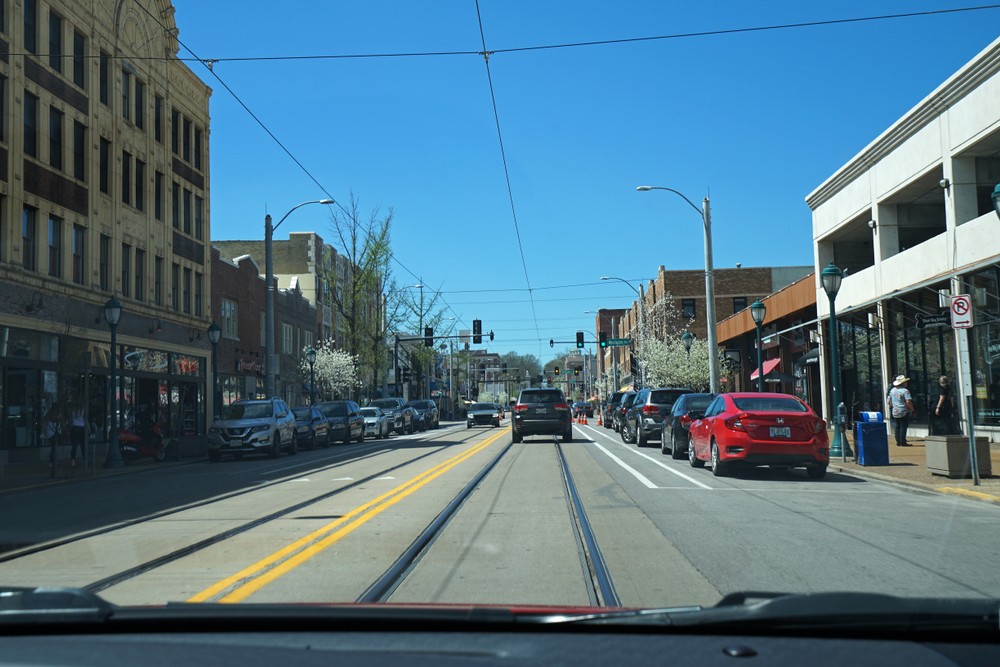
Developers are asking for millions in tax subsidies for a redevelopment project with the hopes of fixing St. Louis’s “Delmar Divide” between the Central West End and the low-income neighborhoods north of Delmar Boulevard. I work (and wrote this piece) not far from the proposed project area, and I’ll admit, it could use a facelift. But not one funded by tax dollars. Is throwing tax dollars and special perks to developers really the way to bridge this gap between a high- and low-income area?
The Kingsway Commercial Tax Increment Redevelopment Plan involves developing multiple projects where the Central West End meets Delmar Boulevard. But perhaps more importantly, a big chunk of funding for these projects would come via a tax-increment financing (TIF) district that would raise $6.2 million. This project will also be financed by a mixture of state and federal tax credits. There are additional plans to create a community improvement district (adding to Missouri’s growing special taxing district problem).
These economic development tools would help to finance this project at the expense of taxpayers; they give developers cash, reduce their tax burdens, and could increase sales taxes in the area. North of the “Delmar Divide” is generally a low-income area, so should we really be redistributing tax dollars from low-income residents to developers instead of using these dollars for public services? Especially when other publicly funded ventures like the Cerner headquarters in Kansas City or the Loop Trolley right down the street from this project haven’t delivered on their promises?
While I’m sure most can appreciate the “bridging the gap” intention of this project, TIF is a flawed economic development tool that often gives no benefit to taxpayers. TIF requires that an area be blighted (for which Missouri has a very broad definition), and that the development would not happen without the public funding. With the thriving Central West End neighborhood just steps from this development, it’s hard to believe that development in this area would not occur without millions of public dollars. Moreover, even if this area were blighted, does it really need these perks for the next 23 years? Is diverting tax dollars to a private development project really the best way to develop this area of St. Louis?
