Signs of Progress on Local Tax Subsidies in Missouri?

I am an optimist at heart. In my world, the glass is half-full, usually—more than ever during the pandemic—with tonic and gin.

So I am excited by some recent, positive steps in the area of local tax subsidies. For too long, state and local governments in Missouri have erroneously believed that tax subsidies spur growth. In fact, the opposite is true. They almost always fail in their purpose of increasing economic growth. Slowly but semi-surely, more people seem to be realizing that.

In Kansas City, there is a serious debate over a bill to further tighten the subsidies offered by the city government (here is my testimony on this bill). When it was first introduced, the bill was stronger. The current version does not go far enough, but, hey: baby steps, man, baby steps. If the bill tightens up subsidy rules at all—and it does—then I think it would benefit Kansas City.

I have already written about Chesterfield rejecting a community improvement district (CID)recently. Hopefully, this is part of this larger trend, both in St. Louis County and statewide.

Earlier this week, the St. Louis County Council delayed a proposal to use tax dollars to support a private youth sports development in Hazelwood. This is a slightly different issue. The tax money at issue here is not an abatement or tax break. St. Louis County would be using hotel tax money raised via measures passed by voters to support tourism-related projects. Nonetheless, the questions raised by those on the council are valid. They want to be certain that if there is a shortfall in hotel tax money (a very reasonable concern in the present environment) that the developer is on the hook for any shortfall, not St. Louis County taxpayers via general revenue tax dollars.

That said, this is fundamentally a private development. While I wish the developers well as they attempt to replace the fiscal, environmental, and totally predictable disaster that was the Hazelwood Mills Mall, they should rely on private funding, not public tax dollars. The fact that elected officials of both parties are questioning the spending is heartening.

Now, time for that tonic and gin . . .

Governor Highlights Medicaid Expansion’s Extraordinary Cost

Missouri’s next budget will include Medicaid expansion, and the price tag is going to be enormous. Recently, the governor warned during his State of the State address that expanding the program as approved by voters this past August will cost state taxpayers “hundreds of millions” of dollars. In reality, the cost of Missouri’s growing Medicaid program will be much higher.

Last week, as the state legislature began working on next year’s budget, the topic of paying for Medicaid took center stage. As I’ve outlined repeatedly, the cost of Medicaid in Missouri has been growing for years, but next year’s estimates indicate the program’s spending will go to another level.

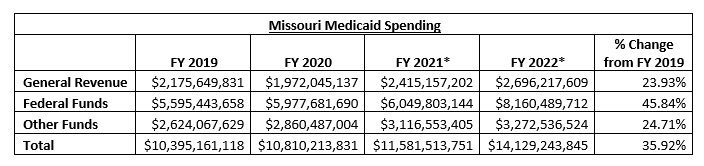
Here is a look at the last four years of Missouri’s Medicaid spending with the governor’s newly released estimates included:

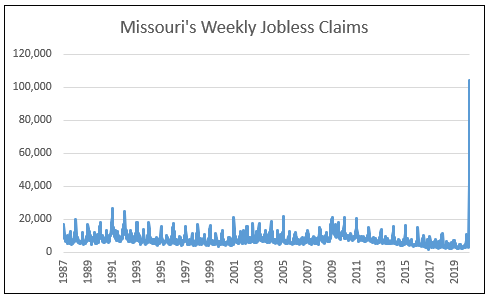
As you can see, the program is expected to be almost 36 percent more expensive than it was just three years ago. If you look at state general revenue (GR) spending (where our state income and sales taxes go), the story isn’t much better. The general revenue cost of the program is estimated to be more than $520 million higher than it was in 2019 (a nearly 24 percent increase), which is far greater than state tax revenues have grown over that same period. See the table below:

This is important because GR spending is what many other state programs such as K–12 education rely on. If the revenue and expenditure estimates for next year are accurate, it will mean that Medicaid consumed all the state’s revenue growth from the last 4 years AND siphoned more than $300 million from other state programs.

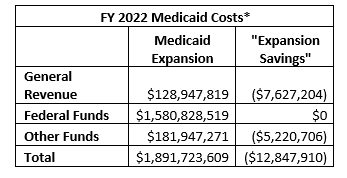
As seen in the table above, revenue is projected to only grow by about $217 million between 2019 and 2022; meanwhile, Medicaid spending is projected to grow by $520 over the same period. The table below shows the additional projected cost of Medicaid expansion, which accounts for a significant portion of the program’s expected cost growth and includes both state and federal spending:

In the first year alone, while expansion enrollment is still ramping up, the policy will cost upwards of $2 billion in total. Before voters approved the initiative, many supporters argued that expansion would be “costless” or “pay for itself,” but these claims never held water. In fact, the savings that we were told would cover the cost of expansion are expected to amount to less than $13 million, which is less than 1 percent of the program’s estimated cost in the first year.

As Missouri’s legislature prepares next year’s budget in the coming months, taking concrete steps to rein in Medicaid spending has never been more important. With the cost of Medicaid expansion looming and the revenue uncertainty of the COVID-19 pandemic ongoing, state taxpayers can no longer afford the price of inaction.

Who’s Driving the Bus on School Openings?

Students and families are nearing the one-year mark of schooling in COVID times. For many, traversing this ever-shifting education landscape has been a fractured and frustrating experience. But finally, with vaccinations ramping up, it seems like there might be a light at the end of the tunnel.

Or maybe not, depending on who you ask. A recent Post-Dispatch story highlighted some who seem skeptical about schools reopening. A superintended in a Texas school district is quoted as saying: “As far as 2021–22, at least some part of that school year is likely still going to be pandemic response-related on the assumption that children won’t have access to the vaccine, or at least many won’t.” The article also quotes Michael Mulgrew, head of the United Federation of Teachers in New York, who says it’s impossible to commit to in-person schooling in the fall because it’s theoretically possible that those who get vaccinated might still spread the virus.

In Fairfax, Virginia teachers jumped to the front of the line to get vaccinated, but the district isn’t reopening in-person schooling even though a large majority of teachers have now been vaccinated—and the union won’t even commit to in-person schooling in the fall. The union also said that schools shouldn’t be reopened until all students have been vaccinated (never mind that no vaccine has been approved for kids under 16 yet).

In Chicago, teachers went on strike in the fall, and then the union issued a laundry list of demands for reopening in December. This list including some untenable items like outlawing simultaneous teaching—where teachers both instruct in-person and remotely—and reducing remote learning screen time. The union then defied an order from Chicago Public Schools to return to classrooms in late January, and narrowly avoided a strike by recently agreeing to a partial reopening of schools.

Similar stories have played out in San Francisco and Baltimore, among many other places. Obviously, everyone wants teachers and other school staff to be safe when returning to schools. But one begins to wonder what’s really happening here when it feels like the goalposts are constantly moving and the pretexts for avoiding reopening are so flimsy. Excessive caution about reopening schools also appears to fly in the face of the available evidence on the subject.

There’s simply very little evidence that schools are significant sources of COVID spread. Based on available data, COVID rates for students and teachers mirror the rates in the surrounding community (this doesn’t even include elementary and middle school students, whose rates are predictably lower than the population at large). The CDC director recently said that schools do not need to wait for all teachers to be vaccinated before safely reopening. The CDC also published its own study in late January, and concluded: “There has been little evidence that schools have contributed meaningfully to increased community transmission.”

Meanwhile, this process is taking an unbearable toll on students. Very few people seem to think remote learning works particularly well; more than a quarter of Missouri parents rated their children’s remote learning experience as a D or F. Remote learning has also left many students and families behind, and has exacerbated existing achievement gaps. We’re still early in the process, but early projections indicate the overall learning loss could be enormous and long-lasting. And it’s not just about learning; research suggests kids are suffering socially and psychologically.

So what does this mean for Missouri? The point isn’t that every school across the state has to fully open tomorrow. Not every district has to have the same plan, as the variables in districts across the state vary dramatically. But we should be listening to what experts have to say and paying attention to the data. And since experts indicate that schools can be reopened safely, it seems that Missouri schools should be planning to do just that as soon as possible. The concerns and needs of parents ought to come before those of special-interest groups.

SMI Podcast: How to Tell America’s Story with Lee Habeeb

Lee Habeeb is CEO and founder of American Private Radio and host of Our American Stories.

Download the Our American Stories podcast on Itunes, Google Play, Spotfiy or wherever you find your podcasts and visit ouramericanstories.com to find an affiliate station near you.

And, Join us on Thursday, March 18 for a special virtual event with Lee Habeeb.

What to Know About Local Fuel Taxes

All drivers are familiar with Missouri’s state fuel tax, which raises money for road maintenance.

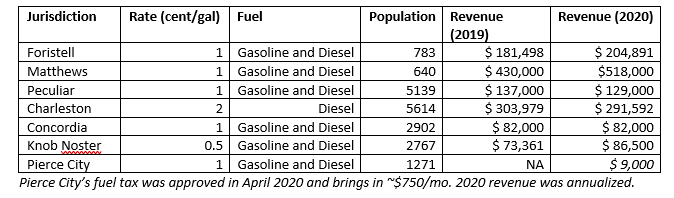
But what many Missourians don’t know (and even many local leaders) is that cities and counties can implement their own fuel taxes to raise money for local roads. Seven cities in Missouri currently use local fuel taxes to supplement what they receive from their distribution of the state fuel tax (cities get about 16 percent of state fuel tax revenue). These taxes raise up to hundreds of thousands of dollars each year and the cost rarely exceeds 1 cent per gallon for drivers.

Here are Missouri’s seven cities with local fuel taxes:

Why should more Missouri localities consider local fuel taxes? The most common method of increasing local road funding is sales taxes levied through transportation development districts. But funding roads through sales taxes is fundamentally unfair—people who use the roads should pay for them. People who drive on roads without paying for their upkeep also have no incentive to reduce their driving, resulting in extra pollution, traffic, and road deterioration.

As my colleague David Stokes and I wrote recently, local fuel taxes do a better job of connecting the act of driving with paying for road upkeep. Buying a gallon of gasoline is more associated with driving—and thus how much damage a car does to the road to necessitate its upkeep—than buying a TV or a loaf of bread. Moreover, the money raised by local fuel taxes is constitutionally required to be spent maintaining local roads.

Local fuel taxes are a secret weapon that cities and counties have for adequately funding their roads. They allow municipalities to raise money for local road maintenance responsibly with little room for playing fast and loose with the money.

The Power of Storytelling: Connecting Policy with People

Join us on Thursday, March 18 for a special virtual event with Lee Habeeb.

Lee Habeeb is CEO and founder of American Private Radio and host of Our American Stories.

Download the Our American Stories podcast on Itunes, Google Play, Spotfiy or wherever you find your podcasts and visit ouramericanstories.com to find an affiliate station near you.

Register Here 

About the Speaker

Lee Habeeb got his start in radio co-creating The Laura Ingraham Show, which launched in 2001. By 2007, it was the #1 show in America in its time slot. He moved to Salem Media Group, where he serves as VP of Content, overseeing shows hosted by some of conservativism’s greats: Bill Bennett, Dennis Prager, Hugh Hewitt, Larry Elder, and Eric Metaxas. Habeeb also writes a weekly column at Newsweek. A University of Virginia Law School graduate, he lives in Oxford, MS with his wife Valerie and daughter Reagan.
We’re Already Seeing the Effects of Delivery Fee Regulation

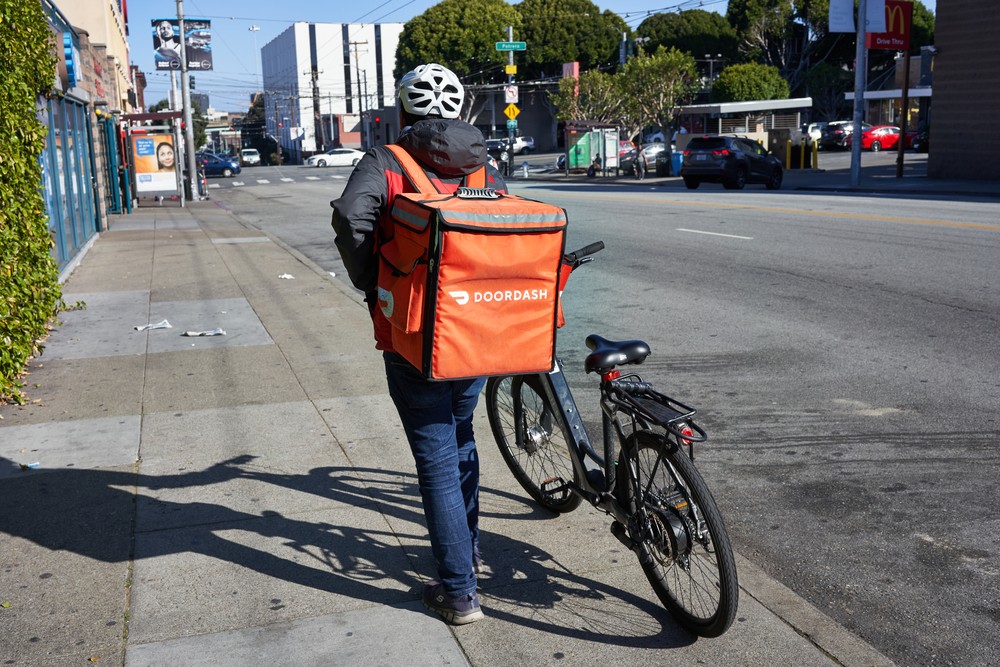
Months ago, I wrote about the new St. Louis City cap on delivery fees that food delivery services can charge restaurants in the city. I pointed out the clear government overreach and interference in the market and how “this bill could ultimately hurt consumers, delivery drivers, and restaurants in St. Louis City.”

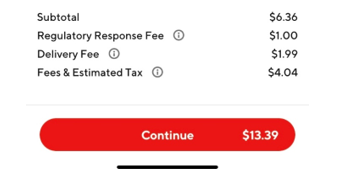
Well, the cap was enacted and consumers can already see the difference it’s making. I was considering an order on DoorDash and I noticed a new fee included during checkout. As shown below, I saw a “Regulatory Response Fee” included with the other taxes and fees.

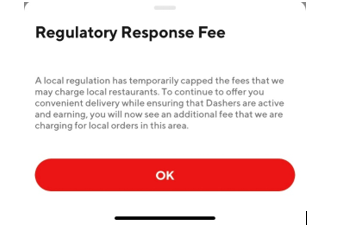
When I clicked on the symbol for more information, the below image appeared:

And there it is. The new fee on customers in St. Louis City is a direct response to the regulatory cap that the St. Louis Board of Aldermen passed.

I don’t revel in this “I told you so” moment. Lawmakers thought they were protecting small businesses, but instead they are hurting consumers by increasing the prices of delivery services. If consumers respond to this by using delivery services less, the small businesses this move was designed to protect will be the ones that end up getting hurt.

Previous fees were mutually agreed upon in the market and neither party was forced to partner with the other. Consumers may have paid a portion of the higher fees before the cap, but they are certainly paying this fee now. This $1 fee may not be budget-breaking, but consumers are only subject to it because lawmakers interfered. Lawmakers should let the market work to avoid unintended though predictable consequences.

SMI Podcast: The GameStop Revolution

On this episode of the podcast, Howard Wall joins Susan Pendergrass. Dr. Wall directs the Hammond Institute for Free Enterprise and is a Senior Research Fellow in the Center for Economics and the Environment. He is also a Professor of Economics in Plaster School of Business & Entrepreneurship at Lindenwood University and a research fellow at the Show-Me Institute.

They discuss the recent GameStop stock controversy, the idea of a $15 federal minimum wage and more.

CID Dies

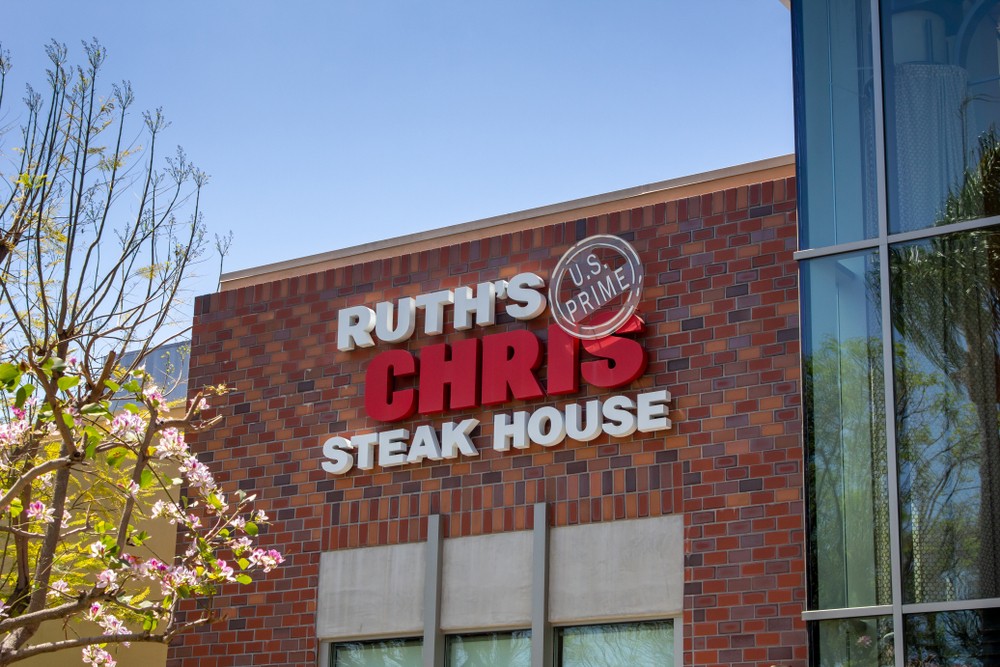
I don’t know what the City of Chesterfield is thinking by rejecting the recent community improvement district (CID) proposal for the Wildhorse Village Development. Look, people, when Ruth’s Chris Steak House can’t get a tax subsidy, something is deeply wrong with America. Without a tax subsidy, the steak there might get expensive . . .

Joking aside, the developer of Wildhorse Village (which includes Ruth’s Chris) is seriously angry that he did not get his tax subsidy from the Chesterfield City Council. That is how bad Missouri has become with the constant corporate welfare giveaways. The developer is actually mad that elected officials did not give him other people’s tax dollars to help him make more money from his development. He assumed (and past history in our area justifies his assumption, unfortunately) that those tax dollars were his for the taking. All he had to do was fill out some forms, make the required official statements, and Chesterfield would give him his tax subsidy.

But a funny thing happened on the way to the finance meeting. The city council finance subcommittee voted the subsidy down. Four votes against, zero in favor. As one councilmember said:

We don’t need to subsidize developers to come into Chesterfield and build. It’s some of the most desirable real estate with the best demographics in the area. We don’t need to bribe people to come in.

He is completely right about this. The same thing can be said about many other parts of the state where tax incentives and subsidies are ubiquitous. In the Central West End of St. Louis, for example, the tax incentives are so unnecessary that they are simply capitalized into a higher price for the property since it is just a given that the new owner will get tax subsidies. More money for the entity that makes the sale, less money for public services, all caused by an unnecessary government market distortion in the first place (the final part is the key point here).

There are very few cities in Missouri that typically take a hard look a tax subsidy requests. Most say yes to the proposals faster than a contestant on The Bachelorette. There are rumors the developers will come back and request money again—hopefully Chesterfield sticks to its gun here. If Chesterfield were to take the lead in turning down at least some of these requests, that would be a big step forward for municipal policy in Missouri.

Support Us

The work of the Show-Me Institute would not be possible without the generous support of people who are inspired by the vision of liberty and free enterprise. We hope you will join our efforts and become a Show-Me Institute sponsor.

Donate
Man on Horse Charging