As Missouri’s legislative session winds down, lawmakers took a major step toward eliminating the state’s individual income tax. Both chambers of the general assembly approved HJRs 173 and 174, a proposed constitutional amendment. Voters will now decide whether to authorize the legislature to begin the process of phasing out the income tax.
Here’s a short summary of what voter approval of the amendment would set in motion:
Requires the general assembly to enact legislation reducing the state’s top individual income tax rate based on revenue growth until it is eliminated. Once eliminated, the tax could not be reinstated.
Authorizes the general assembly to expand the sales and use tax base to include additional goods and services. Currently, Missouri’s constitution doesn’t allow sales and use taxes to be expanded to any service or transaction that wasn’t taxed on Jan. 1, 2015.
Requires that any changes to state or local sales and use taxes that generate additional revenue be offset. At the state level, that revenue must be used to reduce the individual income tax rate. At the local level, governments receiving additional revenue must reduce one or more other local taxes by a commensurate amount, choosing from a specified list that includes earnings taxes, personal property taxes, real property taxes, or local sales and use taxes.
This move comes at a time when Missouri is struggling to keep pace nationally. As my colleagues and I have written about repeatedly, the state’s population growth has been flat, and economic growth ranks in the bottom half of the nation. And while Missouri has reduced its top income tax rate from 6 percent to 4.7 percent over the past decade, many neighboring states have moved faster. Across the country, states are enacting policies that make them more attractive in the competition for families, workers, and investment, and it’s clear that states with low or no income taxes are pulling ahead.
If Missouri wants to change that trajectory, its tax structure has to be part of the conversation.
As I wrote when I testified on the amendment, this proposal does not eliminate the income tax overnight or answer every question up front. What it would do is give the legislature clear authority to move in that direction if voters approve. That matters because any serious effort to phase out the income tax will, sooner rather than later, require a rethinking of the state’s tax structure, especially its outdated and broken sales tax system.
In that sense, the amendment is less about a single policy change and more about forcing decisions state officials have avoided for years. What is a fiscally responsible pace to phase out Missouri’s individual income tax, the state’s single largest source of revenue? How much faster could that process move if the state modernizes its sales tax base? How should the tax policy actions of surrounding states impact that timeline?
There will undoubtedly be difficult tradeoffs if voters approve the proposed amendment, but it’s important to recognize that they are unavoidable. Improving Missouri’s economic prospects will require decisive action and an acknowledgement that maintaining the status quo has produced slow growth and will leave the state further behind its peers.
There are real concerns about how a transition like this would work and who it would affect. Those details will matter, and they will be decided through the legislative process if voters approve the amendment.
With the legislature’s work complete, the remaining question is when voters will weigh in. Under Missouri law, the governor has until May 22 to determine whether the measure will appear on the August or November ballot. The timing of that vote will shape how quickly Missouri can begin addressing these questions and close the gap with states that are already ahead.
There are two bills under consideration in Jefferson City—House Bill 2872 and Senate Bill 1442—that would help address the reading crisis in Missouri. The foundation of both bills is a mandatory, third-grade retention policy based on a reading test. Similar policies have helped students become confident, capable readers in other states.
However, opponents have pushed back, arguing that third-grade retention has not been shown to improve long-term outcomes, particularly in eighth grade and beyond.
The commonly cited example is Mississippi. Since committing to early literacy reform in 2013, the state has seen strong gains on the National Assessment of Educational Progress (NAEP), rising from 49th to 9th in state rankings based on fourth-grade reading. This is frequently contrasted to its more modest improvement in eighth-grade reading over the same period, from 50th to 41st.
While it is important to worry about later-grade outcomes, it is also important to recognize Missouri is facing a dire challenge in basic, early-grade literacy skills. On the 2024 NAEP, 42 percent of Missouri fourth graders scored “below basic” in reading—the lowest possible level. This placed the state 38th in the nation in reading proficiency, far below its ranking of 14th in 2003.
Serious action is needed, and the policy reforms in HB 2872 and SB 1442 have a proven track record across the country. A study from Michigan State University found that states with policies mandating third-grade retention are associated with significant and persistent increases in high-stakes reading scores (such as the MAP for Missouri). The researchers further noted that there is no evidence that reading scores increase in states without a retention component.
Of course, third-grade retention is not an end-all-be-all. But if a student cannot read by the end of third grade, catching up becomes far more difficult as instruction shifts toward comprehension. This policy gives students a better chance to succeed in the long run.
Many states, including Mississippi, have seen large gains in fourth-grade reading with early literacy reform, but smaller gains in eighth grade. Gains in eighth grade still tend to be positive, but the fact that they are smaller highlights a need for continued reform in higher grades as well.
A recent report from Reading Reimagined, a national research initiative, highlights that students need to continue learning to decode, even after third grade. Decoding focuses on connecting letters and letter patterns to spoken sounds, what many think of as learning to read.
Early foundational skills hinge on fluently decoding one- and two-syllable words. But words get more complex in higher grades, and older students need to learn to decode them, too. One example of a skill that supports this is morphology, which uses word parts to infer meaning. For instance, the word “education” is broken up into two parts: “educ” from the Latin root educare (to train, nurture, mold) and “-ation,” which is a suffix meaning “the act of.” Understanding these parts helps students both pronounce complex words and infer their meanings.
Older readers need an expanded set of tools to handle increasingly difficult texts. If students are not equipped to read more complex words fluently (and without great effort), they will struggle to comprehend what they read as more brain power will go to decoding the words themselves. In fact, the same report found that students’ reading comprehension stalls when they cannot decode effectively.
House Bill 2872 and Senate Bill 1442 focus on basic literacy skills in the early grades, which are the foundation of a student’s reading journey. While reading reform in Missouri should not stop there, these bills are a great place to start.
I am fascinated with driverless cars, and have been writing about them since 2013. And now, House Bill (HB) 2069 seeks to bring Missouri in line with states that have set up a legal and regulatory infrastructure for their use.
This is a good thing. My colleague David Stoked submitted testimony in favor of the effort in January and again in early April.
HB 2069 sets up a statewide framework, largely by adopting industry definitions from the Society of Automotive Engineers and clarifying how existing traffic laws apply. For example, it treats an automated driving system as the legal “driver,” while requiring operators to meet standards regarding certification, safety, and financial responsibility.
The legislation also sets baseline operational rules, including how law enforcement deals with car accidents and registration requirements. Importantly, it also sets up how driverless cars can be employed as taxi cabs.
One point of contention is that the bill pre-empts local governments from imposing their own additional restrictions or taxes. But recent history on ride-sharing tells us that Kansas City and St. Louis would likely bow to local pressure groups whose revenue might be challenged by the new technology. And Missouri’s preemption language is consistent with the approach taken in states including Florida, Texas, Nebraska, and Utah, which likewise centralize authority at the state level and prohibit local governments from imposing their own additional regulations.
The benefits of driverless technology in Missouri—and especially our cities—are immense. It will impact not only private owners, but could revolutionize how we provide public transportation, making it much cheaper and more convenient to users.
It may also finally encourage us to abandon our inflexible, expensive, and inefficient light rail and streetcar systems. As I wrote years ago, “the rail system that is being built likely will be abandoned by the hip urbanite core that it is meant to attract as soon as something sexier comes along . . . like a Google car.”
Driverless cars are the future of transit; Missouri needs to get in.
Earlier this month, the United States Department of Education proposed a regulatory framework to hold postsecondary educational institutions accountable for their students’ labor market and earnings outcomes.
Under the proposed rule, students risk losing eligibility for federal loans and, in some cases, Pell Grants, if they are enrolled in undergraduate programs whose graduates’ earnings fail to exceed those of a typical high school graduate. Graduate programs face similar consequences should their graduates earn less than the average bachelor’s degree holder. Though the benchmarks are modest, in the sense that most college programs will meet these criteria, some will not. And the consequences for college programs are severe, as most universities rely heavily on federally subsidized tuition dollars.
For-profit colleges already have a related form of accountability in place: the 90–10 rule requires them to derive at least 10% of their revenue from non-federal sources. This proposed legislation marks the first major step to holding public colleges accountable in a similar way. It remains to be seen whether this rule will become law, and if so, how it will shape institutional outcomes. But this new regulation could create better accountability for the use of taxpayer dollars in higher education.
Susan Pendergrass speaks with Aaron Renn, author and consultant, and David Stokes, Director of Municipal Policy at the Show-Me Institute, about the recurring debate over whether the city of St. Louis should rejoin St. Louis County. They explore what city county mergers have actually accomplished in places like Indianapolis, Louisville, Nashville, and Lexington, why a full merger in St. Louis would be extraordinarily difficult to pull off, and whether the benefits would even outweigh the costs. They also discuss St. Louis’s demographic challenges, what the Pittsburgh model might offer as a path forward, the cultural barriers that make it hard to attract and retain people from outside the region, and more.
Susan Pendergrass (00:05): Welcome back, Aaron Renn, to the podcast. So happy to have you and David Stokes, our own expert on cities and counties and all things municipal. I appreciate you coming on, Aaron. There have been murmurings around St. Louis again on a topic that we have revisited for probably a hundred years: should the city of St. Louis be a separate county from St. Louis County?
Before we get to that, I want to ask you something because I was reading the news this morning, and I know that you’ve written about city county mergers before, like cities that are kind of dying and then either pulling in parts of their closest suburbs to sort of make everything look better, broaden their tax base, make their crime numbers look better. I was reading something you wrote a year or two ago about that, and you said that Louisville is a failed example of that. Is that right, basically?
Aaron Renn (01:01): Yeah, I’m a little skeptical of how these things have worked out in practice.
Susan Pendergrass (01:05): Yeah, in terms of losing the flavor and the coolness of the city. Literally this morning I saw an article about how Louisville is having a renaissance and these young professionals are all moving there because they didn’t tear down all their beautiful old Victorian homes, so you can still get one for close to a million dollars. They’ve got a cool art scene and a bourbon scene. So it sounds like maybe Louisville did not lose its personal flavor in the merger. I would be curious to know what you think of that.
Aaron Renn (01:33): Well, I like to put St. Louis in context. I’m glad you mentioned Louisville because many of these river cities have similar characteristics. I like to look at St. Louis as well as three cities in the Ohio Valley: Louisville, Cincinnati, and Pittsburgh. All of them heavily German Catholic in their demographics. All of them are very geopolitically fragmented with many small tiny suburbs throughout. They all have very fragmented neighborhood systems as well, where everybody has a strong sense of neighborhood identity. Where you go to high school is a big social marker. They all have phenomenal collections of urban assets and great historic buildings. They all still have their own unique character in a country where that has sort of bled away.
Aaron Renn (02:31): And they also have curiously underperformed demographically and economically in terms of growth. They’re slow growth places. So one thing I always encourage people is to pan back the lens and don’t just look at St. Louis in isolation. Look at it in comparison or dialogue with some of these other places and see what you can learn from them.
Louisville is actually a quite troubled city in important ways. From a white collar employment perspective it’s doing well, from a blue collar perspective less so. It’s one of the 10 least educated major metros in the country. I don’t want to spend too much time on Louisville, but I want to talk about the city county merger, which is distinct from recombining the city and the county. This has been considered urban planning best practice for 30 or 40 years. There was a book written by David Rusk called Cities Without Suburbs. The idea is that cities that were able to expand their boundaries through either annexation or city county mergers were prospering, whilst cities that did not, like the Clevelands, the Cincinnatis, and the St. Louises, were struggling. So the idea is we need big box government.
Indianapolis, where I live now, had a city county merger in 1970. Louisville did a city county merger, I grew up near Louisville. Jacksonville, Florida, Lexington, Kentucky, and Nashville, Tennessee did as well. What I would say is a few things. Merger is not necessarily bad. For Indianapolis, merger did prevent the city from essentially going down the tubes in important ways. So it really was a win in important ways.
But it did not prevent the historic city from going into the exact same demographic decline as St. Louis. The historic city of Indianapolis has lost almost exactly the same share of its population since 1970 as St. Louis has. Secondly, these are very politically difficult to pull off. They take enormous effort. They often fail multiple times. Louisville had multiple failures.
The most precious resource is always management time and attention. Is this where you want to put all your political chips? And in order to get it passed politically, what happens invariably is that most entities are actually not consolidated. In Louisville, none of the existing incorporated suburban governments were in fact merged. In Indianapolis, the school districts weren’t merged.
This means you don’t necessarily get all of the benefits you think from consolidation, because many things are excluded. And then unlike a corporate merger, where there’s typically a lot of downsizing and cost rationalization, in city county mergers nobody ever loses their job and salaries and benefits might even be harmonized upward to the high watermark. So don’t expect it to save any money. Personally, city county merger might have some benefits for St. Louis. I’m not saying it would have no benefits, but in my opinion it’s not going to be a needle mover and most likely it would be extraordinarily politically difficult and uncertain to pull off.
Susan Pendergrass (06:00): Yeah, no question. It’s been very politically difficult. People don’t want to do it. However, we do have these little tiny school districts and police districts. We have, I don’t know, 28 911 systems. We have a lot of what looks like bureaucratic waste and red tape. To the extent that doesn’t get resolved in a merger, then what’s the point? But I do think, you know, we’ve been talking about the demographics of St. Louis. There were over 800,000 people in the city once. Now there are maybe 280,000 and declining, and we’re in the death spiral of more people dying than being born. We’ve been in that for a while. And I guess it brings up the question of what is St. Louis to do if we are in this death spiral? We’re not having the babies. We’re having fewer babies than we did 15 years ago. So school enrollment is only declining. What is the prescription in that situation?
I’ve been to Cincinnati quite a bit. They’re trying to get people downtown with sports stadiums. It doesn’t really work. Louisville has sports stadiums downtown. I don’t know if people really want to move down there. I don’t see it working in St. Louis. So what is a city in that situation to do?
Aaron Renn (07:18): It’s going to be challenging in a sense because your problems are a little over determined. St. Louis was once a regional capital city, much like a Dallas or an Atlanta or a Denver or a Minneapolis. And it lost a lot of those functions. Many of its headquarters have left. It used to have a lot of professional services firms like ad agencies that did business all over the country, not just for the local market. Now St. Louis, although it’s still bigger than Indianapolis, looks a lot more like an Indianapolis or a Columbus, Ohio, where you have fewer corporate headquarters and most of the service firms are just there to serve the local market. St. Louis has essentially shrunk a little bit in relative importance, and it’s hard to get that back.
The demographics are also quite difficult and create a situation where it’s hard to attract business when you have a shrinking labor force, weak demographic growth, and a weak ability to bring people in from the outside. So it’s a very complicated situation and I don’t think there’s any silver bullet for St. Louis.
Susan Pendergrass (08:39): That’s what I’m asking you for. You have the answers. What’s the silver bullet?
Aaron Renn (08:43): So here are the things I would look at if I were in St. Louis. One of the clear issues that affects all of these river cities is that their wonderful, unique local cultures come with a downside, which is an extreme parochialism that has two negative effects. One, it makes it difficult for the communities to cohesively work together, which I’m not telling you anything you don’t already know. City-suburb divides tend to be bigger. In Indianapolis, regional leadership is mostly all on the same page about the big issues. Same with Columbus, Ohio. Secondly, it makes it very difficult to attract people from out of town because they come there and they can’t make friends, they can’t penetrate the social networks.
Susan Pendergrass (09:15): 100%, yes.
Aaron Renn (09:40): You hear it over and over again in places like St. Louis, Cleveland, even Minneapolis, Minnesota. There are some sayings there. If you want to make friends in Minnesota, go to kindergarten, because that’s when everybody makes their friends. Or Minnesotans will give you directions anywhere but their house. They’re never going to invite you over. St. Louis has that reputation. I don’t think it’s just a reputation. And I know you just had Ness Sandoval on.
Susan Pendergrass (09:53): Yeah.
Aaron Renn (10:08): He’s talking about you need to get better on migration. Migration isn’t going to improve if migrants are not going to be able to join the social networks here. And that’s not even just international migration, that’s domestic migrants. So I think that’s a huge issue for the city. Cultural issues are hard to solve, but maybe less intractable than infrastructure.
The other thing is looking at Pittsburgh as a sort of model. Pittsburgh hasn’t solved really most of its problems by any means, but it has been able to regenerate in the city a sort of high value economy around Carnegie Mellon and the University of Pittsburgh Medical Center. It’s done quite well. Many Silicon Valley firms have set up shop there. What’s happened in Pittsburgh, although it’s still a demographic decline story, is there’s been a demographic transition in the city. Pittsburgh went from one of the least educated cities in America to now one of the youngest and most educated. Part of it is old people moved and died off and young educated people replaced them. So the total number of people in the city was declining, but there was a churn happening underneath. And the same thing is already happening in St. Louis.
Susan Pendergrass (11:13): How did they do that?
Aaron Renn (11:33): College degree attainment in the city is now well north of 40%. So the people who live in the city of St. Louis are very educated. That demographic churn has raised educational attainment and thus incomes in the city a lot. Now Pittsburgh was different because it was an almost entirely white city. There’s a racial divide in St. Louis and gentrification concerns become more salient. But St. Louis is now an educated city. This is not an old post-industrial blue collar city. The city of St. Louis itself is very educated. And also being very small, it doesn’t necessarily need a massive change to move the needle. In Indianapolis we have a population of over 900,000. Moving that behemoth takes a lot. St. Louis now being smaller has a situation where there could be a big impact from lower numbers of things. So I think a knowledge economy built around Washington University and your medical centers has some possibilities, somewhat similar to Pittsburgh.
Susan Pendergrass (12:45): So much medical.
Aaron Renn (12:58): Carnegie Mellon’s engineering and computer science areas will be a little different. I might also look at Vanderbilt, what’s going on there? What are some peer schools you could watch to see what’s going on? But I think there are actually some reasons to think that the city of St. Louis, believe it or not, could be sort of turning a corner. It has now demographically renewed itself to a higher educational attainment state. Being small, it probably doesn’t have that much further to fall, and you can start building from there. Obviously there are governance challenges, but looking at the Pittsburgh model, studying similar complexes around peer schools, and addressing the culture issues is where I’d look.
David Stokes (13:33): Hopeful.
Susan Pendergrass (13:47): So as a spokesperson for St. Louis, what do you see for the future?
David Stokes (13:52): Well, I would be curious to get Aaron’s thoughts on that size question, about how the city of St. Louis has in fact gotten so small. It’s about 10% of the metro area. How does that affect the pros or cons of any type of a merger? These would not be a merger of equals. St. Louis County would almost subsume St. Louis City into it. How do you think that would affect things for better or worse?
Aaron Renn (14:28): Well, that was the critique of the Louisville merger by two academics at the University of Louisville. I mentioned the book Cities Without Suburbs. They wrote an academic paper called Suburbs Without a City, which basically said if the merger passed in Louisville, it would essentially mean the suburbs take over the city, not the city taking over the suburbs, because the old city of Louisville only had about 260,000 people and the suburbs would numerically dominate. The same thing would certainly happen in St. Louis. If there were a merger, suburban St. Louis County would control the city in essence.
Another consideration, and this is a Cincinnati issue, I interviewed about 15 years ago the mayor of Cincinnati, John Cranley. Here’s what he said, and I think this is an important point. He said, 30 years ago, city county merger was the thing because cities were in decline and you wanted to tap that suburban tax base to fund the city. But now it’s reversed. Now the cities are coming back and it’s the inner suburbs that are actually going down the tubes. And so in Cincinnati today, we have all the corporate headquarters, we have the universities and the medical centers, and we don’t have to share our tax revenue with anybody. If we were merged with the county government, we’d have to prop up all these failing suburbs. And so I think you’re in a similar situation in St. Louis, where the high value activity, not all of it is in the city of St. Louis because of Clayton and so on, but the St. Louis County suburbs are mostly places that are themselves on negative trajectories. Merging the city, which may be on the cusp of being able to bottom out and turn around, with all of these still declining inner suburban areas, might actually be an albatross around the city’s neck.
Susan Pendergrass (15:16): What would that mean?
David Stokes (16:37): I just think one of the differences between St. Louis and Cincinnati, and I don’t know the property tax base of Cincinnati, is that so much of the city of St. Louis is tax exempt right now. Between Washington University, Saint Louis University, and all the government entities, there’s just so much of it. I say that as somebody who supports property tax changes to make them pay something towards it. But I just don’t think the Cincinnati argument applies to the city of St. Louis right now. That property tax exemption part is a huge factor because the most growing, thriving part of it is the entire giant Barnes-WashU-Cortex complex, and the amount of property taxes they pay is miniscule.
Susan Pendergrass (16:38): Hmm.
Aaron Renn (17:26): Well, some of that is a planning issue. And I think the reality is, when you have a complex like that, are all these people going to move to St. Charles? Maybe not. I’ll tell you, I live in the suburb of Indianapolis named Carmel, and a lot of the hospitals and things have been opening facilities here. When these nonprofit hospitals come up here, we will not approve zoning changes for those hospitals unless they agree to make payments in lieu of taxes. You want to come up here and you want a zoning change, you’re going to have to pay. We were actually quite prescient in that one of the local hospital chains opened a for-profit hospital. As part of the approval deal, we said, if you ever convert to nonprofit status, you will continue paying property taxes. And we did that.
So I think there probably is leverage from the city over some of these entities. You don’t have a lot of leverage over a corporation deciding where to put their office, but that’s not a tax exempt situation. The stuff at Cortex is probably not going to leave if you make them pay a little money the next time they come to you for a zoning approval. I think you need to start looking at how to get more money out of these entities that are nonprofits in name only. These universities and hospitals are effectively gigantic hedge funds. Their executives are extremely well compensated and billions of dollars are flowing through there. Undoubtedly the better solution there is to figure out how to tax them rather than figure out how to tax the soon-to-be-dead mall in the suburb over the border.
David Stokes (19:24): Well, yeah, and that’s sort of the trade off, unfortunately, is that they do pay earnings tax. The employees, many of them very highly compensated, pay the earnings tax. And that’s what makes the city more dependent on local income taxes, not less, because they’re either tax exempt or in the case of Cortex, have tax abatements that make them essentially tax exempt.
Susan Pendergrass (19:25): We do have earnings taxes, right? So the folks who work there have to pay an earnings tax.
Aaron Renn (19:53): Yeah. Again, I don’t know exactly the fiscal architecture there. But I would say you don’t want to do a merger simply to do a tax dollar grab. The lesson of Indianapolis is we did that. We grabbed suburban tax dollars and we used it to rebuild our downtown successfully. But here we are 50 years later, and now we have enormous tracts of decayed suburbia that are an enormous problem. Our entire core county is now in a sense the inner city. We have big challenges because we were not able to invest in ways that allow those suburban areas to retain their allure over the long term.
And I’m not saying that’s impossible, but any short term juice you get, cities always rise and fall. Core cities have proven more resilient and more able to regenerate themselves than suburbs. Part of it is because state governments cannot afford to let their state’s largest city or major urban center go down the tubes.
Susan Pendergrass (21:06): Yeah.
Aaron Renn (21:16): Missouri cannot let St. Louis and Kansas City implode. Michigan cannot just write off Detroit and say who cares. But these suburban areas have proven a lot tougher to save. We don’t have a good model. We’ve spent decades thinking about how to rebuild cities and build districts. There are certain things you can pull off in a city around conventions, civic events, gathering spaces, museums, and government that are very hard to translate to suburban settings. So there’s not a great playbook, especially in declining markets, for renewing suburbs. The playbook for suburban renewal, if you want to call it that, is places like Carmel, Indiana, which are growing and affluent, and therefore can build large mixed use centers, new urbanist developments, trails, and parks. The suburbs of St. Louis County are probably tremendously deficient in infrastructure as we would understand it today.
So again, there may actually be some benefits in having St. Louis City rejoin the county in a sense, because then the county functions are spread and amortized across a larger population.
Susan Pendergrass (22:45): It would immediately improve our murder rate because we would be mixing it in.
Aaron Renn (22:48): Yeah, there is some of that. The murder rate is an artifact of the size of the city more than anything. There are places in Chicago with higher murder rates. A former colleague of mine at the Manhattan Institute, Rafael Mangual, did an analysis of Chicago. He said there are areas on the South Side of Chicago that are larger and have more people than St. Louis with far higher murder rates than St. Louis.
Susan Pendergrass (22:56): We get called out because of the small denominator.
Aaron Renn (23:17): And so there is that. The other thing is Chicago is a good example. New York City was essentially a city county merger. In 1898, the five counties that are the five boroughs of New York were consolidated into one city. Philadelphia was also a city county consolidation from the 19th century. But what happens when you create a very large city of say a million people or more is you really have to scale up your government. You have to have a government that operates at that scale.
What happened with Indianapolis was we merged city and county government, but we didn’t really have a government that could effectively manage this new larger territory. It never built out the infrastructure in the suburbs. In New York, the Bronx has subways, great parks, everything built out with proper infrastructure, because it was part of New York and New York had to expand governance to become a city of eight million. Chicago got big in the 19th century and built a city government that could run a city of three million people. And some of the stuff that gets critiqued there, for example, is a lot of city services were organized by ward or city council district. There are 50 city council districts and every city councilor is sort of a little mini mayor of their district. The alderman essentially has veto power over any zoning changes. It’s called aldermanic privilege. So there are a lot of constraints there.
But if it’s just one mayor and one city council trying to think about a huge city of 77 neighborhoods and three million people, they can’t keep that much in their head. All they can think about is downtown. And that’s what happened in Indianapolis. The mayor and city council can really only think about downtown. We should have built out structures in townships throughout the city so that you had leadership focused on that area and money focused on that area. That’s what made the suburbs work really well. A suburb like Carmel is basically township sized. We have 100,000 people, big enough to do things, but not so big that our mayor and council can’t keep the whole city in their head and plan and manage the whole city.
So if you merge with the county government, you’re going to have to create an entirely new government structure that allows you to essentially manage every sub area of the whole thing and bring it all up to a standard of services. That’s the other thing they often did in Louisville and Nashville. They merge, but they have a two tier service system where there’s an urban services district for the old city which gets more services, and then the others get less. They didn’t do that in New York. There’s one standard of service in New York, one in Philadelphia, one in Chicago. So if you can’t commit to a single standard of service, you’re basically creating a bogus merger in my opinion. If you’re going to do a merger, you need to obliterate every government and entity in St. Louis County and city, merge them all into one with one standard. That’s not going to happen.
Susan Pendergrass (26:35): That’s not going to happen. What do you think, David?
David Stokes (26:37): Yeah, that’s not going to happen.
Aaron Renn (26:43): So you end up with a lot of problems. Louisville didn’t merge any fire departments. Imagine a city that doesn’t have a consolidated fire department. Imagine a city without a single police department. That was actually Indianapolis. When we merged, the Indianapolis Police Department still patrolled the old city, but the new parts of the city that were consolidated in from the county were still controlled by the sheriff.
Susan Pendergrass (27:13): That is 100% what would happen in St. Louis. Everyone would retain their school system and their police department and their fire department. I lived for a long time in Fairfax County, Virginia, which is a single county government. It’s massive, 150,000 students in their school system. It seems to function with a single police department and fire department. But I don’t think you can backwards engineer that into a place that for hundreds of years has been operating as it has been operating.
Aaron Renn (27:43): Lexington, Kentucky worked pretty well because one, the schools were already consolidated, as in the South it’s typically county school districts. Secondly, there were no other government entities, no township governments, no other incorporated municipalities. So it merged everything. And they were sort of able to solve the urban services district issue because the outer areas of Fayette County were horse farms. They actually put in a kind of green belt rule, you can’t develop out there, because they wanted to protect these scenic landscapes. So there was actually a good reason to treat that differently, because it was a very unique American landscape. Lexington, I think, was pretty successful.
Susan Pendergrass (28:15): They are. I appreciate it when I drive across Route 64.
Aaron Renn (28:39): Lexington was pretty successful and wasn’t especially controversial when they did it, in part because there weren’t all these entrenched interests like there are in other places. If you look at places that did the mergers, they weren’t the Cincinnatis and Pittsburghs. They’ve been talking about consolidation in Pittsburgh forever. It was very hard. And Louisville did it, but it was one of the least consolidated so-called consolidated governments. What the Louisville merger functionally did was dissolve the city of Louisville and reorganize county government. The county government now has a mayor and a council instead of the old fiscal court with the judge executive and all that.
Susan Pendergrass (29:21): That’s kind of what would happen in St. Louis, right?
Aaron Renn (29:36): That’s essentially what they did. They basically dissolved the city and the county government was reorganized, but nothing was merged.
Susan Pendergrass (29:43): Did you have a question?
David Stokes (29:45): I want to get back to the fire district point. We’re talking about why this would be so hard. There’s actually a law in St. Louis that only applies in St. Louis County that makes it impossible to consolidate fire districts. Even if a modest mid-sized suburb annexes an unincorporated part of town, they’re not allowed to provide fire services to that new annexed area, or they can, but they have to pay so much to the old unincorporated fire district that it makes it impossible to do so. That’s just one example of how even if you wanted a full scale merger, it would just be impossible to actually carry through.
Susan Pendergrass (30:34): Why do you think people float this idea, David? Why does it come back every couple of years?
David Stokes (30:38): You know, it’s the old line. I remember a study I read about Pittsburgh and St. Louis many years ago. The question was, are the St. Louis and Pittsburgh areas really inefficient with all the fragmented government? And the conclusion was, well, you would never design a metro area like this, but they’ve both made it work over the last century better than you would think. The conclusion was that St. Louis and Pittsburgh aren’t actually as inefficient as you might assume when you run the numbers.
I think people have trouble accepting that. People look at so many small municipalities, many of them dysfunctional, many of them until recent times funded themselves primarily with traffic tickets, which is a terrible way to fund local government, and that’s not even an exaggeration. And there’s just this fundamental belief that if you can just plan it better you’ll create a better place. I just think it fails.
One of the reasons it would fail, going back to what Aaron led this conversation off with, is that if St. Louis County and St. Louis City joined together, they’re not actually going to lay any government employees off to save any money. St. Louis City government is not going to fire city employees. It’s never going to happen. So you’re not going to save any money and it’s all just going to collapse.
Aaron Renn (32:12): Yeah, New York City and large governments are not more efficient.
I look at it and say, look, I think merger is a solution for failed states, if you want to call them that, in the St. Louis suburbs. Take some micro-suburb that’s a complete scam or is bankrupt and merge it in with its neighbor. Do some consolidation like that, that probably needs to be led by state government, almost like a receivership sort of thing. That’s just kind of good government as you work through it. But I just don’t think the benefits you would gain from trying to do a complete governmental merger of St. Louis City with St. Louis County would outweigh the opportunity cost of how much time and effort you spend on it, when you could be spending that on other things that I think will actually move the needle more.
The downsides are arguably as high as the upsides. There’s no guarantee it’s even net positive in this environment. The time to have merged was when Indianapolis did it in 1970, not in 2026. Nashville did it in the 60s. Jacksonville did it a long time ago.
And then I think it doesn’t fix the fundamental issues around the culture. You’ve got to take a hard look at that and say, it’s maybe very difficult to change. The idea that people who aren’t from here have to be able to move here and get connected and feel like they belong in the city. There’s a couple we know who lived in St. Louis. The wife taught in St. Louis public schools. They’re big urban people. The husband was from St. Louis, and they moved here to Carmel, Indiana.
Susan Pendergrass (33:47): Tell me more about that.
Aaron Renn (34:10): Basically they said, man, people are just so much friendlier here. They make better eye contact, they engage more. It’s just so much more welcoming than it was in St. Louis, even though they were actually in a sense connected because the husband was from there.
So when even people who lived in St. Louis and liked it notice a difference when they leave, that is a killer when you’re already struggling demographically. I had a guy who owned a business in Cleveland who said to me one time, I learned the hard way never to recruit anyone from out of town to work for my company unless that person or their spouse is from Cleveland, because otherwise they will never stay. When that’s where you are as a place, that is just rough. I think that is one of the killers for these river cities.
Susan Pendergrass (35:16): Yeah, what’s the fix for that? I don’t know what the fix is.
Aaron Renn (35:38): I think the optimistic case for St. Louis, and I actually tweeted this a year or two ago, is that St. Louis City educational attainment is really high now. In a sense, it’s a small, highly educated city that is probably going to continue growing more educated. So I think the Pittsburgh option looks viable in St. Louis.
Susan Pendergrass (36:00): And certainly great medical care. I know that the average age is getting older in St. Louis. I think within 10 years, one in four people will be over the age of 65. But we also have an Alzheimer’s research center and access to medical care, which as you get older gets more important. I do think there’s an opportunity to lean in to the medical services that are available, as the country as a whole gets older. I think St. Louis looks more attractive for that reason. So I think you’re right that with universities and medical centers, there’s an opportunity.
Aaron Renn (36:35): Yeah, I think if America’s demographics keep on this trend, a lot of other places are going to get to where St. Louis is. And the thing to be careful of is that when you’re in a declining market, that often prompts centralization of activity and population. What happened with Japan is that once Japan’s population started falling, everybody started moving to Tokyo. It’s Tokyo and a handful of other cities where everything is concentrated, and they literally have ghost towns there.
I don’t think it’s any accident that Indianapolis’ growth really took off once the Rust Belt era and deindustrialization hit the state. Indianapolis and Columbus, Ohio have grown in large measure through drawing people out of the rest of the state as those states declined. Huge numbers of people move from Cleveland to Columbus every year.
Missouri is a little different than that. One of your challenges is that St. Louis does not draw people from rural Missouri. When I looked at the data, it’s not like there’s a massive flow into St. Louis from the rest of the state. So you don’t have that siphon bringing people in.
Susan Pendergrass (37:55): There are public safety issues around that, but yes.
Aaron Renn (38:00): And the issue we have is that we’ve now eaten our seed corn. There’s not going to be next generations of children in the towns I grew up in in rural Indiana to move to Indianapolis anymore. The cohort sizes are going to be smaller. So that pump, even Tokyo is declining now in population. That siphon is draining the water table. We can only rely on that so long.
But I think this is the risk for St. Louis in that kind of environment. People with opportunity might avoid or flee St. Louis and go to Austin, Texas or Nashville. They go to the handful of places in America that are really still growing. That’s a threat even for Indianapolis and Columbus, Ohio. In a declining market, it’s very hard to get people to want to come to a shrinking city because the opportunity space is shrinking. St. Louis’s opportunity space has been shrinking because you’re losing corporate headquarters and your working age population is declining. That dynamic is really going to be a challenge. But within that, the city of St. Louis might end up doing okay. Again, being small actually helps it here.
Susan Pendergrass (39:25): Any closing thoughts on that, David?
David Stokes (39:27): Just that the part of Missouri that is definitely still growing, and that probably is attracting those young rural people who are moving to a city, is going into southwest Missouri, the Springfield-Branson area. That’s absolutely the growing part of the state. And even Kansas City is growing certainly more than St. Louis is.
Aaron Renn (39:48): Yeah, it’s not a culturally cohesive state. Springfield and that area are definitely growing, and growing despite the fact that they have nowhere close to the urban assets of a St. Louis. It’s interesting to watch, and we’ll just have to see what happens.
Susan Pendergrass (40:05): It is. I think about it a lot. I’ve been talking about this in terms of school enrollment for years and years, where you could see the biggest kindergarten cohort was after the Great Recession of 2009. You know that that’s the biggest kindergarten cohort for the last 15, 16, 17 years. We do nothing but build schools and hire teachers. We are slow to catch on to these things happening. But I think your perspective is certainly very interesting. On the question of the merger, it’s not worth the cost for whatever benefits there might be. But it still gets talked about, so I appreciate you coming and giving us your thoughts on it. Maybe we’ll have to have you back to talk about it again.
David Stokes (41:02): And Aaron, I want you to come back. I want to find out how we get more roundabouts in Missouri. I love roundabouts. I go to Carmel it seems like once a year for these gigantic youth sports tournaments up at Westfield, just a little bit north of you. My kids’ sports take me there. And I love the roundabouts. You cannot get enough of them.
Aaron Renn (41:09): I’d love to talk about that. My favorite topic.
Aaron Renn (41:24): Yeah, it’s great. We hardly ever have to stop. There are barely any stoplights or stop signs left in our city. It’s amazing. We’re one of the few growing places in America where traffic is better today than it was 20 years ago.
Susan Pendergrass (41:32): They’re awesome.
David Stokes (41:45): People don’t realize how good that is for air quality and everything. You just keep moving along, not stop and start. We need 100 times more roundabouts in this area.
Susan Pendergrass (41:55): Are you pretending that people stop at stop signs in St. Louis? Because let’s be honest, people don’t stop at stop signs.
David Stokes (42:00): Well, they roll them, but it’s still wrong when they roll them. Maybe all the people blowing red lights on Kings Highway at 50 miles an hour are just being environmentally conscious. I need to give them more of the benefit of the doubt, I guess.
Susan Pendergrass (42:12): That’s exactly right. All right, thanks so much. I really appreciate it.
Missouri House Speaker Jonathan Patterson suggested to Fox4 news in Kansas City that Missouri’s contribution to a Royals stadium could reach around $700 to $900 million. Patterson said:
“I think if you look at the numbers, and there was an audit in 2023, the teams generate almost $60 million, and so if you take half of that, then it would be $30 million, then times 30 years, it could be that number. I think those are good estimates that you’re working with.”
That number is way off.
In 2025, during a special legislative session, the House and Senate passed, and the governor signed, Senate Bill (SB) 3, the Show-Me Sports Investment Act. While the bill does not specify a bonding formula, it does set limits: that state spending “shall be no greater than . . . baseline year state tax revenues,” that appropriations may “not exceed thirty years” and that “the net bond proceeds . . . shall not exceed fifty percent of the total costs of the project.” In setting those boundaries, the bill also limits revenue to that “derived directly from the facility.”
Patterson’s estimate of stadium revenue is from a 2023 Jackson County Sports Complex audit, which reports $55 million in tax revenue generated by both teams (the Chiefs and the Royals). But that figure includes all tax revenue collected by state, county, and local jurisdictions. Of that $55 million, only $34,929,233 went to the state—which is what SB 3 covers.
But SB 3 further limits potential support for the Royals to revenue generated only at Kauffman Stadium. Let’s assume half that number, $17 million, is from the Royals’ Kauffman Stadium,* which aligns with estimates provided by Governor Mike Kehoe. If that entire amount were bonded at 6% interest over 30 years, Missouri would be able to give the Royals $234 million.
Another news outlet assumed a 4.5% interest rate over 30 years and concluded the state would be able to give the Royals about $274 million.
Either way, it’s a far cry from $900 million.
There is a lot more to learn about this deal, but SB 3 provides real constraints on what can be counted and borrowed against. Based on the legislation, the 2023 Jackson County audit, and different interest rates, Missouri could contribute roughly $234 to $274 million toward a downtown ballpark. That’s a lot, but only a small portion of what many believe to be a nearly $2 billion project.
*Note: Although the Royals play more games at their stadium than the Chiefs, Arrowhead Stadium has a larger capacity and also hosts concerts for musicians such as Taylor Swift.
In a previous post, I highlighted Missouri’s school districts and charter schools with the highest and lowest expenditures per student using data from MOSchoolRankings.org.
Interestingly, the bottom ten spenders had a higher average academic letter grade than those in the top ten. However, many of the top spenders in the state are tiny rural districts with fewer than 50 students. That raised an important question: Would this pattern hold when comparing districts of a similar type?
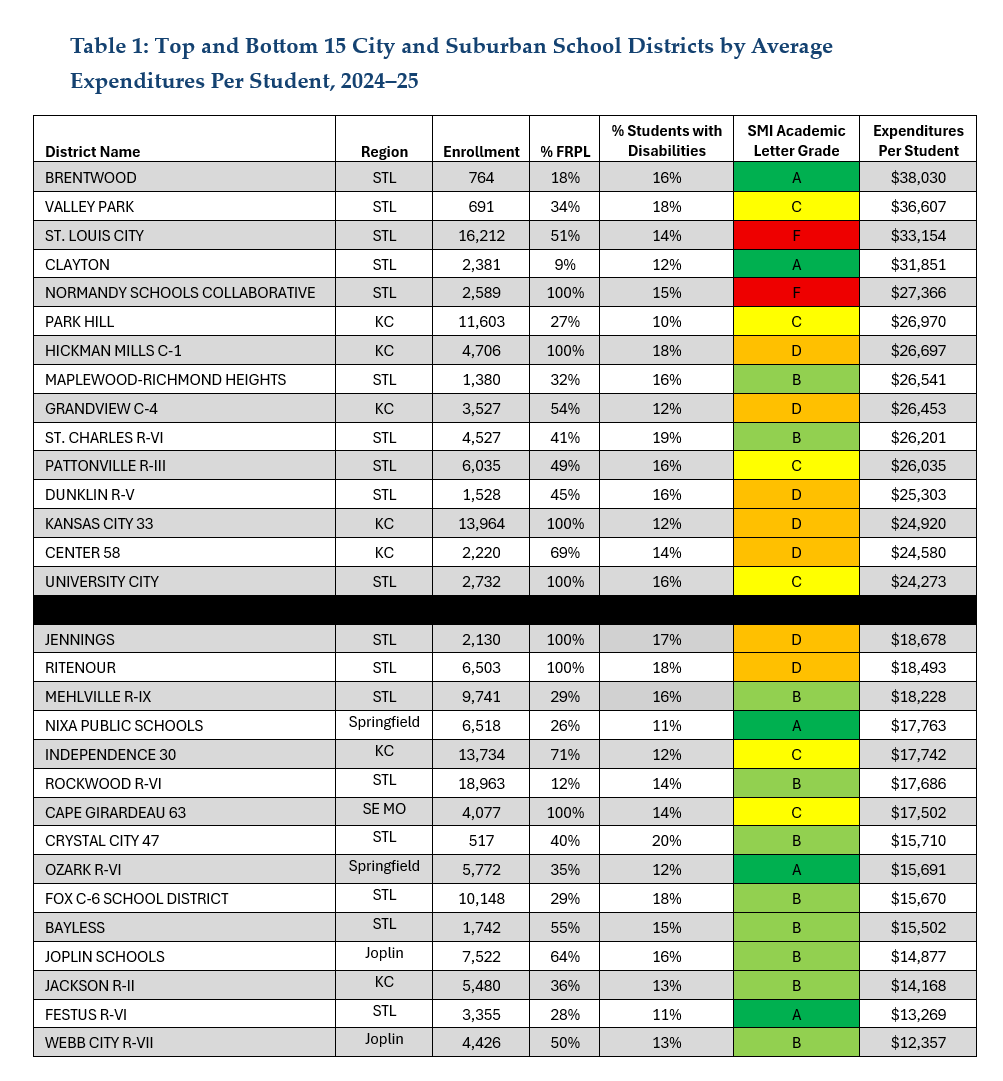
Table 1 begins to answer that question by focusing specifically on suburban and city districts—schools that are far more comparable in size and structure, but still vary widely in student demographics. It should be noted that Table 1 includes non-current spending items like interest and capital outlay (such as constructing a new gym, renovations, etc.).
For reference, in the 2023-24 school year, the average expenditure per student was around $19,500. Of that, about $15,900 were current expenditures and $3,600 were non-current expenditures.
Source: MOSchoolRankings.org
Interestingly, the five highest-performing school districts in the state are split between the highest and lowest total spenders. Table 1 suggests that it is overly simplistic to assume that more money per student automatically leads to better academic outcomes.
Consider Valley Park and Park Hill as examples. Both spend relatively high amounts per student (including non-current expenditures) and serve comparatively lower shares of low-income students, yet neither achieves top-tier academic results. Meanwhile, several lower-spending districts of similar demographics earn strong academic grades.
This does not mean funding is irrelevant, but rather that the process of producing strong academic outcomes is complex and money isn’t everything.
The University of Missouri (MU) recently hosted a lecture by Robert Henderson, who coined the term “luxury beliefs.” These are beliefs that signal status among the affluent while imposing little cost on them, but that burden the poor and marginalized. A common example is the idea of defunding the police: it’s easy to endorse from a safe, well-resourced neighborhood, where the consequences are less likely to be felt personally.
After Henderson’s visit I found myself thinking about school choice, and specifically the debate over charter schools in Columbia. Charter schools are public schools that operate independently of traditional school districts. They have more flexibility in how they educate students, but they’re also held accountable for results. Unlike traditional public schools, they can be closed if they fail to perform or attract students. The data on charter school outcomes in Missouri are unambiguous: Charter schools consistently outperform traditional public schools.
A recent state law change allows charter schools to open in Columbia, but there is vocal opposition locally. This is despite the fact that many district schools perform poorly. Moreover, the first approved charter is operated by one of the most successful Charter Management Organizations in the entire state, Frontier Schools. In the PRiME Center’s 3-Year Growth Report, Frontier has two schools in the top five statewide in terms of promoting academic growth.
Columbia Public Schools has opposed Frontier’s entry (luckily to no avail thus far). Several current and prospective school board members are also opposed, and community forums are full of what I suspect is an angry minority of citizens who don’t want Frontier to open a school in Columbia.
The opposition screams of luxury beliefs.
I wonder how many of the opposing voices send their kids to Battle High School, where of all the students who take Algebra-I, just 7 percent—this is not a typo, 7 percent!—score proficient or higher on the state’s Algebra-1 End of Course Exam. Or how many send their children to Derby Ridge Elementary School, where fewer than 5 percent of 5th graders—again, not a typo—score proficient or higher in mathematics.
How many of those in opposition send their children to any of Columbia’s low-performing schools?
I bet very few, if any.
For families with means, school choice already exists—they can buy homes in neighborhoods with higher-performing schools. Opposing charter schools costs them little. But for families without that option, the stakes are much higher.
What are those families supposed to do?
Why not allow a proven operator like Frontier to offer another path? If you were a family without means, wouldn’t you want that option?
If you’re fortunate enough to send your children to a school you like in Columbia Public Schools, I’m happy for you, genuinely. But don’t stomp on other people’s opportunities with your luxury beliefs.
Public education spending typically comes with a lot of questions. How much are we spending per student? Are some schools spending way more than others? What is that money being used for?
These are all relevant questions, and at the Show-Me Institute, we’ve created a resource to answer such questions: MOSchoolRankings.org
As an example of what these data can be used for, Figure 1 shows how Missouri school districts are distributed across different levels of spending per student. It should be noted that these statistics include non-current spending items like interest and capital outlay (such as constructing a new gym, renovations, etc.).
For reference, in the 2023–24 school year, the average expenditure per student was around $19,500. Of that, about $15,900 were current expenditures and $3,600 were non-current expenditures.
Figure 1: Number of School Districts and Charter Schools Grouped By Average Expenditures Per Student, 2024–25
Source: MOSchoolRankings.org
Most Missouri school districts and charter schools spent between $13,000 and $22,000 per student in the 2024–25 school year, but there are numerous outliers in the data, as shown below.
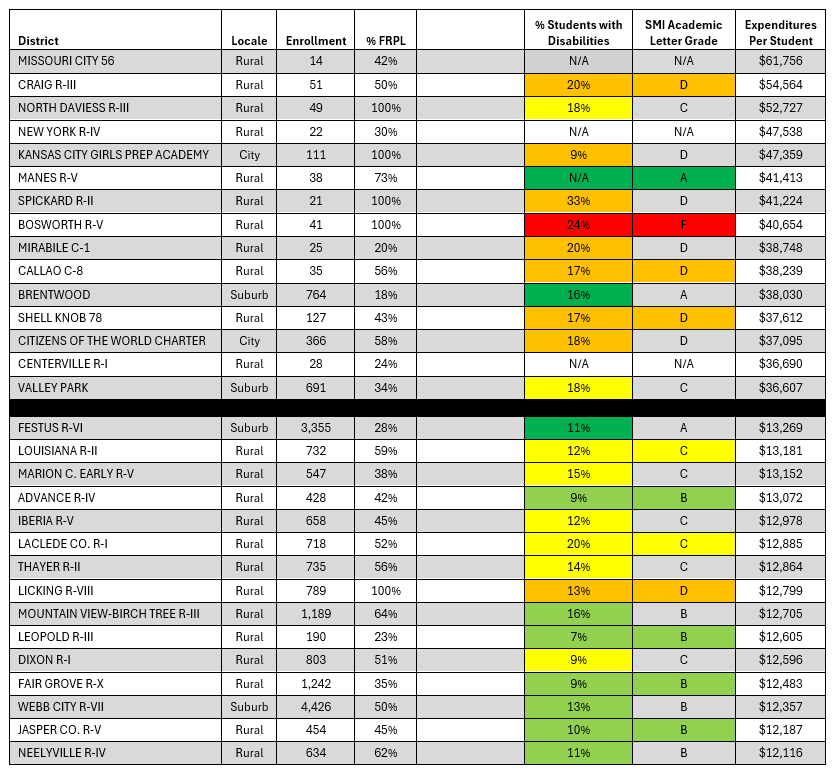
Table 1: Public School Districts and Charter Schools with the Highest and Lowest Average Expenditures Per Student, 2024–25
Source: MOSchoolRankings.org
In Table 1, many of the highest-spending school districts in Missouri are rural, including several extremely small districts, such as Missouri City 56, which enrolls just 14 students. By contrast, many of the lowest-spending districts are also rural, though they tend to be larger and vary more in size.
Missouri’s mean total expenditure per student (weighting each district equally and including non-current expenditures) is $20,406, while the median is $18,934. Even so, there is a surprisingly wide spending range across the state, from roughly $12,000 per student to more than $60,000 per student.
These kinds of statistics are important when evaluating potential changes to the funding formula. To take one small example, Spickard R-II saw enrollment decline from 54 students in 2005–06 to 21 students in 2024–25: a 61% decrease. For state funding, Missouri’s hold-harmless policy guarantees that Spickard R-II receives no less than the state funding it received in 2005–06, even though the district has far fewer students. This likely contributes to why Spickard spent $41,224 per student in 2024–25.
Clear, accessible data are important. And of course, spending is only one aspect of this. MOSchoolRankings.org allows users to go further by comparing districts on academic performance, student demographics, growth, and much more.
Support Us
The work of the Show-Me Institute would not be possible without the generous support of people who are inspired by the vision of liberty and free enterprise. We hope you will join our efforts and become a Show-Me Institute sponsor.