Repeating School Spending History

I saw a meme once that said “Those who fail to learn history are doomed to repeat it while those who learn history are doomed to watch as other people repeat it.” I can’t help but identify with that as the details of the federal government’s massive school spending plans are unveiled.

Those of a certain age in Kansas City might remember the landmark Missouri v. Jenkins case that wound its way through the courts during the 1980s and 1990s. The decision led to direct oversight of the Kansas City public schools by a federal judge and billions of dollars in spending,  but the key indicators that the case hinged on—student academic performance and racial segregation—barely budged.

I can’t do the whole story justice here, but I can highly recommend University of Colorado professor Joshua Dunn’s outstanding book on the case: Complex Justice: The Case of Missouri v. Jenkins.

Here is a brief excerpt from his conclusion, which might give us pause today as we think about the new spending heading our way:

Many of the problems afflicting urban education can be traced to school districts’ political and institutional arrangements, which give incentives to school boards and superintendents to institute quick reforms that do not challenge established interests. The KCMSD is no exception. In the 1970s and early 1980s, a new superintendent would come in with a “new” plan to rescue the city’s schools. The plan would fail. The school board would fire the superintendent and then commission a study to come up with another plan. That plan would fail as well. Missouri v. Jenkins was the continuation of this failed policy strategy by judicial means. Even with the aggressive oversight of a federal judge, the KCMSD’s problems persisted. A dysfunctional organization given all the money it asks for will likely use that money in a dysfunctional way. Fixing the “root causes” of the problem—poor administration and poor instructions—should be the place to start.

Let’s Look at Some Numbers

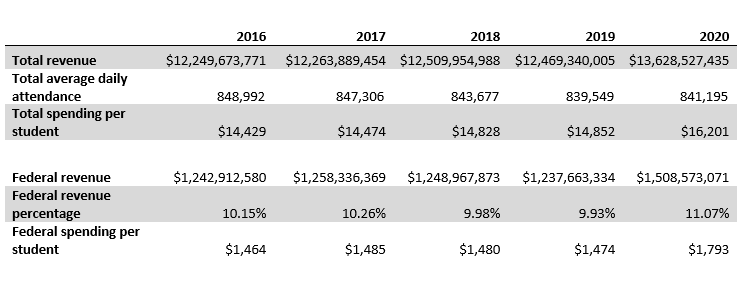
The Missouri Legislature is hard at work on the budget for the next fiscal year. One of the biggest components of the budget is K-12 public education. I think it’s helpful to periodically pause and take a look at what is actually spent on education to see if it’s too little or too much. Most people have no idea how much is even spent, and if they think they know, they underestimate the dollar amounts. So, here’s the truth.

The following numbers are from the Department of Elementary and Secondary Education’s (DESE) Missouri Comprehensive Data System (MCDS). The file is called “Finance Data and Statistics for All Districts” and it can be found here.

Last year, when every school in the state shut down and many were able to offer little more than homework packets and buses stopped running and buildings were closed, Missouri public school districts spent just over $16,000 per student. That sounds a lot like the tuition at a fancy private school.

Of course, we did get about $300 million in federal stimulus funds for public education, but that only explains the $330 difference in federal spending per student between 2019 and 2020. State and local spending also increased. In 2021, Missouri is set to receive an additional $2.8 billion in federal stimulus, or over $3,000 for every student in the state. Does that mean that spending per student will be $19,000 in 2021? Will it be more?

In addition to working on the budget, the Senate is set to debate whether donations to scholarship-granting organizations should continue to be treated as tax deductions or if the donor should get a full tax credit. Giving donors a full tax credit would greatly incentivize donations to these scholarship organizations. The tax-credit-funded scholarships would give families money to customize their children’s education outside of their assigned public school. The defenders of the status quo—superintendents, school boards, and teacher union leadership—will undoubtedly say we can’t afford it. In light of the numbers above, does that seem true?

The New York Times Talks Property Assessments in St. Louis County

The New York Times had an excellent article on property taxation issues a week ago. The article had a nationwide focus, but it included St. Louis County among its data examples. As Missouri is entering its biennial reassessment cycle, the article is especially timely here.

My first work in government was in property assessment and tax issues. I was hired in June of 2001 to work for the St. Louis County Council as an aide. A short time later, the 2001 “Drive-By Assessment” scandal erupted, and the next few months of my life were devoted to property tax and assessment-related constituent work. In 2019, taxpayers in Jackson County experienced a similarly critical and difficult assessment cycle.

The Times story discusses studies that have found that lower-value homes tend to be over-assessed, and higher-value homes tend to be under-assessed. This leads to a shift in the property tax burden to the poor. Why does this happen? It’s due to the way assessment systems work. Home valuations are based on comparable sales data, and at the extreme high and low ends there are fewer sales to compare to. This naturally creates a regression to the mean; houses at the higher end get compared to houses that aren’t quite as expensive, and houses on the lower end get compared to houses that are a bit more expensive. That leads to lower-value homes being over-assessed, and higher-value homes being under-assessed.

That does not mean we should get rid of the average-based assessment system. In fact, I think we should expand on it and stop individually assessing homes every two years. We should just raise or lower assessments based on the average in an area. We could combine that with accurate assessments at sale price for sold properties (important for high-value ones), individual assessments for new construction, and maintaining the appeal system for property owners who believe their property value has increased less than average.

I have been discussing this problem for years. In a 2007 op-ed for the St. Louis Business-Journal, I wrote:

This would safeguard against incorrectly undervaluing properties – particularly expensive ones – that might be underassessed over time by the use of an average-based system.

These changes would make for a much easier rollback of tax rates. When assessments go up, property tax rates are rolled back because assessments are not supposed to lead to a tax increase. However, this isn’t the case for many people. The rollbacks are based on averages, but assessments are currently individual. So if your assessment increased by 20 percent, but the average in the area was only 10 percent, you will get hit with a significant property tax increase. Using an average would mean that everyone faces the same increase, and the same rollback.

I will have much more to say over the coming months about property taxes in Missouri. In particular, it’s time to remove the Kansas City school district’s exemption from property tax rate rollback requirements. That is a big part of the assessment issues in Jackson County that needs to be addressed. But clearly, as the article in the Times shows, we have work to do in Missouri.

The Latest on Missouri Empowerment Scholarship Accounts and HB 349

On Thursday, April 15, 2021, Dr. Susan Pendergrass joined The Gary Nolan Show to provide an update on House Bill 349.

HB 349 would establish the Missouri Empowerment Scholarship Accounts Program. The program would allow taxpayers to claim a tax credit of up to 50 percent of their tax liability for contributions to educational assistance programs. The funds would be pooled in ESAs for use on tuition, textbooks, tutoring services, and other costs.

Learn more about ESAs

 Listen to more from The Gary Nolan Show

We Have the Money. Let’s Expand Education Options for All Students

In the latest round of federal stimulus, Missouri will receive about $2 billion in funding for public education. Of this, the Missouri Department of Elementary and Secondary Education (DESE) keeps 10 percent, or $200 million. What should DESE spend it on? How about supporting the education hubs that have already popped up to help parents with virtual learning? How about creating more of them so that students can access tutoring and other services to overcome learning losses and prepare for next year? Private organizations, such as The Mind Trust and the National Parents Union are already joining the effort.

A database collected by the University of Washington offers several examples of where this is already happening in Missouri. The Boys and Girls Club in Columbia created a virtual learning center this year that provides students in grades K-5 academic support for remote learning and enrichment activities. They charge $150 per child per week. The YMCA locations in Kansas City created the Y Learning Academy. They provide in-person learning support for children up to 12 years old. Staff members are trained in youth development and provide enrichment activities. They charge $35–$60 per child per day. The Timothy Lutheran Church in St. Louis created a virtual learning classroom for parents working outside the home. Church staff help students with their virtual learning. They charge $50 per child for a full day and $25 per child for a half day. The Discovery Center of Springfield created a Learning Support Care program for children in grades K-8. They offer multiple options, including having district teachers leading remote instruction while Discovery Center staff provide support and tutoring. They charge $40 per child per day, plus an additional $25 for tutoring.

These are just a few examples of what is happening across the state. These pop-up education hubs have become a lifeline for working parents. Undoubtedly, many struggle to pay the $150-$250 per week, but what are their other options to keep their children safe and learning? Where are the children with working parents who can’t afford private options?

If DESE used just ten percent of the $200 million in stimulus funding to support these programs, it could fund hundreds of thousands of weeks of learning. More hubs would give more students the chance to catch up and recover lost learning. As we emerge from the fog of COVID, we will need to pull out all the stops to ensure that every child gets the education they need. Supporting programs such as education hubs should be part of the plan.

Earnings Taxes and St. Louis’s Catch 1%.

A version of this commentary was published in the St. Louis Business Journal.

As voters in the City of St. Louis prepare to vote on whether to retain the earnings tax in April, the city is in a tight spot. The city and school district need more revenue, which comes about through more taxes. But because taxes are high and a detriment to growth (especially the one-percent earnings tax), businesses are not locating in the city and the economy is not growing. So, to attract new businesses and convince current ones to stay, the city selectively gives out generous tax incentives. These may attract some businesses and residents, but because of the incentives, they don’t provide the tax revenue that the city was after in the first place.

Are you with us so far? Count us among those who agree that poor public schools and a high crime rate are harming the City of St. Louis more than taxes. But if the economy were growing, City Hall and the board of education would have more money to hire more police officers and teachers. It’s as if St. Louis is in its own Catch-22: a problem or situation where every solution is impeded by other conflicts. Call it our Catch 1%.

St. Louis’s “solution” to the problem of losing businesses and residents over the past couple of decades has been to offer generous tax benefits to every politically influential Milo Minderbinder who asks for them. Last year alone, there were 70 million uncollected tax dollars because of various subsidies. That approach has been a failure. It has led to substantial tax subsidies for developers who do not need them, such as the St. Louis Cardinals and their Ballpark Village development. They succeed while paying significantly reduced taxes. Their subsidies have helped them drive out smaller competitors (e.g., Mike Shannon’s) who paid taxes, but now no longer do because, well, they are closed. The use of tax subsidies actually leads to a reduction in tax revenues. That’s Catch 1%.

The same thing goes for the idea that tax subsidies are intended for blighted sections of the city. Clearly, there are parts of St. Louis that are struggling, and these areas might well benefit from the use of tax subsidies. But for the most part they aren’t getting them. Why not? From an economic development official’s point of view, the incentives are misaligned. If you have tax dollars to invest, why not direct them into a thriving area surrounded by other successful businesses? You’ll look that much smarter when the development succeeds—even if it would have been just as successful without the government handout. The projects that truly need the incentives aren’t the sure things . . . and that’s the whole point of the incentives—to bridge the gap between failure and success for a project in an economically depressed area. But in St. Louis, the less a project needs a tax subsidy, the more likely it is to get one. That’s Catch 1%.

So here we are, giving out tax incentives to people who don’t need them in places that don’t need them and still funding city government with an earnings tax that limits economic growth. Could the City of St. Louis operate without the earnings tax if the residents and voters wanted to do so? Of course. Most large cities in the United States do not have local income taxes. One problem (of several) with the tax subsidies and abatements the city gives away is that they make it impossible to rely less on the earnings tax and more on local property taxes, which is how many comparable cities fund their local services. Nobody says it will be easy to phase out the tax, which brings in an estimated $159 million per year. But if voters decided to end it, during the 10-year phase-out period an overall effort toward ending corporate welfare, raising alternative (and less economically harmful) taxes, budget cuts, continued pension reforms, service sharing with other governments (as in re-entering St. Louis County), and privatization efforts (e.g., the water utility) would allow St. Louis to continue to fund necessary services. It bears repeating that most comparable cities, including Chicago, Memphis, Omaha, Tulsa, and Nashville, fund their local services without local income taxes.

As St. Louis City voters prepare to decide the fate of the one-percent earnings tax in April, they do not have a simple choice. But the way the city has been operating for years is not working. The population is still declining, crime rates are high again, and the schools are failing too many students. If the city continues to go along as it has been for years, managed decline is about all we can hope for. Perhaps it is time to break out of the Catch 1% the city is in and do something radical.


St. Louis Voters Support School Choice

The Missouri Association for Public Charter Schools has released a new poll measuring the opinions of voters in St. Louis.

The online survey, conducted by Change Research, surveyed 614 St. Louisans in February of 2021 and asked them a battery of questions about their opinions on education in St. Louis.

Some highlights:

  1. 57 percent of voters in St. Louis say that public education is on the wrong track.
  2. 87 percent of voters earning less than $30,000 per year say that education in St. Louis needs to change “somewhat” or “a lot.”
  3. 92 percent of voters who earn between $30,000 and $50,000 say that education in St. Louis needs to change “somewhat” or “a lot.”
  4. 90 percent of voters say that it is “somewhat important” or “very important” that parents be able to pick their children’s school.
  5. Charter schools have a 21-point favorability advantage over traditional public schools in St. Louis.
  6. Interestingly, when asked about some basic facts of charter schools (respondents were asked whether statements such as “charter public schools are free” or “charter public schools are public” were correct or incorrect) lower-income St. Louis voters were more likely to get the answers right than higher-income voters.
  7. 58 percent of respondents disagree with the statement “Public district schools in St. Louis are serving Black students well.” Only 25 percent of respondents agreed.
  8. 39 percent of voters said that they were more likely to support a candidate who supports opening more charter schools while only 26 percent said that they would be less likely to support a candidate who supports opening more charter schools.

Voters know the score. Public education in St. Louis is not working for thousands of families. Parents should have more choice in where their children attend school.

That said, it is quite interesting that higher-income St. Louisans were more likely to not understand basic facts about charter schools. It would be a shame if their ignorance created political headwinds for solutions that their lower-income neighbors want and need.

How will this sentiment translate into policy? We don’t know. But, hopefully, civic leaders will respond to the needs and wants of their voters.

If This Is a War, Who Needs Peace?

Apparently, Missouri is continuing its “war on public education.” According to a recent op-ed by a columnist at the Northwest Missourian, a House Bill (HB 543) that would give more Missouri parents access to a charter school is evidence of this war. In fact, according to the columnist, if the bill passes “it will be the next step in destroying public education.” The bill actually pertains to open enrollment, not charter schools, but other bills would expand access to charters.

Let’s look at some facts. The Missouri Legislature is currently considering a budget that will fully fund the education foundation formula next year even though many predicted doom and gloom for school finances. For the purposes of funding, Missouri public school districts get to use this year’s attendance (difficult to keep track of), last year’s, or the year before. In other words, they get to pretend that no parents got fed up with their district’s educational offering this year and left— something we know is not true.

In addition, Missouri has received approximately $2 billion in federal stimulus money in the past year, 90 percent of which is required to be distributed to school districts. That’s nearly $2,500 per student in additional funding beyond the $11,000 average expenditure per student in Missouri. The supposed war on public education seems to involve giving public schools a lot of money.

But here’s the real deal—the public education establishment doesn’t want to give parents a way out. Here’s a direct quote from the op-ed: “There is only so much money to fund public education, and increasing the parents’ choice in where their child goes to school will bleed established districts dry.” Wow. Katie bar the door!

We all know that parents with the means to do so already choose where their child goes to school. They choose by moving. So, what this columnist is railing against is evening the playing field for everyone else. The op-ed points to Hickman Mills, a district that serves mostly disadvantaged students, as one of the districts that will be hurt by this bill just when they’re “already so close to getting things together.” Do you want to send your child to a district that is so close to getting things together? Neither do I. Parents in Hickman Mills deserve to choose whether they’re willing to wait for that to happen or to enroll their children somewhere else, like a charter school.

It is the rare parent who sees their role as the protector of their school district and its finances. Most parents I speak with just want to do the best they can for their children. Using inflammatory rhetoric and fearmongering to restrict them is a tactic that could easily backfire.

Support Us

The work of the Show-Me Institute would not be possible without the generous support of people who are inspired by the vision of liberty and free enterprise. We hope you will join our efforts and become a Show-Me Institute sponsor.

Donate
Man on Horse Charging