If at First You Don’t Succeed . . .

Try, try again, right? Unfortunately, that seems to be the motto developers are using with the Crestwood Plaza mall site. New developers are seeking tax-increment financing (TIF) and other taxpayer assistance to develop the long-vacant site into a subdivision and grocery store. This isn’t the first time that developers have tried to get government assistance to develop this property.

In 2016, $25 million in government assistance (including TIF and special taxing districts) was approved for this site but the developers never moved forward with the plans. It’s not yet clear exactly what developers will be asking for this time, but whatever it is, it’s too much. Crestwood is not a blighted community and even if the property is an eyesore, there is no reason for government to be giving out incentives for this property. There’s already a Schnucks and an Aldi right across the street. Do we really need subsidies to build another grocery store in this area? And is it fair to the existing stores to have the government subsidizing their competition?

Using taxpayer dollars to fund private projects isn’t a good idea. Developers aren’t going to quit asking for these unfair advantages, but lawmakers need to stop giving them out

Jackson County Assessment Facts, Part 3

This is the third in a series of posts on assessment practices in Jackson County, Missouri. It comes a mere 8 years after the first two posts. (My time in a different role for the Institute, and then at a different organization, explains this time lapse.) Unfortunately for me, and even more so for many Kansas City taxpayers, 2019 was the most critical and controversial reassessment for Jackson County in years. With home prices rising substantially right now, will those issues in Jackson County repeat?

But first, some history. One might have reasonably guessed that the historic underassessment of property (finally corrected, for better or worse, under orders from the state tax commission [STC] in 2019) was a response to the famous judicial-desegregation case tax increases from Judge Russell Clark. After all, the best way around a big property tax hike is to keep assessments low. The tax rate doesn’t matter much if the assessed value is low enough. But Jackson County assessments were low compared to St. Louis prior to Judge Clark’s order in 1987 that doubled the Kansas City school district tax rates.

In 1985, Jackson County had 44 percent of the population of St. Louis City and St. Louis County, but only 32 percent of the residential assessed valuation. That is a significant difference, especially when you consider that the Case-Schiller real estate value index ranked Kansas City’s housing values higher than St. Louis’s, both then and now. That difference in assessed values grew over time. In 2018 (before the STC ordered redo), Jackson County had 54 percent of the population but only 36 percent of the assessed value of St Louis City and County. What to make of this and how it relates to Judge Clark’s order? I make of it that Jackson County was under-assessed from the start of the current system in 1985, and that the judge’s tax increases gave Jackson County politicians, voters, and taxpayers an incentive to keep those assessments low instead of trying to make them more accurate until more than thirty years later.

That matters for a number of reasons. As Kansas City is within multiple counties, if homes in Jackson County are under-assessed, but similarly valued homes in Platte, Clay, or Cass county are properly assessed, then those taxpayers are paying more property taxes to Kansas City than their Jackson County neighbors based on the same municipal tax rate. That’s just one example. There are many taxing districts that affect your property tax bill; some cross county lines and some don’t.

I don’t think it is far-fetched to believe that something along these lines happened. Judge Clark’s tax increases were outrageous (and some were quickly overturned), and Jackson County officials stated they were going to oppose them at the time. Once the income tax aspect of the order was overturned, keeping assessed valuations low would help deal with the property tax increases.

Fast forward to 2019. Jackson County was compelled (properly) to make its assessments more accurate and property assessments jumped. However, one last holdover from the desegregation case is the Kansas City school district’s exemption from the property tax rollback rules. So, when the assessments increased substantially, the school district had no obligation to lower its tax rate. Final result? Very large tax increases for many people. That is not supposed to happen through reassessment, but it did. This is all a very complicated issue, but there is one change that should be made going forward. It is time to remove the Kansas City school district’s rollback exemption, which is turning assessment increases into a tax windfall for Kansas City schools.


Missourians May Lose Their Homes Because of State-Supported Loans

As reported by ProPublica’s Jeremy Kohler and Haru Coryne, more than 100 homes with PACE loans in metropolitan Kansas City and St. Louis are at risk of being sold at public auctions after their owners fell at least two years behind on payments, according to a ProPublica analysis. Of those homes, at least 29 are slated for sale at auction this year.

Read the full story from ProPublica 

David Stokes joined The Gary Nolan Show and The Pete Mundo Show to discuss what PACE loans are, the issues with them and why oversight is vital when the government decides to outsource to the private sector.

Should Missouri Mandate Biodiesel?

Should the Missouri Legislature require all diesel fuel sold in Missouri be blended with corn and soybean oil? A bill passed by the House and currently in the Senate would require that diesel fuel sold in Missouri consist of 5 percent biodiesel by volume until April 2024 and 10 percent thereafter for seven years. The bill also mandates that half of the biodiesel content come from Missouri-grown and raised crops and animals. Biodiesel is a type of diesel fuel made from renewable, biodegradable materials such as plants, animal fats, and oils.

Supporters of the bill argue that the mandate makes sense because customers ask for biodiesel and it would support local industries. Yet if biodiesel truly is popular, a mandate wouldn’t be needed to convince people to buy it. Supporters also argue that this mandate would be a good way to support Missouri farmers, as it would require half of the mandated biodiesel to be made from Missouri-grown materials. Forcing everyone to buy a certain state industry’s product is not only a heavy-handed way to “support local industry” but also certain to give rise to legal challenges. Has anyone heard of the Commerce Clause?

Detractors of the bill argue that biodiesel is more expensive at the pump than regular diesel and that mandating a more expensive fuel will harm the state’s economy. While prices do fluctuate, the true cost of biodiesel appears to be more expensive than regular diesel, although the price at the pump is trending downward. In 2015, biodiesel was 12 cents per gallon more expensive than regular diesel. In 2019, biodiesel cost roughly the same as diesel in the Midwest and was actually less expensive than diesel when calculating a nationwide average. But this calculation omits the current subsidies that biodiesel producers receive each year of $1 per gallon of biodiesel produced. Without these subsidies, that extra dollar will show up in the price at the pump.

The prudent course of action is to let the market work. If biodiesel is truly popular and cheaper than regular diesel, a mandate is not necessary. A mandate, particularly as this one is drafted, amounts to little more than a handout to certain farmers at the expense of anyone who buys diesel fuel.

Tides Turning Against TIF?

Public support is growing for efforts to protect local funding from bad tax-increment financing (TIF) deals, but will the elected officials of Boonville listen?

In the April 6th election, voters in the Boonville R-1 School District approved Proposition 2. Proposition 2 allows the district to borrow $4 million to repair and improve the area’s schools; it passed by a more than 50-point margin. The overwhelming support for the proposal serves as a reminder of how important the Boonville community views sufficient funding for public schools. But if so many residents of the district believe schools deserve millions in new funding, why would the city’s elected officials consider using TIF to divert future tax dollars away from schools and into the pockets of a private developer?

Cities across Missouri are finally catching on to how bad of a deal TIFs can be for local schools. In fact, the Boonville R-1 Board of Education recently joined the ranks of the St. Louis and Kansas City school districts by formally opposing the use of TIF.

The reasoning behind the school’s opposition is simple: When a home is built within a TIF district, the families that live there will pay the same property (real estate) taxes as everyone else in the community, but instead of their tax dollars funding schools as they normally would, some of those funds go to the developer. In effect, this means that children could be attending public schools without the necessary funding.

The support for protecting local taxing districts (schools, public health, etc.) has become so widespread that the issue is finally receiving attention in Jefferson City. Over the past few weeks, Missouri’s legislature has moved closer to passing much-needed reforms to the state’s TIF laws. The bill being considered, SB 22, would make it harder to unnecessarily use TIF to the detriment of local taxing districts, and would represent a significant improvement for all of Missouri.

While we’re still waiting to see the final TIF proposal for Boonville and whether SB 22 gains final passage, it’s easy to see which way the winds are blowing. It’s time for Boonville’s elected officials to protect local funding for the Boonville R-1 School District by saying no to TIF.

SMI Podcast: What We Got Wrong About School Reopenings with Andy Smarick

Andy Smarick joins the podcast to discuss his recent piece in The Dispatch titled What the Narrative on School Reopenings Has Missed.

Andy Smarick is a senior fellow at the Manhattan Institute, where his work focuses on education, civil society, and the principles of American conservatism.

He currently serves as the chair of the Maryland Higher Education Commission and was previously the president of the Maryland State Board of Education.

Listen on Apple Podcasts 

Is it Time to Merge Two St. Louis County Police Departments?

David Stokes

On Tuesday, April 27, David Stokes, Director of Municipal Policy for the Show-Me Institute, joined The Mcgraw Show on The Big 550 KTRS  to discuss push back from a local community on merging police departments with another municipality and provide some thoughts on the current state of the St. Louis County Auditor’s Office.

LISTEN HERE:


How Are We Recovering? (Part 1)

The economic recovery from the COVID-19 pandemic has been much more rapid and robust than people initially predicted. It’s possible that memories of the slow rebound from the Great Recession created pessimistic expectations. However, despite the faster-than-expected rebound in 2020, employers are reportedly experiencing hiring difficulties, which may slow the return to economic prosperity. Evidence from the aftermath of the Great Recession suggests one risk factor that may delay jobs recovery: generous unemployment benefit extensions. This blog post will be the first in a series that discusses the unemployment insurance program, its economic effects, and its implications for the current recovery.

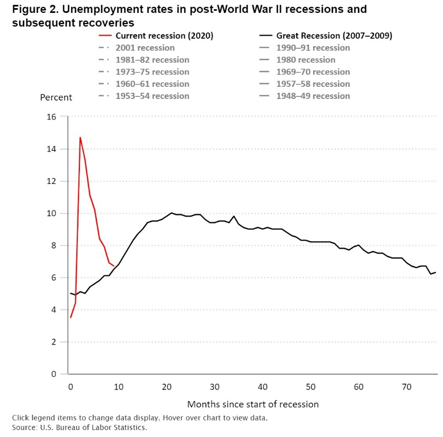
In the spring of 2020, the COVID-19 pandemic and associated shutdowns quickly sent our country into unimaginable economic lows. The national unemployment rate reached its peak of 14.8 percent in April 2020 while Missouri’s unemployment rate jumped to 12.5 percent the same month. However, the economy has bounced back faster than expected. Recent numbers show the national unemployment rate at 6.2 percent in February 2021, and Missouri’s preliminary unemployment rate for January 2021 was 4.2 percent.

Though still higher than the national unemployment rate of 3.5 percent from January 2020, we’ve recovered much more quickly than we did from the Great Recession.  It took nearly five years for the unemployment rate to fall from its peak of 10 percent in October 2009 to below 6 percent. As the image below shows, unemployment reached an even higher peak during the pandemic but has still managed to fall to 6 percent in less than a year’s time.

Source: https://www.bls.gov/opub/mlr/2020/article/employment-recovery.htm

Perhaps the historical fiscal relief packages passed in 2020 help explain the more robust recovery. The CARES Act was passed in March 2020 to support the economy in a variety of ways through a period of widespread lockdowns. Included in the CARES Act was enhanced unemployment insurance to help those who had lost their jobs at a time when it was difficult to find jobs.

However, with the economy re-opening, job postings on the rise, and accelerating vaccinations signaling a potential end to the pandemic, it is worth re-examining the evidence on the effects of unemployment benefits during downturns and recoveries. Are the benefit extensions helping the recovery by sustaining consumer spending, or are they slowing the recovery by discouraging people from searching for jobs by paying them generously not to work? This will be discussed in future blog posts.

St. Louis County Needs to Get the Auditor’s Office in Order

I was an aide at the St. Louis County Council in 2003 when the council appointed Mark Burchyett as the county auditor. Mr. Burchyett was a highly qualified, experienced government and business auditor before coming to St. Louis County. Before him, the county auditor’s office had been, in the words (spoken to me) of a Post-Dispatch reporter who shall remain nameless, “A dumping ground for political hacks.”

Fast forward a decade or so, and the county has unfortunately appeared to have returned to those undistinguished roots. Several years ago, the council appointed an individual to the auditor position who had essentially no experience in large-scale government auditing functions. Over the past several years, the inability to actually do such audits has resulted in an auditor’s office almost without audits. This is not an exaggeration. It just takes a moment to compare the output of the St. Louis and St. Charles county auditor’s offices to see the striking difference. One has some very short reports over the past several years. The other (St. Charles) has real audits.

In fact, if you go to the two pages that list St. Louis County audits and reports, there is exactly one (ONE!) released financial document in all of 2020 and 2021, and that document is one (ONE!) page long.

This county auditor oversees a very small staff of just 2 or 3 people The auditor is not just overseeing audits and reports; he has to actually do the work himself. Members of the St. Louis County Council have recently asked for a state audit of county funds in light of the fact that the county auditor has not performed this vital task. The county council is also considering instituting tighter qualifications for the position.

With the enormous amount of money coming into St. Louis County over the past year from federal aid, the office of the county auditor is more important than ever. The county needs a qualified, independent auditor’s office to provide oversight on the spending. (The auditor’s office is one of two positions in St. Louis County government that reports to the council, not the county executive.)

Loyalty is a wonderful thing and calling for people to be replaced is not something anyone should ever be cavalier about, but it is well past time for St. Louis County to have an auditor who will get the job done.

Support Us

The work of the Show-Me Institute would not be possible without the generous support of people who are inspired by the vision of liberty and free enterprise. We hope you will join our efforts and become a Show-Me Institute sponsor.

Donate
Man on Horse Charging