Suggested Change to Missouri’s Nuclear Construction Bill

A new bill in the Missouri Legislature proposes easing regulations on nuclear and renewable power construction. House Bill 261 would allow utilities to charge ratepayers for the construction of nuclear and renewable power plants before they’re operational. However, this would only apply to plants with the capacity to generate more than 200 megawatts of electricity per year.

This exemption would favor large, traditional nuclear power plants at the expense of cutting-edge nuclear energy technology—small modular reactors (SMRs). Putting aside the merits of the current monopoly structure—customers in other states benefit from competitive electricity markets—does it even make sense for a bill to promote traditional nuclear over SMRs?

Let’s put this in perspective. Few large, traditional nuclear power plants have been built nationwide in the past few decades. In recent years, multi-billion dollar cost-overrun debacles for new traditional nuclear plants in South Carolina and Georgia have put a damper on constructing new large nuclear plants. So what’s so special about SMRs?

SMRs are much smaller than traditional nuclear power plants (generating fewer than 200 megawatts of electricity per year) and are also cheaper to construct on a per-megawatt basis than traditional nuclear plants. NuScale Power, which is on track to receive the U.S. Nuclear Regulatory Commission’s first construction approval of an SMR this August, expects its SMR to produce electricity for $65 per megawatt-hour. That price is competitive with electricity from natural gas plants, which are also “baseload” power providers. (Baseload power is reliable, around-the-clock power, as opposed to the intermittent power provided by solar and wind.)

SMRs are also safer than traditional nuclear plants. The traditional way of generating nuclear power is already the safest form of electricity production available, even when considering disasters like Chernobyl or Fukushima, but SMRs come with enhanced safety features. For instance, traditional nuclear power plants cool their reactors by circulating water via electricity, meaning that in the event of a natural disaster that removes all possibility of power (such as what happened in Fukushima in 2011), the reactor could malfunction. SMRs use natural circulation rather than power to cool the reactor, meaning that a disaster like Fukushima is even less likely to happen with SMRs, and it is already extraordinarily unlikely.

Their smaller size also means that SMRs may be deployed in places where it wouldn’t make sense to build an enormous, traditional nuclear power plant, such as in remote towns or industrial sites. SMRs can operate individually as well as being grouped together, again in contrast to traditional nuclear plants. This allows for more flexible operation and even expansion if population or industry requires it.

SMRs are nearing full approval by federal regulators and are already being built in several countries. Putting aside the concerns about the monopoly powers Missouri utilities currently have (which are not insignificant), wouldn’t Missouri be better off focusing on the future of nuclear energy technology rather than the past?


SMI Podcast: It’s Always Infrastructure Week Somewhere with Brian Riedl

On this episode of the Show-Me Institute Podcast, Susan Pendergrass is joined by Brian Riedl.

They discuss his recent piece in National Review titled Four Principles for a Conservative Infrastructure Alternative

Brian Riedl is a senior fellow at the Manhattan Institute, focusing on budget, tax, and economic policy. Previously, he worked for six years as chief economist to Senator Rob Portman (R-OH) and as staff director of the Senate Finance Subcommittee on Fiscal Responsibility and Economic Growth. He also served as a director of budget and spending policy for Marco Rubio’s presidential campaign and was the lead architect of the ten-year deficit-reduction plan for Mitt Romney’s presidential campaign.

Listen on Apple Podcasts

A Huge Win for Missouri Families

Thankfully, the Missouri Legislature has recognized that one size does not fit all when it comes to education. The House and the Senate have passed a bill that will allow Missouri families to receive scholarships to customize their children’s education outside of their assigned public schools. Once the legislation is signed by the governor and people begin donating to the fund, students in the St. Louis, Kansas City, Springfield, and Columbia areas can apply for an Empowerment Scholarship Account (a kind of ESA) to pay for private school tuition, tutoring, virtual education, micro-schools, or educational therapies. This is a huge win for Missouri and for Missouri families.

The scholarships will be funded by donations to non-profits. Donors to the scholarship-granting organizations will receive a 100 percent credit on their state taxes for the amount donated. The next step is to encourage Missourians to change a child’s life by donating to the organizations. The scholarship-granting organizations can raise up to $50 million each year.

Missouri joins several other nearby states, such as Oklahoma and Iowa, that have also created school choice programs this year.  No doubt the experiences of the past year—when parents were put in the driver’s seat—brought to light that kids need choices. As Show-Me Institute analysts have repeatedly pointed out, parents support school choice, parents need school choice, and the states that give parents school choice outperform those that don’t.

It’s the dawning of a new era of parental empowerment in Missouri. Hopefully, this is just the beginning.

Indexing Fuel Taxes

Paying tax on gasoline or diesel fuel by the gallon makes intuitive sense—the more gas you buy, the more tax you pay. But in this case, our intuition isn’t doing us any favors. The per-gallon model for taxing fuel doesn’t account for inflation or the increased fuel economy of newer cars, and those two factors are making it harder to pay for the upkeep of our roads and bridges.

In addition to a 17-cent-per-gallon state fuel tax, Missourians pay federal fuel taxes on gasoline and diesel fuel of 18.4 and 24.4 cents per gallon, respectively. This federal fuel tax revenue is deposited into the Federal Highway Trust Fund (HTF), from which money is sent to each state—and money from the federal government is the largest part of the Missouri Department of Transportation’s road and bridge budget. In 2020, MoDOT received almost a billion dollars from the HTF, making up nearly 40 percent of MoDOT’s road and bridge budget. In fact, for every $1 that Missouri drivers contribute to the HTF through federal fuel taxes, MoDOT gets $1.21 back. Obviously, it’s in Missouri’s best interest to keep the HTF healthy.

But the HTF isn’t looking so good these days, because its mechanism for generating revenue hasn’t aged well. Fuel taxes are charged by the gallon rather than as a percentage of the purchase price, so they don’t automatically keep up with inflation. The price of gas has gone up a lot since 1993, but regardless of whether you paid $1.25 or $2.50 per gallon during that time, the federal tax on each gallon has been stuck at 18.4 cents (or 24.4 cents for diesel fuel) for the past 28 years. Meanwhile, inflation has increased all the costs associated with road maintenance and repair. Worse yet, the costs of road construction equipment and materials have risen faster than overall inflation. As a result, each dollar raised from the fuel tax now has one third of the purchasing power it had in 1993.

In theory, a per-gallon fuel tax can still bring in increasing revenue over time as more drivers hit the road and log more miles every year. This is exactly what would have happened, except that improvements in vehicle fuel efficiency (not to mention the advent of electric cars) have decreased the amount of gas we buy for each mile we drive.

So where does that leave us? Fuel tax revenue is no longer sufficient to cover the HTF’s expenditures, and Congress has resorted to transferring money from the general revenue fund just to keep the fund solvent. This is at best a short-term fix that doesn’t solve the HTF’s core problem, adds to the national debt, and should hardly make Missourians feel comfortable. The fund we depend on for almost 40 percent of our road and bridge budget can’t support itself anymore. Up to this point, the federal government has covered the shortfall, but can we count on that to continue?

At the federal level there appears to be some recognition of the problem. A bipartisan group of 58 members of Congress has proposed indexing the federal fuel tax to some combination of inflation, construction costs, and fuel efficiency to keep it current with the times. The exact mechanism for the indexing hasn’t been determined, but the proposal is a promising start. Perhaps of more interest to Missourians is that several states have already indexed their own fuel taxes to measures like these. Policymakers here should consider indexing our fuel tax as well, since state fuel tax revenues have stayed practically the same for the last 17 years.

If we believe that quality roads and bridges are important for Missouri’s economy, then it makes no sense to allow the funding source that pays for them to remain stuck in the past.

PACE Loans Are Out of Line

A decade ago, Missouri created the Property Assessment Clean Energy (PACE) loan program to help homeowners and businesses get loans for clean energy improvements to their property. A PACE loan would be available if you needed new, energy-efficient windows, furnaces, water heaters, etc. Administration of the loan program has been contracted out to private entities around Missouri, generally authorized and “supervised” at the county level.

Unfortunately, the program has become another way for lenders to target the disadvantaged. I know what you may be thinking if you are familiar with Show-Me Institute’s work. “Wait, I thought you liked privatization?” Yes, I do. But this PACE program really is a combination of the worst of all options. The PACE program:

  • Is a government program of questionable need in the first place. Is it really the government’s job to facilitate personal loans for new appliances?
  • Was outsourced to the private sector with basically no oversight at all,
  • Authorizes private lenders to use government taxing authority to collect on loans. PACE bills can be placed on your tax bill, and if you don’t pay the PACE bills, tax authorities can take your home on behalf of the lenders.

We learned about all of this through terrific reporting by investigators at Pro Publica. Jeremy Kohler and Haru Coryne documented how private lenders were making loans above the value of someone’s entire house at relatively high interest rates to people with risky credit histories. They were targeting these people and doing this precisely because they had greatly reduced risk. If the homeowners didn’t pay, the loan amounts would be put on the tax bills and the lenders would be able to take the homes eventually. Here are examples from the Pro Publica report:

But in St. Louis, an elderly widow said she had no idea she had taken on thousands of dollars in PACE debt, though she saw her property taxes rise sharply. A disabled couple in the Kansas City suburb of Raytown said they weren’t told of the impact on their property taxes; now they’re two years behind on their property taxes.

A Vietnam veteran and his wife in Kansas City are struggling to pay off a $21,658 loan for a solar panel array despite being enrolled in an energy assistance program; they said they just wanted to do something good for the environment.

A PACE loan is NOT a mortgage. Even with a mortgage, the private lender has to go through a civil process with their own lawyers to enforce the loan on the home. With a PACE loan, the county collector is required to do it for them. That is wrong. This situation is like taking out a loan for a new car, and then losing your house if you can’t make the payments. If the PACE private lenders were assuming more risk themselves, they would have been much more careful about their loans.

I have defended the title and payday loan industries in the past. Those companies loan very small amounts compared to what PACE programs will lend you—at admittedly extreme interest rates. But at least when you miss payments to the payday loan company, you don’t lose your home. (My understanding of title loans is they just work with vehicle title.) Those companies take some risk.

PACE lenders basically take on very little risk. Sure, if they loan more than the value of the house and don’t get any money back, you can say they are taking some risk. But how often will the recipient make no payments at all? Between the comparatively high interest rates cited in the articles and the availability of seizure for non-payment, the PACE lenders are incentivized to make large loans to people who might not normally justify the risk.

The St. Louis Business-Journal also has a very good story on this issue this week. There have been bills introduced to reform PACE in Missouri, and reforms are much needed. Some of the true heroes of this fight have been local county collectors who have pushed back against the involvement of their counties in this harmful program.

In my opinion, we should probably get rid of the entire program, but at the very least the ability of lenders to put the loan on your tax bill and take your home if you miss payments must be eliminated.

Are Occupational Credentials the Answer to Educational Polarization?

As a scholar of education policy, three related facts have troubled me recently:

Fact #1: Our economy and society are increasingly bifurcating along educational lines.

Fact #2: People with bachelors’ degrees are doing much better than people without them.

Fact #3: Not everyone can or should earn a bachelor’s degree. (Okay so this one is part fact, part opinion)

A recent paper by economists Anne Case and Angus Deaton showed that while racial gaps in life expectancy are narrowing, the gaps in life expectancy between those with bachelor’s degrees and those without them are widening. And, tracking the last two decades of unemployment data shows that every time there is an economic contraction, those at the lowest end of the educational spectrum are hurt substantially more than those with college degrees. This is reflected in the completely different pandemic experience of more-educated Americans who were more likely to have jobs that could be performed remotely and less-educated Americans who had jobs that had to be performed in person.

If our society continues to cleave along educational lines, there will be serious negative consequences for our politics, communities, and economy.

It is tempting to respond to this problem by saying “Okay, well then everyone should get a bachelor’s degree,” but we know that many good jobs don’t require bachelor’s degrees, many people are unable or unwilling to engage with college-level work, and college is increasingly expensive.

The real question is: Is there another way?

A recent working paper published by the Annenberg Institute at Brown University may offer a better way forward. Researchers from Rice University and the RAND Corporation examined occupational credentials—post-high school certifications that denote skills or knowledge relevant to a particular field.

The authors found that certifications increased the probability of employment for workers without a bachelor’s degree by 37 percent. As they put it, “this suggests that occupational credentials act as an important signal to employers in the hiring process, especially for those with less than a bachelor’s degree.” This, as one might imagine, also translates to higher earnings.

It is increasingly clear that students need some kind of post-high school education to access more stable, more rewarding, and more remunerative jobs. Creating quality certification programs and helping link students to the training that they need could go a long way in bridging the educational divide.

Missouri’s Population Growth Is Still Lagging

The U.S. Census Bureau just released its updated state populations from the 2020 census, and the results were not good for Missouri.

Over the past decade, Missouri’s population grew by only about 160,000 residents, or 2.8 percent. This growth badly trails the national rate of 7.4 percent and every neighboring state except for Illinois. In fact, only eleven states in the country experienced less population growth than Missouri. Missouri dropped one spot in total population rank, from 18th to 19th. This is a significant decline from the state’s high-water mark of 5th at the turn of the 20th century.

Census results are important because they have real-world implications for states. Aside from being a measure of a state’s relative desirability, these population totals determine the apportionment of representation in Congress over the next decade. After losing a seat following the 2010 census, Missouri’s population is still sufficient to maintain eight congressional districts for another ten years, but Illinois was not so lucky. Along with Missouri’s neighbor to the east, six other states will be losing a congressional seat: California, New York, Michigan, Pennsylvania, Ohio, and West Virginia. States gaining these lost seats will be Florida, Colorado, Montana, North Carolina, Oregon, and Texas, which gets two additional seats.

While it can be difficult to fully understand what is driving the country’s population shifts, there appears to be a relationship with cumulative tax burdens. The state’s losing seats rank 1st, 8th, 10th, 18th, 23rd, and 26th in total tax burdens. On the other hand, the state’s gaining seats rank 11th, 21st, 32nd, 34th, 43rd, and 47th (Texas). While this isn’t the only factor in migration, people are indisputably moving from high-tax states to states with lower taxes.

State and local governments competing for residents via tax rates is not a new idea, and is something my colleagues have written about for years. Charlies Tiebout originally proposed the idea that people would “vote with their feet” by moving to communities with their preferred level of public services and taxes. If Missouri’s population growth continues to lag much of the country, there’s reason to believe the state’s taxes are contributing to the problem. Over the next decade, it should be a priority for Missouri’s elected officials to bring more people to the Show-Me State, or we could face the same fate as Illinois.

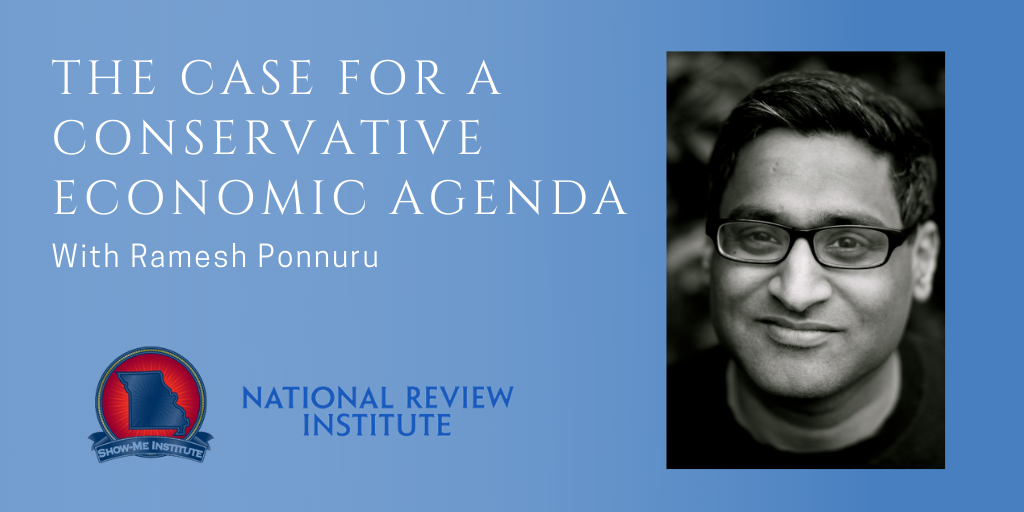
Wednesday, May 12 – Ramesh Ponnuru: The Case for a Conservative Economic Agenda

Conservatives have traditionally favored freeing markets and shrinking government. But new political and economic trends are leading many conservatives to question these old commitments. Join us on Wednesday, May 12 at noon for a talk by Ramesh Ponnuru who will make the case for a new conservative economic agenda.

Register Here 

Questions may be submitted prior to the event by emailing them to [email protected] and during the event via the Q&A feature on your Zoom screen.

Ramesh Ponnuru is a senior fellow at National Review Institute and a senior editor at National Review, where he has covered national politics and policy for 25 years. He is also a columnist for Bloomberg Opinion, which syndicates his articles in newspapers across the nation. He is a visiting fellow at the American Enterprise Institute and he serves as a contributing editor to National Affairs, the quarterly journal of conservative ideas. His articles are frequently published in The Wall Street JournalThe New York Times, and The Washington Post. In 2015, he was included in the “Politico 50,” Politico’s list of “the thinkers, doers, and dreamers who really matter” in American politics.

In 2014, Ponnuru contributed to and (with Yuval Levin) edited the book Room to Grow: Conservative Reforms for a Limited Government and A Thriving Middle ClassNew York Times columnist David Brooks called the book “the most coherent and compelling policy agenda the American right has produced this century.” Ponnuru was subsequently featured in a New York Times magazine cover story about reform-minded conservatives. In 2013 he was a resident fellow at the University of Chicago’s Institute of Politics. He is a regular speaker on policy, politics, and constitutionalism at the nation’s leading college campuses and law schools. He also appears regularly on television programs about public affairs. He is the author of a book on the sanctity of human life and American politics and of a monograph on Japanese industrial policy. Previously he has been a columnist for Time magazine and WashingtonPost.com. Ponnuru grew up in Kansas City, Kansas, and graduated from Princeton University. He now lives in the Washington, D.C., area with his wife and three children.

Support Us

The work of the Show-Me Institute would not be possible without the generous support of people who are inspired by the vision of liberty and free enterprise. We hope you will join our efforts and become a Show-Me Institute sponsor.

Donate
Man on Horse Charging