

David Stokes joined TCT on NewsTalk STL to discuss the current state of tax incentives in St. Louis and some recent development dealmaking.
Listen: Lee’s Summit School District wants $40,000 to Answer CRT Records Request

Patrick Ishmael joined Pete Mundo in the Morning on KCMO Talk Radio to discuss the Lee’s Summit School District’s response to his public records request to find out whether they are teaching critical race theory (CRT) or any of its related concepts, Monday’s hearing on CRT and more.

Listen: The Latest on CRT in Missouri Schools

On July 21, Patrick Ishmael joined The Vic Porcelli Show to discuss what he’s learned about CRT in Missouri schools after sending out thousands of records requests to schools across the state.
Listen to more of The Vic Porcelli Show on NewsTalk STL
HB 349 Creates Opportunity (For Some)

Some Missouri children will finally be able to sign up for tax credit–funded scholarships. But why not all?
Much has been written about the newly signed HB 349. For those who don’t know, HB 349 creates scholarships for families to use for their children’s education. The scholarships will be funded from taxpayer donations, and in exchange donors will get a credit on their state taxes. The scholarship funds can go toward private school tuition, books, tutoring, or other education-related costs. (The program basically works as a kind of Education Savings Account.) Legislators are realizing that education may need to be different for each student, and this program will give parents the resources to pursue the best education for their children in whatever unique form that might take.
But this opportunity is only available to Missouri citizens in cities with more than 30,000 people. Eligible students (low-income students and those with disabilities) in the City of St. Louis, St. Louis County, St. Charles County, Jefferson County, as well as the areas around Kansas City, Springfield, and Columbia will be able to benefit from this program. Not so for families living anywhere else in Missouri. Some critics argued in the St. Louis Post-Dispatch that “if the program was good for the state, it should apply to the entire state,” The implication being that since the program wasn’t adopted for every city, there must be something wrong with it.
But it’s not a bad program. There’s just more work to be done convincing other areas (especially rural communities) of the benefits of school choice. The Missouri Empowerment Scholarship Accounts program is good for the state, and it should apply to the entire state. All of Missouri’s families, urban and rural, should be given the opportunity to pursue the best education for their children.
It Doesn’t Work That Way

The St. Louis Board of Alderman just passed a symbolic resolution to ban any new schools (read charter schools) as long as enrollment in St. Louis Public Schools (SLPS) is declining. But banning alternatives to SLPS will not force families to stay. Just the opposite, in fact. Providing options may very well be what is keeping families in the city.
In the last 20 years, enrollment in SLPS has declined from nearly 46,000 students to just over 21,000. Meanwhile, charter school enrollment in the city has grown to over 11,000 students. This has led to a fairly steady public school enrollment of between 30,000 and 35,000 students in the city for almost 15 years.
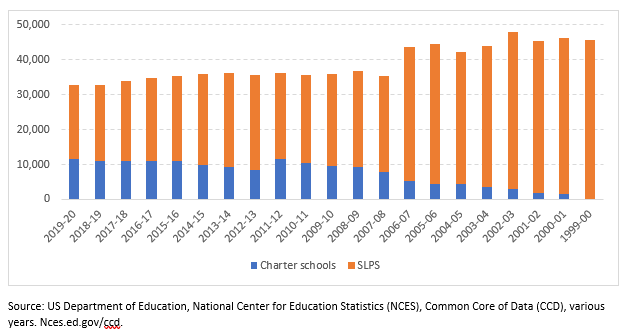
Soon, St. Louis children who qualify will also be able to apply for scholarships through the new Empowerment Scholarship Program, signed by the governor this week. This will open even more doors to families.
Ultimately, parents will stay in the city if they have several options for their children. Other cities that have created vibrant portfolios of school choices, such as Washington, D.C., provide proof of this fact. Enrollment in D.C. Public Schools declined from 71,000 students in 1999 to just over 44,000 in 2009. In the last ten years, it has increased to almost 52,000.
Resolutions to tie children to their one and only assigned public school seat are desperate attempts to protect a failing system. Wouldn’t it be better to consider all students in the city, both public and private, as precious resources that make St. Louis more livable? Wouldn’t it be better to provide every family in the city with at least a few choices? Don’t we want St. Louis to be a city where young families choose to stay and raise their children, rather than one that bans their demonstrated preferences?
It’s time for the adults to stop fighting over us versus them and to get busy building a portfolio of schooling options for every family.
Podcast: Missouri is Not Ready for the Next Recession – Corianna Baier & Elias Tsapelas

Susan Pendergrass is joined by Corianna Baier and Elias Tsapelas to discuss how prepared Missouri is for the next economic downturn.
Read Their Full Report Here
Crestwood TIF Update

Dierbergs has withdrawn its request for $17 million in subsidies ($13.5 million via tax-increment financing [TIF] and $3.5 million from a community improvement district [CID]) to redevelop the Crestwood mall site. However, it’s not a win for taxpayers.
Dierbergs has decided instead to use the TIF that was approved for the site in 2016 for a different developer but was never acted on. The previously approved TIF is for $15 million, a slightly higher amount than the one in Dierbergs’ proposal. But TIF projects can only be active for a maximum of 23 years, and because this one was approved in 2016, it will only have 18 years available. It appears that there will still not be a request for funds for the residential portion of the development
The 2016 proposal also included a $5 million CID and $5 million transportation development district (TDD). A Dierbergs representative said the company will be asking for a CID that is less than $5 million and will not use both a CID and TDD to develop this site. If this remains true, the overall size of the subsidy package will be slightly smaller than the overall $25 million proposal in 2016. But it’s possible that this new avenue will give Dierbergs access to even more taxpayer dollars than its proposal from a few months ago.
It’s unfortunate that taxpayer dollars are being used to develop this area at all. Sure, there’s a shorter timeframe for the TIF and no subsidy for the residential portion, but that’s small consolation. What was true in 2016 is still true today: A TIF at this location is just a way for lawmakers to look like they are “doing something” about this long-empty location at the expense of taxpayers. Hopefully in the future, Crestwood can do better for taxpayers by not offering their dollars to developers at all.
Webster Groves Addresses Hard Issues in Zoning

A version of this commentary appeared in the Webster-Kirkwood Times.
Zoning can be a complicated issue for people who believe in limited government and market-based policies. There is the conflict between the rights of people to organize their community how they want it, the rights of people to develop their own property as they see fit, and the issue of how local governments will prioritize those rights.
Usually, any discussion of reducing or ending zoning immediately leads to nightmare scenarios of a chemical plant opening up right next door to your house. (This actually happens in rural areas with concentrated animal feeding operations, but that is another issue.) But what if the concerns and questions are about much smaller changes to zoning?
The City of Webster Groves is undergoing such a debate right now. Recently, the city council passed changes to the city’s zoning code that will increase housing and development options in parts of the city. In short, the city will allow more small, multi-family homes (i.e., duplexes) in parts of the city previously reserved for single-family zoning. The stated reason for the change was to provide greater housing options that might allow people from different backgrounds to move into Webster Groves. However, a group of residents opposed to the changes has collected enough signatures to put that ordinance change up for a referendum on the ballot on August 3. Those residents, like many suburban residents in our country, prefer single-family zoning for their communities. Needless to say, the upcoming vote has stoked a great deal of interest in Webster Groves. I don’t think the town has been this riled up since the premier of Sixteen in Webster Groves 55 years ago.
The debate over allowing more duplex housing could be academic enough, with good arguments on both sides, but from discussions with residents, letters-to-the-editor, and more, it is pretty clear this debate is closely related to issues of public housing as well. Two years ago, Webster Groves added “source-of-income” to the anti-discrimination rules of its housing ordinances. That means that a landlord in Webster Groves can’t refuse to rent to a person or family who will use a federally funded Section 8 housing voucher to pay the rent. This goes far beyond Obamacare simply requiring everyone to buy health insurance; this law says that a landlord is now compelled to participate in a welfare program whether they want to or not. Bake the cake, landlord! (Keep in mind that Section 8 is a federal program, and there is no federal requirement that landlords accept it). Taken in combination, it is not unreasonable for some people in Webster Groves to think that this rezoning is a first step towards much greater use of multifamily housing and Section 8 vouchers in their city.
Should a community ban the use of the camel because it occasionally sticks its nose under the tent? I guess it depends on what you think about the tent. If your community is based on one-tent per family per lot and you and your neighbors like the community you have built that way, changes in zoning to allow for more tents per lot can be concerning. But if you think tent prices are too high and people need more options, then a simple allowance for two smaller tents on a parcel instead of just one makes sense. (And make sure that camel is not a nonconforming pet under the animal code.)
The rubber will meet the road in debates about equality in housing policy when people—including suburban liberals who claim to passionately support more diversity and inclusion—are forced to consider changes that could affect their own home values and community makeup. I don’t claim to know what the people of Webster Groves should do in the long run. (Though they should definitely use another referendum to get rid of the terrible “source-of-income” rule). However, people have a right to create and abide by zoning laws that maintain the type of community they want to live in, even if not everyone would make that same choice. It is going to be very interesting to see debates play out like this across Missouri’s suburban communities in the coming years.
A Property Tax Tale of Two Cities

A version of this commentary appeared in the St. Louis Post-Dispatch.
It costs money to run cities, and that money comes from taxes. While governments at all levels waste that tax money to varying degrees, sometimes it is necessary to increase certain taxes to fund necessary services.
Right now in St. Louis County, two prominent suburbs have put property tax increase votes before their citizens in August. The first one is Clayton, the county seat and central business hub. The second one is Frontenac, a wealthy bedroom community with a major mall right in the center of St. Louis County.
Too often governments try to export the costs of running their cities to outsiders with tourist taxes, sales taxes, special district taxes, and so on. In the cases of Clayton and Frontenac, the best thing you can say about the proposals is that they are property taxes that will be paid by the residents and businesses of their respective communities. Of course, the businesses don’t vote—only the residents do. But businesses and residents all benefit from effective police, properly equipped fire departments, and well-maintained roads.
There is one difference between the two proposals. That is, simply, the size of the proposed property tax increases. Clayton’s proposal is relatively modest, at 18 cents per $100 dollars of assessed valuation. While Clayton has very valuable buildings and beautiful homes for which even a low-percentage increase will mean real money, at least at this reasonable level of increase people can fairly weigh the costs and benefits to the proposal. (As a point of reference, a home worth $500,000 would have a $171 tax increase.) Nobody is getting hammered with radical tax increases. What’s more, residents and businesses will see the same rate increase. They will share in the costs and benefits of the proposal.
The same can’t be said for Frontenac. Frontenac’s proposed tax increase is huge any way you look at it. The city’s residential tax rate is more than doubling from $0.435 to $1 per $100, and the commercial property tax rate is tripling. Tripling! The owners of 1701 S. Lindbergh, the primary parcel for Plaza Frontenac, will pay $150,000 more in property taxes to the city if this proposal passes. $150,000! The owners of the Frontenac Hilton—which just experienced a pandemic year with hardly any guests and furloughed 128 employees in 2020—will have to pay $40,000 more per year in taxes. Nothing says “we will all get through the pandemic together” like a huge tax hike on struggling businesses.
Do these cities truly need this money? That is up to the voters to decide. They both claim that they have cut waste as much as they can, and I believe they have tried to do so. Frontenac’s website details money it has saved by sharing services with other cities and freezing employee salaries. Fair enough. Clayton’s website also documents recent budget savings by the city, but considering that Clayton still offers rear-yard trash pick-up, I know of at least one more thing they could cut to save tax dollars—rear-yard trash pick-up). Clayton is expected to receive over $3 million and Frontenac about $750,000 from the latest federal stimulus funds. This is on top of the likely increases in tax revenue for each city from online sales tax collections and higher gas taxes passed in the recently concluded state legislative session.
Residents, voters, and taxpayers (most people are all three, of course) generally like the high quality of services found in most St. Louis County suburbs, especially in the more prosperous cities like the two we are discussing here. But you can only ask for so much before people start saying “no.” People want quality services; they also like fair taxation and the idea that their cities aren’t just out to gouge them. The Clayton proposal will probably pass that test with many voters, but with numerous Frontenac residents staring down an increase of over $1,000 in property taxes, I think the gouging question is going to be asked a lot.
