This November, Laclede County residents will vote on reducing an obscure tax that places the county at a competitive disadvantage compared to its neighboring communities.
See a map of commercial surtax rates across Missouri here.

This November, Laclede County residents will vote on reducing an obscure tax that places the county at a competitive disadvantage compared to its neighboring communities.
See a map of commercial surtax rates across Missouri here.
A version of this commentary appeared in the Clay County Courier-Tribune.
This November, Clay County residents will vote on reducing an obscure tax that places the county at a competitive disadvantage compared to its neighboring communities.
In 1985 the State of Missouri changed the way local governments tax commercial and industrial property. It eliminated the tax on business merchandise and inventory and replaced it with a surtax on the value of commercial real estate. Every county that year calculated the new surtax at a revenue-neutral replacement level for the lost business inventory taxes. Among the reasons for the change was a desire to base the tax on the value of real estate, which is more consistent than the ever-changing values of inventories. The change, made by an amendment to the state’s constitution, was explicit that the replacement levy calculated by the counties could be lowered only by voters, not elected officials, and that the surtax would not adjust downward as assessed valuations increased. This puts the commercial surtax at odds with most other property taxes in Missouri, for which the tax rate is supposed to go down as assessed valuations go up.
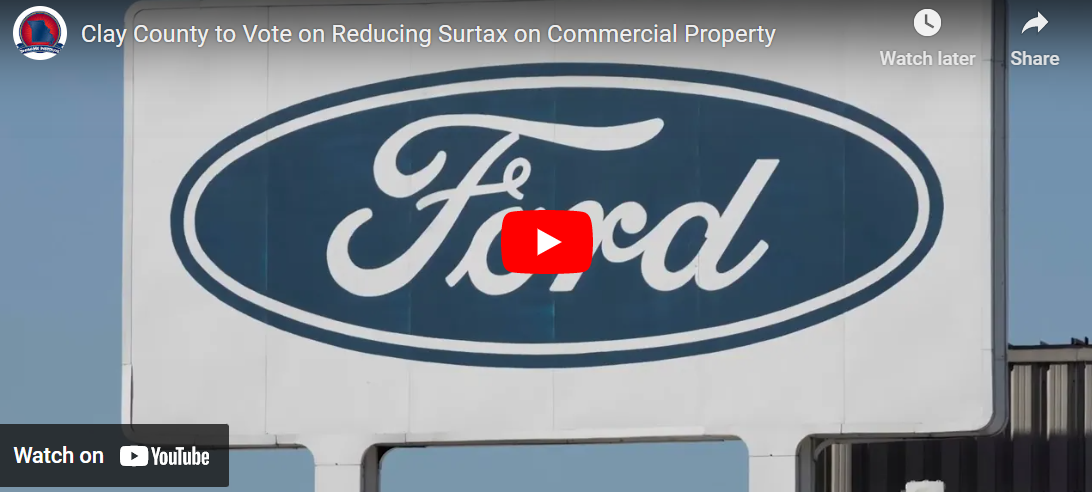
When the rates were established in 1985, most of the collar counties around Kansas City and St. Louis were much smaller than they are today, with fewer businesses. Consequently, these collar counties set their commercial surtaxes at a low rate. But Clay County, likely because of inventory taxes generated by its massive Claycomo Ford Plant, bucked that trend. It set its surtax rate at $1.59 per $100 of assessed valuation. That is the third-highest rate in the state, and the highest in Western Missouri. By comparison, Jackson County has a commercial surtax of $1.44, while Cass’s rate is much lower at $0.54 and Platte’s surtax is a mere $0.36.
Assessed valuations have grown enormously since the tax was introduced. For example, the commercial assessments in Clay County have gone up 287 percent between 1985 and 2021, from $302 million to $1.17 billion, yet the surtax rate has never been reduced to offset that increase. The combination of a high tax rate and the difficulty of reducing it puts Clay County at a competitive disadvantage compared to other counties in its area, especially its Northland neighbor and competitor, Platte County.
This is a problem for Clay County. These differences may not have been a big deal in 1985, when the tax alteration was a neutral one for Missouri businesses and more of them were located in our central business districts. But it is a problem now. After much discussion and debate, the Clay County Commission decided in July to propose lowering Clay County’s surtax to $1.44, equal to Jackson County’s rate. If passed by voters, this modest reduction in the commercial surtax rate would both spur economic activity in Clay County and reduce the perceived need for tax incentives. As Clay County continues to grow and assessed valuations continue to increase, revenue reductions for local governments that receive the tax money will be miniscule or nonexistent. Even with the tax cut, revenues from the tax will almost certainly grow past current levels in the near future. That’s not voodoo economics; it simply reflects expected growth in population, business, and assessed valuation.
Clay County leaders deserve credit for placing this surtax reduction proposal on the ballot this November so voters can have a say in making their community more economically competitive. If approved, this reasonable and beneficial tax cut will help grow Clay County’s economy, and everyone benefits from that.
Congratulations, West Virginia families! The West Virginia Supreme Court just ruled that the new Hope Scholarship program—an education savings account program—is, indeed, constitutional. That means that the over 3,000 families that have already applied for the scholarship can now proceed with their applications and, hopefully, receive funding for next semester.
But the big news is that now any West Virginia family with children enrolled in a public school can take nearly $4,300 in state education funding to the school of their choice. The program isn’t just for low-income parents, or parents of students with disabilities, or parents in larger cities, or parents of students in low-performing schools—ANY parent of a public school student can use their state funding to attend a private school, purchase tutoring services, sign-up for courses leading to an industry-recognized credential in a trade, or enroll in educational therapies.
This win for West Virginia families comes close on the heels of an even bigger one for Arizona families. Arizona’s groundbreaking universal scholarship of $6,500 can also be used by students who are already attending a private school or homeschooled students.
West Virginia and Arizona lawmakers trusted families to decide what’s best for their children’s education. They trusted that putting families in charge is true school accountability. Nearly 70 percent of Missouri students are below grade level in math. Do we believe that if Missouri families were given the same choices they wouldn’t consider different educational options? Those in charge of public education in Missouri tell us not to worry that only 32 percent of our students are proficient in math—they’re working on it. Put parents at the helm and see how many would be okay with that.
Kudos, West Virginia. Missouri, we got next.
In the fall of 2019, a student in the Independence (MO) School District applied to the Missouri Virtual Academy (MOVA). MOVA is an online school provided by the Grandview School District. Through Missouri’s virtual education law, students could apply to take a single course or their entire educational program online via MOVA. When the Independence high schooler sought to enroll in MOVA’s full-time program, she faced significant opposition from the school district. First, the district denied the application because MOVA was not in the student’s best “educational interest.” After the family successfully appealed to the Missouri Department of Elementary and Secondary Education (DESE) and the student was admitted to the virtual program, the district then put another roadblock in place—they wanted the student to complete the virtual school coursework while physically present at the local high school.
You read that right. The student was allowed to attend the virtual school program, so long as she completed the coursework while she sat in a district school building.
For obvious reasons, requiring in-person attendance in a school building for a student to attend a virtual school is a slight inconvenience.
The family took the district to court. And, like all things in 2020, the case was impacted by COVID. The district sent all students home in the spring and changed the requirement to only 5 hours each week of in-person attendance the following fall. Partially as a result, the court ruled in favor of the school district.
Those in favor of allowing parents to choose the best educational option for their child were dismayed by the Independence School District’s actions. Should a school district be able to circumvent the very intent of the virtual education law by requiring attendance?
In response, legislators included changes to the virtual education law in HB 1552 of 2022 which were intended to make it easier for a student to enroll in a full-time virtual program. Previously, a district had to approve a student’s application to enroll in a virtual program. The changes to the law were supposed to remove the home district’s oversight of this process. These changes, however, appear to have been circumvented by new rules put out by DESE.
State Rep. Phil Christofanelli explains this in a recent letter to the Commissioner of Education:
While there were many important improvements in that bill, the primary reform was a full rewrite of the enrollment procedures for full time virtual schools, removing the resident district “gatekeeper” role that had been written into the previous law. The enrollment process for virtual schools (as opposed to supplemental courses) was completely revised so that the parent and the virtual school itself were placed in the lead and decision-making roles, while preserving an input role for the district of residence, if so desired.
The intent of the law, as Rep. Christofanelli explains, was to allow students to enroll in a full-time virtual program without the approval of the district. DESE’s rules leave the district in a position to approve or deny the student and parent’s wishes for a virtual education.
Christofanelli went on to say that “the end result” of DESE’s rules “is an enrollment process for full-time schools that works in the exact reverse order of what the Legislature intended and specifically wrote into law.” He concludes his letter with this: “Please let me know as soon as possible if DESE intends to revise this guidance to bring it into conformity with the new law, or if other steps will be necessary to see that the new law is given the effect of both its intent and clear language.”
It is not clear whether DESE will change their rules regarding the virtual education program or whether the legislature will once again have to take action to address this issue.
Back in August, my colleague Elias Tsapelas wrote a succinct blog post about why the legislature’s intention to pass or extend a bevy of agricultural tax credits was a bad idea. To quote him:
[O]nly 71 entities used these tax credits in the last full year they were active. That’s right, just 71! Forgoing millions of state tax dollars in favor of so few entities seems like the opposite of the governor’s sentiment in the tax rebate discussion. I’d simply ask the same logic to be applied to agricultural tax credits. Research and experience have shown us that these programs do not work. Instead of using the special session to double down on bad policies, a better and fairer solution is to lower taxes for everyone.
Indeed, as Show-Me Institute analysts argued for with SBs 3 & 5, generally the best kind of investment government can make is in “the market.” Like investors, government certainly has the power to make big bets on small industries, but the prudent approach with taxpayer money is to let all Missourians keep and invest their money through tax cuts, rather than dole out more and more cash to rent-seeking special interests.
The good news is the legislature did pass a broad-based tax cut bill in the special session. Quite a treat for taxpayers! The bad news is it also passed the tax credits we warned about to benefit special interests in the agricultural industry. Quite a trick! Boo.
Show-Me Institute staff have noted the problems with “economic development” tax credits for years; those problems include their haphazard creation and the way in which they, in practice, serve to gild the coffers of a host of powerful special interests in the state. Those objections and criticisms are as applicable now as they’ve ever been. It doesn’t matter if tax credits such as these go to large-scale property developers in cities or large-scale farmers in the countryside—it’s bad policy, and wrong, to force the rest of the taxpaying population to underwrite the profits of these private actors.
Taxpayers shouldn’t have to have to endure the “tricks” of tax credits to get the “treats” of better tax policy through income tax cuts. At some point, legislators need to gather the courage and say no to this constant rent seeking, once and for all.
The tale of 2022’s legislative activities has been a bit of an odyssey. Hopes were high in January that reforms—from tax cuts to government transparency—were in the offing, but when the regular session ended in May with very little progress on these items, I made my frustrations known, and of course, I wasn’t alone in that.
Then as the summer began, rumors percolated that a special session would be called to reduce income taxes, and in July, Governor Parson declared his intention to bring the legislature back for that purpose. Show-Me Institute experts supported that move. The special session gaveled in September, and the governor signed that tax cut bill—SBs 3 & 5—into law yesterday.
The details of the tax cut bill accord with the original recommendations for reform from Institute analysts in July, so you may be unsurprised that I’m keen on the final product. Starting next year, the income tax will drop below 5% for the first time, to 4.95%, and then (subject to revenue triggers) will migrate toward 4.5% over a period of years. The bill also modestly cuts taxes from the bottom alongside these top-rate cuts, exempting the first $1,000 of a taxpayer’s income from taxation. All in all, a good strategy.
That said, I sure hope future legislators plan on accelerating the process sometime in the next few legislative sessions. At the current tax cut pace, the income tax would be due to be eliminated in roughly 50 years . . . assuming tenth-of-a-point cuts continue to be scheduled in the future and happen on time from the 4.5% rate. Knowing the way the legislature operates, the issue of income tax cuts may not be broached much in 2023, but the legislature should consider shortening the timeline for such cuts considerably, and soon.
That said, congratulations to the governor, the Senate, and the House for getting this across the finish line. While we look askance the agricultural tax credits that were passed alongside the tax cuts, the income tax cuts were needed and at least partially saved this year’s legislating cycle. Hopefully next year another special session won’t be required because the regular session ends up being very productive. Fingers crossed.
In November, voters in Clay County (and also Laclede County) will have the opportunity be the first counties in Missouri to reduce their commercial property surtax rate.
See a map of commercial surtax rates across Missouri here.
The commercial surtax is a property tax levied at the county level on commercial property only. Unlike other property taxes, it does not adjust downward as assessment value increases, and it cannot be lowered by elected officials. Per the Missouri Constitution, it cannot be raised, and only voters can lower it. To date, voters in Missouri have never lowered a surcharge tax rate, but in November, voters in Clay County will have the opportunity to be the first to do so. The modest reduction Clay County is proposing to equalize itself with Jackson County, in my opinion, is very good public policy, but more on that later.
The tax rate varies by county based on the amount of money the tax it replaced—a commercial inventory-based tax—raised in each county in 1985. If your county had many businesses that generated products subject to the inventory tax, such as Clay County with the Claycomo Ford Plant, you probably have a high replacement tax rate. If you are a county that had a lot of businesses that did not generate much taxable inventory, such as counties in the Lake of the Ozarks region with its tourism economy, you likely have a low commercial surtax rate. But the real issue is that because of the difficulty in adjusting the rate, counties still have the rate based on the economic conditions of 1985.
The federal government is once again using climate change as a justification for a massive economic project. The National Electric Vehicle Infrastructure Deployment Plan (NEVI) was recently approved by the Biden Administration, and through it, Missouri will receive $98.9 million in NEVI funds through the year 2026. Missouri’s funding is one small part of NEVI, as the federal government has dedicated $5 billion nationwide to deploy a comprehensive electric vehicle (EV) charging infrastructure.
Is this massive undertaking needed? Can the free market not guide the expansion of EVs itself?
A mere 8% of Tesla owners and 18% of other EV owners said charging stations being too far away was a major difficulty, and an even lower 8% and 14% respectively said there were not enough charging ports at each charging station. Despite these statistics, the federal government is attempting to control the charging station market throughout the country instead of allowing the free market to operate. The government claims to be farsighted when protecting future generations on climate change policy, but their policies are routinely shortsighted. If we truly want to be more environmentally friendly, central planning is not the answer; instead, we ought to trust in the responsiveness of the free market to consumer desires.
Lucid Motors is an example of market innovation occurring naturally without central planning. Recently, Lucid gained traction in the stock market due to having the longest-lasting car battery in the market. In response, competitors started creating longer-lasting batteries in order to win over consumers who prioritize battery life.
With the free market spurring innovation for battery life in EVs, why would we need a massive expansion of charging stations? The already high levels of satisfaction with charging station availability will only increase as battery life further improves. As the demand for EVs continues to grow, electric chargers and EV infrastructure will likely grow proportionately. There’s simply no reason for the federal government to interfere in an industry where the free market is already spurring plenty of innovation.
The Kansas City Westside neighborhood is the historic home of the Mexican–American community in Kansas City. It has experienced particularly large property assessment and tax increases in recent years for a variety of reasons, some of which you can read about here, here, and here.
Due to its great location, the neighborhood is undergoing gentrification as new, wealthier homeowners move in, leading to property value increases and higher taxes on long-term residents. In order to combat this, the neighborhood organization proposed turning the entire neighborhood into a Chapter 353 abatement plan designed to refund a percentage of property taxes to current residents based on their incomes.
I genuinely understand the desire for people to stay in their neighborhoods and not be taxed out by rising property values. But I think this enormous neighborhood abatement plan is a very bad idea. If it were copied throughout Missouri, it would lead to increased reliance on sales and income taxes (that is a bad thing), an increase in the abuse of abatements as certain people get special deals and other people pay higher rates, and a general increase in the involvement of government in the simple act of owning a home, since a government body has to vote on plans like this. Make no mistake: if this practice becomes common everyone, on average, is going to end up paying higher property taxes.
An article in support of this plan states that it is only available to current residents. That is deeply troubling (emphasis added):
These benefits accrue only to existing West Side residents. New people coming in would not receive any of the benefits, so the plan would not produce further gentrification.
There is a name for this type of tax policy. It’s called “welcome stranger.” That simply means that new property owners pay higher tax rates for comparable properties than current owners. The U.S. Supreme Court ruled against it in 1990, but I strongly suspect that the lawyers behind this Westside 353 plan crafted the plan to try to avoid legal challenges. Even if that is the case, is this good public policy? Absolutely not. This is going in the entirely wrong direction. We need to end tax abatements and other tax subsidies throughout Missouri so that the tax base is broader for everyone—and rates thereby lower—to fund the government services we want.
I had hoped the mayor of Kansas City would veto this bill, but he did not. I now expect the lawyers who drew this plan up to start passing out business cards at every neighborhood meeting in Missouri where there is a colorable claim for using Chapter 353. The short-term gain for the Westside community may produce long-term harms for Missouri.