The Emerging, Awful Response Of The Missouri House To The Tax Credit Crisis

The Show-Me Institute has detailed many times what pro-growth tax policy looks like. In short, tax structures that let all taxpayers retain their money rather than just the favored few are superior to those that pick winners and losers. Unfortunately in Missouri, we spend more in economic development tax credits than we take in with the corporate income tax (CIT). Cronyism in this state has gotten so bad that you could completely eliminate the CIT by not handing out these special interest tax breaks, and you would still have tax credits remaining.

That extraordinary liability provides the state with a great opportunity — to pursue deep, substantive, and pro-growth tax cuts while mitigating their budgetary impact. I trust Missourians to invest their money more than the state to invest it on their behalf. Unfortunately, some in the Missouri House of Representatives appear to disagree (emphasis mine):

A Missouri House committee has approved a tax-credit reduction plan, but it stops short of the significant cuts passed by the Senate.

The legislation endorsed Thursday by a House panel would impose a $135 million annual cap on tax credits for historic renovation projects. That could essentially allow the program to continue as is, since it issued a total of $134 million of tax credits last year.

A Senate bill passed last week would impose a $50 million annual cap on historic tax credits.

The Historic Preservation Tax Credit (HPTC) returns 23 cents for every dollar the state plows into it. This, like so many other “development” tax credits, is a special interest money pit, not an investment. It is an affront to good governance that the House would impose a “reform” that fails to reform anything. That the House appears prepared to continue this destructive status quo by also creating new tax credits and maintaining others is beyond disappointing.

Missouri needs tax reform. It needs it now. Tax credits are central to that conversation, but it seems the House may want to talk about something else. That is very, very unfortunate.


Stokes on KWMU – TIF Hurts Communities

Shrewsbury is the latest city within Saint Louis County to consider Tax Increment Financing (known as TIFs) to subsidize a new Walmart. TIFs have been ravaging our region for twenty years, despite strong evidence they don’t help the economy. A study of TIF use in Chicago suburbs found that cities that did not use TIF grew faster than those that did, while a study of TIF in Iowa found no evidence of economy-wide benefits from its use. Here in Saint Louis, researchers at the East-West Gateway Council of Governments have documented the total failure of these projects to produce jobs or economic growth in the region. So, why do TIFs keep popping up like zombies in a bad economic development film?

TIFs keep surfacing because city officials often blindly focus on sales taxes. After all, that’s how cities are primarily funded. Desperate not to be one-upped by border cities and their own giveaways, cities gladly sacrifice property taxes for more sales tax dollars.

The problem is that property taxes pay for schools and many other critical services.

Disturbingly, the quest for precious sales tax dollars often encourages cities to abuse eminent domain as a part of TIF. St. Louis County residents and business owners in Rock Hill, Sunset Hills, Richmond Heights, Manchester, and elsewhere have suffered the pain of having their property taken so that taxpayers can subsidize new developments. Joanne and Arthur Bailey fought for years to be able to keep their home in Hadley Township (in Richmond Heights) against threats of eminent domain. Thankfully, the Baileys won their battle. Many others have not been so lucky.

Even when some officials understand the dangers and try to stop them, TIFs aren’t easy to defeat. County TIF commissions in Saint Louis and Saint Charles County have recently rejected TIF proposals only to see city councils override their decision. That is what happened in Ellisville, and will likely happen in Shrewsbury, because the law allows it.

It is hard to believe that a city of a few thousand can make tax decisions that harm an entire region, but that is exactly what happens. Shrewsbury has 6,600 people, but it will make tax decisions that affect the Saint Louis Community College district, which serves 1.3 million residents. Why continue to allow small cities to impose policies that hurt our larger region, with no way to stop it? It is ludicrous.

Happily, some citizens are finally starting to recognize the harm done by TIF and local government economic planning. The Ellisville City Council passed the TIF despite substantial opposition from the residents. Anti-TIF candidates in the most recent Ellisville mayoral election received more than 70 percent of the vote last year, but the TIF still went through. It remains to be seen whether the opposition in Shrewsbury will be able to mount a major attempt to defeat the latest Kenrick Plaza TIF proposal.

Major TIF changes are sorely needed at the state level. Countywide TIF commissions should have the final say, not city councils, and Missouri needs far stricter limits on what can be taken by eminent domain. Until then, the municipal TIF sprint to the bottom will continue. Next stop: your town.

Is Legislation The Only Answer?

I was wrong when I thought the Thanksgiving Family Protection Act would be the most ridiculous bill introduced in the Missouri Legislature this year.

Now some legislators want to get bicyclists off the roads, presumably so cars can drive faster. The cyclist ban would apply to state roads within 2 miles of a state bicycle path or trail. Missouri Rep. Bart Korman (R-Dist. 99), who introduced the bill, said that its purpose is to “encourage people to use the bicycle trails that are for the bicycles and pedestrians and not for motor vehicles.”

Should the answer to our aggravations always be to make them illegal? With the Thanksgiving Family Protection Act, lawmakers sought to close retail stores on Thanksgiving because they felt workers should spend time with family. That is a reflection of their ideals and their preferences— but not necessarily everyone else’s. The same is true with the proposed bicycling ban. Korman would prefer that cyclists stay off the road, but many cyclists would like to share the road. Why can’t they? He is not saying it is incredibly dangerous. Even if it were, people do incredibly dangerous legal and illegal things everyday, and whether we like it or not, that is their own choice. We cannot restrict people from doing everything we do not like.

This is a situation in which legislators should ask themselves whether we actually need a law. Making things illegal is not the only way to impact behavior. Look at texting while driving, for example. Which method do you think is more effective in reducing texting while driving, Oprah’s No Phone Zone Pledge or a state law? I think we all know the answer to that. Let’s just say I doubt Stedman ever texts, “U were gr8 on tv 2day O,” while driving.

Agreeing About The Minimum Wage

It appears that questioning the merits of raising the minimum wage is a phenomenon that stretches across the ideological spectrum (hat tip: The Corner). Christina Romer, who once served as the president’s chairman of economic advisers, believes that a minimum wage increase would not be as great a boon to poorer Americans as some would lead us to believe.

Lara Granich, of Missouri Jobs with Justice, supports raising the minimum wage in Missouri and presumably throughout the country. Granich contends that in Missouri, “the modestly higher wages received by low-paid workers in Missouri this year will go right back into the economy, generating economic growth as these workers put food on their tables and raise their families.” On the contrary, Romer contends that “. . . economic analysis raises questions about whether a higher minimum wage will achieve better outcomes for the economy and reduce poverty.”

That is the same conclusion that David Neumark reached in his 2012 study for the Show-Me Institute examining whether Missouri should raise its minimum wage. Neumark stated in his study that “. . . research fails to establish that higher minimum wages help poor or low-income families.” Neumark also stated that “there is simply no evidence” to conclude that raising the minimum wage will stimulate the economy.

Raising the minimum wage is an appealing idea to many voters. However, that is not the case with many economists. There are better ways to help alleviate poverty; increasing the minimum wage is not one of them.

Now It’s Time To Say Goodbye

Folks in Columbia, Mo., will not be flying to see Mickey this summer. Frontier Airlines, one of the two airlines still serving the Columbia Regional Airport, announced last week that it will discontinue service in May.

Frontier just began flights from Columbia to Orlando, Fla., last November. American Airlines now will be the only provider at the airport — and the company receives a revenue guarantee for two years to provide service. So if American does not make a profit from this market, they can still dip into funds that Columbia will provide to make up for any lost revenue.

Delta Senior Manager Trebor Banstetter commented that revenue guarantees “can be a tool to perhaps get things started, [but] . . . airlines really like to see a service that can sustain itself and be successful, without having a guarantee in place.” He added that the most important thing when considering what a community can offer an airline is “having the community and the travelers embrace  the service and use it on a regular basis because without that it’s hard to justify operating the route.”

Banstetter makes the point that revenue guarantees and other subsidies are not sustainable. The only way to keep service at the airport is if the flight itself is profitable. Prior to 2008, Delta served the Columbia airport with revenue assistance from the federal government, as part of the Essential Air Service program to provide air service to rural airports. Delta continued serving the airport for the next few years, until it was no longer profitable (Delta reported a $900,000 loss in 2011). During this time, Columbia had two airlines and no city subsidies — and now it has just one, plus subsidies.

Columbia officials would be better served if they give up on the “40 in 2020” goal to have 40 percent of mid-Missouri airline passengers using the Columbia airport by 2020. The loss of Frontier and Delta are real indications that flying to Columbia is not profitable for airlines. Yes, it would be convenient for Mizzou students and others in the area to have affordable flights closer than Saint Louis or Kansas City. It might be difficult to conceptualize because we live in a world where the federal government subsidizes almost everything, but there are costs to doing business. We all face constraints in resources. Airlines cannot provide services to a market that is not profitable. How long will it take for Columbia officials to understand this?

Road Warriors

I guess it is that time of the year for everybody to have their hands out, to the detriment of those who actually pay, the taxpayers. On Thursday, the Missouri Department of Transportation (MoDOT) hosted one of its “On The Move” listening sessions, where representatives from various organizations discussed what type of projects should be prioritized.  Consider this Exhibit No. 1 in classic displays of public choice economics in action.

It was plain to see that people who represented a specific organization placed a high priority on funding the project that most affected their group. This is what tends to happens in democratic societies. The people who want the public goodies take the time and effort to get them. For instance, Show-Me Policy Researcher Kacie Galbraith and I were at a table with a woman who represented bicycle enthusiasts. Not surprisingly, she pushed for more funding for bike trails. Show-Me Policy Analyst David Stokes was at a table where a representative from Citizens for Modern Transit talked up the benefits of high-speed rail.

This is not to say that some of the projects that some people favor do not have merit. I favor increased funding for road maintenance and highway safety. But when you get a lot of special interests together, the result is a lot of projects that “need” to be funded. For example, MoDOT has four long lists of proposed projects just for the Saint Louis District, with total costs in the billions.

I do not really blame people for showing up to try to get a piece of state funding. However, we should consider what William Graham Sumner wrote:

Whenever A and B put their heads together and decide what A, B and C must do for D, there is never any pressure on A and B. . . . The pressure all comes on C. Now, who is C? He is always the man who, if let alone, would make a reasonable use of his liberty without abusing it. He would not constitute any social problem at all and would not need any regulation. He is the Forgotten Man.

“C” is the Missouri Taxpayer here. Do not forget that the Missouri Taxpayer will pay for these projects. I believe in funding transportation, but the state should only fund what is necessary, not what every special interest wants to have financed.

Hello, It Is Called A GPA

On Tuesday, the Missouri House of Representatives passed a bill that was originally intended to give letter grades to individual schools. The argument in favor of this is to give parents easily accessible information about how their school is doing.

The initial idea was to provide a single letter grade for the school, but that single letter grade was removed via an amendment. Mike Wood, associate executive director of government relations for the Missouri State Teachers Association, had this to say about the issue:

We support all the data being collected, which the bill calls for, but if your child comes home, he doesn’t get a grade for his whole school experience.

To this point I simply say . . . yes, he does. It is called a grade point average. Or, how about the A honor roll or the B honor roll? Any of these measures recognize a student for his or her overall performance, not for his or her performance in any single subject.

Wood goes on to say:

He gets a grade for everything, because in some areas he’s probably stronger than others. If a school does one thing very well and another thing not so well, is a letter grade going to reflect that?

Wood is missing the point of a single letter grade. The single letter grade is supposed to simplify the information so you can see how a school is doing overall. His argument is akin to saying we should not look at a baseball player’s batting average, because he may do well against fastballs, but not so well against curveballs.

While I agree that we need to look at a school’s performance from many different angles, I see a real benefit to providing an overall score for a school’s performance.

Is Missouri’s Economic Development Tax Credit Scheme Working For You?

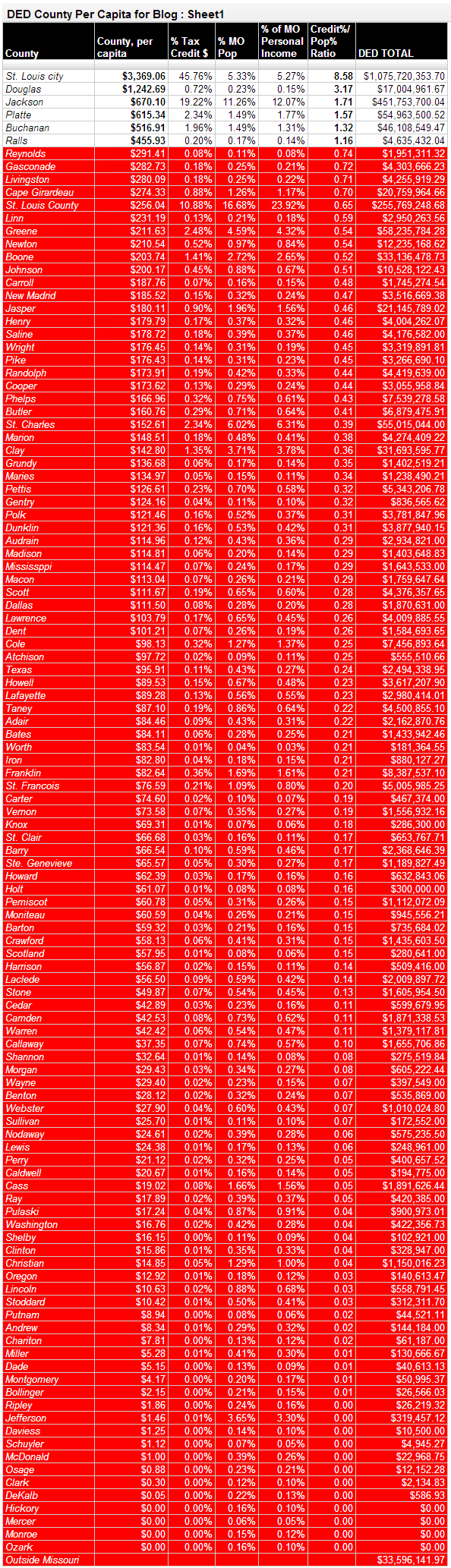
Two years ago, Bruce Stahl and I compiled tax credit data from the Missouri Department of Economic Development (DED), the state’s primary development agency, to determine how economic development tax dollars were distributed geographically. Now that the tax credit reform issue has returned to the legislative forefront, it is important for Missourians to understand that these incentives have not been distributed on anything approaching a geographic basis — the way in which a tax cut, generally speaking, would reveal itself.

The data below encompasses tax credit issuances from 1999 to 2011. If tax credits had been distributed in line with Missouri’s population, each resident would have received the equivalent of about $393 in tax credit issuances.

Six of Missouri’s 115 counties (114 plus Saint Louis City) received above this $393 per person figure. The remaining 109 — more than 90 percent of Missouri counties — received less than that average. A searchable version of this document is available here. To put it bluntly, it seems to me that a vast majority of Missourians are essentially picking up the economic development tax credit tab for projects in just a half dozen Missouri counties. The disparities between counties here would be far, far less pronounced if instead of focusing on distributing tax credits to some, we distributed tax cuts to all.

Support Us

The work of the Show-Me Institute would not be possible without the generous support of people who are inspired by the vision of liberty and free enterprise. We hope you will join our efforts and become a Show-Me Institute sponsor.

Donate
Man on Horse Charging