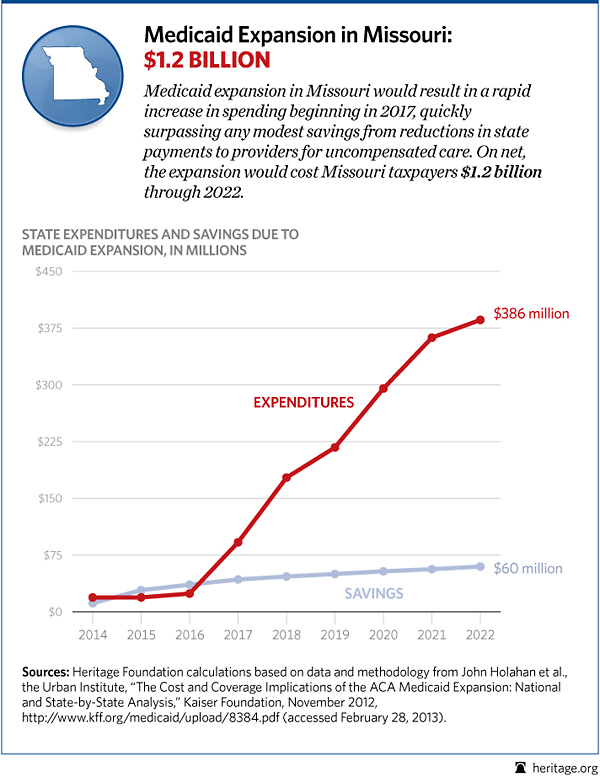
Chart: This Is Not ‘Medicaid Reform’

Earlier this month, the Heritage Foundation built and published a chart that ran out the direct costs of a Medicaid expansion with the “savings” the state could expect from now until 2022. This chart does not include the $1.6 billion in costs associated with the expansion’s so-called “woodwork effect,” whereby those currently eligible for the existing Medicaid program but not yet enrolled would become enrolled as a result of the Medicaid expansion. That fact makes this chart essentially a best-case cost-benefit scenario for a program whose costs, again, have not really been engaged by Medicaid expansion proponents. “No plan” for those costs is not good enough, as this chart bears out.

North Kansas City Should Privatize Its Hospital

The number of government-owned and operated public hospitals in the United States has declined dramatically over the past three decades. There were almost 2,000 public hospitals in the U.S. in the 1970s. There were only 1,045 public hospitals by 2011, and the trend is continuing for many of the same reasons North Kansas City is considering selling its hospital. Like the post office, the model of a government-owned and operated public hospital facility is simply not nearly as effective as it used to be. All the public concern and political opposition that opponents can generate will not change the long-term economic outlook of public hospitals.

Local governments should provide services that government is best suited to provide and that the private sector cannot serve as effectively. This includes streets, police, fire protection, and neighborhood parks. The list does not include hospitals. The private sector, including both non-profit and for-profit hospitals, has long provided fantastic health services to our country. Indeed, to many Americans, the idea of a government hospital probably feels like a relic.

As with many privatization efforts, the fears of turning a beloved public asset over to the profit-mongering private sector are vastly overstated. The Kaiser Foundation found in a 1999 study of public hospital ownership changes that, “In most instances, access to care for low-income patients has been preserved after conversion and teaching programs have not been cut.”

A 2001 study for the National Bureau of Economic Research concluded: “In many respects, the empirical evidence from hospital conversions is reassuring. … On the whole, hospitals’ missions appear to be preserved post-conversion.” The studies note that the government should carefully negotiate the contracts and monitor the operations after the sale to ensure compliance with public goals and protect the public interest. Missouri law already requires the state attorney general to review any hospital sales, as it did when Sweet Springs, Mo., sold its hospital to a for-profit company in 2009. No more state regulation is needed, especially changes that outright prevent sales to for-profit companies.

Private hospitals, both non-profit and for-profit, are a cornerstone of our health care system. They treat the uninsured and poor as part of their mission, and they do it well. The idea that only a government hospital can take care of society’s needy is as ill-founded as the idea that government should make clothes and grow food for the poor because the private sector is not capable of doing those things, either.

There is nothing wrong with North Kansas City making money off the sale of the hospital if that is what it chooses to do. That money would not disappear in a sinkhole — it would be invested back in the city or returned to city taxpayers via lower tax rates. In particular, if a for-profit hospital took over operation, the tax base of the city would be greatly enhanced. The money from the sale or new taxes could allow the city to do many things, including investing in a lower-cost health care clinic if it chose. Clinics are a far more responsible long-term strategy for local governments than large hospitals. Such a change would not be new to Missouri. Saint Louis County now operates three clinics after closing its public hospital more than two decades ago.

North Kansas City officials deserve credit for launching a careful effort to investigate the best options for the city. They are not doing this as part of a fire sale. If city leaders determine that a sale of the hospital to a private company is best for the city and its residents, they should be allowed to do so without new state regulations blocking the way. Limiting the city’s options, which recent bills filed in the state legislature would do, has no real benefit. If residents and voters do not like North Kansas City officials’ ultimate decisions, they have numerous ways to send that message.

Privatizing the hospital will benefit North Kansas City. Health care services under private operation would continue just as they have for decades under public ownership. North Kansas City should not be expected to hold back against a nationwide trend toward converting public hospitals because of erroneous fears of private operation.

David Stokes is a policy analyst at the Show-Me Institute, which promotes market solutions for Missouri public policy.


Valuing Public Employee Pension Liabilities: Nothing ‘Fair’ About It

The Show-Me Institute recently released a study that I authored about Missouri public employee pensions. The study argued that pensions should value their future benefit liabilities using a low “discount rate” to account for the fact that retirees’ benefits are legally guaranteed, regardless of how the plans’ investments turn out. The study cites numerous sources, such as the Federal Reserve, the Congressional Budget Office, and others arguing for so-called “fair market valuation.” If you value guaranteed public pension liabilities using a safe 4 percent interest rate, rather than the 8 percent rate that is common for public plans, Missouri’s unfunded pension liabilities rise from about $11 billion to $54 billion.

The St. Louis Post-Dispatch’s David Nicklaus brought these results to Gary Findlay, executive director of the Missouri State Employees Retirement System (MOSERS) and an outspoken opponent of fair market valuation. “Using a risk-free discount rate, Findlay says, is about as sensible as arguing that the state should take a zero-risk approach to traffic accidents — by banning cars.”

In fact, fair market valuation does not say that pensions cannot take investment risk. Nor does it argue that investment risk cannot pay off. Rather, it merely says that we cannot assume that investments always pay off and ignore the risks those investments pose to the budget and the taxpayer. Under current pension accounting rules, a plan that takes more investment risk — say, by shifting into stocks, private equity, or hedge funds — automatically becomes “better funded” because the plan then assumes a higher investment return. But high-risk investments do not make pensions better funded. Yes, they reduce contributions for current taxpayers — but shift an equal and opposite contingent liability onto future generations to pay full benefits should the assumed rates of return fail to materialize.

And, as recent experience has shown, riskier investments do not always pay off, even over the long run. In fact, MOSERS’s own investment consultants told them that the plan has a less than 50 percent chance of achieving its stated returns. But full benefits must be paid 100 percent of the time. Fair market valuation catches the cost of guaranteeing full benefits. Current accounting standards ignore it.

Findlay’s traffic accident analogy is not the most apt, but think about it this way: Automobiles come with obvious benefits but also costs, including the risk of traffic accidents. But we cannot weigh the costs and benefits if we refuse to count the number of accidents each year. Similarly, we cannot refuse to consider the possibility that our bets on high-risk pension investments will not pay off, particularly when billions of taxpayer dollars are on the line.

This Land Is My Land

Where I grew up, private neighborhood streets were rare. None of my friends lived on gated streets, and city plows did not pass over anyone’s street during storms. But in Saint Louis, private streets seem to be more common. Some Sunset Hills residents living on private streets want to keep them that way.

Alwal Moore owns a 10-acre property near Tapawingo National Golf Course. He had plans to construct a private library on the property that would offer cultural classes such as violin and yoga. But the streets leading to his property are privately owned, and homeowners were not happy with his plans.

Resident Chris Rothrock said the library “will be nothing short of disruptive to all of our lives and it presents a significant safety threat to all of the children in our neighborhood.”

Overwhelming opposition to the project, including a petition that 68 percent of residents on surrounding streets signed, prompted the Sunset Hills Board of Aldermen to reject Moore’s private library proposal. But why was the government involved in the first place?

As a private neighborhood, these homeowners have a right to stipulate how their streets will be used and who will use them. Moore, as a private property owner (not part of the surrounding neighborhood associations), has a right to do what he wants, to a certain extent, with his property.

Zoning laws already allow the construction of a library in a residential neighborhood. I do not see a need for additional government approval here.  If private property owners oppose the project,  that is a matter for them to take up with Moore without government involvement.

Moore should be able to work out a deal with area residents to get them on board, such as contributing toward their annual maintenance fees. Because, what good would the library be if homeowners decided to close their streets to public traffic?

No, A Medicaid Expansion Would Not Be ‘Medicaid Reform’

On Wednesday, the Missouri Hospital Association (MHA) and the Missouri Chamber of Commerce held a press conference touting a report which portrays the expansion of Medicaid under the Affordable Care Act as a “reform.” It is not, as I have reiterated time and time again. It is not “a jobs program.” Other states will not “get Missouri’s money.” It is a fiscal sinkhole that is not funded, but the MHA and Chamber are OK saddling taxpayers with the cost.

Let me briefly set the rhetorical stage on the Missouri Medicaid news of the last couple weeks that these two groups, in large part, have driven. First, hospital groups favored the enactment of the Affordable Care Act in 2010, and the Missouri Hospital Association even went so far as to oppose Proposition C, the Health Care Freedom Act, later that summer. Hospitals want, and have wanted, the Affordable Care Act for some time; it is not surprising that they would demand that the state expand Medicaid under that program.

Second, the Missouri Chamber of Commerce has supported pricey government programs in the past, and the Medicaid expansion is a doozy. Readers may remember that the Missouri Chamber was a key supporter of one of the biggest proposed boondoggles of the last decade, the Aerotropolis project, and that project was “only” a half billion dollars. The Medicaid expansion? The cost is upwards of $3 billion to the state, and billions more to the federal government (a government which we, of course, also fund.)

Lastly — and tying this all together — that MHA poll from last week was “reviewed” for an organization I cannot find by a lobbyist for a Medicaid managed-care provider, a lobbyist who worked side-by-side with the Chamber two years ago on . . . the Aerotropolis legislation.

We have seen this all before, and around we go yet again.

Stated simply: expansion is not reform. The tactics being used to re-package and re-message the issue are about as predictable as those used to promote Aerotropolis. Indeed, some of the same parties involved in Aerotropolis are involved in the Medicaid expansion. That fact should give us all some pause.

Saint Louis Earnings Tax Is Bad for Our Health – But Do We Care?

Listen online here:

Call it “the smoker’s dilemma”: Everyone knows that smoking kills, but a habitual smoker may be convinced that he needs the steadying effect of cigarettes. When voters in Saint Louis go to the polls on April 5, they will confront a similar dilemma in deciding whether to maintain the current earnings tax.

Show-Me Institute research has established that the 1-percent earnings tax hurts economic growth in our state’s largest cities. But many officials think that their budgets will collapse without the revenues they receive from it.

If voters decide to rescind the earnings tax, would Saint Louis city government collapse? No, but there is no magic bullet for replacing the revenue it generates. If the earnings tax is eliminated, it would be phased out over a 10-year period. During that time, Saint Louis could adjust to the new realities through a combination of changes.

The city of St. Louis could follow the county’s example by selling its municipal water utility to a private company. That could be worth hundreds of millions of dollars. It would give the city a quick infusion of money that would more than offset the initial hit without the earnings tax.

There are many opportunities for Saint Louis to consolidate services. During the 10-year phase out, city officials can work to re-enter Saint Louis County. Consolidating certain government functions along with a county takeover of some things like highways and bridges could save the city millions of dollars.

All taxes are not equal. As the earnings tax is phased out, it could be replaced by less harmful taxes. For years, Kansas City has charged a land tax to fund parts of its transportation system. Land taxes are property taxes based only on the value of the land rather than the building. Many economists think they are among the least harmful methods of taxation. This type of tax system could be adopted in Saint Louis.

All budgets can be cut. Saint Louis should embrace this opportunity to cut unnecessary services. For instance, the city already has both the Police and Sheriff’s Departments, so why does it need a third law enforcement agency, the City Marshal? Every duty of that office can be transferred to the police or sheriff, and that department can be eliminated entirely, saving the city more than a million dollars a year.

Perhaps the most important thing that Saint Louis can do is eliminate tax subsidies. As of 2009, Saint Louis had $683 million in tax-abated property. If the city stopped issuing abatements, a large percentage of that property would return to the tax rolls during the following 10 years.

Quitting smoking may be hard, but doing so is in any smoker’s long-term interest. A 10-year phase-out period allows plenty of time for Saint Louis to kick its habit and make the changes needed to continue providing necessary services without relying on the earnings tax.


What Can Starbucks Tell Us About Kansas City?

Starbucks is one of the most ubiquitous brands on the planet: Since its founding in 1971, the upscale coffee chain has expanded rapidly to more than 20,000 stores worldwide. Many American urbanites have probably grown accustomed to passing one regularly, if not frequently dropping in themselves. The company has arguably saturated the U.S. market, making its weak presence in Kansas City proper a curious anomaly. This prompted me to delve deeper into potential reasons for Starbucks’ tepid growth in Missouri’s largest city.

A book co-authored by Arthur Rubinfeld, known as the “architect behind Starbucks’ expansion,” outlines the logic underlying the company’s growth strategy. With a target market comprised of “urban professionals, high-income individuals from the age of 18 to 45,” Starbucks sought to conquer the country’s major metropolitan areas. Demographic considerations, the intensity of competition, city-specific macroeconomic conditions, and a number of other factors, determined the pattern of expansion.

The areas surrounding Kansas City are home to a multitude of Starbucks coffee shops, which form something of a ring around the city itself. This same distribution is not evident in other Midwestern cities such as Saint Louis, Oklahoma City, Omaha, and Indianapolis. We can learn a lot about certain areas from the behavior of private enterprise.

My colleague Patrick Ishmael and I intend to explore this phenomenon in greater detail. We wish to better understand why Starbucks has chosen to focus disproportionately on Kansas City’s peripheral markets. As Rubinfeld’s volume makes clear, a substantial amount of research goes into determining how capital can be most profitably distributed. Accordingly, there is almost certainly a strong rationale under-girding Starbucks’ behavior in Kansas City. Perhaps further investigation can teach us some important lessons about the business climate in the City of Fountains.

Note: The green circles with white numbers simply represent areas with such a high density of Starbucks stores that individual emblems cannot be displayed. A circle with a number, n, corresponds to an area with a concentration of n stores.

TIF Reform Stalled In State Legislature

There are definitely some good things happening in the Missouri Legislature. There are, as always, plenty of bad ideas, too. Unfortunately, this session appears to be missing an opportunity (again) to reform the rampant abuse of Tax Increment Financing (TIF) in Missouri. There are several very good bills in the Missouri House that appear to be stalled. I would love to be wrong. I would be delighted to eat crow on this, but everything I see and hear tells me TIF reform is not getting out of the House of Representatives despite substantial support for reform from the rank-and-file of both parties.

TIF reform can be accomplished if voting from all taxing districts that the TIF affects is required, as the above linked bills propose, or if the ability for cities to override a county TIF commission is eliminated. Both would be excellent. Neither plan would eliminate TIF in Missouri, though both would heavily reduce its use, in my opinion. The overuse of TIF is empowering local governments to plan our economy, pitting city against city (willingly, too often) in a property tax base race to the bottom, increasing the use of eminent domain, and is violating tax fairness because it allows cities to decide on tax exemptions that affect all levels of government.

Of course, there are many good aspects of TIF, but our word count limit will not allow me to go into them. That is a joke. There is absolutely nothing worthwhile about how we administer TIF in Missouri. (Other states use it more wisely, mostly because they focus TIF only on property taxes and do not include sales or income/earnings taxes.)

The focus for TIF reform is on the House because it pretty clearly will pass the Senate. (Last year, a major reform bill passed 34-0 in the Senate.) I think the governor would sign a good reform bill if it makes it to his desk. I am fairly certain that a substantial majority of House members would vote in favor of reform if it makes it to the floor. I think it is imperative that key House leaders allow TIF reform to get on that floor for a vote. Otherwise, this would be a tremendous lost opportunity for important changes in Missouri.

Support Us

The work of the Show-Me Institute would not be possible without the generous support of people who are inspired by the vision of liberty and free enterprise. We hope you will join our efforts and become a Show-Me Institute sponsor.

Donate
Man on Horse Charging