NorthSide Receives State’s Largest TIF

The Missouri Supreme Court enabled Saint Louis City to award a staggering $390 million TIF (Tax Increment Financing) package to NorthSide Regeneration (a.k.a. Paul McKee).  This is not only the largest TIF in Saint Louis history — it is the largest TIF ever awarded in the state of Missouri.

Do you think that pumping hundreds of millions of taxpayer dollars to one developer is the key to successful North Side revitalization? I would love to be wrong on this, but can someone please give me evidence (economic, historic, etc.) where this type of huge subsidy to one developer working hand-in-hand with government planners has managed to successfully revitalize a community? Some say that McKee’s dream is worth a shot despite a high uncertainty that it will work; I obviously do not agree in this case. But who knows, maybe McKee will be to Saint Louis what Baron Haussmann was to the rebuilding of Paris.

If you are not familiar with the NorthSide project saga, I recommend reading this short article in St. Louis Magazine to get the Cliff’s Notes version.

Saying Hello To An Amazon Tax

Late last month, a New York Court of Appeals ruled that the state of New York can force online retailers such as Amazon.com and Overstock.com to collect sales taxes, even in states where the retailer does not have a physical presence. This sets up a potential showdown at the U.S. Supreme Court because this ruling conflicts with an earlier Supreme Court decision stating that states cannot force retailers to collect sales taxes in which they are not located.

If the Supreme Court rules that states can impose an online sales tax, expect to start paying more. In Missouri, the Senate approved a bill that would force online retailers to collect sales taxes; the House is considering the proposal now.

I have been going back and forth on the prospect of paying sales taxes on my Internet purchases. I am sympathetic to proponents’ arguments that say the tax code should not favor one type of business over another.

However, these types of taxes can be really complicated. There is also a decent chance that they will not generate much money. After one study in Illinois estimated that the state would collect $153 million, it turned out that after instituting a tax on e-commerce, it was on track to collect just  $6.4 million from the tax, a mere 4 percent of the original estimate (hat tip: Illinois Policy Institute) .

Again, I am sympathetic to the idea of ending tax preferences in the tax code. However, if the cure is worse than the disease, which these types of taxes are starting to look like, the state should take a pass.

Is Head Start ‘Worth Every Penny’?

In light of a recent federal study, which concluded that the Head Start program does not have lasting benefits, there have been increasing calls to cut funding for the program. But in Saint Louis’ KSDK-NewsChannel 5’s recent report, U.S. Sen. Claire McCaskill (D-Mo.) said the program is “worth every penny.”

Since 1965, we have spent more than $180 billion on Head Start. That is a lot of pennies! I am not so sure this program is worth the cost.

The KSDK piece does a nice job of presenting the traditional arguments on both sides of this issue. Unfortunately, the traditional debate lines are structured as Head vs. Heart. That is, the academic literature says Head Start is not working, but the heart says that we must serve these disadvantaged students. The proposition is set up as if it is an either-or; either we can serve low-income families through Head Start or we do not serve those families.

I firmly support helping disadvantaged families access quality educational programs. That is why I support school choice. In my opinion, the question is not whether we should help poor families. The question is whether Head Start is an effective way to do that or if there might be a more effective method.

Watch the video and tell me what you think the proper role of government is in this regard.

Additionally, here are some previous Show-Me Daily posts on Head Start:

Early Childhood Education Funding

Choice, Not Early Childhood Education, Is a ‘Smart Investment’

On The Medicaid Proposal Coursing Through The House

Last week, the Missouri House Committee on Government Oversight and Accountability voted 7-2 to pass House Bill 700, a proposal that would expand Medicaid eligibility, but short of the levels that the Affordable Care Act (ACA) proscribes. The media has variously described the proposal as an “expansion” and an “alternative,” and Democrats and Republicans alike — depending on what they want to see in the measure — can and have described it as both. In view of that rhetorical ambiguity, it is unsurprising then that not only was committee support for the bill bipartisan, so, too, was its opposition.

Rep. Kevin McManus, a Kansas City Democrat, pointed out that Health and Human Services Secretary Kathleen Sebelius has repeatedly said states couldn’t get full federal funding unless they fully complied with the national law. That’s why he was one of two lawmakers to vote against the bill in committee.

Joining him in opposition was Rep. Mark Parkinson, a St. Charles Republican who said he could not support the bill because of an ideological opposition to the federal health care law. Three times, he said, voters in his district have rejected Obamacare. The first was a ballot measure in 2010 on the individual mandate. The second was last fall’s ballot measure on health insurance exchanges. The third was a vote against President Barack Obama’s re-election.

The committee had previously voted down an attempt to amend HB 700 to actually implement a full Medicaid expansion. That was not altogether unexpected, either; the House has been stalwartly opposed to an ACA Medicaid expansion as both standalone bills and amendments. Suffice to say, I share their skepticism and concerns about the program.

As to HB 700 itself, my views about the proposal have been documented; the legislation has some good points, including reforming some aspects of how Medicaid is delivered. But it seems in some respects to bow to a perceived political reality that more has to be spent on the program for reform to be passed. I do not agree with that view. Medicaid reform is a good unto itself that policymakers of all stripes should be able to get behind. Moreover, I worry that in the process of HB 700’s continued legislative sausage-making that we ultimately will find the state passing a law that, inadvertently or purposefully, actually expands and implements the Medicaid program under Obamacare. The governor is still pushing for that, and by keeping the increased spending aspect a live wire, I am still concerned about this possibility. Indeed, if this compromise legislation moves any further in the expansion direction, it will be right and truly compromised.

The perfect need not be the enemy of the good, but I am not yet convinced the pavestones of this legislation are leading us someplace Missouri voters want to be. Stay tuned.


Empowerment Scholarship Accounts

I have written several times about education savings accounts (ESAs). In 2011, Arizona enacted the first ESA program and named them “Empowerment Scholarship Accounts.” Watch the video below and I think you will see why these scholarships truly empower parents to access the educational services needed for their child.

Before you watch the video, I want to point out one very interesting thing that you may miss. When the mother of the special needs student is interacting with the physical therapist, you see her swipe a card on the doctor’s phone. That card is the debit card linked to the family’s ESA.

We May Still Have Mail Delivery On Saturday

A few weeks ago, I wrote about the United States Postal Service’s (USPS) intention to cut Saturday delivery. I argued that this proposed cutback is consistent with the Postal Service’s status as a government-sanctioned monopoly: Instead of finding innovative ways to cut costs without sacrificing customer service, the USPS simply opted to strengthen its bottom line at the expense of the latter. By law, no other entity can deliver first-class mail, so why worry about keeping your customer base happy?

It now seems the proposal will not materialize. Congress passed legislation last month, which President Barack Obama signed, that obligates the USPS to maintain six-day delivery. The USPS may still alter the kind of mail it delivers on Saturday, with plans to eliminate first-class mail delivery and pick-up service while continuing delivery of packages and pharmaceutical drugs on Saturdays.

Officials with the USPS have warned that a $47 billion bailout, which taxpayers would fund, may soon be necessary if it is not given more freedom to change course. Everybody knows that the Postal Service needs to cut costs (or increase revenue), but Congress is standing in the way. This is all part of a broader pattern: It is precisely this inability and/or unwillingness to confront economic reality that made the sequester necessary.

One of two scenarios seems likely: Service will be cut to avoid bailing out the USPS or Saturday service will continue at the price of funding a bailout. This is a false alternative, one that the free market would not present. The proper course of action — privatizing and abolishing the monopoly status of the USPS — would yield a twofold benefit. Companies would compete with one another to not only keep their costs sustainable, but to continually improve their services. Moreover, if one such company failed to maintain financial solvency, it would simply go out of business. In short, these forces would function to keep customers satisfied without putting their property at risk (through taxpayer-financed bailouts).

The dilemma about the USPS is totally unnecessary and such situations can be solved if we keep the government out of business and out of our pockets.

Small Business Friendliness Survey: Kansas Gets ‘A,’ Missouri Gets ‘C,’ Illinois Gets ‘D’

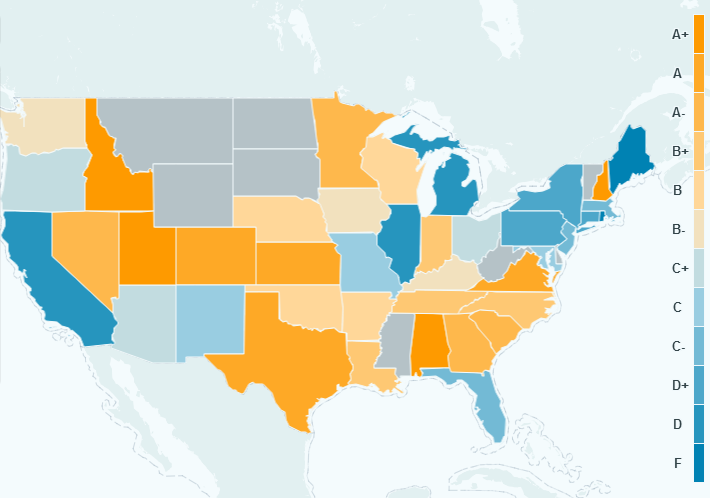
The usual suspects are out in full force with the Parade of Economic Horribles they say would come from Missouri enacting Kansas-style growth policies. However, a survey by Thumbtack.com and the Kauffman Foundation published this week throws yet another bucket of cold water on those warnings. The survey asked more than 7,000 small businesses how states are doing in facilitating small business development . . . and the results are not good for Missouri.

Kansas was viewed favorably for its support of small business, improving upon last year’s A- ranking. The state graded well for the ease of starting a business, especially its regulatory systems.

Missouri slipped slightly in 2013 after earning a B- a year ago. That decline can be attributed partly to issues with licensing and permitting requirements.

You can find an interactive map that looks at all the aspects the survey examined — including regulations, health and safety, licensing, and more — here. As with any index, all of the survey’s findings have to be put in the proper context: survey methodologies, assumptions, and objectives do matter, so your mileage may vary on whether you think Thumbtack.com and the Kauffman Foundation are balancing their factors credibly. In that context, I think it is still worthwhile to highlight their topline results, visually represented in the screenshot below and available on Thumbtack’s website.

That Midwestern section sure looks like the kind of growth corridor I have discussed in the past, but unfortunately, Missouri sticks out like a sore thumb on the map. The question is, will Missouri be a part of this growth corridor? Will Missouri go the way of Kansas . . . or of Illinois?

Funny-But-Not-So-Funny Update On Columbia Airport

Columbia is forging ahead with plans to create a new passenger terminal, despite a significant drop in airline service.

Here is a quick recap of recent events. This past year the airport enjoyed service from American Airlines, Delta, and Frontier Airlines. But American Airlines is now the only commercial airline staying in Columbia, as Delta already left the market, and Frontier exits in May.

Consulting firm Parsons Brinckerhoff will provide design services for the new terminal for $38,000. In a recent press release, Parsons Brinckerhoff hypes the new terminal and defends the need, stating that “Columbia Regional Airport has been experiencing growth and has seen an increase in the number of commercial airline service offerings.”

After reading that, I literally double-checked the date of the press release to confirm that it indeed said March, 28, 2013, and not 2012. While it is technically true that the airport has increased commercial airline service offerings, the statement leaves off the very important second half of that statement — the growth has stopped, and service offerings are much lower than they were a year ago.  It is like saying George Bush is president. It was true, at one point in time, but you are not going to find him at the White House today.

Still, city leaders seem confident with their multi-million dollar plan. The Columbia City Council decided on Monday to transfer $1.2 million away from other city projects to fund the terminal, and plan to allot another $18.7 million to the project in the 2014 Capital Improvement Plan, in hopes that the federal government will agree to contribute a large portion of the total cost.

Support Us

The work of the Show-Me Institute would not be possible without the generous support of people who are inspired by the vision of liberty and free enterprise. We hope you will join our efforts and become a Show-Me Institute sponsor.

Donate
Man on Horse Charging