New Documentary Highlights Criticism Of Common Core

On Monday, the Home School Legal Defense Association released a documentary about the Common Core State Standards, “Building the Machine.” There is an obvious bias against the standards in the film, which means Common Core proponents undoubtedly will pan it as propaganda. Nevertheless, the documentary does present some pretty compelling criticisms of the Common Core development process and the standards themselves.

It also does something that Common Core proponents haven’t done very well; it treats individuals with opposing ideas with some respect, ominous music notwithstanding. For example, Michael Farris, founder of Home School Legal Defense Association, stated:

David Coleman [lead writer of Common Core] is a nice man…I don’t agree with his approach at all. I don’t agree with his philosophy. I think that on balance his proposals are not for the good of the public schools. They certainly aren’t good for homeschoolers or private schools. You know, I have some criticism there. But the man’s motives, I don’t think we should be attacking people for their motives. Because, he wants to try to improve the public school system. He genuinely believes that systemization and centralization and data collection are good things for kids.

His point was the underlying current of the film – people have deeply held convictions on issues of education and those convictions often vary.

The film ends with this message:

Decades of research show that the single most important element in a child’s education is parental involvement. So, regardless of which side you support in the reformation of America’s schools…Be involved.

That is good advice. In fact, it is the same advice Emily Watson shared on the Show-Me Daily blog about a month ago.

KC Streetcar TDD Will Not Raise Enough Money for Expansion

Bus IconAccording to the newest plan for the Kansas City Streetcar expansion, there is a $30 to $50 million gap between what the streetcar’s transportation development district (TDD) will raise and the actual cost of the project.

We have written before that the Kansas City Streetcar is an exceptionally expensive and inefficient transit device. We have also warned that the claims of streetcar induced development are, at best, premature. Now we learn that, according to a streetcar plan that the City Council passed last week, no one knows how Kansas City will pay for the project.

The proposed TDD includes a 1% district-wide sales tax and a new tax for properties within 1/3 mile of the streetcar track. That new property tax ranges from 40 cents per $100 of assessed value, to $1.04 per $100. One might note that the $1.04/ $100 rate is on city-owned properties, which Kansas City residents will pay through taxes somehow. The consultants who created the TDD calculate that available revenue for debt service from property and sales taxes will be $177 million, but the capital costs of the streetcar extension plan are around $515 million.

How does $177 million pay for $515 million? First, the planners assume that the city will pay the utility costs of the project from other revenue, or about $28 million dollars. That lowers the project cost to $487 million. Then, they assume the federal government covers half the plan, which, as the authors point out, is not guaranteed.  That leaves a funding gap of about $53 million. The study further reduces this gap through contributions from the city’s Mass Transportation Sales Tax, which essentially means they will divert funds from KCATA. They also plan to offset costs with rider fares (they optimistically assume revenue of $2,000,000 per year, much better than some other streetcars). With those additional funding sources, the gap is only $31 million.

Where will the streetcar get that extra $31 million? There is no answer to that. The consultants hope that increased economic activity from the streetcar will raise TDD revenue, but that is risky. Among the proposed revenue sources they claim could be used for the streetcar: various federal grants, Missouri state tax credits and grants, the city park capital improvement fund, a city gasoline tax, new TIF districts, private foundation grants, among many others.

To sum it up, a large TDD that imposes a 1% sales tax and property tax increases will not fully fund the streetcar (even with the federal government already paying for half), and the planners know it. Unless the federal government is willing to pay the balance, Kansas City or Missouri tax payers will be expensively called on in some way to make up the difference. All in all, the funding section of the streetcar plan should have been called “here be dragons.”

Don’t Forget About Homeschoolers!

School IconNew Hampshire is one of 14 states that have implemented a tax credit scholarship program for students. Essentially, these programs give tax credits to people who donate to approved scholarship funds. Families can apply to use these scholarships to send their students to schools of their choice. So what is so unique about the program in New Hampshire? It is the only program that allows families to use these scholarships to homeschool their children.

In a new case study for the Show-Me Institute, Jason Bedrick notes that more than half the scholarships awarded in 2013 were used for homeschooling expenses. And the families who enrolled in the program were, for the most part, extremely pleased with the opportunity, more than 80 percent, in fact. Homeschool families also saw more academic improvement than their private school counterparts. They appreciated the fact that they were in control, that they were able to adjust the curriculum according to their children’s needs, and that they had more options for different or harder classes. Many of them mentioned that it helped strengthen family relationships.

I have nine siblings. When I was growing up, my parents wanted to make sure that my siblings and I received an education that met our individual needs. They explored public and private schools and each of us was homeschooled at one time or another. The beauty of homeschooling is that it allows parents to tailor the curriculum for their children. Additionally, homeschooling benefits the state because it saves taxpayers money. However, for families like mine, it can be financially difficult. That is why New Hampshire’s tax credit scholarship program is particularly interesting. It could enable more families to homeschool and benefit both families and the state.

As Missouri looks at options for expanding school choice and implementing tax credit scholarship programs, it should seriously consider expanding these to include homeschooling.

The Overly Optimistic Estimates For The Kansas City Streetcar

The latest plan for the streetcar extension in Kansas City has 7.6 miles of routes at a cost of $472 million. We have written before that for the same cost, the Kansas City Area Transportation Authority (KCATA) could afford to massively expand its bus service. But we have not addressed the very optimistic ridership projections in the new Transportation Development District (TDD) proposal.

According to the NextRailKC website, the 7.6 miles of streetcar could achieve anywhere from 13,700 to 23,200 passengers per weekday, based on modeling they have performed. With 7.6 miles of track, that is between 1,800 and 3,000 weekday passengers per mile. While models can be useful, at some point, someone should have checked what streetcars achieve in other cities.

Simply put, these ridership estimates are unrealistic. The high-end estimate would make it the most successful streetcar line in America according to ridership. It would have more riders than Seattle, the busiest streetcar line in America, which is only a mile long and is right in the heart of downtown Seattle. Do they really think that is going to happen?

If Kansas City achieved its low estimate of 13,700 riders per day, it would be performing about as well as Portland’s streetcar.  Portland’s system is considered highly successful in terms of riders, but there are reasons to think that Kansas City will have difficulty reaching Portland’s ridership levels. Portland has offered streetcar users low fares (originally there were free zones and the price eventually increased to $1) and used significant subsidies for transit-oriented development.  In addition, rail lines in Portland run through much denser population centers than what is proposed in Kansas City.

Of course, other streetcars see much less ridership than Portland’s and Seattle’s. Streetcars in Memphis, Tenn., and Kenosha, Wis., each had ridership below 1,000 daily passengers per mile. Why do Kansas City planners see no possibility of their streetcar performing at that level?

sc

It is possible that the Kansas streetcar will be wildly successful, and garner 23,200 passengers on an average weekday. But that is not something that is fair to sell to the public as a likely occurrence. The lower estimate, 13,700, is a more realistic maximum estimate given the performance of existing streetcar operations in other cities.

Further Remonstrances On Clayton Tax Increases

Last week, I blogged about the Clayton economic development sales tax proposal. While that is a bad idea in and of itself, it is unfortunately part of a much larger package of tax hikes. There are four (four!) different proposed tax hikes for voters to consider on the April ballot. If you think that is a lot, well, . . . it is.

I want to focus here on the property tax aspect. The proposals call for two different bond issues, each requiring a separate tax increase. One is for neighborhood road improvements in Clayton, and one is for improvements to Shaw Park, mostly the ice rink. If they both pass, the property tax increase would be 24 cents per $100 of assessed valuation.

Supporters of this tax hike, and most tax hikes, like to make the numbers seem small. “Only 25 cents added to an average restaurant meal” or something similar. For this tax hike, I keep hearing it is less than $20 a month for an average Clayton home. Fair enough; that does not sound so bad. (Math is $500,ooo home x 24-cent tax increase per $100 of assessed valuation = $228 annually.)

However, Clayton residents benefit from the enormous business concentration there, and businesses don’t get a vote on the tax hike. (They can vote with their feet, metaphorically.) What is the tax hike here on a Clayton business?

Well, we don’t know it by business, but we can easily figure it out by building. Take one of Clayton’s nicest buildings: 7701 Forsyth. If these two property tax increases go through, it’s owners would pay $21,175 more each year. That is $21,000 more to support park and road improvements that will benefit the businesses far less than the residents. (The road bonds are all for neighborhoods, not the business areas.)

Take its sister building, 7733 Forsyth. That property would pay $32,000 more in property taxes under these proposals. This for a building whose owners already pay well over a million a year in property taxes. That means higher rents in Clayton. These higher rates would also apply to business property (factory equipment, copiers, computers) so there would be less capital investment in Clayton, though I admit that effect likely would be very small.

That is $53,000 per year from two buildings that already pay an extra downtown tax assessment that can be used for their central business district streets. (It usually isn’t, but it can be and likely has been in the past.) At some point, asking Clayton businesses to pay much higher property taxes that will primarily benefit the residents is a poor policy choice, in my opinion. At a minimum, the proposal to increase the property tax for park renovations should be shelved in favor of privatizing the rink’s operations (but not ownership) just like the Saint Louis City has done with Steinberg Ice Rink.

State Audit Recommends Sunset Of Historic Preservation Tax Credit

You saw the original, and now here’s the sequel. Just weeks after producing an excellent report on Missouri’s Low Income Housing Tax Credit, Missouri’s state auditors have returned with a review of the Historic Preservation Tax Credit (HPTC) program. We have talked about the HPTC at length here on the blog and elsewhere, and I am delighted that the state’s auditors took a look at a program that has hemorrhaged taxpayer money for years.

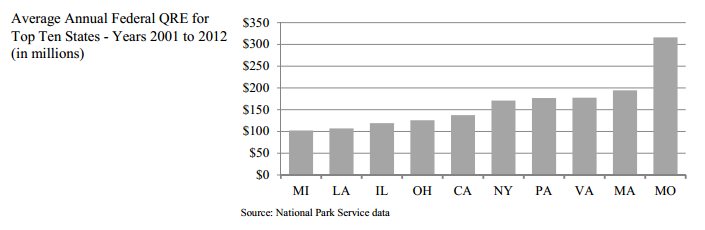
What did the auditors find? A lot. For starters, HPTC tax credits have cost the state nearly $600 million over the last five years alone and more than a billion dollars over the last 10. Missouri leads the country in “qualified rehabilitation expenses” (QRE) for historic preservation, which relates to the expenses against which the HPTC could be applied. Broadly speaking, the higher the QRE that rehabbers claim under the HPTC, the more money the state will be spending on it.

So, how big is Missouri’s QRE lead? Check out this chart from page 8 of the audit.

For perspective, Massachusetts, Virginia, Pennsylvania, and New York are all original U.S. colonies. Are we to believe that Missouri should have been subsidizing preservation spending at almost twice the rate as the next closest state… and not only that, subsidizing it at that level for more than a decade?

I can appreciate that we love our old buildings in Missouri, but if anything and everything can get the stamp of being “historic,” then we degrade the things that are, in fact, historic and waste limited taxpayer resources in the process. Could some projects be worthy of taxpayer support? Possibly, but those cases would be an exception, not a billion dollar rule.

To name a fraction of the examples that underscore this reality, Norwood Hills Country Club should not have received taxpayer money. A whole host of private mansions that the HPTC subsidized should not have received taxpayer money. Check out this story, from the audit:

In 2011, the DED issued about $296,000 in credits to an applicant who renovated a 3-story, 5,400 square foot home in an affluent neighborhood in a metropolitan area. The applicant purchased the home in 1993 for nearly $300,000 and reported about $1.2 million in qualified rehabilitation expenditures. The home has a fair market value of approximately $434,000.

So the owner buys a $300,000 house, drops $1.2 million into it, gets nearly $300,000 (almost what he paid for the house originally!) in credits from the state, and the value of the house rises… about $130,000? On what planet does subsidizing a private residence in a wealthy neighborhood make any sense for taxpayers? Why did Missourians have to effectively reimburse this person the purchase price of their home? Who’s looking out for the taxpayers here? And who in their right mind and looking at the numbers thinks this is a good “investment” for the state?

The HPTC is a mess of a program. The least the legislature could do is set a date for this madness to end.

Spending ‘Brewster’s Millions’ On Missouri Public Schools

Brewsters Millions

Imagine your great uncle passes away and leaves you a huge sum of money, but there is a catch. To get the money, you have to spend $30 million on Missouri’s public education system and make a demonstrable impact on student achievement. Contrary to the plot of the 1985 comedy “Brewster’s Millions,” your great uncle demands results. Would you follow Missouri Budget Project’s advice and put the $30 million into the state’s foundation formula for public schools to make up for the funding gap?

If so, you could probably kiss your riches goodbye. You might be better off following Monty Brewster’s lead and organizing a baseball game against the St. Louis Cardinals. You could invite disadvantaged students to watch the game on a field trip. After all, one study has shown that “poor” readers with more knowledge about baseball outperformed “good” readers with relatively little knowledge about baseball.

All levity aside, there is little reason to believe that pumping more money into the funding formula will lead to improved results.

Let’s imagine that you do put the money in the formula to fill the “underfunding” gap. In the table below, I display how much Missouri schools would get from your great uncle’s generosity. In this graph, schools were sorted into deciles based on the percentage of students scoring proficient or advanced on the state’s math exam (districts were weighted for size). As you can see, you would be giving almost as much money to the highest-performing schools as you would to the lowest-performing schools.

If you would not invest your own money in this manner, why would you invest taxpayer money this way?

I have never denied that Missouri is underfunding the foundation formula; the state is. This does not mean that the formula is infallible. The formula is flawed and is in need of change. It is time to stop asking how much money we can spend on schools and start asking how we can spend our money more effectively, so that we can truly improve the lives of students.

Performance Decile (1=Low, 10=High)

Percent of Funds Received

Brewster’s Wasted Millions

1

11%

$ 3,268,083.78

2

11%

$ 3,408,597.58

3

9%

$ 2,633,148.34

4

12%

$ 3,562,383.35

5

9%

$ 2,742,869.50

6

10%

$ 3,107,064.16

7

10%

$ 3,026,888.02

8

12%

$ 3,545,048.73

9

8%

$ 2,407,816.09

10

8%

$ 2,298,100.43

Support Us

The work of the Show-Me Institute would not be possible without the generous support of people who are inspired by the vision of liberty and free enterprise. We hope you will join our efforts and become a Show-Me Institute sponsor.

Donate
Man on Horse Charging