The Francis Howell Transfer Decision: One Family’s Disappointment

“It’s a slap in the face.” That was parent Cameral Cotton’s response to the Francis Howell School District’s decision to not allow students from the Normandy School District to return this fall. A series of decisions from the Missouri State Board of Education and the Missouri Department of Elementary and Secondary Education made the action possible. Freshman Mar’Kita Fields, senior Mark Fields, and fifth grader Georgina Montgomery are among the 350 Normandy students who had applied to return to Francis Howell.

Some Normandy residents complained that the transfer law made it possible to move into the district and transfer without having attended a Normandy school. Now, some parents are talking about moving just to avoid the non-accredited district.

Cotton said her children won’t be returning to Normandy. “I’ll move out of the district,” Cotton said. Cotton, like so many Normandy parents, said she will do anything to ensure her kids have access to a quality education.

When Cotton and I first met, she was hopeful that all three of her children would be able to return to Francis Howell. She smiled as she spoke about what the district had done for her kids. Watch the Show-Me Institute video below to find out her reaction to Francis Howell’s decision to turn away transfer students.

Missouri’s Airports Don’t Need Sales Tax Money

In August, Missourians will decide whether the state should increase the sales tax by 0.75 cents to fund transportation projects. Because the sales tax would raise money without relation to how much people use a particular type of transportation, some localities have proposed wasteful projects with little transportation merit. Among these questionable destinations for sales tax money are 16 airport projects.

Airport Plane Icon

Airports in Missouri already are self-sufficient and/or receive significant federal and state funds. Missouri’s largest commercial airports, Lambert-St. Louis International, Kansas City International, and Springfield-Branson, are capable of financing any reasonable capital improvement projects without aid. In addition, these airports receive federal money through the Airport Improvement Program and the Passenger Facility Charge. Missouri’s largest airports do not need sales tax money.

Missouri’s smaller commercial airports, though not self-sufficient, already receive significant local, state, and federal aid. For instance, Columbia Regional Airport received $8 million in federal grants in the past three years and is slated to receive an extra $350,000 in the next five years from state airport grants. This is on top of a regional revenue guarantee scheme to entice airlines to fly out of Columbia without risk of financial losses. Joplin’s airport received $13 million in federal grants in the past three years and expects $10 million in state aid over the next five years. It also is a beneficiary of the Essential Air Service (EAS) program, which is essentially federally subsidized airline service.

Eleven of the proposed sales tax recipients are general aviation airports. While they may serve a useful purpose to local businesses and recreational fliers, these airports already are heavily subsidized. For example, Camdenton Memorial Airport is a small airport that plans to spend almost $826,443 in the next year with less than $100,000 of user-generated revenue. The remaining funds will come from the city coffers and federal or state grants. Without any sales tax money, this small airport with only 30 based aircraft is scheduled to receive $5.85 million in aid.

Simply put, like much of Missouri’s transportation system, airports already have effective funding mechanisms. For the smaller airports, it is probably too effective, unless you love enormous subsidies for small assets.

The fact that cities and counties plan to spend general sales tax money on Missouri airports is another reason the proposed Amendment 7 is terrible public policy.

Transfer Decisions Begging For A Lawsuit?

Carla Hargrove

Recent decisions that the Missouri Department of Elementary and Secondary Education (DESE) and the State Board of Education have made raise some real questions about their ability to read the law.

First, the State Board of Education voted to remove the transfer right from any student who did not attend class in the Normandy School District in 2012-13, relegating at least 130 students who had transferred back to the struggling district. Yesterday, it was announced that DESE has instituted new regulations that impose the same restrictions on new transfers from the Riverview Gardens School District. Both of these decisions are begging for a lawsuit.

I’m thinking specifically about Carla, a parent from the Riverview Gardens School District who applied to transfer her children this year. She has lived within the district for some time, but realized that the schools were not where she wanted to send her children. Through hard work and sacrifice, she has been able to put her children in a private school. Now, she is being punished for that decision.

Carla and the hundreds of other families like her are being singled out unnecessarily and possibly in violation of the law. This is a true injustice and it should be corrected.

Why Not Charter Schools In Normandy?

School Icon

After years of paying taxes in a school district that failed them, the Normandy community deserves quality schools that will address the needs of each individual student. Charter schools will do just that.

Statistics show that charter schools help urban students. One recent study found that charter high school enrollment increased the probability of graduating within five years by 7 to 11 percentage points. Another working paper looked at students six years after being admitted into a charter school. Lottery winners (those who were admitted into the school) scored higher on national math and reading achievement tests than non-lottery winners. The study also found that female lottery winners were 12.1 percent less likely to report unplanned pregnancies.

While there is evidence supporting the implementation of charter schools, the Missouri State School Board voted Monday to give Normandy Schools Collaborative a non-accredited status. Now, it is unclear whether charter schools will be allowed to open due to uncertainties regarding the state’s charter law.

According to the Missouri Charter Public School Association (MCPSA), the following questions must be answered:

1. With a non-accreditation status, could the new Normandy Schools Collaborative Board sponsor, or partner with a current sponsor, establishing a quality charter public school in Normandy?

2. Could an existing accredited school district choose to sponsor, or partner with a current sponsor, establishing a charter public school in Normandy?

Although the answers to these questions are unclear, it is clear that charter schools provide another option to a community that is desperate for choice. I hope for the sake of Normandy parents whose only “choice” is Normandy Schools Collaborative, these questions are answered sooner than later.

The Transfer Program – Curbing The Decade-Long Drop In Enrollment?

sold home

According to data from the Missouri Department of Elementary and Secondary Education, enrollment in the Normandy School District has been dropping for years. The district has been losing approximately 122 students per year and has 1,100 fewer students than it did in 2004. That is with the influx of students the district received when it absorbed nearly 600 students from Wellston in 2010.

The Normandy School District has some of the worst academic results in the state. About half of Normandy students fail to graduate high school on time. Among those who do, the prospects are slim. The average ACT score for Normandy students is just 16.8. That is not high enough to gain admittance to most state universities. On top of that, the district’s property tax rate of $6.3974 per $100 of assessed valuation is among the highest in the state. That is $1.50 per $100 higher than the average Saint Louis County school district.

Despite these facts, there seems to be a force strong enough to get 130 students to move into the district – the school transfer law.

As I explained yesterday on the blog, I don’t really believe that all of these families moved into the district simply to take advantage of the program. Normandy Superintendent Ty McNichols seems to believe a slight uptick in occupancy permits proves otherwise.

Let’s just assume for argument’s sake that he is correct. Let’s assume that all 130 students who had not attended Normandy schools in the 2012-13 school year moved into the district simply to transfer to a better school. That would mean that now the families of those 130 students are paying property taxes on their homes or through the rent payments in the Normandy School District. It would mean the transfer program is helping to curb the decade-long trend of families fleeing the Normandy area. These are good things.

The fact that some individuals may be willing to move to take advantage of the transfer program is not an indictment of the program. Rather, it demonstrates how important educational choice is for families.

Thank Obamacare: Buchanan County, Mo., Tops List For Insurance Rate Hikes On Men

Last year, Forbes published a story about how much insurance rates were expected to rise across the country because of Obamacare. Today, Avik Roy and his crew published their follow-up. The study has bad news for just about everybody, but our own Buchanan County appears to have been hit especially hard by the President’s signature legislation. (Emphasis mine.)

Our new county-by-county analysis was led by Yegeniy Feyman, who compiled the county-based data for 27-year-olds, 40-year-olds, and 64-year-olds, segregated by gender. We were able to obtain data for 3,137 of the United States’ 3,144 counties….

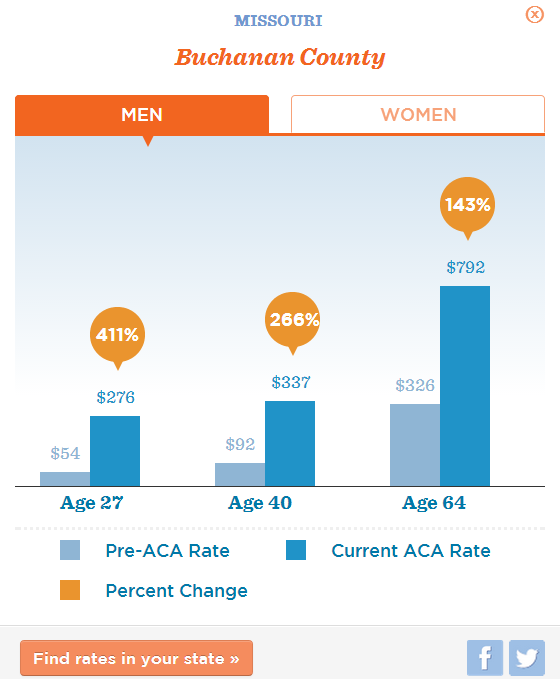
Among men, the county with the greatest increase in insurance prices from 2013 to 2014 was Buchanan County, Missouri, about 45 miles north of Kansas City: 271 percent. Among women, the “winner” was Goodhue County, Minnesota, about an hour southwest of Minneapolis: 200 percent. Overall, the counties of Nevada, North Carolina, Minnesota, and Arkansas haven experienced the largest rate hikes under the law.

Amazingly, that 271 percent figure conceals something else about Buchanan that is just jaw-dropping. If you use Forbes’ national rate navigator, you discover that a 27-year-old man in Buchanan County can expect an individual insurance policy rate increase of — get this — 411 percent.

This is “affordable”? How can any politician tell his or her constituents with a straight face that Obamacare is working, or that we need to help the Feds implement this disaster in Missouri? Missouri needs market-based insurance reforms, not Obamacare and its Medicaid expansion. Our people deserve better than this raw deal.

Supply, Demand, And The Minimum Wage

Early last week, Lindenwood University Professor and Show-Me Institute Fellow Howard Wall debated the merits of raising the minimum wage on St. Louis Public Radio. It was an interesting discussion, but  one thing stuck out for me. In the debate, Chris Sommers, who co-owns Pi Pizza and is in favor of raising the minimum wage, stated that (at 5:37), “We raised the wage in order to also attract better people.” This was said in the context of Pi raising the wages its pays its employees.

This is interesting because Pi raised its wages voluntarily. It didn’t need the government to mandate a hike in pay, it chose to do it because it made sense from a business perspective. That is how it is supposed to be. In fact, that is what businesses do. They pay their workers a competitive rate commensurate with the value that these employees generate for the business. If they pay their employees too little, other businesses can offer these workers a higher rate and they will leave. Sommers mentioned his workers moving to another business because it offered a 25-cent increase in hourly wages (at 4:30). This is the market working.

Take what happened in North Dakota as an example. Because businesses were so desperate for workers, even fast food establishments had to significantly increase what they would pay their employees. For example, Taco John’s, a local area fast food restaurant, had to offer new employees $15 an hour salaries in order to get them to work there.

north dakota

I want to help the poor do better, but there are betters options available than raising the minimum wage, like the Earned Income Tax Credit. This would ensure the benefits would go to the people who really need them, the working poor.

Missouri State Board Of Education Robs Students Of Educational Opportunities

educational larceny


Larcenist is a strong word to call someone, but that is exactly what Missouri Sen. Maria Chappelle-Nadal (D-Dist. 14) called parents attempting to secure a good education for their children. The senator, who has otherwise been good on the transfer issue, was referring to parents who moved into the Normandy School District to take advantage of the transfer program, which allowed them to send their children to better schools outside the district. “I think it’s educational larceny for people to move into a community from another community just so they can attend another school,” Chappelle-Nadal said.

The Missouri State Board of Education seems to agree. Earlier this week, the board voted to revoke the transfer right of any individual who was not enrolled in the Normandy School District the year before the transfer law went into effect. Now, more than 130 students who benefited from transferring to higher-performing schools have had that right stripped away.

Among the list of bad decisions the state board has made recently, this is among the worst.

First, I find it highly unlikely that 130 students moved into the district with the intent purpose of taking advantage of the transfer program. Most likely, many already lived in the district, but paid to send their children to private schools or they relocated for various other reasons. This was the case for Diane McCrary and Connie Holtrop. You can read their story in this excellent piece by Elisa Crouch.

Nevertheless, let’s imagine that some families did move to the Normandy School District simply to take advantage of the transfer program. They did not violate any law. They simply made a decision to put their kids into better schools.

Now these families have had that opportunity stripped away because it was good for the district’s bottom line. If any educational larceny has occurred, it took place when the State Board of Education robbed these students of the opportunity to attend good schools.


Support Us

The work of the Show-Me Institute would not be possible without the generous support of people who are inspired by the vision of liberty and free enterprise. We hope you will join our efforts and become a Show-Me Institute sponsor.

Donate
Man on Horse Charging