Alternative public charter schools like DeLaSalle in Kansas City serve kids who struggle in traditional public schools. Because of school choice, K'Von Williams is now a senior at DeLaSalle who is benefiting from their unique academic approach.

Alternative public charter schools like DeLaSalle in Kansas City serve kids who struggle in traditional public schools. Because of school choice, K'Von Williams is now a senior at DeLaSalle who is benefiting from their unique academic approach.
Last week, the Regional Convention and Sports Complex Authority (RSA) brought suit against Saint Louis City over an ordinance that requires a vote on city dollars going to a new stadium. The lawsuit’s proponents argue that the city’s ordinance is broad and vague, prevents the city from participating in planning and site preparation, and contradicts state statutes. In fact, the ordinance is doing precisely what it is designed to do: prevent the city from using every trick in the book to fund a new stadium without a vote.
The ordinance in question is Chapter 3.91 of the Revised Code of the City, which requires a vote on any public assistance for a professional sports stadium. Assistance is defined as:
. . . any City assistance of value, direct or indirect, whether or not channeled through an intermediary entity, including, but not limited to, tax reduction, exemption, credit, or guarantee against or deferral of increase; dedication of tax or other revenues; tax increment financing; issuance, authorization, or guarantee of bonds; purchase or procurement of land or site preparation; loans or loan guarantees; sale or donation or loan of any City resource or service; deferral, payment, assumption or guarantee of obligations, and all other forms of assistance of value.
Banning both direct and indirect assistance may seem broad, but cities too often spend large amounts of public dollars planning, and then publicizing, controversial projects. For example, Kansas City spent almost $2 million planning a streetcar expansion that was ultimately defeated at the ballot box.
Far from being vague and overly cautious, the ordinance’s language seems prescient, as the RSA plans to use just about everything the ordinance describes as assistance, including:
It seems obvious the situation here is not that of a badly written ordinance restricting reasonable city planning, but rather an ordinance that blocks, and was designed to block, exactly what the RSA is trying to do: get city dollars for a stadium, no matter the source, without a public vote.
Yesterday, we detailed the ever-shifting claims of streetcar proponents about the economic benefit of streetcars. Numbers have ranged from $750 million to $1.2 billion.
 Streetcar supporters cannot agree on the impact because, most likely, the streetcar had no impact on the economic development of downtown Kansas City. The evidence presented in support of the streetcar’s impact is often merely anecdotal and fails to account for the diverted development. In February 2014, we provided a list of studies demonstrating that economic development is not a result of fixed rail. We encouraged streetcar supporters to provide contrary evidence that stands up to scrutiny.
It has been more than a year since we solicited that information, and no streetcar supporters have met the challenge. One attempt was particularly sloppy. Even the Kansas City Business Journal was dismissive of the study, titling their piece, “Streetcar Study: Take It With a Grain of Salt.”
Proponents still make the argument. The developer of the 1914 Main Street development recently added his own take on Twitter, writing, “Have said it before, will say it again: Would not be doing our 1914 Main development if not for streetcar.” But that neglects to mention the fact that the 1914 Main project also received taxpayer subsidies in the form of a property tax abatement.
So we are back to where we started: The streetcar alone cannot be said to have created any economic impact. Quite the contrary, when you look into the claims put forth by streetcar supporters—whether it is regarding the GSA, Centric, or 1914 Main Street—you find that there are always other more compelling explanations for development.
If this development is occurring because the city is handing out tens of millions in subsidies, why are we also spending tens of millions on a streetcar?
Over the past year, the Normandy School District has grabbed the state’s attention, and for good reason. Little more than half of the district’s students graduate on time. For those that do, the prospects are slim. Of the 125 Normandy students who took the ACT in 2014, just eight performed as well as or better than the national average. The composite ACT score was a paltry 16, not good enough for most state colleges.
While it is useful to examine what is happening in Normandy, it can distract us from problems in all Missouri schools. According to the National Assessment of Educational Progress (NAEP), just 35 percent of Missouri fourth graders are reading on grade level. Roughly a third of our college students take remediation courses. Missouri public schools are having an incredibly tough time carrying out their primary directive—educate students. Yet, some look at our schools and want them to do more.
It seems every interest group, lobbyist, and legislator with a particular hobby horse wants to require schools to include their issue in their curriculum. Currently, legislators are calling for more bullying prevention programs and for an increased emphasis on civics education. Add those issues to sex education, gun control or gun awareness, criticisms of evolution, global warming, and a host of other topics that have been touted in recent years, and it’s easy to see that schools are being inundated by agendas.
While each of the issues mentioned could have value for Missouri’s K-12 students (that is really a subjective opinion), mandating new requirements for Missouri public schools is likely to cause mission creep, distract from efforts to teach students to read and do math, and cause controversy. Public schools already struggle to educate Missouri’s children. Diverting resources to new mandates would exacerbate the fundamental issue that our schools face.
Like lawmakers, parents have their own mandates and demands for the schools. Whether at the state or local level, however, we are never going to agree on all of the things that schools should do. The solution is not more mandates, the solution is more choice.
Instead of dictating what schools should do, lawmakers should focus their attention on giving parents more educational options. Allow parents to choose the school that most closely aligns with their values and their sense of mission, whether the school is private, public charter, or traditional public. We cannot make sure that every school caters to every family’s needs and preferences, but we can make sure every family has the ability to choose the school that comes closest.
Simply layering mandates on top of one another will not solve any of our educational problems, and it will not improve the educational system. A system built around school choice, however, has a better chance at both. It will allow individuals to choose the school that meets their needs, without forcing their will on others. Choice also will help create a system of continual improvement, which leads to increased efficiency.
We cannot mandate our way to a system that meets everyone’s needs. The more we try, the further we erode a local school’s ability to adapt, innovate, and meet the individual needs of the students it serves. It’s time to stop asking schools to do more and more. It’s time to start allowing parents to choose.

Schools today are asked to teach a lot more than reading, writing, and ‘rithmetic; and if lawmakers have their way, the list of topics mandated for instruction will continue to grow. Currently, proposals in the Missouri Legislature would require schools to caution students about sexual predators and inappropriate text messages, beef up bullying prevention, and cram in more civics education. While there may be value in these issues, continually mandating new requirements is counterproductive to improving Missouri’s educational system. It invites mission creep, distracts from core educational duties, and causes controversy.
Schools, and parents, do not need more mandates; they need more freedom.
Instead of dictating what schools should do, lawmakers should focus their attention on giving parents more educational options. Allow parents to choose the school that most closely aligns with their values and their sense of mission, whether the school is private, public charter, or traditional public. We cannot make sure that every school caters to every family’s needs and preferences, but we can make sure every family has the ability to choose the school that comes closest.
Simply layering mandates on top of one another will not solve any of our educational problems, and it will not improve the educational system. A system built around school choice, however, has a better chance at both. It will allow individuals to choose the school that meets their needs, without forcing their will on others. Choice also will help create a system of continual improvement, which leads to increased efficiency.
We cannot mandate our way to a system that meets everyone’s needs. The more we try, the further we erode a local school’s ability to adapt, innovate, and meet the individual needs of the students it serves. It’s time to stop asking schools to do more and more. It’s time to start allowing parents to choose.
How much has downtown Kansas City grown? And why? It’s not so easy to know. Here are some claims from the past year.
In January 2014, streetcar boosters floated downtown economic growth figures of $879 million. By March of that year, they reduced it to $791 million. That dropped further to $750 million in May. According to KCTV at the time [emphasis added]:
The mayor also said businesses are already investing $750 million in downtown, like with the new Marriott Hotel that’s set to be built just feet from the construction site. The mayor said it’s all thanks to the new streetcar.
 A few months later, the number shot up to $900 million again, albeit with a caveat. Amy Hawley at KSHB reported:
The city has long said streetcars drive business. It attributes $900 million of new downtown business to the new streetcar line.
“We have about $900 million in projects in the downtown area right now since the starter line was first approved by the voters,” Chris Hernandez, the KCMO Director of Communications, said.
Those are very different standards. On the one hand the city wants to say the development happened because of the streetcar, on the other the city says the development happened after the streetcar. This is a classic logical fallacy: post hoc ergo propter hoc or “after therefore because of.” The city wants to claim everything that happened after the streetcar vote as happening because of the streetcar vote. We have pointed out that basic flaw for over a year here and here and here.
As of January 2015, the number is $1.24 billion, according to the Downtown Council. They put the number at $1.24 billion according to their “research.” But they seem to commit the same logical fallacy as the city [emphasis added]:
The past two years marked the beginning of an exciting new chapter in the renaissance of Downtown Kansas City as more than $1 billion dollars of new investment was announced or started construction since voters approved the new streetcar line.
If the economic development benefit of streetcars is so concrete, why can’t boosters agree on a number? The answer, of course, is that the numbers aren’t concrete. In fact, they’re often baseless.
I think we can all agree that drinking in excess is not good for you. Not only is it bad for your health, but if you’re not smart, such a habit could end up destroying the lives of others as well. That’s why I applaud the intentions behind Christopher Ingraham’s recent op-ed, if not his prescription.
 In his article, Ingraham calls for raising alcohol taxes, stating: “Higher taxes make alcohol more expensive. More expensive alcohol makes people drink less of it. And when people are drinking less, they’re less likely to suffer costly health problems or do stupid things like drive drunk.”
If Ingraham’s ultimate objective is to make people drink less alcohol, why not just ban it? Wouldn’t prohibition really reduce the health problems associated with alcohol consumption? However, we’ve already tried Prohibition, and it didn’t work out too well. So Ingraham’s alternative is to raise taxes to cut down on consumption. Except, there are problems with that approach as well. Increase taxes too much and people will resort to smuggling. It’s happening in New York with cigarettes. What’s to say it wouldn’t happen with alcohol?
Both Ingraham and I want to cut down on drunk driving. Thankfully, drunk driving is already on the decline. Since 1986, alcohol-related fatalities have seen a 54 percent decline! Why solve a problem that is already fixing itself?
There are negative side effects to raising alcohol taxes as well. Because of our low taxes on alcohol, cigarettes, and gasoline, commuters from out of state make it a point to purchase these products in Missouri. If we raise taxes on alcohol we are removing an incentive for people to shop in Missouri. If less people shop here, Missouri businesses will suffer and the state will see less tax revenue. How will that help anybody?
I can sympathize with Ingraham’s efforts to curb the more negative effects of heavy alcohol consumption, but the biggest problem, drunk driving, is becoming less of one over time. Coupled with the fact that increased alcohol taxes can hurt Missouri businesses, we should leave tax rates alone and focus on other ways to improve public health and safety.
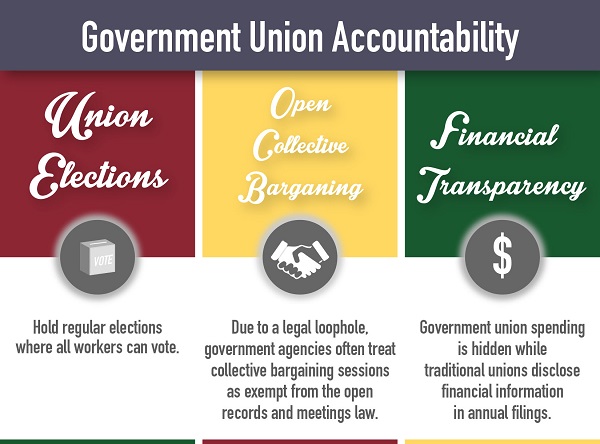
Missouri law pertaining to government collective bargaining contains serious inadequacies. The law is part the product of individual court cases, part 50-year-old statute, part long-standing practice, and fails to adequately protect the rights of both citizens and workers. The picture below presents the basic reforms that would help restore accountability. I’ve written more in-depth on each of these needed reforms: union elections, open collective bargaining, and financial transparency.
For folks in the free-market movement, the annual publication of Rich States, Poor States (RSPS) in many ways marks time. The book is part almanac and part analysis; it explores the minutia of state economic policies nationwide, highlights ongoing state economic successes or failures, and assesses the prospects of states succeeding economically in the future.
 It always makes for interesting reading, and this year’s edition (released last week) is no exception. Missouri’s economic performance has bounced along RSPS’s bottom quintile of states since its first edition, and unfortunately Missouri hasn’t made much progress since 2008; Missouri now ranks 42nd of 50 states in economic performance for 2015. That finding is consistent with economic assessments we’ve shared with readers in the past. Simply put, the state hasn’t made a lot of economic progress over the last decade relative to its peers.
Missouri is seeing movement in its “economic outlook”—but it’s all in the wrong direction. In 2012 Missouri ranked 7th for how bright its economic future appeared, which at the time I noted that the ranking looked a bit like an aberration. Only three years on, however, the state has dropped back to 27th overall. That is the worst Missouri has ever done in RSPS’s outlook ranking, dating all the way back to 2008 when the state ranked 25th. Suffice it to say, a weak economic track record paired with a mediocre economic outlook doesn’t inspire a lot of confidence in the status quo.
The fact is not a whole lot changed from 2013 to today, which is sort of the problem. States across the country are pursuing tax cuts and regulatory reforms in earnest, and yet Missouri has been slow to respond for years. Last year’s tax cut was an important first step toward turning the economic tide, but it is too small and being too slowly instituted to be a last step. Time is running out for the legislature to do much on the tax issue this year; it will be interesting to see if the body chooses to do nothing.