Missouri is 35th. Yay!?

When thinking about Missouri’s recent economic track record, one would be tempted to treat any positive economic signs with much joy and enthusiasm. So when the Bureau of Economic Analysis shows that Missouri ranks 35th among states in gross domestic product growth for 2014, one can be forgiven for treating the news like Steve Martin treats the arrival of a new phone book.  

Yet should we really be all that excited? I guess it depends on your standards.

Sure 35th is better than 36th and it is a lot better than 49th or 50th, but we’re still below the national average. Nor are we in the top half of states in economic growth. Looking at the data, the most encouraging sign I see is that at least we’re growing faster than a few of our neighbors (Nebraska, Arkansas, and Iowa). You’ll notice Kansas isn’t on that list. That should give critics of the Kansas tax cuts at least a moment of pause before declaring the whole thing a disaster

So how does Missouri do better? Well, here are a few suggestions. How about abolishing the Department of Economic Development and using the millions it hands out in economic development tax credits to cut taxes on businesses? How about shrinking the public sector while delivering better services through privatization? How about making sure we have a well-developed infrastructure that benefits all of us?

Those are a few suggestions. You can always find more on our website at showmeinstitute.org. I am glad that Missouri is seeing some improvement in its economic performance, but I wouldn’t put us in the winner’s circle just yet. Missouri needs to do better and there are lots of places it can improve.  

Positive Train Control Creates Doubts for Amtrak in Missouri

With the recent Amtrak derailment in Philadelphia, the push for increased passenger-rail safety measures has greatly increased. As part of this effort, the federal government may force the speedy implementation of long-delayed positive train control (PTC) systems for all Amtrak routes. PTC is a system of improvements to locomotives, railroad tracks, and IT connectivity for the purpose of preventing train-to-train collisions. While PTC’s effects on passenger rail safety are debatable, what is not debatable are its costs, which should cause a rethink of Amtrak subsidies in Missouri. 

Amtrak currently serves three routes in Missouri: the River Runner, the Southwest Chief, and the Texas Eagle. The Missouri River Runner runs entirely within in the state of Missouri (and is primarily subsidized by the state), while the Southwest Chief and the Texas Eagle are long-haul routes that make only a couple of stops each in Missouri. Amtrak has in the past garnered a fairly negative reputation. In most parts of the country, Amtrak has few riders, low levels of service, and large subsidy requirements. However, in the last decade inter-city passenger rail has seen large ridership growth in Missouri and elsewhere, although recently that growth has slowed:

mo-amtrak-ridership

Much of the increase is due to capital investments that have improved Amtrak’s previously notorious on-time performance. Unfortunately, while passenger levels have increased, all the routes that serve Missouri still operate deeply in the red. In 2014, the River Runner was able to generate more than $5 million in revenue. However, in the same year state subsidies to the service topped $8 million. That’s a $42 state subsidy per rider, more than the cost of a standard ticket.

The long-haul routes perform even worse, with the Southwest Chief requiring federal subsidies of $177 per passenger. The implementation of PTC on Amtrak routes will greatly add to this red ink. In fact, Kansas City Terminal (KTC) has estimated that improvements will cost $32 million in the Kansas City area alone. Statewide, the costs could be tens of millions more.

As of today, there is no agreement on who will pay for PTC improvements. The obvious candidate is the federal government, but Congress has been reticent to increase funding for Amtrak. Some policymakers want to push the costs of PTC onto the profitable freight rail industry, for the reason that they own the tracks. But freight rail companies are balking, because as they rightfully point out, they only need these immediate upgrades because Amtrak operates on their rails.

Missouri taxpayers will likely have to pick up some of the costs of upgrades, especially for the state-funded River Runner, or risk losing service. Perhaps it’s time for Missouri residents to give Amtrak subsidies another thought. With profitable inter-city bus and airline service, passenger rail is a redundancy. That’s all well and good if passengers are willing to pay for it, but they are clearly not, at least as it’s currently run. If the choice comes down to large state payments for PTC implementation and cutting Amtrak loose, residents should choose carefully.  

Employers Need Help-and They’ll Pay Too

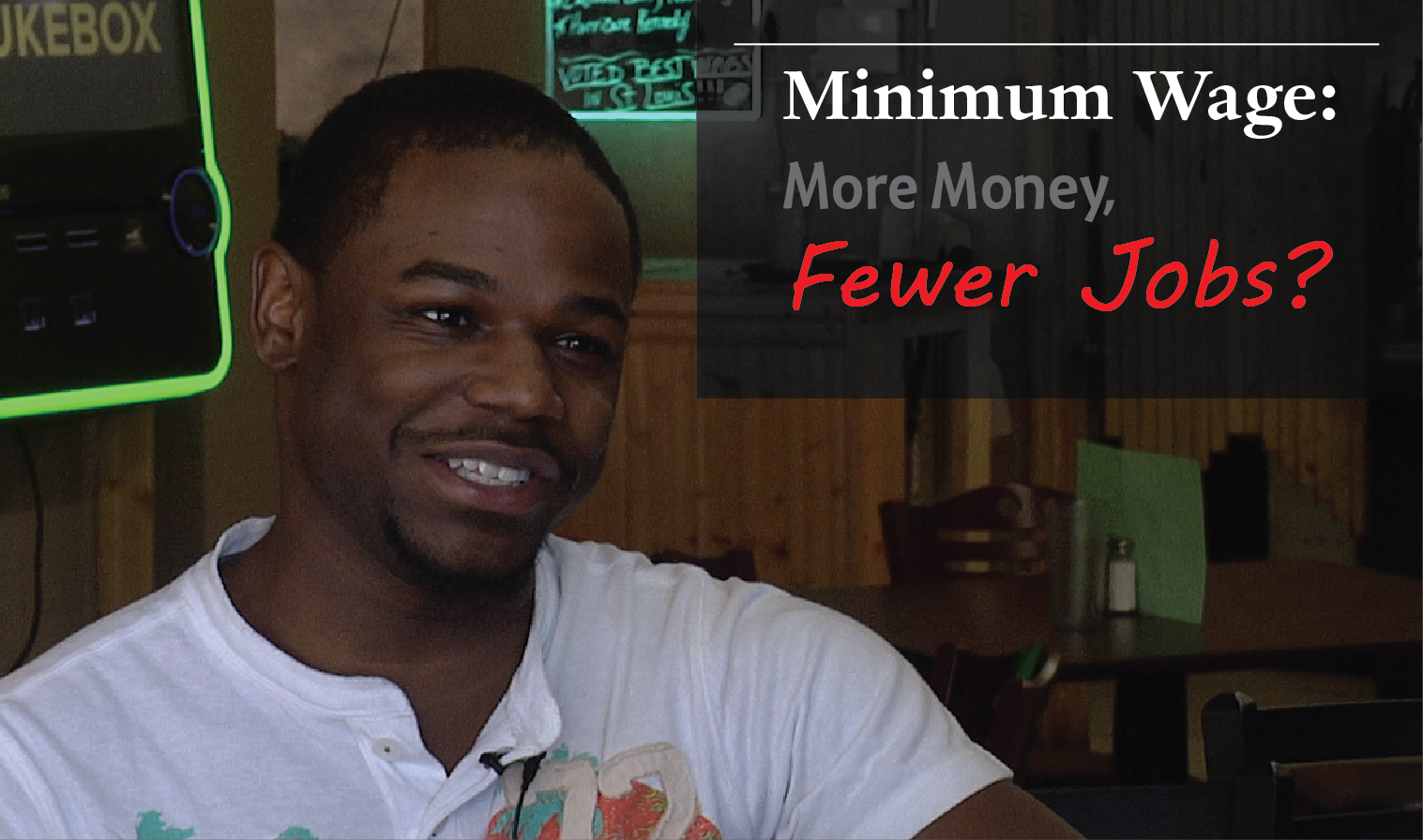
There’s been a lot said about this new minimum wage proposal in Saint Louis. However, there is an interesting topic that gets lost in the back and forth about how many jobs will be lost (quite a few) versus how many people will be lifted out of poverty (not many) if the minimum wage goes up. That topic is how workers can benefit from wage competition among businesses.

In a free market, as workers compete for jobs, businesses also compete for workers. If a worker won’t bring enough value to an employer to justify his/her salary, he or she will not be hired. On the other side, if a business doesn’t provide an attractive wage to a worker, that worker will find work elsewhere. Thus, both sides have to provide enough value to the other.

You might think that big business might be immune from these forces, but you’d be wrong. Even the largest companies have to offer decent wages to their employees. Take Walmart for example. It has the highest revenue of any company in the world and is one of the largest private employers in America. Even it has to compete for employees. That competition results in jobs paying higher than the (current) minimum wage.

I took the above picture at a Walmart in Saint Louis County last Wednesday. The starting wage is $9.00 an hour, which is higher than the minimum wage. Is Walmart making this offer out of the goodness of its heart? That’s doubtful. They’re probably offering a high starting wage because they recognize that if they don’t workers will head over to Target, Costco, or Walgreens instead.

That’s how the free market is supposed to work. Increasing the minimum wage is popular with the public, but it is not good policy. An individual and a business should negotiate compensation that is mutually agreeable to both parties. Mandating a higher minimum wage will end up mandating unemployment.

Would Union Elections Help SLU Nurses?

Some SLU nurses seem to be dissatisfied with their union representative recently. In May, a Saint Louis University Hospital nurse filed a federal charge against National Nurses Organizing Committee, a major California-based health care union, for violating workers’ rights.

In the complaint, the nurse alleges that union executives are using illegal dues deduction authorization forms and refusing to provide workers with information about their right to refrain from paying certain fees. This is important because workers have a right to refrain from paying for union political campaigns and other activities that are not directly related to representing workers.

When union fees are automatically withheld from employees’ paychecks without an option to pay for only core union services, employees may be forced to pay for political activities that they do not agree with or benefit from.

SLU nurses also recently held a vote on ending forced union dues. While 22 percent of nurses eligible to vote voted for the measure, 36 percent voted against it, meaning union dues will remain mandatory for SLU nurses.

Between the lawsuit and the vote to end mandatory union fees, it seems that a faction of nurses at SLU hospital are no longer satisfied with the way they are represented. A union exists to give workers a voice before management, but what happens when workers feel they no longer have a say before their own union?

Regular union elections are one answer to the question of how to keep union leaders accountable. In such elections, workers have the opportunity to vote in a secret ballot whether they wish to continue the union’s representation, select another organization to represent them, or forgo formal representation altogether. Such elections have recently been considered by Missouri’s legislature as a way to ensure accountability for public sector workers, but the proposal has not gotten much traction among private sector unions, such as SLU nurses.

Union elections may or may not be the answer for nurses at SLU; however, such elections provide one answer to the question of how to keep organizations democratic and accountable to the people they represent.

Equitable Funding For Charter Schools?

ad for charity event

“Funds raised from our Fourth Annual Soiree will fund the gap between public dollars and the true cost of educating every SLLIS student,” reads the invitation for an upcoming fundraiser for the St. Louis Language Immersions Schools.

Because SLLIS is a charter school, it does not receive the same amount of public dollars as a traditional public school. In 2011, on average, Missouri charter schools received $3,800 less than traditional public schools.

“Missouri’s charter public schools are living up to their end of the bargain and demonstrating the ability to provide a high quality education. It’s time to move past ‘stepchild’ funding and ensure every public school in Missouri receives equitable funding,” Missouri Public Charter Schools Association Executive Director Doug Thaman wrote in the Missouri Times.

While some argue that charters are able to fill the gap in funding through fundraising, a recent report found that charitable donations do not eliminate the funding gap between charters and traditional public schools.

Buckets of Water into the Ocean: Non-Public Revenue in Public Charter and Traditional Public Schools found that revenue from nonpublic sources (non-public food service, investment revenue, philanthropic fundraising, etc.) totaled almost 6.4 billion for traditional public schools and nearly 400 million for charter schools in the 15 states included in the study.

Interestingly, the authors found that traditional public schools receive most of their non-public revenues from selling meals to their students and investment profits. Charter schools receive most of their non-public revenue through philanthropy. Still, charitable donations do not make up the difference—adding as little as $74 (New Jersey) and as high as $1320 (Hawaii) to total per pupil revenue.

The findings of this report may change the conversation in Missouri as revisions to the way schools are funded are considered. One of the authors of the study, Arkansas Professor Patrick Wolf said:

If students in public charter schools are to receive funding on a par with students in traditional, district-run, public schools, it will have to come from more equitable public school funding laws.  Saying that charitable donations can make up the funding gap between district-run and charter schools is like saying that throwing buckets of water into the ocean will change the tide.


Jefftran Has Deeper Problems than Fare Revenue

Recently, Jefferson City’s City Council voted against raising fares on its public transportation system, Jefftran. The proposal would have increased full fare from $1 to $1.50. Jefferson City’s transit director lamented the decision, stating that the fare increase would have brought in an extra $30,000 to Jefftran.

But in reality, if Jefftran is to become  financially stable, it should start by reexamining how it runs its buses. In 2013, Jefftran carried about 335,000 riders. However, Jefftran’s expenses were more than  $2 million in the same year. That means  for every person who stepped on board a city bus, Jefftran spent about $6 .  However, on average, each passenger paid only 60 cents per trip. Percentage wise, that’s a huge subsidy; a subsidy that is ultimately borne by local and national taxpayers. By raising fares 50 cents, revenue from riders would go from covering about 10% of operating costs to covering almost 12%. That’s more than a drop in the bucket, but not much more.

Rather than aiming for a little extra money from fares, Jefftran could look into how its buses operate. Despite Jefftran’s extremely low fares (half the cost of riding a bus in Saint Louis), it has struggled to attract customers. In fact, ridership on the system is down more than 25% since 2008.

ridership-n-spending-jefftran

Jefftran buses have low utilization for the service level they provide, and that utilization has decreased in recent years along with ridership. It’s clear that the service Jefftran offers is not serving the needs of residents, at least not in a way that is commensurate with the amount of resources the system requires.

If Jefftran is truly to become an efficient transportation system, it needs to be prepared to ask tough questions about its operations. Questions like: What type of services do residents demand, and would be willing to pay for? Are traditional bus routes a cost-effective way of providing mobility in Jefferson City? Is Jefftran running the type of routes that maximizes ridership while keeping costs low?

However Jefftran answers these questions, it seems clear that Jefftran has problems that will not be solved with a 50 cent fare increase.

State Departments of Education Should Stop Trying to Predict Who Will Be a Good Teacher

Teacher quality is hugely important. The difference between a good teacher and a bad teacher can be as much as a year’s worth of learning. These academic gains translate to increased earning potential for students with great teachers.  In his paper, “The economic value of higher teacher quality,” economist Eric Hanushek writes, “A teacher one standard deviation above the mean effectiveness annually generates marginal gains of over $400,000 in present value of student future earnings with a class size of 20 and proportionately higher with larger class sizes.” So, when the Missouri Department of Elementary and Secondary Education (DESE) decided to focus on teacher quality in the “Top 10 by 20” initiative, it made sense. The problem is that DESE’s efforts to improve teacher quality are completely misguided.

DESE decided the best way to improve teacher quality was to raise the bar on licensure exams. Licensure exams and other certification requirements are only effective at improving the quality of the workforce if they are related to the outcome we desire; namely, increased teacher quality. The figure below offers an illustration. This figure comes from a paper by economist Dan Goldhaber, “Everyone’s doing it, but what does teacher testing tell us about teacher effectiveness.”

On one axis, you have a measure of teacher quality and on the other a teacher’s performance on licensure exams. The height represents the number of teachers, with most being somewhere in the middle. The red line indicates a minimum passing score on the licensure exam and the blue line indicates some minimum level of teacher quality. If teacher quality and performance are highly related, as they are on the left figure, then a licensure exam could do a good job of screening out individuals. “A” represents the individuals who would be good teachers, but are kept out because they fail the test, “B” are the bad teachers who fail the test, “C” are the bad teachers who pass the test, and “D” are the individuals who pass the test and are adequate teachers. As you can see, when the test isn’t related to teacher quality, as presented on the right, we have more ineffective teachers passing the test (“C”) and more good teachers failing the test “A”.

Goldhaber Teacher Quality


Teacher licensure tests are more like the figure on the right. They do a poor job of predicting who will be a quality teacher. What DESE did is move the red line further to the right; thus, keeping more people out.

The fact is, we are lousy at predicting who will be a good teacher. Thus, increasing the rigor of licensure exams will not do any good. Hanushek offers another solution – teacher de-selection. He writes, “replacing the bottom 5–8 percent of teachers with average teachers could move the U.S. near the top of international math and science rankings with a present value of $100 trillion.” Rather than try to predict who will be a good teacher, we should focus on removing those individuals who have proven to be bad teachers.

Raising the bar on licensure exams will not improve the quality of the teaching profession. If we want to do that, we need to make teaching more attractive to high performing individuals and we need to get rid of the bad apples in the teaching profession.


Jefftran Has Deeper Problems than Fare Revenue

Recently, Jefferson City’s City Council voted against raising fares on its public transportation system, Jefftran. The proposal would have increased full fare from $1 to $1.50. Jefferson City’s transit director lamented the decision, stating that the fare increase would have brought in an extra $30,000 to Jefftran. But in reality, if Jefftran is to become for financially stable, it should start by reexamining how it runs its buses. In 2013, Jefftran carried about 335,000 riders. However, Jefftran’s expenses were over $2 million in the same year. That means that for every for every person who stepped on board a city bus, Jefftran spent about $6 dollars. However, on average, each passenger paid only 60 cents per trip. Percentage wise, that’s a huge subsidy; a subsidy that is ultimately borne by local and national taxpayers. By raising fares 50 cents, revenue from riders would go from covering about 10% of operating costs to covering almost 12%. That’s more than a drop in the bucket, but not much more. Rather than aiming for a little extra money from fares, Jefftran could look into how its buses operate. Despite Jefftran’s extremely low fares (half the cost of riding a bus in Saint Louis), it has struggled to attract customers. In fact, ridership on the system is down more than 25% since 2008. jefftran Jefftran buses have low utilization for the service level they provide, and that utilization has decreased in recent years along with ridership. It’s clear that the service Jefftran offers is not serving the needs of residents, at least not in a way that is commensurate with the amount of resources the system requires. If Jefftran is truly to become an efficient transportation system, it needs to be prepared to ask tough questions about its operations. Questions like: What type of services do residents demand, and would be willing to pay for? Are traditional bus routes a cost-effective way of providing mobility in Jefferson City? Is Jefftran running the type of routes that maximizes ridership while keeping costs low? However Jefftran answers these questions, it seems clear that Jefftran has problems that will not be solved with a 50 cent fare increase.

Federal BRIDGE Act Could Help Fund Missouri Infrastructure Improvement

As we have written about many times before, Missouri continues to grapple with an impending funding shortfall for the Missouri Department of Transportation (MoDOT). At the same time, mirroring the failure of state policy makers, the federal government is facing a transportation funding crisis of its own. A new bi-partisan bill, the BRIDGE Act, may provide more federal support for Missouri infrastructure projects if the state can solve its own funding mess.

For some background, in recent years federal highway revenue has failed to keep pace with the federal government’s transportation spending. This has caused the federal highway trust fund, which takes in highway user fees and funds highway and transit projects across the country, to hemorrhage money. Only regular infusions of general revenue, to the tune of more than $55 billion in recent years, have kept the trust fund solvent. Missouri is heavily dependent on the highway trust fund to build highways and transit improvements, among other needs. Missouri has no backup plan if there are large federal funding cuts.

National leaders have suggested many ways of fixing the funding problem, including drastic spending cuts, raising the fuel tax, developing congestion taxes, introducing more tolling, cutting funding to transit, tapping repatriated tax dollars, and even eliminating the trust fund altogether. The BRIDGE Act side steps the ultimate fate of the highway trust fund, and instead will try to extend financing to important state projects outside the traditional funding system. The act proposes to set up an Infrastructure Financing Authority (IFA), which would finance up to 49% of large state and local infrastructure projects of “national importance.”  The remaining 51% of project financing would need to come from local dedicated revenue streams. While the Authority would have $10 billion in seed money, the goal is self-sufficiency, with IFA charging state and local governments fees for loans.

While the BRIDGE Act is just the latest reform idea for federal infrastructure funding, it has significant bi-partisan support and does not entail increased taxes or spending cuts. If this proposal were to come into force, it could mean more financing for infrastructure projects across Missouri, but only if the state and local governments get their own funding sources in order. IFA would only loan money, which will have to be paid back, and local governments need to secure financing for the non-federal portion of the debt.

MoDOT could best use this act to alleviate its funding crisis by introducing tolling on major projects. That would create the revenue stream to apply for IFA support without raising taxes. Local governments could also fund necessary infrastructure projects, without raising taxes, by choosing projects where user fees could pay back IFA loans. And while the Bridge Act may or may not pass, getting transportation funding in Missouri on stable footing will pay dividends whatever happens at the federal level.

Support Us

The work of the Show-Me Institute would not be possible without the generous support of people who are inspired by the vision of liberty and free enterprise. We hope you will join our efforts and become a Show-Me Institute sponsor.

Donate
Man on Horse Charging