

Missouri ranks in the top 10 … in corporate tax giveaways. And that may explain why the Show-Me state is lagging near the very bottom in economic growth.
The House Isn’t On Fire, but It Is at Greater Risk

Several years ago, my wife and I were in the market to buy a house. As is customary, we had an inspection completed on the house we wanted to purchase. Minor things were noted here and there on the report, but one thing in particular caught our eye. Somehow the wires got crossed when the outlets were installed. The electrical outlets still functioned, and we were told it probably would not be a problem. However, the home inspector suggested we be cautious about plugging any large appliances in the outlets until we had an electrician fix the polarity.
The problem our home inspection revealed was below the surface. It wasn’t causing any noticeable problems today. Down the road, however, it could have caused a fire, resulting in irreparable harm.
Recently, Michael Rathbone and I performed an inspection of our own—not on a home, but on Missouri’s teacher pension systems. Similar to my home inspection, we found something troubling just below the surface. Missouri’s teacher pension systems have shifted to riskier assets. This shift has not caused any noticeable problems as of today; and like my reversed polarity, may not ever cause any harm. Of course, an increase in risky assets also increases the possibility that the house could burn down.
Imagine if upon receiving my home inspection, I had yelled at the inspector, “You just hate houses!” As ridiculous as that might seem, that is exactly the reaction Michael and I have received. In response to a recent op-ed in the Springfield News-Leader, in which we called for increased transparency so that the problem could be monitored, we were vilified. One pensioner even claimed that we dislike public education. The author of the response to our op-ed then went on to list several facts that were not germane to the point we made.
Somehow it seems our message has been lost. Therefore, I want to reiterate the point of our paper, “Betting on the Big Returns: How Missouri’s Teacher Pension Plans Have Shifted to Riskier Assets,” one more time. Missouri’s pension investments are becoming more risky. In other words, the house isn’t on fire, but it is becoming more flammable. It would be wise to monitor the investments more closely and plan for these increased risks.
School Choice in Missouri: The Power Rankings

Football season is upon us, and while I’m cautiously optimistic about the Chiefs this year, I’m really looking forward to another year of fantasy football.
Fantasy football is a useful analogy when it comes to public policy. We all have our “dream team” we want to put together—the perfect set of policies that would make a championship polity. But we don’t always get the perfect team, and we need a strategy should we not get our first choices.
With that in mind, I decided to put together an ESPN-like cheat sheet of my rankings of school choice programs for Missouri; stars and sleepers, first choices and backups. Without further ado:
The Top of the Heap
If you get the first pick in your draft, you pick a stud running back. It’s fantasy football 101. They get a lot of carries; they get touchdown opportunities; they’re steady, solid points all season long.
If I had the first pick in the school choice fantasy draft, I’d take an education savings account (ESA) program. ESAs place state funding for a child’s education into a flexible-use spending account (like an HSA) that they can take to a private school or spread out among multiple providers to pay for online courses, tutoring, or services for students with special needs.
Nevada just passed a huge, nearly universal program that has already seen thousands of students apply. Arizona, Mississippi, and Florida have ESAs for students with special needs. A large, substantial ESA program would be a solid anchor for the state’s education system.
The Runner-Up
OK, so all of the best running backs are taken. It’s now time to dip into the quarterbacks and wide receivers. There is a little more variability, more ups and downs from week to week, but still lots of upside.
The most solid second-tier option is a tuition tax credit program. Tuition tax credit programs (there are currently 16 across the country) allow individuals or corporations to get a credit on their tax bill for money that they donate to nonprofit organizations that give scholarships to K12 students. This would encourage participation in civil society, avoid thorny state constitutional issues, and drastically expand the number of options available to students in the state.
The Sleeper
Lots of players are off the board now. The draft is in its later rounds, and maybe you don’t have the team you wanted when you set out. Now it’s time to try and find a sleeper—an undervalued player that will have an outsized influence
My school choice sleeper? A course access program. Course access programs allow students to take a portion of their per-pupil funding to a provider outside of their school for individual classes. A student still attends school normally, but might head to the library to learn Mandarin while the rest of the students go to Spanish class, or might duck out early to head to the local community college for a welding class. Course access is blowing up like Clinton Portis did against the Chiefs in 2003. Thousands of students across 11 states are rerouting some portion of their state funding into different providers and customizing the education that best fits their needs.
The Kicker
You wait until the last rounds. Some buddy of yours picks one way too early. Yes, I’m talking about a kicker.
Just like you have to draft a kicker, the state has to expand charter schools outside of Kansas City and St. Louis. Of the 41 states across the country that offer charter schools, Missouri is one of the few that limits them to a particular geographic area. Given the well-documented struggles in several St. Louis County school districts, denying students better choices is just wrong.
Putting the Team Together
I worry that too often school choice advocates get their hopes up for their top picks and are then disengage during the later rounds of the policy draft. That’s a mistake. People can still win their fantasy league if their top pick goes bust. They just have to be smart with the rest of the draft.
Parking Is a Privilege in Saint Louis City

Parking at Lambert-Saint Louis International Airport (STL) can get expensive. Depending on the lot, the airport will charge anywhere from $7 to $23 dollars a day. The prospect of paying so much for airport parking is one reason why many of us will take a cab instead. But expensive parking isn’t a problem for the region’s taxicab regulators, nearly all of whom get free airport parking.
And taxicab commissioners aren’t the only ones. Last week, the Post-Dispatch reported that scores of current and former officials get free parking at Lambert, including former airport commissioners, elected officials, police brass, and industry representatives. According to Lambert Director Rhonda Hamm-Niebruegge, the free parking is a “courtesy.” However, the selective nature of this courtesy leaves open a number of questions. For instance, why honor the mayors of only three Saint Louis County cities? Why give a courtesy to one specific partner from an area law firm? Why do many taxicab commissioners receive free parking? Perhaps there are reasonable answers to these questions (among others), but left unexplained it looks just like another unjustified perk for political insiders.
To its credit, STL officials are planning on phasing out the free parking passes. But parking privilege is not just confined to Saint Louis’s airport. Last year, a city-commissioned parking study (performed to decide where new parking meters should go) found that the city allows any individual employed by the city or county, regardless of their position, to park for free at any metered spot. The city has no comprehensive list of authorized outstanding permits or rules determining which departments and which vehicles are eligible for permits. The study’s authors recommended limiting such permits to positions that require quick access to vehicles (like police officers or emergency response vehicles). Unfortunately, while the city is already well into the process of installing new meters to charge residents, the employee on-street parking policy has not been revised or even reviewed.
Most people understand that free parking is not a right. But it should not be a privilege either, handed out on an ad-hoc basis to entrenched civic insiders.
By the way, the one member of the Taxicab Commission who does not enjoy free airport parking is Chris Sommers. He is also the only member of the Commission who vocally supports ridesharing in Saint Louis. Go figure.
Saint Louis Property Taxes, Part 4: All Together Now
In the first three blog posts in this series (here, here, and here), we have seen how Saint Louis City’s property tax base is significantly curtailed because much of the city’s land is owned by governments and nonprofits, which pay little or no real property tax. Many other properties also receive special real property tax breaks, like TIF and Chapter 353 abatements, further reducing the number of parcels paying the city’s full property tax rate of $7.5850 per $100 assessed value (with a $1.64 commercial surcharge).
While the share of the city’s property that either gets tax subsidies, qualifies as a non-profit, or is owned by the government is large individually, looking at these issues together shows the scale of the problems confronting Saint Louis’s tax base. In fact, about half of the city’s property by area is either tax exempt or receives tax breaks. Property tax exceptions are basically the rule. The map below demonstrates this:
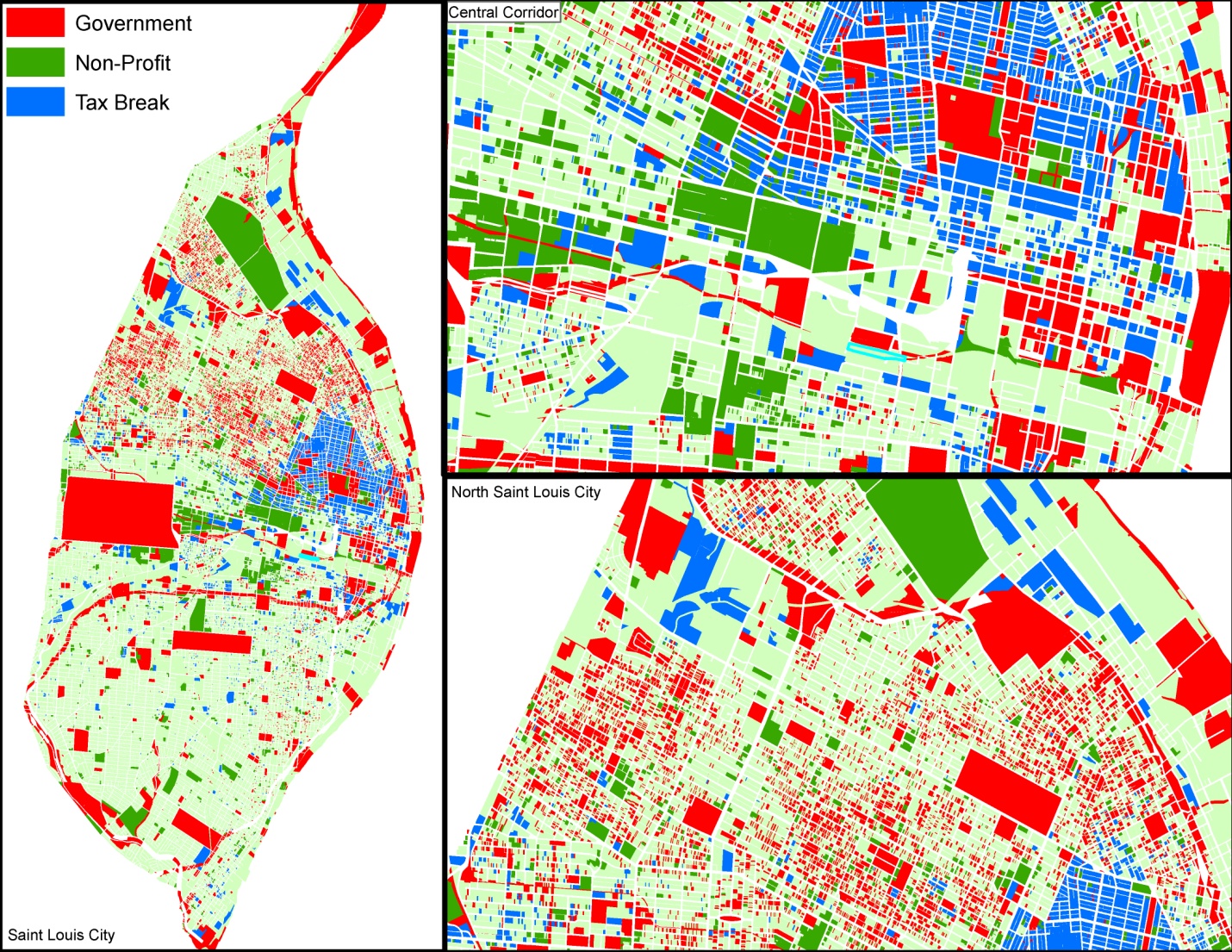
As we discussed in previous posts, these areas include some of Saint Louis’s most economically important and profitable institutions, such as BJC Healthcare, Washington University in Saint Louis, Busch Stadium, the Eighth Circuit Court, and IKEA. In total, around 40% of the city’s property by value either is tax exempt or receives special tax breaks.
Who is left paying the full property tax rate? For the most part, residential areas on the city’s South (and especially Southwest) side have fewer exempt properties and tax breaks. In terms of value, utilities, casinos, manufacturing and distribution companies, as well as a handful of large businesses downtown appear to pay full property tax rates. However, as the map below shows, when it comes to parcels paying full real property tax levels, the city is hollowed out:
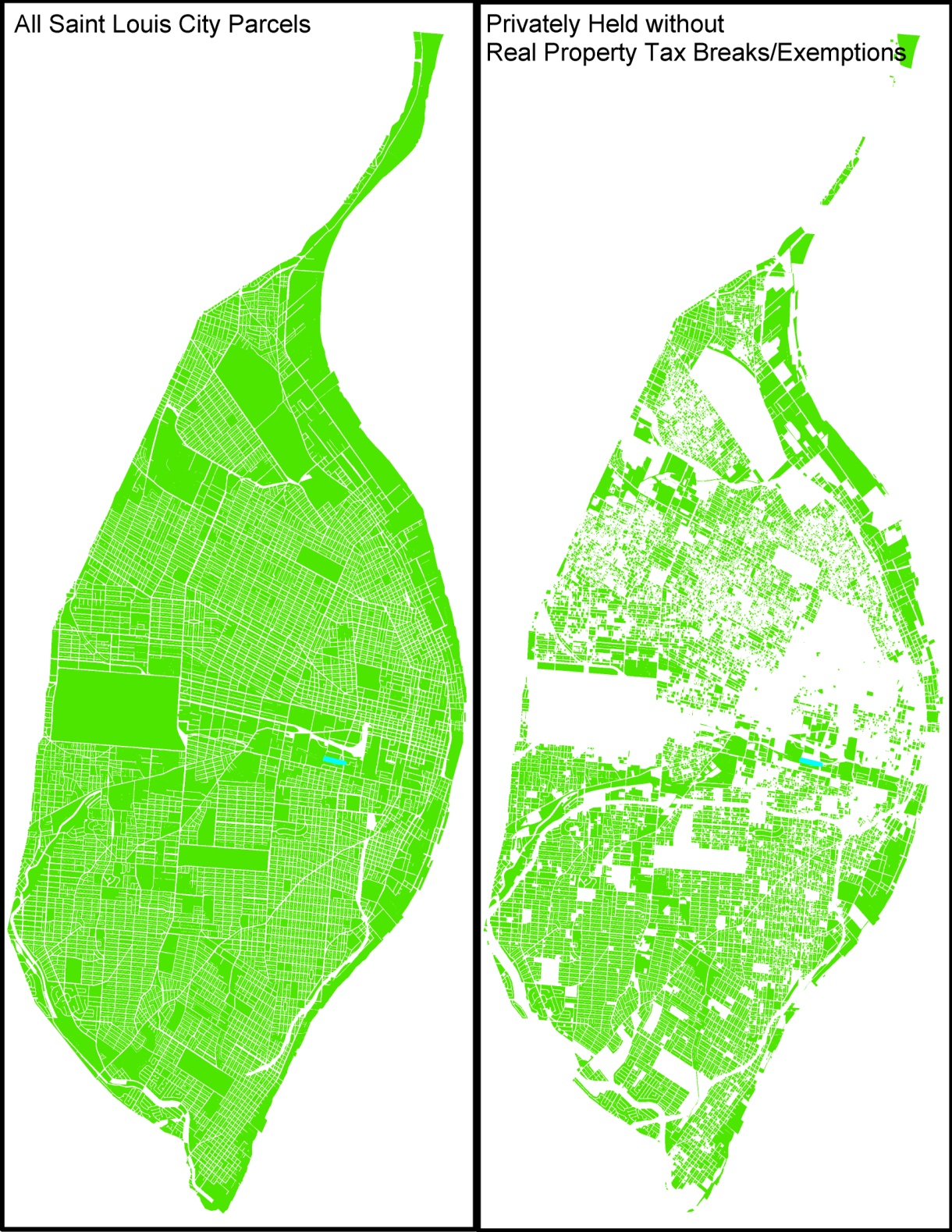
The next post on this issue will discuss some the negative results of this reduced real property tax base, as well as strategies for improving the base.
MCI and the Evacuation That Wasn’t
KSHB news reported Tuesday that portions of Kansas City International Airport's (MCI) Terminal C were evacuated due to an "unruly passenger."
Kevin Koster, a member of the Airport Terminal Advisory Group empanelled by the mayor two years ago to consider the wisdom of a $1 billion new terminal, reacted on Twitter,
A single terminal would have had to be completely evac. TSA told KCI task force this was advantage of current design
Back in March 2014, The Kansas City Business Journal reported that a TSA official did exactly that [emphasis added]:
Della Jacono also shot down an assertion that KCI was more vulnerable to curbside bombings than other airports because the pickup and drop-off curb is so close to the passenger terminal. He said that vulnerability is common among U.S. airports.
He also said a multiple-terminal layout prevents large, vulnerable crowds from forming and could help the TSA isolate threats if they arose.
According to KSHB, the aviation department spokesman released a statement saying, "Out of an abundance of caution, KCI Airport Police evacuated portions of the airport terminal to ensure the safety of the general public." Only two American Airlines flights were canceled.
It is reasonable to wonder how much of MCI would have been shut down if the same "abundance of caution" was required in a single terminal.
Washington University Faculty Oppose Public Dollars for Stadium; Planners Promise Brew Pub
As we have mentioned many times before, economists are virtually unanimous in their agreement that publicly funded sports stadiums are bad investments for cities. They do not generate additional economic growth, promote urban revitalization, or result in increased tax collections. This broad consensus is being reiterated by the faculty of Washington University in Saint Louis.
Last week, Student Life, a WashU college paper, published a story about the Rams stadium. For the story, the author interviewed five WashU faculty from different disciplines. The faculty spoke nearly unanimously against using public money to fund the stadium. Here are some of the faculty’s comments, as reported in the article, the Longest Con:
“It’s really hard to see this as overall a good idea. It’s going to be very expensive…That’s not a very good way to spend government money.”—Glenn MacDonald, an economics professor in the Olin Business School
“We’ve known since the mid-’70s that sports teams don’t bring fast economic benefits, certainly nothing that offsets the kinds of credits they’re getting…Ten times a year, 12 times a year, you get a huge influx of people in, [but] that’s it.”—Sunita Parikh, an associate professor of political science
“What it does is it destroys the area so it vanquishes the blight that it identifies by just knocking everything down,” and “decimates the existing urban character.”—Michael Allen, a University College coordinator and American culture studies lecturer
“I think it’s pretty clear to anyone that spends any time here…that this town’s civic sporting identity is Cardinals first, second, third, fourth, fifth, down through 10, then Blues probably and then Rams. So they’re already the low man on the totem pole… I think it’s kind of silly that some people in cities feel like they need to measure their city by how many teams from the Big 4 leagues they have”—Noah Cohan, a recent Ph.D. and adjunct instructor in English who studies the relation of sports fandom to identity and politics,
The only WashU faculty member interviewed who supported the stadium plan, Rich Ryffel (senior lecturer of finance in the business school who helped finance the Edward Jones Dome), admitted a stadium was “not a good public investment. In other words, if the public puts in a dollar, they’re not going to get a dollar out of it.”
In other news, stadium proponents are touting the final initial design (which I guess is kind of like jumbo shrimp?) of a planned stadium. It will even have a new brew pub. Will policymakers heed the advice of experts or opt for beer and circuses?
Minimum Wage Harms the Workers It’s Meant to Help
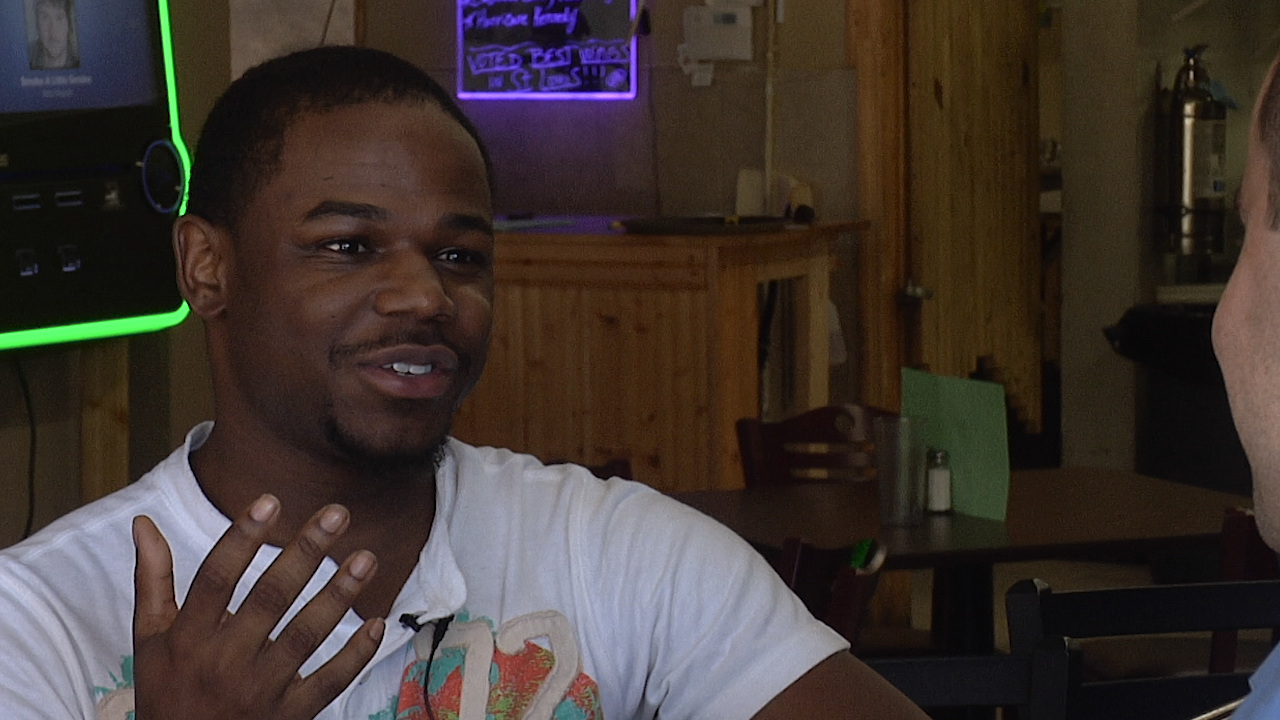
If you grab lunch at Sister Cities in the Dutchtown neighborhood of St. Louis, you’re likely to be greeted by Javion Johnson (going by JJ), who works the front of the popular Cajun and BBQ restaurant several days a week. JJ is 22 years old, lives in the neighborhood, and wants to pursue his passions for art and food. He didn’t start working in the front of the restaurant, however; he got the job when the co-owner, Pam Melton, needed a dishwasher in a pinch.
JJ first stopped into the restaurant after smelling the food. “I could smell the smoke from Louisiana.” JJ tells me. [Louisiana is a street several blocks from Sister Cities.]
When JJ and his girlfriend went inside to check out the place, Pam needed someone to help out in the back of the house. She asked him if he’d like to make some extra money. “I was like, sure, why not?”
After starting washing the dishes, JJ quickly worked his way to the front of the house. Pam told him, “You have a good smile. You have a good personality. I need you in the front. You can’t be nice to the dishes anymore. They’re clean now.”
Now JJ seats customers, takes orders, takes care of checks, and works as a back bar man. Sister Cities put up a chalk board, so JJ taught himself chalk art from a Youtube channel. He now does much of the signage for Sister Cities.
JJ’s story is a common one. When I was a teen I got a restaurant job under similar circumstances; the manager needed someone to wash dishes. I got my foot in the door cleaning, bussing, and earning minimum wage, but soon moved up to a position where I took orders and prepared food.
Minimum wage mandates are so dangerous because they threaten people like JJ who don’t already have formal work experience. If Pam had been forced to pay a starting wage of $11, she probably wouldn’t have taken a risk on someone without previous restaurant experience. If you remove the bottom rung of the economic ladder, it’s harder for people to get the skills they need to move up.
Minimum wage laws can also keep businesses from operating altogether. “I’m afraid I’ll ultimately have to close my doors,” Pam tells me when I ask her about the impact of the minimum wage hike. If Pam has to shut down Sister Cities or move out of the city, JJ will be out a job.
Zoos, Taxes, and Admissions Charges
A recent editorial in the Post-Dispatch by former Clayton Mayor Ben Uchitelle once again set off a debate on how the region funds the Zoo Museum District. Mr. Uchitelle recommended the implementation of entrance fees. The board that runs the district says there are no plans to begin charging admission, with one member stating that he’d rather see property taxes go up in Saint Charles and Jefferson County instead.
Why the need for entrance fees or higher taxes? The district’s institutions, like the zoo, art museum, and history museum, face mounting expenses. For example, just from 2011 to 2014, the art museum’s operating losses grew from $20.2 million to $25.5 million. The zoo’s expenses have also been rising steadily. Add to that ambitious plans for capital improvements (like a gondola over Interstate 64/US 40), and the desire for more revenue is understandable.
The Zoo Museum District depends heavily on property tax revenue. The district’s museums receive the vast majority of their support via property taxes. The zoo, even with private supporters and charges for services, still relies on tax revenue for almost 40 percent of its budget. That property tax, (8 cents per hundred dollars of assessed value in Saint Louis City and County) is maxed out.
Supporters of reform want to broaden the district’s revenue base. They argue it is unfair that Saint Louis City and County taxpayers bear the entire burden of supporting these institutions. Only an estimated 39 percent of zoo visitors come from Saint Louis City and County. Twelve percent are from Saint Charles and Jefferson County, and 37 percent are visiting from outside the Saint Louis area altogether. Mr. Uchitelle’s proposal to make zoo and museum goers pay some sort of entrance fee would allow visitors to jointly invest in these destinations. After all, admission fees are the norm at other popular institutions in Saint Louis, like the Cardinals (obviously), the Botanical Garden, and even the Jewel Box. In other cities, zoos (including the country’s most visited) and museums charge entrance fees without losing their appeal.
Still, to many the idea that zoo or museum improvements should be paid by those who use them is an anathema. They argue that residents at large, regardless of whether they enjoy or approve of the institutions, should have to ensure zoo visitors always get free admission. And because some residents of Saint Charles County and Jefferson County use the zoo, the “fair” method of increasing revenue would be to charge all the residents of Saint Charles and Jefferson County.
There is nothing wrong with putting the question on the ballot in neighboring counties, but convincing residents in Saint Charles and Jefferson County to pay for a luxury hotel and gondolas in Saint Louis City via local property taxes is going to be a hard a sell, “fairness” aside. If the zoo really needs more money for large-scale improvements, perhaps they should take the idea of fairness to its logical conclusion and raise the money from people who actually visit, wherever they might come from.
