Opt Out? Or Opt In to Other Accountability Measures

The release of the scores from the 2015 MAP test a few weeks ago has brought with it new discussion about standardized testing. Prior to the spring testing period, groups throughout the state and nation provided parents with information about how to “opt out” of Common Core tests. Missouri Coalition Against Common Core, for example, supplied this form.

There are currently no figures available for how many Missouri students opted out, but the Wall Street Journal reported that 20 percent of students opted out of New York state tests this year.

A recently released survey showed that despite lobbying from an eclectic group of advocacy organizations (including Tea Party Republicans, Black Lives Matter activists, and teachers’ unions), 59 percent of Americans are opposed to parents deciding whether or not their child takes a standardized test. At the same time, the 2015 Education Next poll indicated that a large number of Americans do not believe state governments do a very good job of measuring what students learn in math and reading.

So while Americans may want to know how students are doing at the state and national level, state governments may want to rethink how they hold schools accountable.

NPR Education highlighted four alternatives to standardized testing that were featured in Anya Kamenetz’s book, Why Our Schools Are Obsessed with Standardized Testing, but You Don’t Have to Be, as follows:

(1)   Sample. Instead of every student taking a test, only a small, representative group does. This alternative wouldn’t require changing anything about the testing process or the actual test itself, but it would give many kids a break from testing year after year.

(2)   Stealth assessment. Students are tested throughout the year using low-stakes evaluations such as quizzes. The data shows which skills students have mastered at a particular moment as opposed to measuring all students in all skills at the same point in the year.

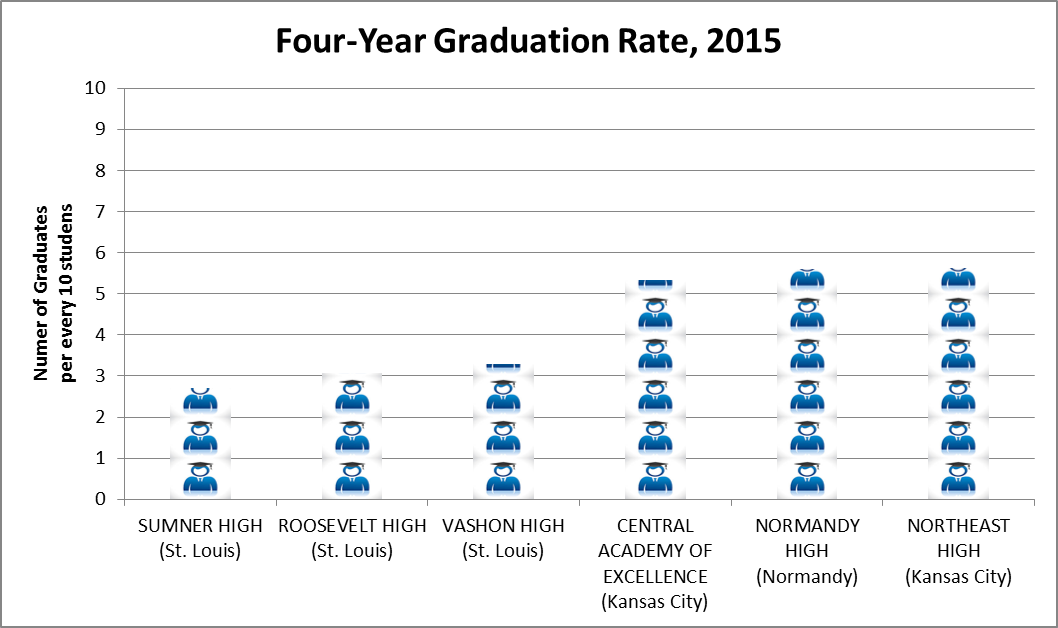
(3)   Multiple measures. This is just what it sounds like. School districts are evaluated using graduation rates, discipline, demographic information, teacher created assessments, and post-graduation outcomes. 

(4)   Social and emotional skills surveys. Studies show that students can be evaluated using nonacademic measures. Some districts are using measures like hope, for example, as a way to evaluate their students’ high school and college potential. In 2014, 64 percent of Rockwood students reported feeling hopeful.

(5)   Inspections. This type of policy places an emphasis on student assessments, as well as presentations, performances, and reports. In the United Kingdom, for example, inspectors observe lessons, evaluate work, and interview students and staff members.

What should Missouri’s public school accountability system look like? Is it really necessary to test all students every year? Are there better measures than just reading and math proficiency? These are tough questions, but taking a long look at alternatives to standardized testing might provide answers.

Oops! Columbia Taxing District Likely To Be Decided by One Voter

As my colleagues David Stokes, Michael Rathbone, and Joe Miller have chronicled for years, community improvement districts (CIDs)—a type of local taxing district—are both popular and problematic for policymakers in Missouri. CIDs can generally raise property assessments without much restriction, and after a CID is formed, the operations of the district often become a black box. As Michael wrote earlier this year, "The auditor’s office has consistently found deficiencies in reporting and documentation for these districts." Once a CID is in place, it can be very difficult to keep it accountable. 

But sometimes even the formation of a CID lends itself to chicanery. In Columbia, organizers of a CID planned to have only the businesses within the district's bounds vote on a proposed sales tax, so earlier this year they crafted the bounds of the CID to include only businesses—excluding nearby residents who, in many cases, would be paying the proposed tax. Why would they cut out those residents? Well, when there are no registered voters in a CID, under state law the property owners vote instead. And since the district has already started spending money, a vote in favor of the sales tax by the property owners who supported it was all the more important to keep the CID functioning.

There's just one (and I emphasize one) problem.

A mistake by representatives of the Business Loop 70 Community Improvement District means a sales tax increase the district needs to thrive will require approval by a single University of Missouri student.
 
On Feb. 28, Jen Henderson, 23, became the sole registered voter living within the community improvement district, or CID, meaning she is the only person who would vote on a half-cent sales tax increase for the district….
 
[CID Executive Director Carrie] Gartner said the CID has incurred “significant debt” the district hoped to pay down through the tax, including more than $100,000 it owes the city and for legal representation, $55,000 owed to Jack Miller of True Media and a $60,000 line of credit with Landmark Bank.
 
An official apparently even asked Henderson to "unregister" her vote so that the CID could be decided by the property owners as organizers intended, but it doesn't sound like that's happening.
 
Henderson said she doesn’t plan to give up her right to vote and feels negative about an increased sales tax—but has not made a decision about how to vote. Henderson said her concerns include vague project outlines, Gartner’s pay, Business Loop improvements she said will help businesses but not nearby residents and how an additional sales tax would affect low-income people purchasing groceries and other necessities.
 
Those are all very important questions that deserve serious consideration in all CIDs. Of course, the director of the CID has said that if they can't get their sales tax, they'll begin paying off the district's debts through special assessments on district properties instead. The reason is simple: a special levy by the CID has no voting requirement, but a CID sales tax needs voter approval. So even a "no vote" here (emphasis on the singular) or having no vote would still likely mean higher taxes being passed on to consumers in the CID, albeit in a more indirect way.
 
But whatever the case, Columbia's tax district problems are beginning to attract interest from around the country, focusing much-needed attention on CID practices that not only are largely done out of sight, but oftentimes are designed to game our political system. In this case, the CID wanted to impose a sales tax without letting the people purposefully left outside the district a chance to vote on the matter. That is difficult to justify under almost any circumstance, and points to the need for significant reform of the laws that control CIDs in Missouri. Hopefully, Columbia's comedy of errors will provide the final umph needed to make those reforms happen.

Big News: Accounting Board Beefs Up Tax Abatement Disclosure Requirements

Back in April I noted that the Government Accounting Standards Board (GASB) was mulling significant changes to the way that cities and counties reported their tax incentive liabilities. For a long time, local governments have been able to sidestep the question of how much of their tax revenue is given away through local incentive programs. In order for the public to get a better sense of their governments’ financial conditions, reform was needed in the way governments reported their incentive liabilities.

Well, earlier this month GASB issued long-awaited guidance on local tax abatement reporting, and it's a doozy for abatement-happy governments. From GASB's Statement:

This Statement requires governments that enter into tax abatement agreements to disclose the following information about the agreements:

• Brief descriptive information, such as the tax being abated, the authority under which tax abatements are provided, eligibility criteria, the mechanism by which taxes are abated, provisions for recapturing abated taxes, and the types of commitments made by tax abatement recipients

• The gross dollar amount of taxes abated during the period

• Commitments made by a government, other than to abate taxes, as part of a tax abatement agreement.

The accountants out there can find greater detail about the policy change at the link above.

Also, this story from American City & County magazine has an excellent rundown of the reactions to GASB's guidance seen in the policy sphere.  Greg LeRoy of Good Jobs First, while generally supportive of the change, notes that GASB's guidance doesn't necessarily require local governments to disaggregate tax abatements by company, and I do think that's a shortcoming of the reform. The other reservation I have is that many of these reforms won't become effective until later this year, with the first round of data becoming available sometime in 2017. I hope that in the interest of being proactie and transparent, local governments in Missouri will release a version of this data well before then.

Overall, GASB's reform is a significant improvement over the status quo. Tax abatement liabilities have long been a public policy concern; it's terrific that local governments, many of which have been less than forthcoming about them, will now have to reveal those costs annually.


Why Labor Reform Is a Low-cost Improvement to Missouri Government

In Missouri, once a union becomes the “exclusive representative” for a group of public employees, that union remains in power indefinitely. Another election will not be scheduled unless employees organize against the union and successfully gather enough signatures for a decertification election. Often, employees are punished by the union—in some cases successfully sued for thousands of dollars—for attempting to have a decertification election

Some have suggested fixing this system by requiring government unions to run for re-election periodically. A regular secret-ballot election sounds like a good check on the potential abuses that can occur when a representative body isn’t held accountable to its constituents. But aren’t elections expensive?

In fact, by following the example set by Wisconsin, our state can provide regular elections for its unionized employees at a low cost to incumbent unions and at no cost to taxpayers.

I’ve pointed out before that Wisconsin has revenue-neutral elections for its unionized public employees. In Wisconsin, teachers and state workers periodically decide whether or not to keep their unions. These elections do not cost the state money because they are paid for with a small filing fee—about $1.50 per voter—paid by each government union. The state also contracts with a private company that uses telephone voting to decrease the amount charged to unions, while increasing the convenience of elections.

Lawmakers should carefully consider the costs and benefits of union elections before enacting reforms. However, Wisconsin proves that fiscal cost should not be treated as a serious obstacle to more democratic union representation. By carefully crafting the law to encourage contracting for polling services and by requiring the unions to pay for these elections, Missourians can enjoy greater union accountability without increased cost.

Department Testimony Confirms: One-in-Seven Missourians on Medicaid

Ronald Reagan once said that Americans "should measure welfare's success by how many people leave welfare, not by how many are added." Unfortunately, the Affordable Care Act (ACA) has taken us in the opposite direction. Even in Missouri—which prudently chose not to expand Medicaid under the ACA—the law is swelling the state’s welfare rolls, as reported by the Jefferson City News Tribune:

The number of Medicaid cases, including youth in the Children’s Health Insurance Program (CHIP), hit a high point in May with more than 918,000 cases. Since January, the cases have increased by more than 55,000 due to various factors, including the implementation of a new enrollment system and policies in the Affordable Care Act, said Brian Kinkade, director of the department of social services.

Cases hit a low in May of last year with approximately 819,000 enrolled, which Kinkade credited to the Affordable Care Act taking effect in January. They have since steadily increased, but with a more noticeable jump this year.

Missouri’s population is just over 6 million, so having over 900,000 enrollees means that about one in seven Missourians is now in the state's Medicaid program. Part of the year-over-year growth here is attributable to the department fixing a host of technology problems, about which I've written before

But much of the topline enrollment growth is connected to the "woodwork effect" of the ACA. The woodwork effect describes what happens when individuals currently eligible for Medicaid but not enrolled become enrolled, thanks to other enrollment drives pushed under the law. Enrollees "come out of the woodwork" and join the program who, but for the ACA, would not have. In fact, much of the cost of the ACA comes from this woodwork population, who on a per-beneficiary basis are considerably more expensive to states than the expanded population. Policymakers should keep in mind that ACA supporters often omit those expanded costs when talking about the law, perhaps because it dispels the illusion of "savings" they regularly tout.

The latest numbers from the Medicaid program serve as yet another reminder that a Medicaid expansion under the ACA is precisely the wrong course for Missourians and for Missouri's budget. Our state leaders must remember that growing welfare rolls are not a mark of success, but of policy failure.

Size No Barrier to School District Consolidation

By most academic measures, the Show-Me State usually performs near the middle of the pack, rarely cracking the top 25 in national rankings. But there is at least one area in which Missouri is a top-tier state: the number of school districts. With more than 500 districts, Missouri ranks 11th in the nation.

There is nothing inherently wrong with having a lot of school districts, provided that you are able to support them all. Researchers such as James Conant have long argued that small school districts are more costly to operate. In addition, small districts often are unable to offer the same quality or diversity of educational opportunity as some larger districts. This is one reason why some are looking to school district consolidation as a possible way to improve outcomes and decrease costs.

One argument often made against district consolidation has to do with geography. Opponents contend that many districts with low enrollments are actually very large geographically, meaning that consolidating them would require students to travel great distances to get to school every day.

There are two easy responses to this objection. First, district consolidation does not necessarily mean consolidating schools themselves. Children’s travel times don’t have to change at all; districts could just consolidate their central offices and eliminate costly and redundant staff and services.

But more importantly, the premise of the argument simply isn’t true; Missouri’s small school districts aren’t nearly as big geographically as you might think.

The table below shows the mean square miles of Missouri school districts of various sizes. These data were obtained from the Missouri Department of Elementary and Secondary Education’s website. The average school district in Missouri covers an area of approximately 134.5 square miles. Large school districts (those with more than 1,000 students) cover more area (averaging 142.8 square miles). School districts with fewer than 350 students cover just 100.4 square miles. These districts receive additional funding form the state because of their low enrollment. Smaller still, school districts with fewer than 100 students cover just 63.9 square miles.

For perspective, an 8-mile by 8-mile square would be 64 square miles.

Student Enrollment

Number of School Districts

Mean Square Miles

100 or less

49

63.9

350 less

191

100.4

351–1000

158

166.9

1001 and up

169

142.8

All Districts

518

134.5

There may be perfectly valid arguments against school consolidation, but for districts with fewer than 100 students, size does not appear to be one of them.


Saint Louis City Board of Aldermen Passes Saint Louis County Employment Act of 2015

The Saint Louis Board of Aldermen met yesterday to discuss a modified proposal that would have raised the city’s minimum wage to $13 per hour by 2020. Eventually, the Board passed a measure that would raise the wage to $11 per hour by 2018. The bill needs just one more vote before going to Mayor Slay.

Some might see a silver lining in the fact that the minimum wage will “only” go up to $11 instead of $13 or $15 per hour. That lining, unfortunately, is hair-thin; an $11 per hour minimum wage is still likely to have serious, negative consequences for the Saint Louis labor market, hurting the very people it is meant to help. If enacted, the increase will make Saint Louis County even more attractive to businesses compared to the city, because the county will have a much lower minimum wage coupled with the lack of an earnings tax.

The timing of this proposal is significant; it was passed now so that it would be exempt from HB 722, which, if enacted, would bar cities from raising their minimum wages after August 28 of this year. However, even if the minimum wage proposal is enacted before HB 722 goes into effect, there are still legal issues with this bill. Namely, section 67.1571 of Missouri State Statutes states that “No municipality as defined in section 1, paragraph 2, subsection (9) shall establish, mandate or otherwise require a minimum wage that exceeds the state minimum wage.”

Of course, things are never as simple as we might hope with regard to state statutes. A Saint Louis Circuit Court did rule that 67.1571 is invalid on procedural grounds. However, no higher court has ruled on this, so the question of 67.1571’s constitutionality is still open.

Relying on the courts to come to the rescue is no substitute for avoiding bad legislation in the first place. Policymakers should realize that minimum wage increases are not the way to alleviate poverty—but if they don’t,  a court ruling that the increase is invalid would preserve the jobs of many low-wage workers in the city.

The Idea That Would Not Die

Last month I talked with a restaurant owner who told me that a sizeable increase in Saint Louis’ minimum wage would be “devastating.” Last June, this owner and many others were granted a reprieve   when the Chairman of the Ways and Means Committee canceled all future meetings to discuss the bill. Yet, like Jason Voorhees and Freddy Krueger, a city-wide minimum wage increase is the idea that will not die.

It seems that there are those in the city who want to get some type of minimum wage increase passed before the Legislature has a chance to override Governor Nixon’s veto of HB 722, which would forbid municipalities from raising their minimum wages after August 28. What’s interesting to note is that even if the Board of Aldermen passes a bill before the August 28 deadline or the Legislature fails to override the Governor’s veto, Saint Louis probably lacks the legal authority to raise its minimum wage above the state minimum wage. Regardless, a $13 per hour minimum wage would be disastrous for the city and its workers.

The Congressional Budget Office studied the effects of increasing the federal minimum wage to “just” $10.10 an hour and found that it would cost 500,000 jobs. Now this 500,000 figure is a national number, but the effect on jobs would be especially pronounced if the wage went up at the local level, because companies forced to pay the higher wage can just hop across the city border to escape the mandate. Even the liberal Vox.com thinks that $13 per hour (never mind $15) would be too high a minimum wage for Saint Louis.

What about the other cities that have raised their minimum wages? If the recent evidence from Seattle is any indicator, things aren’t looking good.There are also some signs out of Los Angeles that might give policymakers in Saint Louis pause.

                Momentum is building in some parts of Saint Louis City government to increase the city’s minimum wage, as evidenced by the convening of a special session to debate the issue. However, that doesn’t mean that such a move would be good policy. A large increase (and going from $7.65 to $13 or $15 per hour would certainly qualify as large), will end up costing jobs  and failing to help the working poor. 

Support Us

The work of the Show-Me Institute would not be possible without the generous support of people who are inspired by the vision of liberty and free enterprise. We hope you will join our efforts and become a Show-Me Institute sponsor.

Donate
Man on Horse Charging