Just How Low Cost Is Labor Reform?

If you’ve been following our work, you know that once a government union comes to power, it can stay in power for an indefinite length of time. Public employees, such as teachers and firefighters, are trapped by labor laws that give a union tremendous power after a one-man, one-vote, one-time election. In our newest study, The Low Cost of Labor Reform, we show how Missouri can provide public employees the ability to replace or retain their union every few years with union elections.

So how low cost are union elections? If the state contracts out with a company that specializes in providing elections, the price tag could be less than 1% of union dues.

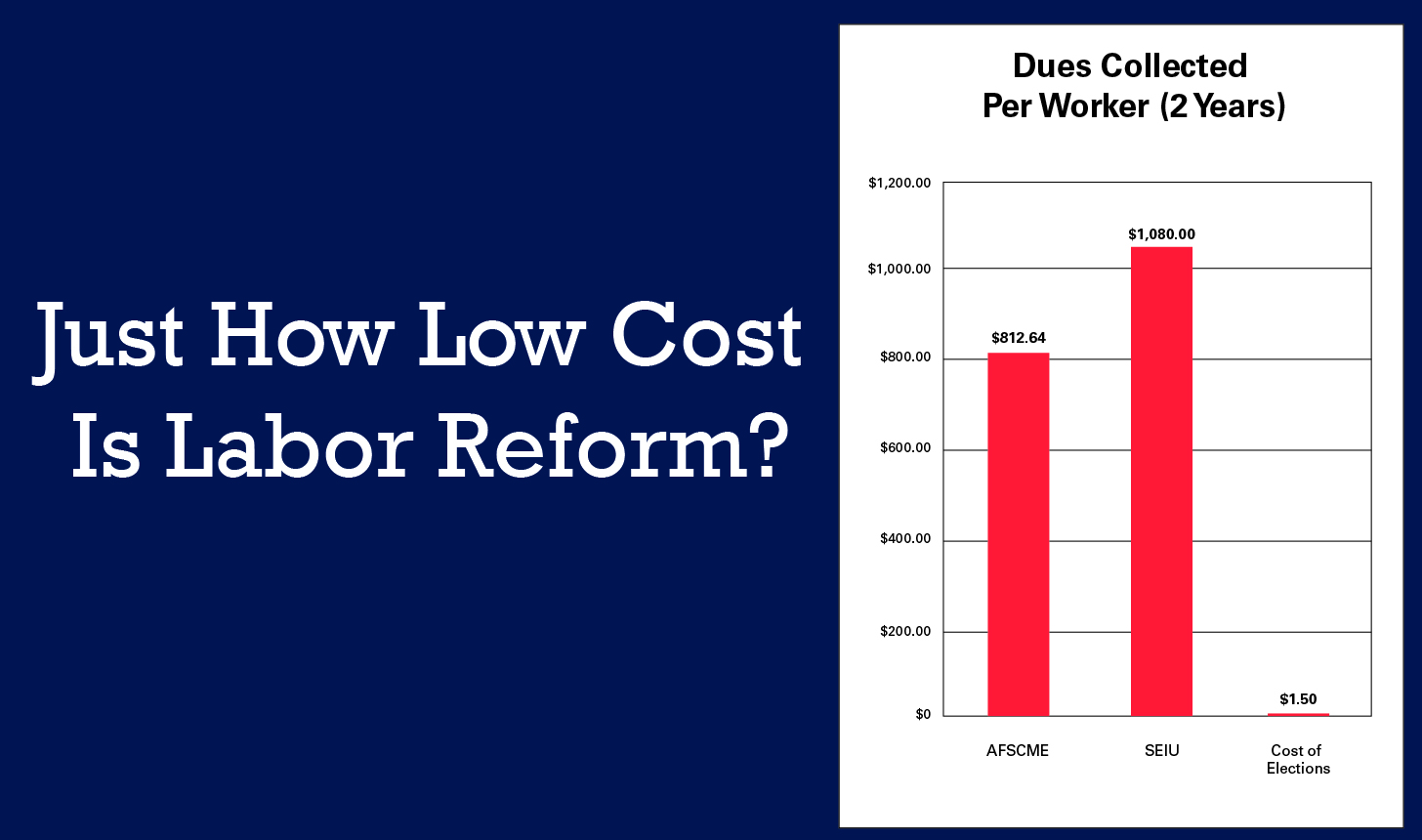
When Wisconsin contracted with the American Arbitration Association (AAA) to provide union elections for its public employees, the cost was about $1.50 per voter per election. AAA is a well respected arbitration firm, but there are other options. For example, a service called “Election Buddy” by Event IQ, Inc., conducts elections for Harvard and Yale Universities and thousands of other companies internationally for approximately 9 cents per voter. $0.09 to $1.50 is a wide range, but even at the top end of that range, elections are inexpensive.

For comparison purposes, consider the dues charged to state employees by some of the major government unions. The American Federation of State, County and Municipal Employees (AFSCME) charges Missouri state employees $16.93 per pay period, or $406.32 per year. The Service Employees International Union (SEIU) charges patient care professional employees $22.50 per pay period, or $540 per year. Even if the state contracts with a more expensive arbitration firm, rather than a relatively less costly corporate election firm, and ends up charging each union around $1.50 per voter, with an election every two years that’s less than two dollars out of the $812.64 AFSMCE collects per person during that period or the $1,080.00 SEIU collects.

Contracting out for union election is just one way of saving money. By contracting out for elections, the state will not need to hire additional staff, pay for increased travel expenses for staff conducting elections, or purchase new voting equipment. The savings will allow the state to charge a much lower fee to unions for conducting these elections, saving public employees money.


New Study Suggests Missouri is Still Stuck in the Middle

By almost every academic outcome measure, Missouri’s educational system ranks in the middle of all the states. This shouldn’t shock long-time readers of the blog, as I’ve written about it here, here, and here.  Despite efforts to get Missouri in the “Top 10 by 20,” it appears we may be falling further behind.

A new study by Matthew Chingos, a senior fellow at the Urban Institute, examines the changes in scores from 2003 to 2013 on the National Assessment of Educational Progress. Chingos adds to this analysis by adjusting the growth according to each states changing demographics.  It is no secret that some groups of students, such as students with special needs or students living in poverty, score lower on standardized exams.

When adjusting for state demographics, Missouri ranked 29th in overall performance on the 2013 NAEP.  In terms of growth from 2003 to 2013, Missouri ranked in the bottom ten. In other words, we are not moving towards the top ten; we’re moving towards the bottom.

The 2015 NAEP results are being released today (Oct 28th.). Missouri appears to be no closer to the top ten than we have been in the past.

The Great Race: Taxi v. Uber v. Metro Link

With UberX finally available in Saint Louis, Show-Me Institute staff decided to hold a race to see how the service can add to the city’s transportation options. The contestants, Nathan Coursey, Joseph Miller, and Brittany Wagner, took a taxi, an Uber car, and the MetroLink, respectively, from the Show-Me Institute office in St. Louis's Central West End to Mr. Curry’s downtown. Watch the video to see who prevails!

Missouri’s Waterways Receive Bad Marks for Transportation

An organization named “America’s Watershed” recently released a report card on the country’s inland waterway systems, three of which are important to Missouri (the upper Mississippi, the lower Mississippi, and the Missouri River). Unfortunately, Missouri’s waterways received poor marks (Ds and Fs) for transportation and infrastructure condition, which could lead to Missouri missing important opportunities for growth in the coming decades.

While organizations that release infrastructure report cards are almost universally pushing for greater investment (and therefore tend to be alarmist about current conditions), there is little doubt that Missouri’s waterway infrastructure is in a poor state of repair. Nearly every lock and dam on the upper Mississippi is well past its useful life. While many don’t think of the rivers as important carriers of freight, Missouri’s rivers carry almost 50 million tons of freight annually. Rivers are especially important for shipping agricultural products and commodities to international markets. And with the expansion of the Panama Canal nearly completed, the Mississippi River may become a more important conduit for Missouri’s exports in the future.

The federal government is primarily responsible for maintaining and improving waterway navigability, specifically through the Army Corps of Engineers. Theoretically, funding for the Corps’ projects should come from a 29 cent per gallon tax on barge fuel. When the Corps takes on a new project, it is also supposed to split the costs 50-50 with barge companies.

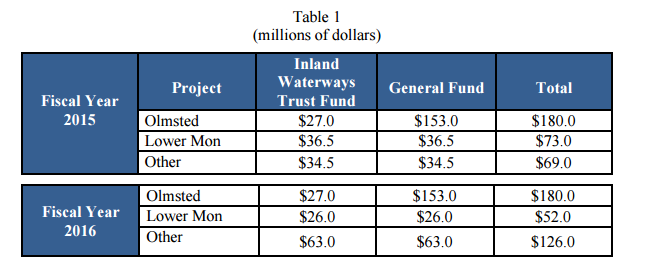
In reality, barge fuel tax revenue is insufficient for such a system to work. Even with a rate increase last year, the tax will bring in only about $100 million in revenue in 2015. Individual lock and dam projects usually cost hundreds of millions—if not billions—of dollars to complete. Thus, while dozens of projects require repairs, the Corps can only address a few projects at any given time. And even these require heavy taxpayer subsidies. In 2015, general funds accounted for 70% of federal spending on inland waterways. Worse yet, 50-50 cost splits with barge companies are honored more in the breach, because Corps projects regularly run over budget. Overruns are handled by taxpayers, not barge companies. The table below lists the two largest lock and dam projects and shows the division of costs for each.

A federal body notorious for cost overruns and funded with insufficient user taxes is unlikely to build and maintain an efficient, modern, inland waterway transport system. The shipping companies and exporters that would directly benefit from an improved system could, with federal coordination, make the necessary investments. But until they do, Missouri will not be in a position to see large economic gains from the Panama Canal expansion and can expect low marks for its waterways in the future. 

Show-Me Institute Presents: Comparing Income Tax Liability Across States: Where Does Missouri Rank?

There has been a lot of back and forth regarding whether Missouri is a low-tax state. The truth depends on which tax one looks at. Missouri has the lowest cigarette taxes in the country, but its combined state and local sales taxes rank amongst the highest in the country.

My colleague Rik Hafer and I decided to compare Missouri’s income taxes to those of other states. In our anaylysis, we went beyond looking at states’ top marginal income tax rates or income taxes collected per capita. Using tax preparation software, we examined how much an average family of four would have to pay in income taxes in each state. This is a new way to look at how income taxes actually affect households by giving people an idea of how much they would owe if they were to live in a particular state.

So where does Missouri rank? Give our paper a look and find out.

20150814 – Compairing Income Tax Liability Accross States – Hafer_Rathbone.pdf

The Risks to the City of the Convention Hotel Gamble

At the City Council's recent business session on the proposed convention hotel, proponents kept repeating that there was no risk to the city. The risk is being shouldered by investors, supposedly. And so, really, this project is just another riskless freebie. It wasn't so long ago that City leaders were telling Kansas Citians that in a few years we'd be calling them geniuses over the Power & Light District. Even the most ardent fan of spending gobs of taxpayer money on downtown, The Kansas City Star (which received its own subsidy), isn't calling them geniuses now.

City Manager Troy Schulte says the city learned lessons from that deal; the new project makes none of those same errors. Perhaps. But the City might be making a whole new round of mistakes. 

The St. Louis convention hotel project of the early 2000s was so bad that is changed the way Wall Street investors look at convention hotel investments. In a piece to The Kansas City Star, convention hotel expert Heywood Sanders put it thusly:

With an expanded convention center and domed stadium, consultants told St. Louis city officials they needed a big, new hotel. The 1,081-room Renaissance Grand Hotel and Suites was supposed to be filled by a wave of new convention attendees as the number of major conventions grew from 33 to 56, almost doubling the city’s convention business. But by 2008, the city garnered only 24 major conventions and fewer hotel room nights than in 1999 and 2000—before the Renaissance hotel opened. Without new convention attendees, the hotel couldn’t pay its annual debt service and the bondholders foreclosed in 2009. They finally were able to sell the hotel, at a serious loss, in May 2014.

Regarding that sale, The St. Louis Post-Dispatch reports that the new owners will invest millions in renovation and re-open them. The piece offered this observation:

“We had a shuttered building next to our convention center, and it will be alive with activity,” said David Richardson, a lawyer with law firm Husch Blackwell who advises the city on development issues.

This underscores the risk to Kansas City; will we build a huge hotel just to have it shuttered? It isn't just an idle thought experiment; we've been here before. After all, the last time Kansas City built a convention hotel—The Vista in 1985—the owners were considering bankruptcy within 18 months. A decade later, the city subsidized the Muehlebach hotel and took a loss because business was so soft. Why are these things unthinkable now? Hotel occupancy rates in downtown Kansas City have been averaging at an abysmal 50% to 55%, yet hotel proponents predict the new hotel will have a much better 68% occupancy. Are those reasonable expectations? We don't know—the reports don't explain how they reach those conclusions. But betting on them to be correct is certainly risky.

These same consultants have predicted that Kansas City convention business would almost double if we just built a hotel. Just build it and people will come, apparently. But the consultants again fail to explain how they reach these conclusions. As a result, we don't know if the predictions are reasonable.

The city may have learned its lesson from the awful plan to build the Power and Light District, but we cannot know what lessons we may have yet to learn. What is clear, however, is that projections of wild business growth seem unreasonable, and that should be enough of an alarm to those elected to protect city resources.

325 System Dead

Last week, we questioned the future of MoDOT’s “325 System,” or how the department would have prioritized spending in the event of a revenue shortfall. While MoDOT has not yet announced an official change in policy, the link to “Tough Choices Ahead,” which outlined the system, is now dead. It will live on in our hearts.

For those interested, the pages taken down can be viewed in part below:

[[{“fid”:”2444″,”view_mode”:”default”,”fields”:{“format”:”default”,”field_folder[und]”:”157″},”type”:”media”,”link_text”:”Missouri’s 325 System Fact Sheet.pdf”,”attributes”:{“class”:”file media-element file-default”}}]]

ToughChoicesAheadExecutiveSummary.pdf

Difference Between Primary Highway System.pdf

index.pdf

The Low Cost of Labor Reform

SMI’s newest study shows how government union elections don’t have to cost taxpayers an arm and a leg.

In Missouri, once a union becomes the “exclusive representative” for a group of public employees, that union remains in power indefinitely. Some have suggested fixing this system by allowing unionized public employees the ability to vote to maintain or replace their union every few years. A regular secret-ballot election sounds like a good check on the potential abuses that can occur when a representative body isn’t held accountable to its constituents. But aren’t elections expensive?

This study shows how our state can provide regular elections for its unionized government employees at a low cost to incumbent unions and at no cost to taxpayers. In The Low Cost of Labor Reform, I examine some of the ways the cost of these elections can be greatly reduced or shifted away from taxpayers entirely. 

Riverfront Stadium Unlikely to Increase Construction Jobs in Saint Louis

This week, members of the Saint Louis City Board of Alderman announced that they support a public vote on the proposal to spend over $100 million on a new football stadium downtown. An ordinance requiring such a vote already existed, but was ruled invalid earlier this year. The mayor’s office criticized the effort, saying there is not enough time for such a vote, and that the delay could cost the city the Rams and “3,000 new construction jobs,” among other benefits.

This post will not discuss the timing of the proposed ordinance. We can only note that the city could have scheduled a vote on public funding for a new stadium months ago. If the city had actually sought public approval, instead of trying to make an end run around democracy, timing would not be an issue.

However, in its effort to justify opposition to a public vote, the mayor’s representatives have again made claims about the stadium’s impact that fly in the face of economic evidence. According to city representatives, the stadium project will create an amazing 3,000 new construction jobs. But academic economists have studied the impact of stadium projects on the construction industry, and found that they have little or no positive effect.

In fact, a paper from an economist at the University of Missouri studied the impact of the Edwards Jones Dome and the Kiel Center (now the Scottrade Center) in Saint Louis specifically. The author found:

“By econometrically modeling construction employment during the 1970’s, 1980’s and 1990’s, it was found that there was no more nor no less construction employment within the St. Louis MSA during the time the Kiel Center and the Trans World Dome [Edward Jones Dome] were being constructed…”

This perhaps counter-intuitive result happened because:

“…instead of creating new construction jobs, jobs were shifted from projects that would otherwise have been undertaken, resulting in no net new job creation in the construction industry.”

The author concluded:

“These results, coupled with the more extensive analysis given in the article on construction employment, suggest that the net impact of stadium construction on construction employment and worker incomes is zero.”

This finding is in line with the bulk of the economic literature: stadiums do not boost economic growth, greatly increase tax revenue, or spur revitalization. A new football stadium is an expensive want, not a need, in Saint Louis City. With its lack of economic merits, civic leaders should reject the public funding for the stadium. If they cannot bring themselves to do so, they should at least allow residents to accept or reject a plan to use public funds for football.     

Support Us

The work of the Show-Me Institute would not be possible without the generous support of people who are inspired by the vision of liberty and free enterprise. We hope you will join our efforts and become a Show-Me Institute sponsor.

Donate
Man on Horse Charging