Comparing Teacher Pay by State Offers Heat, but Little Light

I’m going to tell you something you already know: Teacher salaries are higher in Saint Louis and Kansas City than they are in the state’s more rural areas. “Of course they are!,” you might say, “It costs more to live in those areas.” That, my friends, is the point. It costs more to live in some areas than it does in others. That’s why the wages are higher there.

That’s also why I do a facepalm when someone compares Missouri’s teacher salaries to the average salaries in other states.

In a recent press release promoting a new study on teacher salaries, Bruce Moe, executive director of the Missouri State Teacher’s Association, said, “Missouri ranks 42nd nationwide for average classroom teacher pay. That translates to $8,896 less than the national average.”

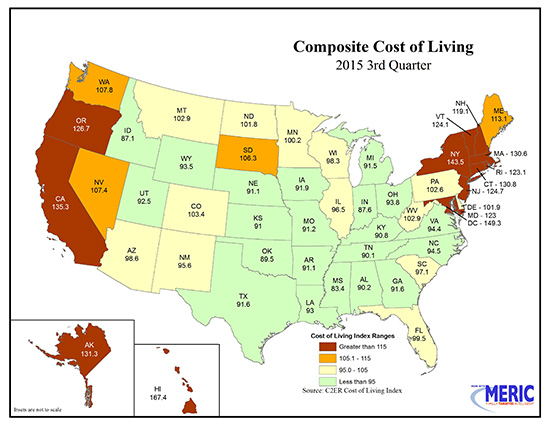
Let’s do a little test. Here is a cost-of-living map from the Missouri Economic Research and Information Center (MERIC). It provides an index for each state. Missouri’s cost of living in the 3rd quarter of 2015 was just 91.2% of the national average. Using just this information, what states would you bet have the highest teacher salaries?

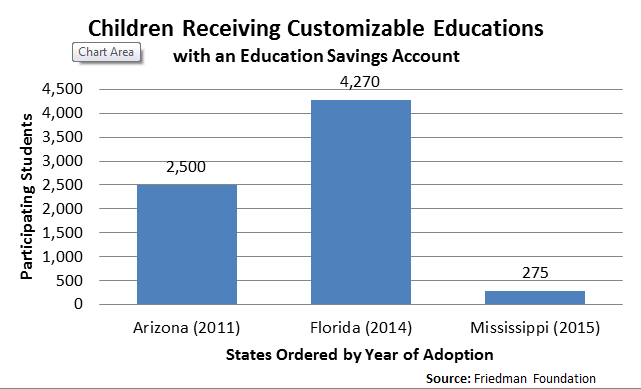
Did you guess New York, Washington D.C., or California? Give yourself a gold star!

According to the Digest of Education Statistics from the National Center for Education Statistics (Table 211.60), the average teacher salary in each of these places was over $70,000. Massachusetts and New Jersey also have average salaries higher than $70,000, but each of these places has a cost-of-living that is much higher than the national average (including 149.3% of the national average in D.C.!).

According to MERIC, “Missouri had the 11th-lowest cost of living in the United States for the third quarter of 2015.” We should expect the average teacher salary in Missouri to be below the national average, because the cost-of-living in Missouri is below the national average.

Just as teachers in Saint Louis and Kansas City make more than teachers in Mt. Vernon and Niangua, teachers in New York and California make more, on average, than teachers in Missouri. This is not a bad thing—it simply reflects that it costs a lot less to live here. Not taking that into account yields wildly skewed results, and the MSTA should know better.

Taxicab Commission Gets New Year Rolling with Reform

After an acrimonious showdown with ridesharing company Uber in the middle of last year, the the Metropolitan Taxicab Commission (MTC) is no longer in the public eye. In many ways, things have changed little since October, when Uber began operating in Saint Louis City and County without the MTC’s sanction. Uber is still running (with a car about 4 minutes away from me at the time of writing), the MTC still objects, and lawsuits continue to move forward.

But while the public’s attention has drifted to other issues, the MTC continues to make changes. For one, in late December, the MTC passed a large revision to the taxicab code. Many of the changes are improvements. For instance, airport taxis can now operate as normal on-call taxis on days with particularly high demand. In addition, taxis up to nine years old can now be entered into service (previous requirements held that number to six). The commission also removed the “nighttime taxi” permit designation, which was itself a bizarre response to an MTC-created taxi supply problem.

Perhaps the most welcome news of all is that on January 4, 2016, the MTC will finally begin accepting applications for new on-call taxi Certificates of Convenience and Necessity (CCNs). As we’ve discussed before, a CCN is necessary to set up a new taxi business in Saint Louis. The MTC unilaterally froze all CCN applications for on-call taxis back in February of 2013, while the body “studied” taxi supply and demand for cabs in Saint Louis. After almost three years, and no study, the moratorium will finally come to an end.

Finally, Lou Hamilton, the controversial chair of the MTC, resigned on December 15, stating as a reason for his resignation that, “There is only so much fun one person can have.” We wish him an uneventful retirement. 

Does It Matter What a Lost Job Would Have Paid?

In a recent Wall Street Journal editorial, economist David Neumark challenges some of the myths about the minimum wage. From the article:

Economists have written scores of papers on the topic dating back 100 years, and the vast majority of these studies point to job losses for the least-skilled. They are based on fundamental economic reasoning—that when you raise the price of something, in this case labor, less of it will be demanded, or in this case hired.

***

The broader research confirms this. An extensive survey of decades of minimum-wage research, published by William Wascher of the Federal Reserve Board and me in a 2008 book titled “Minimum Wages,” generally found a 1% or 2% reduction for teenage or very low-skill employment for each 10% minimum-wage increase.

That has long been the view of most economists, although there are some outliers.

Neumark himself conducted two policy studies on the effect of minimum wage laws right here in Missouri. These studies (from 2006 and 2012) examined the minimum wage increases being considered at the time. Both studies drew from a large body of existing research that suggests that minimum wage hikes do more harm than good.

Despite all of the research and hard evidence, some politicians and activists still push for minimum wage increases. In fact the “Fight for 15” movement, a campaign funded in large part by service industry unions, is still agitating for a 15 dollar minimum wage in Kansas City and St. Louis. 

Let’s not ignore what the evidence says: Unemployment is a clear downside to the minimum wage. And that downside is borne by the people minimum wages are usually thought to help.

New Bill Would Raise Missouri Fuel Tax, Cut Highway Miles

Recently, we discussed a couple of pre-filed bills that would raise the fuel tax in Missouri to avert a funding crisis at the Missouri Department of Transportation (MoDOT). But raising the fuel tax is not the only proposal on the table, and one bill (SJR 18) proposes a solution that could aid MoDOT’s financial situation over the long term: reducing the size of the state highway system.

SJR 18 has two parts. The first part would increase the state’s regular fuel tax by 1.5 cents per gallon and the state’s diesel fuel tax by 3.5 cents per gallon. This increase has the potential to net MoDOT around $60 million in additional revenue annually, which would put off any immediate funding crisis for the state.

However, SJR 18 is different from other fuel tax increase proposals in that it also contains provisions for transferring responsibility for the state’s “supplementary” highway system to localities. The supplementary system is mostly made up of the state’s letter routes, but also includes urban streets like Gravois Road in Saint Louis and MO Route 283 in Kansas City. We’ve discussed before how these routes eat up a significant portion of MoDOT’s budget. These types of roads are maintained by counties and municipalities in most other states.

SJR 18 would not simply hand off the supplementary highway system to localities without any aid. The state would continue to provide localities with financial support for the transferred roads (fixed at the average spending of the last three years on that road). This means that in the short-term, MoDOT would spend the same amount on these highways as it does today. However, over the long term this spending would be capped, with local governments responsible for increased investment.

SJR 18—which would require a vote of the people before being enacted—is an interesting policy proposal that addresses both short-term and long-term financial problems at MoDOT. It does not encompass a large tax increase, and instead focuses on capping long-term spending as a method of setting MoDOT’s funding on firm footing.

Metro Ridership Trending Down in 2015

Earlier this year, we talked about how, contrary to the hopes of many Saint Louis regional planners, there is no evidence that people are ditching their cars for public transportation. In fact, Metro ridership peaked around 2008, took a nosedive during the recession, and has experienced tepid growth ever since. The latest data (from 2015) paints an even bleaker picture from Metro, as sluggish growth has transformed into decline.

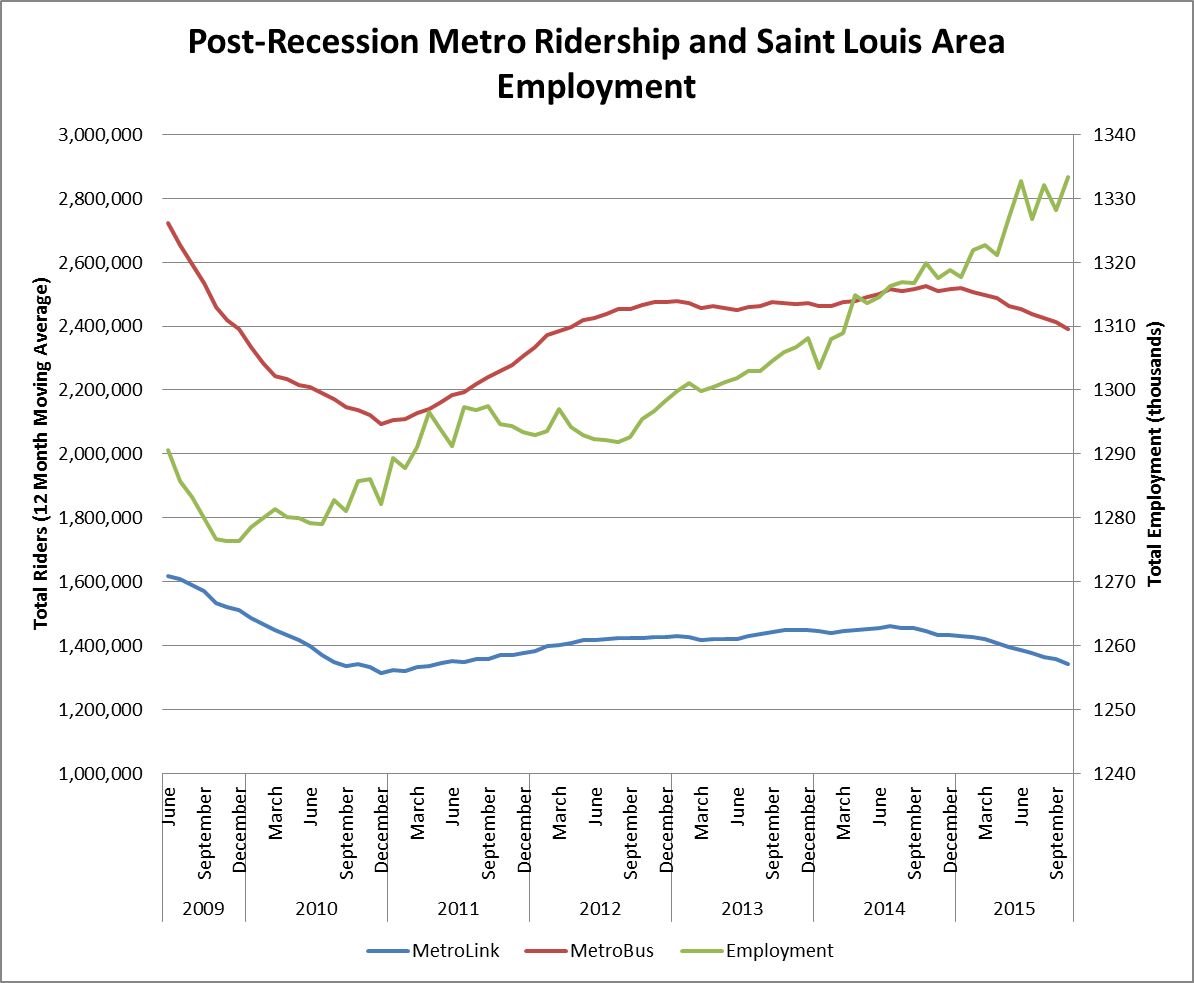
To see this, we can look at ridership changes on the MetroBus and MetroLink systems since the end of the recession. That recession technically ended in mid-2009, according to the Saint Louis Federal Reserve. And while 2010–2013 cannot be described as great years, total employment in the Saint Louis Metropolitan area has steadily risen since around October of 2009.

Metro ridership was anything but recession-proof. During the economic downturn, MetroLink ridership fell 37% and MetroBus ridership fell 28%. But while the employment in the Saint Louis area has slowly but steadily recovered, the same cannot be said of Metro ridership. In 2010 and 2011, MetroBus gained back much of the ridership it had lost in the recession, but in 2012 and 2013 growth stagnated. MetroLink ridership recovery was less robust. By mid-2014, five years after the recession’s end, MetroLink ridership was still 30% below its pre-recession peak.

But as the chart below also shows, 2015 saw ridership levels reverse their post-recession trend of steady (if modest) growth. From July 2014 to October 2015, MetroLink ridership fell 8% and MetroBus ridership fell 5%. Taking all this together, it means that MetroLink ridership in late 2015 is only 2% higher than the post-recession ridership lows.

There are many factors that may explain weak post-recession ridership growth for Metro. Saint Louis has had a weak jobs recovery, with total employment still below pre-recession highs; employment has only increased 4% since 2009. However, economic growth has accelerated in the last year, the same time ridership began to decline on Metro.

Whatever the underlying reasons, this much is clear: there is no evidence that Saint Louis residents are flocking to public transportation or the MetroLink, despite significant investments made in the 1990s and early 2000s.

Missouri Legislature Takes Up New Roosevelt Laws

Lawmakers are teaming up to address the growing problem of unaccountable government unions. This month Senator Bob Onder and Rep. John Weimann filed twin bills in the House and Senate that seek to reform the way these unions operate.

Government unions—the unions representing government employees such as teachers, firefighters, and state workers—bargain in a much different setting than private sector unions. Rather than negotiating with private companies, government unions negotiate with public officials. This means that public sector collective bargaining affects everyone—not just the few who happen to be associated with a specific business.

In the public sector, unions can use political muscle to help elect politicians favorable to their interests. When it comes time to negotiate pay and pension benefits, politicians are often willing to return the favor.

Franklin D. Roosevelt, a great advocate of organized labor, understood the differences between unions in the government and unions in the private sector. According to FDR, when it comes to government labor, “the employer is the whole people, who speak by means of laws enacted by their representatives in Congress.” For this reason FDR thought that “the process of collective bargaining, as usually understood, cannot be transplanted into the public service.”

Roosevelt was right. The labor laws we use in the private sector are a poor fit in government. Instead, the laws that allow public employees to bargain with their managers should have special features that protect both government workers and the public at large.

I welcome reform introduced in this spirit. Look for more posts from me on this subject in the coming weeks.

Gregg Keller Joins Show-Me Institute’s Board

We are pleased to announce that Gregg Keller is now a member of the Show-Me Institute’s Board of Directors.

Gregg is the Principal of Atlas Strategy Group and is widely regarded as one of the preeminent public affairs professionals in the country. A former Executive Director of the American Conservative Union, the Conservative Political Action Conference (CPAC), and the Faith & Freedom Coalition, Gregg has been an advocate for free-market public policy at local, state, and national levels for 15 years.

Gregg has worked—and continues to work—extensively with the Show-Me Institute to increase the organization’s membership and following among the next generation of free-market leaders. 

Show-Me Institute Chief Executive Officer Brenda Talent had this to say about our newest board member:

"We’re excited to have Gregg Keller join the Board at the Show-Me Institute. His youth and expertise in free-market public policy will bring a fresh and vital perspective to our Board."


Support Us

The work of the Show-Me Institute would not be possible without the generous support of people who are inspired by the vision of liberty and free enterprise. We hope you will join our efforts and become a Show-Me Institute sponsor.

Donate
Man on Horse Charging