Full Steam Ahead for Transportation Funding in Missouri

Before Missouri’s legislative session started a couple weeks ago, we wrote about how one of the main focuses for the body would be the state’s transportation funding issue. Quick action on fuel tax bills in the Senate has confirmed this position.

For instance, SB 623, a bill that would increase the fuel tax by 1.5 cents for regular fuel and 3.5 cents for diesel fuel, has already been voted out of the Senate’s transportation committee (unanimously). A similar bill last year (SB 540) did not even have a hearing until March 18th. SB 623 is not the only transportation bill that has seen a concerted push. SJR 18, which would not only increase the fuel tax but also transfer many of the state’s smaller highways to the control of local governments, has also been assigned to the transportation committee and will likely have a hearing soon.

Measures similar to those going forward in the Senate are making their way through the Missouri House of Representatives (HB 2032, 1581, and 1381), although not at such a breakneck pace. In addition, the legislature has yet to propose any infrastructure-related public–private partnership (P3) bill, which was introduced in last year’s session and would be essential for any efforts to use tolling to fund I-70’s reconstruction. Such a bill might never be introduced, but it is worth noting that the last year’s attempt at P3 legislation came late in the legislative session as an amendment to SB 540.

We’ll keep track of all these bills as they make their way through the legislative process. 

State of the State Address Strikes Happy Notes, But Forgets Opportunities Lost

Last week Missouri Governor Jay Nixon delivered his eighth and final State of the State address to the Missouri legislature. You can find the full text of his speech here. In contrast to previous years, the Governor struck a much less antagonistic tone toward supporters of free market policies, focusing instead on a host of priorities he claims were successes during his tenure. The Governor deserves credit for the positivity in his speech.

But sadly, the Governor's positivity doesn't bring back the missed opportunities of the last seven years. In Jefferson City we have seen hostility to substantive income tax cuts, opposition to serious education reforms, the promotion of a long line of tax incentive boondoggles, and the rejection of reasonable reforms to the state's labor policies. This year's priorities also leave something to be desired; for instance, "keeping tuition low" at Mizzou, a key plank from last week's speech, is probably a misplaced priority while the University fights to earn back the trust of the taxpayers who fund it

A few months remain for the Governor and the Legislature to make real progress on a host of important policy matters, and I expect that there will be some forward movement on ethics reform before he leaves office. That is a great thing. I worry, however, that that's where the progress will end. Let's hope not.

Jennings Superintendent’s Departure: Lessons for Education Policy

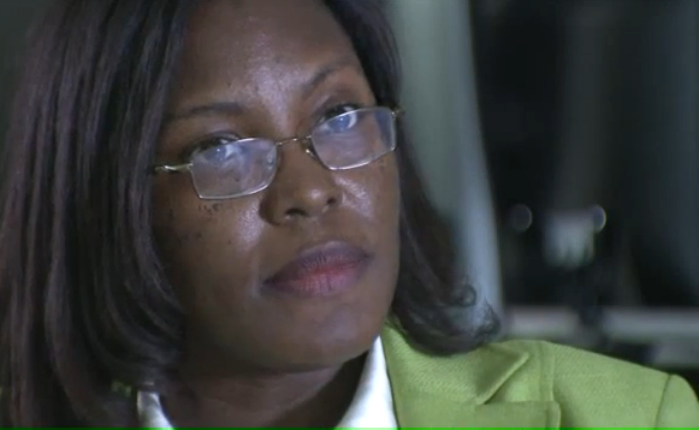
Tiffany Anderson, the superintendent of the Jennings school district, is leaving to head up the Topeka, Kansas, school district. By all accounts Dr. Anderson is a rock star.  When she assumed control of the school district in 2012 it was in bad shape, deeply in the red and severely underperforming.  It has now reached full accreditation and is back in the black. She will be sorely missed.

There is a lesson to learn here. It is one that people across the country have found when their great superintendent leaves for greener pastures.  We cannot have school systems that are completely dependent on a one-in-a-million talent at the helm in order to succeed.  There is only one Tiffany Anderson.  Missouri has 520 school districts.

One of the main reasons that I advocate for a decentralized schooling system is that it is more resilient to the shocks that occur in everyday life. People move. People’s life priorities change.  People die. If, for example, a school district is run by a collection of independent charter school operators and one amazing principal leaves, there is a limit to the disruption in the equilibrium of the system. But if power is centralized and the person at the top leaves, the whole system is affected.

Tiffany Anderson is proof that there are great leaders out there who can turn around struggling organizations. The problem is that there just aren’t enough of them.  Our response should not be to bemoan this fact, just like it doesn’t make sense to get upset at blizzards or floods or thunderstorms.  We should try and build systems that can handle the snow, the rain, and the wind.

We will have to see if the Jennings district is resilient enough to absorb the loss. For its kids’ sake I hope it is. But if it isn’t, we’ve got to start moving toward a better way.

A Must-Watch Video about Teacher Pensions

For years now, scholars at the Show-Me Institute have been writing about the problems with teacher pensions.  Don’t believe me? Just look at this impressive list of publications:

The Funding Status of State and Local Government Pensions in Missouri – Andrew Biggs, Ph.D.             

Betting on the Big Returns: How Missouri Teacher Pension Plans Have Shifted to Riskier Assets –James Shuls, Ph.D., and Michael Rathbone

Pension Reform in Missouri – Erin Hawley

Teacher Pension Enhancement in Missouri: 1975 to the Present – Robert Costrell, Ph.D.

Missouri Transition Costs and Public Pension Reform – Andrew Biggs, Ph.D.

Public Employee Pensions In Missouri: A Looming Crisis – Andrew Biggs, Ph.D.

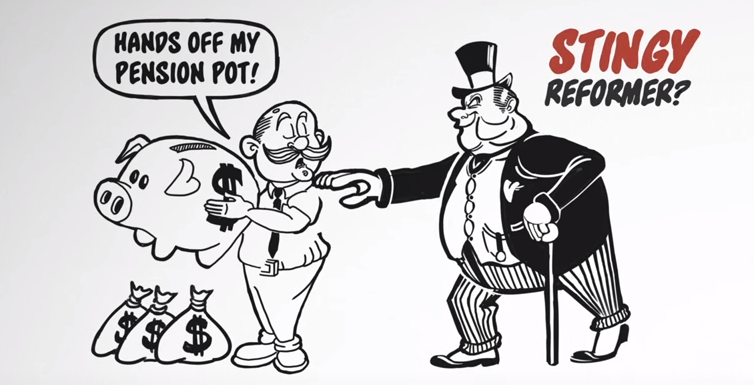
But as informative and compelling as these papers are, there is just something engaging about a video with hand-drawn illustrations. That’s why I love this new video released by TeacherPensions.org, a project of Bellwether Education Partners. In less than three minutes, the video shows the key problems with teacher pensions. Check it out.

Kansas City Government Union Embezzlement Shows Need for Greater Transparency

The former head of an AFSCME local representing Kansas City corrections officers pleaded guilty to a federal wire fraud scheme this week. Lowell Wreh, the former AFSCME executive, admitted to embezzling $7,642 in checks from the union's bank account to himself and others for his own benefit and personal use. This story is an example of why Missouri government workers deserve the same transparency from their union representation that private sector union workers have enjoyed since the 1950s.

In 1959 Congress passed the Labor-Management Reporting and Disclosure Act (LMRDA), a powerful set of protections for unionized workers and a much-needed check on the power of union executives. Among other things, the LMRDA required all private sector unions to disclose their finances annually in what are called “LM filings.”

The impact of the LMRDA was huge. Although it didn’t fix everything, workers and journalists were better able to discover instances of self-dealing by looking through LM filings. In many cases this meant a better, more responsive union. The lack of secrecy in union finances is still helping workers hold their union leadership accountable.

Unfortunately, the LMRDA does not apply to Missouri’s government unions. As a result, public sector workers have no easy way of finding out where their dues go, which hinders their ability to question the use of these funds. Self-dealing schemes like the kind this AFSCME executive took part in become harder to uncover when union finances are not transparent.

Our public sector workers deserve the same level of protection that private sector workers have enjoyed for decades. It’s time to close the gap between the public and private sectors. Government unions should be at least as transparent as their private sector counterparts.

Kansas City’s Secret Streetcar Plan

American Public Square hosted a panel discussion at the Kansas City Public Library on January 20, and I was privileged to be included. No new new ground was broken: streetcars remain very expensive investments that do not effectively or efficiently move people where they want to go; and they certainly do not themselves contribute to economic development.

What was remarkable about the discussion is what was not said. Specifically, the representative of the Kansas City Regional Transit Alliance, funded with taxpayer dollars, refuses to share its plans for a streetcar expansion campaign. Below is a transcript of the segment in which I repeatedly ask if KCTRA will make it's presentations public. You can see it thanks to a short, low quality Periscope video here (transcript starts at 1:53). 

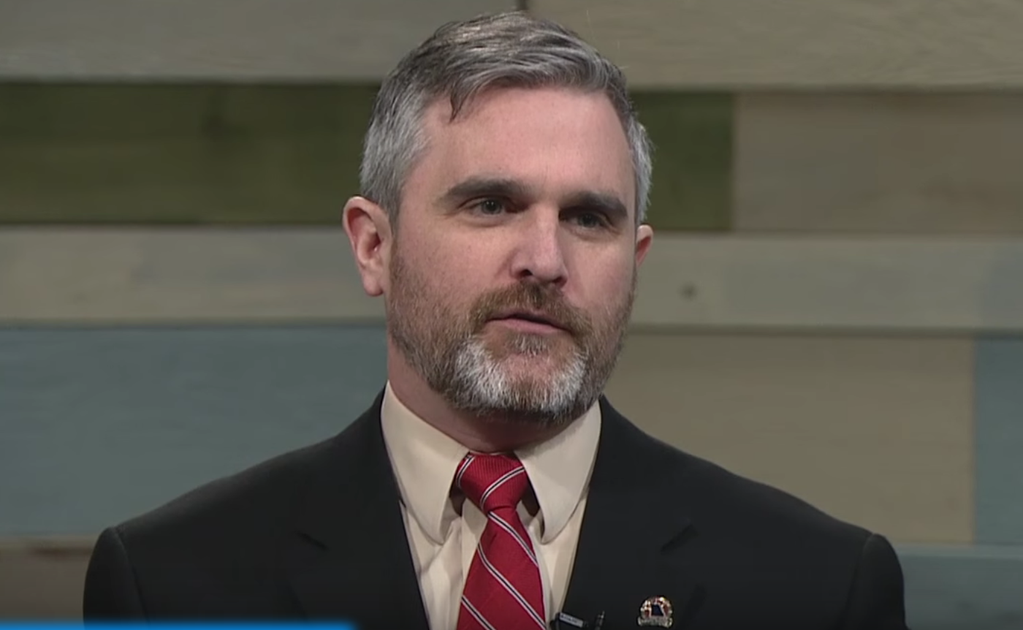
Patrick Tuohey (Show-Me Institute): Your organization has made presentations on next steps, correct?

Dave Johnson (KCRTA): We’re talking to all kinds of people about things that are possible, especially using the transportation development district.

SMI: Will you share those plans publicly?

KCRTA: We’re talking to people about the Main Street corridor. That shouldn't be a surprise to anybody.

SMI: So the presentation you made the Downtown Council, will you share that?

KCRTA: That is a presentation that just talks about extending the streetcar to UMKC. That’s what I’m telling you right now. Theres no secret.

SMI: …So the answer is yes, you’ll share it with us?

KCRTA: It’s got a lot of boring financials.

SMI: I would love to see the boring financials.

KCRTA: It’s the same financials you voted on in the expansion plan in 2014.

SMI: Do you commit to sharing the presentation you made the Downtown Council public?

KCRTA: We’re a simple non-profit so we don’t have to share that information.

SMI: I’m not saying that you have to share it with the public, I’m asking. Will you share that plan publicly?

KCRTA: No.

The KCRTA is funded with taxpayer dollars. Regardless of whether they are subject to disclosure laws, the KCRTA should immediately share with the public how they have been spending public money and what presentations they have about next steps. If they do not, the Mayor and City Council should demand they do so, or withhold all future contributions. Good public policy requires nothing less than complete transparency.


Downtown Saint Louis Restaurants: Coming or Going?

With the recent closure of a number of downtown establishments (the most recent being Mike Shannon’s), local media are considering Saint Louis’s restaurant scene, especially in the city’s central business district (CBD). Some local politicians and restaurateurs are pointing the finger at Ballpark Village, accusing it of taking business and putting the nail in the coffin of local bars and restaurants. The Post-Dispatch interviewed other restaurateurs who took a more circumspect tone, claiming restaurant industry growth is strong and blaming closures on changing tastes. But what do the data show?

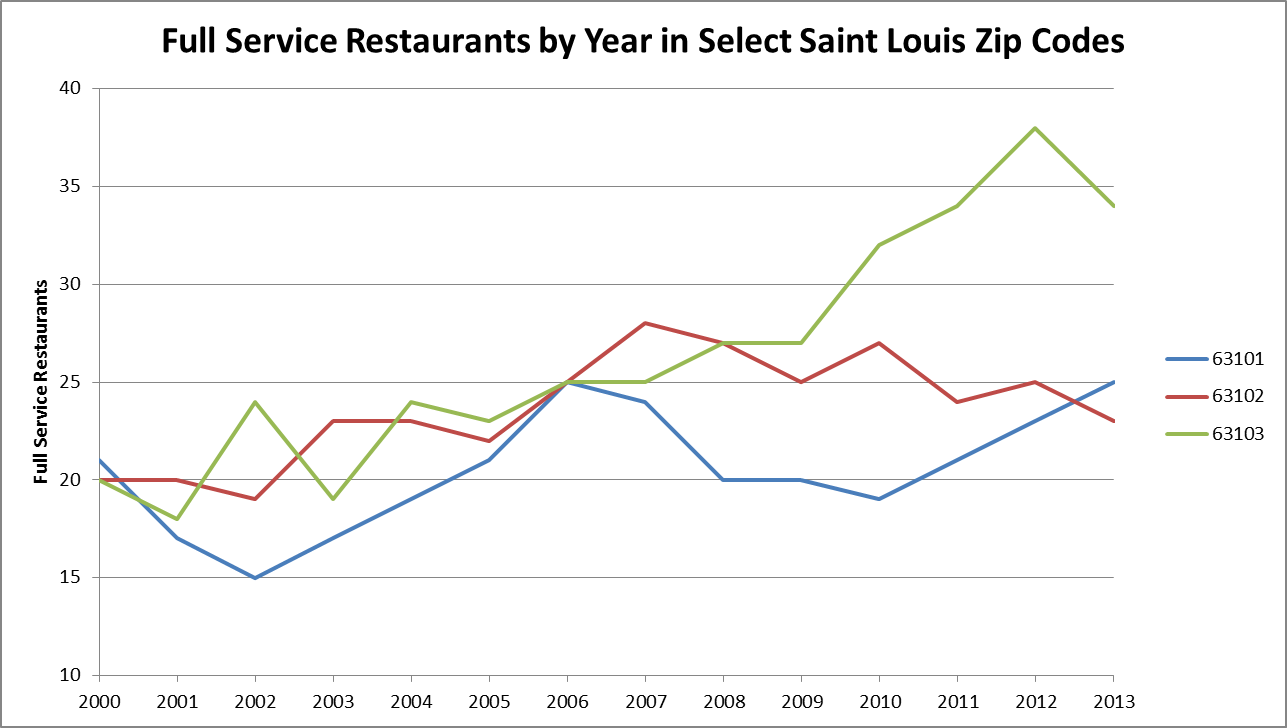
In terms of the current state of restaurants downtown, it is hard to get enough information to move beyond anecdote. But if we analyze the latest census data for three zip codes containing downtown and west downtown (63101, 63102, and 63103), we can glean some knowledge about the state of downtown dining in the recent past and its trend over time. The data show that from 2000 to 2013, total full-service restaurants in the three zip codes above increased by 21 establishments (a 34% improvement). The added restaurants employed more people, too. In 2000, only 29 restaurants had more than 20 employees. By 2013, 52 did. So there were not only more restaurants, but they were larger.

Unfortunately, it was not all good news. The vast majority of restaurant additions were in the 63103 zip code, which not only contains West Downtown, but also much of Midtown, the SLU Campus, and Grand Center. If we just look at the heart of downtown and the area around Busch Stadium (63101 and 63102) there were barely any more full service restaurants in 2013 than there were in 2000:

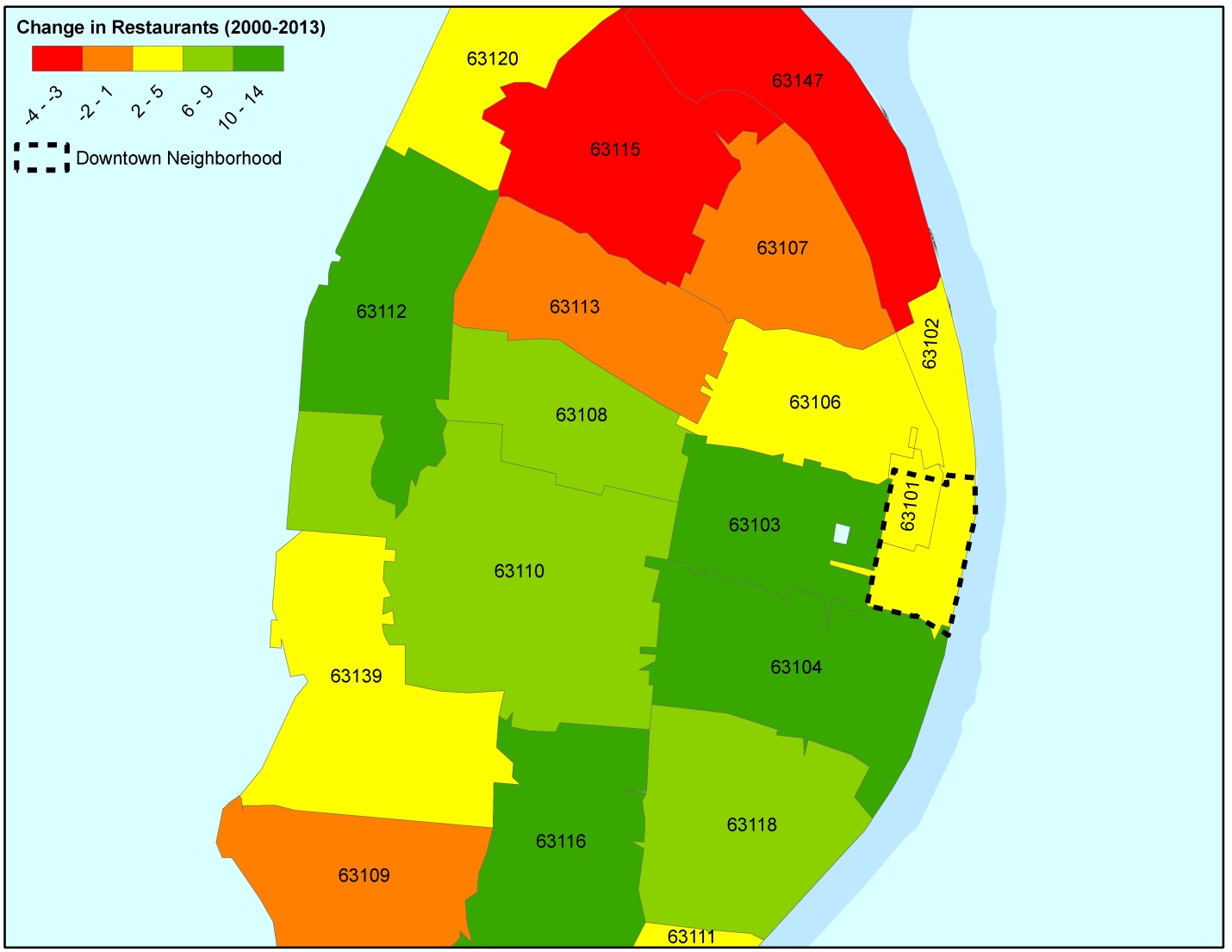
Taking a look at the city as a whole, the zip codes containing just the downtown neighborhood performed poorly when compared to other parts of the central corridor as well as areas in the South Saint Louis City. Some areas of the city lost restaurants during the same period, but this only took place in depressed areas of North City.  

Looking at everything together, it seems clear that the city as a whole added restaurants from 2000 to 2013, but progress was spotty. Some areas were contracting, others were expanding, and still others were treading water. The situation may have changed in 2014 and 2015, but we will leave that to future analysis. Just looking at the latest available census data, the downtown neighborhood was in the treading-water category. 

Support Us

The work of the Show-Me Institute would not be possible without the generous support of people who are inspired by the vision of liberty and free enterprise. We hope you will join our efforts and become a Show-Me Institute sponsor.

Donate
Man on Horse Charging