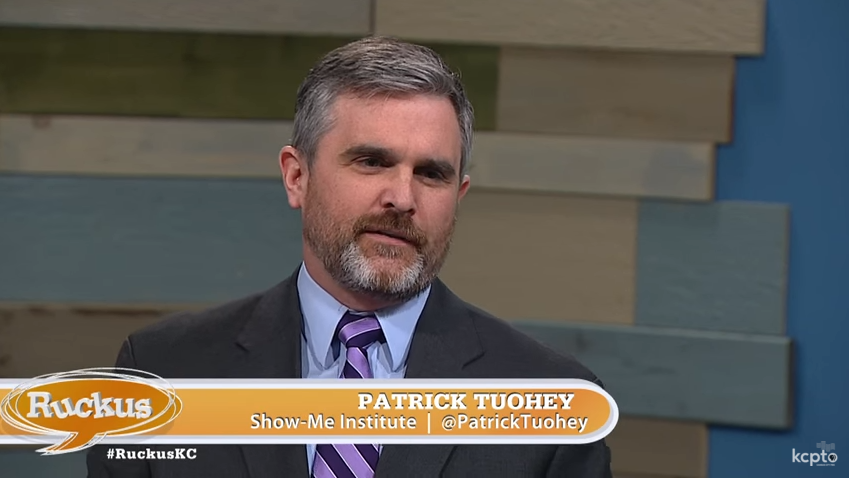
On September 30, Show-Me Institute CEO Brenda Talent was interviewed on Saint Louis Public Radio’s Politically Speaking. Brenda discussed a broad range of issues, including the earnings tax in Saint Louis and Kansas City, education savings accounts, and the stadium proposal for downtown Saint Louis. Listen to the entire interview here.
Taxicab Commission Gets New Year Rolling with Reform
After an acrimonious showdown with ridesharing company Uber in the middle of last year, the the Metropolitan Taxicab Commission (MTC) is no longer in the public eye. In many ways, things have changed little since October, when Uber began operating in Saint Louis City and County without the MTC’s sanction. Uber is still running (with a car about 4 minutes away from me at the time of writing), the MTC still objects, and lawsuits continue to move forward.
But while the public’s attention has drifted to other issues, the MTC continues to make changes. For one, in late December, the MTC passed a large revision to the taxicab code. Many of the changes are improvements. For instance, airport taxis can now operate as normal on-call taxis on days with particularly high demand. In addition, taxis up to nine years old can now be entered into service (previous requirements held that number to six). The commission also removed the “nighttime taxi” permit designation, which was itself a bizarre response to an MTC-created taxi supply problem.
Perhaps the most welcome news of all is that on January 4, 2016, the MTC will finally begin accepting applications for new on-call taxi Certificates of Convenience and Necessity (CCNs). As we’ve discussed before, a CCN is necessary to set up a new taxi business in Saint Louis. The MTC unilaterally froze all CCN applications for on-call taxis back in February of 2013, while the body “studied” taxi supply and demand for cabs in Saint Louis. After almost three years, and no study, the moratorium will finally come to an end.
Finally, Lou Hamilton, the controversial chair of the MTC, resigned on December 15, stating as a reason for his resignation that, “There is only so much fun one person can have.” We wish him an uneventful retirement.
Does It Matter What a Lost Job Would Have Paid?
In a recent Wall Street Journal editorial, economist David Neumark challenges some of the myths about the minimum wage. From the article:
Economists have written scores of papers on the topic dating back 100 years, and the vast majority of these studies point to job losses for the least-skilled. They are based on fundamental economic reasoning—that when you raise the price of something, in this case labor, less of it will be demanded, or in this case hired.
***
The broader research confirms this. An extensive survey of decades of minimum-wage research, published by William Wascher of the Federal Reserve Board and me in a 2008 book titled “Minimum Wages,” generally found a 1% or 2% reduction for teenage or very low-skill employment for each 10% minimum-wage increase.
That has long been the view of most economists, although there are some outliers.
Neumark himself conducted two policy studies on the effect of minimum wage laws right here in Missouri. These studies (from 2006 and 2012) examined the minimum wage increases being considered at the time. Both studies drew from a large body of existing research that suggests that minimum wage hikes do more harm than good.
Despite all of the research and hard evidence, some politicians and activists still push for minimum wage increases. In fact the “Fight for 15” movement, a campaign funded in large part by service industry unions, is still agitating for a 15 dollar minimum wage in Kansas City and St. Louis.
Let’s not ignore what the evidence says: Unemployment is a clear downside to the minimum wage. And that downside is borne by the people minimum wages are usually thought to help.
New Bill Would Raise Missouri Fuel Tax, Cut Highway Miles
Recently, we discussed a couple of pre-filed bills that would raise the fuel tax in Missouri to avert a funding crisis at the Missouri Department of Transportation (MoDOT). But raising the fuel tax is not the only proposal on the table, and one bill (SJR 18) proposes a solution that could aid MoDOT’s financial situation over the long term: reducing the size of the state highway system.
SJR 18 has two parts. The first part would increase the state’s regular fuel tax by 1.5 cents per gallon and the state’s diesel fuel tax by 3.5 cents per gallon. This increase has the potential to net MoDOT around $60 million in additional revenue annually, which would put off any immediate funding crisis for the state.
However, SJR 18 is different from other fuel tax increase proposals in that it also contains provisions for transferring responsibility for the state’s “supplementary” highway system to localities. The supplementary system is mostly made up of the state’s letter routes, but also includes urban streets like Gravois Road in Saint Louis and MO Route 283 in Kansas City. We’ve discussed before how these routes eat up a significant portion of MoDOT’s budget. These types of roads are maintained by counties and municipalities in most other states.
SJR 18 would not simply hand off the supplementary highway system to localities without any aid. The state would continue to provide localities with financial support for the transferred roads (fixed at the average spending of the last three years on that road). This means that in the short-term, MoDOT would spend the same amount on these highways as it does today. However, over the long term this spending would be capped, with local governments responsible for increased investment.
SJR 18—which would require a vote of the people before being enacted—is an interesting policy proposal that addresses both short-term and long-term financial problems at MoDOT. It does not encompass a large tax increase, and instead focuses on capping long-term spending as a method of setting MoDOT’s funding on firm footing.
Metro Ridership Trending Down in 2015
Earlier this year, we talked about how, contrary to the hopes of many Saint Louis regional planners, there is no evidence that people are ditching their cars for public transportation. In fact, Metro ridership peaked around 2008, took a nosedive during the recession, and has experienced tepid growth ever since. The latest data (from 2015) paints an even bleaker picture from Metro, as sluggish growth has transformed into decline.
To see this, we can look at ridership changes on the MetroBus and MetroLink systems since the end of the recession. That recession technically ended in mid-2009, according to the Saint Louis Federal Reserve. And while 2010–2013 cannot be described as great years, total employment in the Saint Louis Metropolitan area has steadily risen since around October of 2009.
Metro ridership was anything but recession-proof. During the economic downturn, MetroLink ridership fell 37% and MetroBus ridership fell 28%. But while the employment in the Saint Louis area has slowly but steadily recovered, the same cannot be said of Metro ridership. In 2010 and 2011, MetroBus gained back much of the ridership it had lost in the recession, but in 2012 and 2013 growth stagnated. MetroLink ridership recovery was less robust. By mid-2014, five years after the recession’s end, MetroLink ridership was still 30% below its pre-recession peak.
But as the chart below also shows, 2015 saw ridership levels reverse their post-recession trend of steady (if modest) growth. From July 2014 to October 2015, MetroLink ridership fell 8% and MetroBus ridership fell 5%. Taking all this together, it means that MetroLink ridership in late 2015 is only 2% higher than the post-recession ridership lows.

There are many factors that may explain weak post-recession ridership growth for Metro. Saint Louis has had a weak jobs recovery, with total employment still below pre-recession highs; employment has only increased 4% since 2009. However, economic growth has accelerated in the last year, the same time ridership began to decline on Metro.
Whatever the underlying reasons, this much is clear: there is no evidence that Saint Louis residents are flocking to public transportation or the MetroLink, despite significant investments made in the 1990s and early 2000s.
Missouri Legislature Takes Up New Roosevelt Laws
Lawmakers are teaming up to address the growing problem of unaccountable government unions. This month Senator Bob Onder and Rep. John Weimann filed twin bills in the House and Senate that seek to reform the way these unions operate.
Government unions—the unions representing government employees such as teachers, firefighters, and state workers—bargain in a much different setting than private sector unions. Rather than negotiating with private companies, government unions negotiate with public officials. This means that public sector collective bargaining affects everyone—not just the few who happen to be associated with a specific business.
In the public sector, unions can use political muscle to help elect politicians favorable to their interests. When it comes time to negotiate pay and pension benefits, politicians are often willing to return the favor.
Franklin D. Roosevelt, a great advocate of organized labor, understood the differences between unions in the government and unions in the private sector. According to FDR, when it comes to government labor, “the employer is the whole people, who speak by means of laws enacted by their representatives in Congress.” For this reason FDR thought that “the process of collective bargaining, as usually understood, cannot be transplanted into the public service.”
Roosevelt was right. The labor laws we use in the private sector are a poor fit in government. Instead, the laws that allow public employees to bargain with their managers should have special features that protect both government workers and the public at large.
I welcome reform introduced in this spirit. Look for more posts from me on this subject in the coming weeks.
Gregg Keller Joins Show-Me Institute’s Board
We are pleased to announce that Gregg Keller is now a member of the Show-Me Institute’s Board of Directors.
Gregg is the Principal of Atlas Strategy Group and is widely regarded as one of the preeminent public affairs professionals in the country. A former Executive Director of the American Conservative Union, the Conservative Political Action Conference (CPAC), and the Faith & Freedom Coalition, Gregg has been an advocate for free-market public policy at local, state, and national levels for 15 years.
Gregg has worked—and continues to work—extensively with the Show-Me Institute to increase the organization’s membership and following among the next generation of free-market leaders.
Show-Me Institute Chief Executive Officer Brenda Talent had this to say about our newest board member:
"We’re excited to have Gregg Keller join the Board at the Show-Me Institute. His youth and expertise in free-market public policy will bring a fresh and vital perspective to our Board."
Private School Pioneers in Kansas City and St. Louis?
The past 40 years have seen a well-documented decline in Catholic school enrollment across the country. But what many people don’t know is that there has also been a decline in total private school enrollment—Catholic and otherwise—particularly in the last 15 years. The entire sector is shrinking.
In a new paper, Juliet Squire, Kelly Robson, and Andy Smarick look all the way back to the 1890s to track private schooling’s long rise to its peak in the mid-1960s and its decline to today. The trend line is shown in the graph above.
In recent years, numerous states have passed private school choice programs that have helped turn these trends around, at least locally. But even the growth in school choice programs has not been enough to stanch the decline.
Into that context jump Squire et al, documenting a new phenomenon called “Private School Management Organizations” (PSMOs). Much like Charter management organizations like KIPP or Green Dot work to help organize and supervise networks of charter schools, PSMOs like Wisconsin’s HOPE Christian Schools or Memphis’s Jubilee Schools work to help organize and supervise networks of private schools. These groups are organized around one of two major goals. Some are designed to shore up the finances and management of existing private schools and help put them on a sustainable long-term trajectory. Others are designed to help open and expand new private schools.
Charter management organizations have been extremely successful in spreading charter schooling nationwide. KIPP schools, for example, started in Houston in 1994 with only 47 students in one school. They now educate over 70,000 students in 183 schools in 20 states and the District of Columbia. It would be wonderful if private schools could learn from them.
Kansas City has the Strong City Schools and St. Louis has the ACCESS Academies, which are kind of proto-PSMOs, but private school leaders across the state could look to the examples Squire et al highlight and the lessons from nascent efforts to see how such organizations might help students looking for a private education in Missouri.
I worry that when the happy day comes that Missouri passes a school choice program, so many private schools will have closed that the options available to students will be limited. Clearly, help is needed to keep private schools alive until more sustainable support, in the form of vouchers, tax credit scholarships, or education savings accounts, arrive. PSMOs are one path to achieving that.
Riverfront Stadium Costs Change, Backers Push Ahead
We’ve covered the proposal to spend some $400 million in public dollars on a new stadium for Rams extensively on this blog. Specific plans have come and gone with regularity, leading to a continuous shell game that can be difficult for residents to follow. That is, perhaps, why a $10 million increase in the amount the city has to pay went almost completely unnoticed.
As part of a recent overhaul of the stadium financing package, which includes giving the NFL all the naming rights proceeds for “National Car Rental Field,” the total cost of the stadium went up about $10 million dollars. With NFL uninterested in paying anything (much less more), and state legislators in near revolt over the governor’s plan to unilaterally extend bonds for the stadium, the city is left holding the bag. Its total payments will increase from an estimate $150 million to $160 million:
|
Current Proposal |
Old Proposal |
|
|
NFL |
$450,000,000 |
$450,000,000 |
|
PSLs |
$160,395,657 |
$160,395,657 |
|
State |
$239,950,585 |
$239,950,585 |
|
City |
$160,453,758 |
$150,438,514 |
|
Total Cost |
$1,010,800,000 |
$1,000,784,756 |
Ten million dollars is not a small amount for Saint Louis City. That’s the equivalent of the annual salaries of 190 teachers or the cost of 20 brand new buses. It should not be treated like a rounding error.
Worse than the cost escalation is the reaction of stadium backers to the funding reconfiguration. I sat in hearings where city representatives said, in contradiction to dozens of academic studies, that the stadium would be an economic boon for Saint Louis. I heard how the city was supposedly shifting risk to the NFL by using naming rights dollars to pay for the stadium and paying the NFL back with future tax revenue. I heard how the stadium plan would supposedly be a tax benefit to the city.
Now that the naming rights are going to the NFL and the cost of the stadium has gone up, has this prompted stadium backers to rethink their support? Unfortunately, no. Now they simply argue that keeping the tax revenue and giving away the naming rights proceeds was always better for the city all along. And what’s ten million when the Chamber of Commerce thinks the stadium will generate more than $100 million in new taxes?
With this type of non-response to a worsening deal, what reaction can we expect when we find out who will pay for maintenance? Or when someone has to pay to refurbish the Edward Jones Dome? Or if there are cost overruns? Will stadium backers still claim the plan makes financial sense, or that it is too late to turn back?