Texas Toll Road Goes Bankrupt, but Taxpayers Don’t

This month, a major toll road company filed for bankruptcy in Texas. The company in question is the SH 130 Concession Company, which manages segments 5 and 6 of SH 130 between Austin and San Antonio. Like the bankruptcy of the Indiana Toll Road Concession Company in 2014, the problem for the SH 130 Company was that traffic estimates turned out to be optimistic following the recession.

Some toll road opponents have latched onto this bankruptcy as an example of how privatized toll roads are a bad idea. But when we look closer, the case of SH 130 (as well as the Indiana Toll Road) teaches the opposite lesson. A private, international investment consortium—and not the Texas Department of Transportation—spent almost a billion dollars improving highway infrastructure in Texas. Traffic estimates did not live up to expectations, but that is a normal risk with highway expansion, a risk that would normally be that of state taxpayers.

SH 130 received no money from the state of Texas. The only public support for the project came in the form of over $400 million in Transportation Infrastructure Finance and Innovation Act (TIFIA) loans from the federal government. If the SH 130 Company is unable to restructure its debt and cannot find a buyer for the toll road, the federal government (and hence the taxpayer) is at risk of taking some loss on the loan. But as we have pointed out before, financing part of infrastructure projects with federal loans (with the risk of losses) is a vast improvement over the current modus operandi, where the federal government provides 80 to 90 percent of a highway project’s funding with no mechanism for getting a return.

So what is the future of SH 130? While the bankruptcy is proceeding, SH 130 Concession Company will continue to operate the road. The company will then either restructure its debt or the toll road will be sold to a new operator (as happened with the Indiana Toll Road). It is too early to say whether the company will default on any federal TIFIA loans. Whatever the end result, Texas residents will continue to enjoy the highway that private investment built. 

How Much Testing Is Too Much?

From a student’s point of view, standardized testing is stressful, particularly in the elementary school years. It can also be very disruptive to the material students are normally learning. When I was a kid, any kind of testing put me on edge, especially when the tests were hours long. Some testing is certainly necessary as a source of information about our education system and what it’s getting right or wrong.  Still, testing takes up a substantial amount of school resources—both time and money—and anyone with a stake in our schools should take an interest in why we do so much of it.

Before we can decide if there is too much or too little testing, we should lay out some facts:

·         Missouri spends roughly $30 million a year on standardized tests

·         On average, students spend 20–25 hours per school year taking standardized tests. Over the course of grades 3–12, that totals out to be 180–225 hours of testing.

·         Grades 3–8 are required to take the yearly MAP (Missouri Assessment Program) test which assesses students understanding of concepts in language arts and math. Grades 5 and 8 are also tested in science.

·         Grades 4, 8, and 12 are administered the NAEP (National Assessment of Education Progress) which tests all students in the areas of math, science, reading, and writing.

·         High school juniors are required by the State Board of Education to take the ACT (at no charge)

·         High school students must pass a personal finance assessment in order to graduate. This assessment can be taken by students who are enrolled in a personal finance course or students who wish to test out of the course and still receive the half credit.

·         End of Course (EOC) evaluations are administered to students enrolled in Algebra I and II, Biology, English I and II, Geometry, Biology, American History, Physical Science, and Government courses.

Rep. Kurt Bahr of St. Charles is sponsoring a bill that would allow students to opt out of Missouri standardized testing if they or their parents request it. What would this accomplish, though? Students will simply have to wait for school to resume while other students take the tests they opted out of. And if the tests are administered only to the students who want to take them, they wouldn’t be a representative sample of the student body.

Is there a better way we can retrieve this information and not overwhelm students and teachers? Knowing how well our students and schools are doing, and what should be improved on, is important. However, we need to remember that the only “right” amount of testing is that which gives us the information we need in the most efficient way possible, so that teachers can spend more time teaching and students can spend more time learning. Determining the purpose and use of each test might be the key. 

Tax Levy Increases by the Numbers

Two weeks from today, voters in 10 school districts across the state will be asked to increase property taxes to provide more funding for their local schools.  The proposed tax levy increases vary from 17 cents per $100 of assessed valuation in the Bloomfield school district in Stoddard County to 96 cents per $100 of assessed valuation in the Newburg district in Phelps County.

First, a quick primer on property taxes. Homes are assessed at 19% of their market value. So, for example, a school levy rate of $3.00 per $100 of assessed value applied to a house with a market value of $100,000 would mean that person pays $570 per year in tax.  An increase of 50 cents per $100 in assessed value would mean paying an additional $95 per year.

As a reference point, the statewide average millage rate is $3.69 per $100 in assessed value, and the state calculates “local effort,” the amount local districts are expected to contribute before the state adds its funds, at $3.43 per $100 of assessed value.

Sometimes tax levy increases are necessary.  For districts that are growing and need to build new school buildings, or districts that operate efficiently but are facing aging infrastructure, modest increases to the tax levy are perfectly appropriate.

That said, there are reasons to be skeptical. First, many school districts are not currently operating as efficiently as they could be. By comparing teacher/student ratios and administrator/student ratios, we see that many schools do more with less.  The same is true with the average salaries for those positions—there is serious variation across districts (even in what seem to be similar labor markets) in how much teachers and administrators get paid. Also, some districts ask for levy increases to build new buildings when it is clear that their enrollment is on the decline.  They should be figuring out how best to use what they already have.

We should also always be on the lookout for the pernicious effect of TIF deals that erode the tax base of school districts.  Kansas City and St. Louis are chronic abusers of this system, which diverts tax revenue that should go to schools back into the pockets of developers, but TIF projects take place all over the state.  If a district has hollowed out its tax base through TIF, why should ordinary citizens have to pick up the slack through increased property taxes?

To better inform voters, we have put together a series of information sheets on the proposed mill levy increases that are on the ballot on April 5. We provide data on what the mill levy means for homeowners in terms of the increased taxes they will be paying every year.  We also provide data, drawn from publically available spreadsheets on DESE’s website, on the school district and the school districts that surround it so taxpayers can compare and contrast how well or how poorly the district is being managed.  

Links to each of the info sheets are below.

Update, March 23: We now have an info sheet for the Maplewood-Richmond Heights school district.

Evergreen Headline: Kansas City Needs More Good Schools

Over at the Star, Joe Robertson put together a heart-wrenching piece of journalism documenting the struggles of Kansas City families trying to figure out where to send their kids to school. Should they take a chance and participate in a charter school lottery? Should they move to Kansas or another school district?

Kansas City is home to several great public charter schools. As Robertson reports, Crossroads Academy has a waitlist 150 students long.  Academie Lafayette has a 130-student waiting list. Scuola Vita Nuova has a waiting list of over 60 students, the Kauffman School has a waiting list ranging from 10 to 50 depending on the grade, and University Academy has a waiting list of 9 for kindergarten.

The problem in Kansas City is that there simply aren’t enough great schools to go around.  Families with money can hedge their bets by entering the lottery to get into one of the schools I’ve mentioned, and if they lose they can move to a different district or pay for a private school. Parents without those resources cannot.  Those less-fortunate families live within the Kansas City Missouri School District, but they also live in Raytown, Hickman Mills, Center, and in several of the other districts that overlap with the borders of Kansas City. Charter schools are functionally limited to the KCSD boundaries, so students zoned to attend low-performing schools anywhere else are simply out of luck.

Crossroads Academy has a promising expansion plan, and I’m particularly interested in watching the parent-led Citizens of the World charter school that is slated to open next year, but even with that growth, supply is nowhere close to meeting demand.

Here at the Show-Me Institute, we’ve documented the declining enrollment of the KCSD, and these families’ stories continue to make the case for the correct course of action moving forward. Rather than figuring out the best way to apportion a small number of good seats in schools across the city, why don’t we focus our efforts on creating new seats? Expand good charter schools. Help new schools get buildings.  Allow charter schools to open outside of the narrow bounds of KCSD.

Until we take these steps, we can expect to see a constant stream of stories of families struggling to find places for their children. 

Will Lawsuit Funding Regulation Limit Access to Justice?

Some Missouri lawmakers are considering legislation to regulate lawsuit funding companies. This regulation is pitched as consumer protection, or even tort reform, but it falls short on both accounts.

For background, a civil litigation funding company helps a person pay for the costs of a lawsuit before a reward is obtained. In return, the company gets a portion of the reward if the litigant is successful. Critics say that civil litigation funding companies often take an unreasonably large portion of the eventual reward. Critics are also hopeful that regulation will reduce the number of lawsuits brought against businesses, saving businesses money.

Defenders of civil litigation funding say that without these funding arrangements, many people with legitimate claims wouldn’t be able to access our justice system. In many instances people who’ve been injured or wronged would be forced to settle with an insurance company for a fraction of the compensation necessary to make them whole again. If you make it harder for people to fund lawsuits, you won’t necessarily decrease the number of frivolous claims—but you will limit access to justice for people who can’t afford to wait for resolution of their claim.

I’m most interested in whether regulating lawsuit funding companies is consistent with a free market. Shouldn’t a plaintiff be able to sell a portion of a legal claim at any freely agreed upon price? What business does the state have in regulating how people pay for a lawyer?

Professor Jeremy Kidd, a law professor at Mercer University, addressed the Alabama State Senate Judiciary Committee opposing a bill that would regulate lawsuit funding in Alabama. In doing so, he helped answer this question:

“This issue—and so many others—requires acknowledgement of a simple truth, that there is a fundamental difference between being pro-business and being pro-market. Free markets enable tremendous human flourishing, and protecting markets is essential to growth. Importantly, however, while protecting markets protects consumers and businesses, protecting businesses typically improves the businesses’ bottom line at the expense of markets and, by extension, every consumer. Senate Bill 67 is pro-business, rather than pro-market, because it is designed to protect businesses against lawsuits without inquiring as to whether those businesses are actually at fault.”

I see a great deal of truth in this statement. Real tort reform will address the problematic aspects of our tort system. Regulation of civil litigation funding appears to ignore the merits of individual lawsuits, making it even more difficult for poor Missourians to pursue legitimate legal claims.

How Would You Pivot From the Earnings Tax? Let Me Count the Ways

The Show-Me Institute has argued again and again that earnings taxes have hurt economic growth in St. Louis and Kansas City. That most American cities don't have a earnings taxes only makes pivoting away from them all the more reasonable, and while it may be news to the Kansas City Star, we've put forward a host of plans and proposals to phase it out over the last decade.

So, what would a better taxing system—one without earnings taxes—look like? And how would we get there? To my mind, there are three main policy changes to consider.

Element 1: Curb cronyism. Kansas City takes in a bit over $200 million every year from the earnings tax, and yet each year it also gives away nearly $100 million in special breaks to City Hall's favorite special interests. Giving tax incentives to crony capitalists is an admission that taxes in the city are too high; those rates should be lowered for everyone, not just for a select group of municipal insiders in the hope that the benefits will trickle down to everyone else.

Drawing down this cronyism could be accomplished several ways, including capping and, over time, ratcheting down how much property the city can abate each year, or by making blight determinations in TIF proposals dependant on poverty levels around the property in question. Whatever the reform, if a city were to reduce tax incentives as it reduced the earnings tax, pivoting away from the earnings tax entirely would become much easier. 

Element 2: Reform city spending. Cities should reexamine how they spend money, both administratively and in their provisions of public services. That includes taking another look at how government pensions are structured and moving from defined benefit plans to defined contribution plans. Doing so would promote long-term budget predictability and employee retirement security. Spending reform also includes privatizing public departments like the water department that the city doesn't have to run and would actually profit from unloading. Getting a liability off the books would be an improvement, but turning a liability into a profitable opportunity makes more robust privatization of city services a no-brainer.

Element 3: Reorient taxes. After moving away from tax incentives and reforming city spending priorities, the rest of the earnings tax "pay for" could be made through systemic tax reforms. Income taxes are more destructive to growth than sales taxes, which are more destructive than property taxes. Moving from income taxes and toward property taxes would not only ensure that municipal tax collections are more stable, but also that they city's taxes would be less economically harmful to the city and the region as a whole.

To achieve this, however, will require fixes to the city's tax incentive practices either as a precursor or as a parallel reform. If earnings taxes fall, property taxes rise, but the cronies who don't pay the taxes now also don't pay them in the future, we'll be back where we started—with an inequitable taxing system. Kansas Citians and St. Louisans deserve better than that.

Overall, St. Louis and Kansas City have taken a wrongheaded approach to tax revenue for too many years, subsidizing cronies and passing the tax burden to everyone else through earnings taxes. Rather than shifting the burdens of bad policy, the city should pursue sound policies and stable tax revenue sources that promote growth rather than undercut it. By reforming tax incentives, adjusting spending, and readjusting taxes, Kansas City and St. Louis can help to ensure they remain the economic engines the state needs.

TIFs Fail to Meet Expectations

Steve Vockrodt over at The Pitch has an excellent column about how taxpayer subsidized development projects often underperform their goals. He writes in part:

Developers often win over politicians and the public by promising that TIF will help "create" a certain number of new jobs. But those projects often miss the mark, and at times by a wide margin.

Last month, the Missouri Department of Revenue released its annual report for all TIF projects in Missouri. The numbers were stark.

Among the 504 TIF districts across the state, developers estimated that 266,261 new jobs would be created. In fact, 89,485 were realized. That's 33 percent of the projection.

The annual report that Steve cites is here. Pages 258 and 259 show that now that the Power & Light District’s KC Live project is completed, only 1,003 of the projected 2,034 jobs have been realized. The reality, however, could be much worse than that.

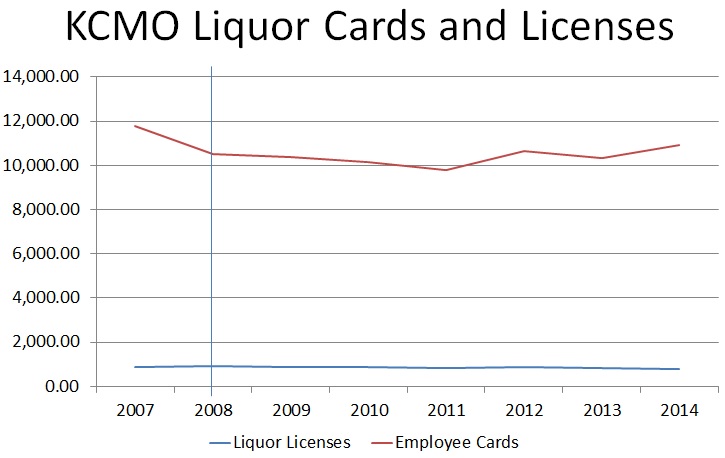
Using data provided by Kansas City's Regulated Industries Division, we sought to see if there was any citywide increase in either liquor licenses issued to businesses or the liquor cards issued to individuals who work in bars and restaurants. The chart below shows that since the Power & Light District opened in 2008, these numbers have been flat.

If KC Live created jobs as the TIF report suggests, yet citywide employee liquor cards remained flat, it means that the TIF didn’t so much create jobs as just move them from elsewhere in the city such as Westport or just outside the TIF area.

Yet the financial costs to the city and other taxing jurisdictions for this storefront shuffling are very real. In addition to the cost of foregone tax revenue, the city must pay about $15 million each year to cover the underperforming investment through 2040. 

The question that responsible policymakers must consider is not merely how to move jobs and residents downtown, but at what cost? The city has shown that it can drive property development downtown by paying for it. That's hardly impressive. But it cannot show that there is any real net economic benefit citywide. Without that, we're just throwing good money after bad.

Support Us

The work of the Show-Me Institute would not be possible without the generous support of people who are inspired by the vision of liberty and free enterprise. We hope you will join our efforts and become a Show-Me Institute sponsor.

Donate
Man on Horse Charging