On April 2, Show-Me Institute Fellow and Senior Writer Andrew B. Wilson gave a speech on the Earnings Tax to the Missouri Progressive Action Group at the Saint Louis County Library. These were his prepared remarks.
On Tuesday, April 5, Saint Louis voters will decide whether to extend the city’s 1 percent earnings tax for five more years.
Without a doubt, this is a hugely important decision.
In inviting me to talk to you, Ron Zager (co-chairman of the Missouri Progressive Action Group), asked that I begin by presenting both sides of the argument—for and against the earnings tax .
I am happy to do so. It makes for an interesting—and even a startling—contrast.
Supporters cite three principal reasons for extending the earnings tax:
- It is simple, fair, and easy to collect. Businesses withhold $1 out of every $100 from the paychecks of all of their employees and pay it directly to the city. They also pay a 1 percent tax on their net profits.
- It brings in a lot of revenue—almost as much as the combined receipts from the city’s property, sales, and utility taxes. It provides a third of the city’s General Revenue Fund, used to support fire, police, courts, streets, parks, recreation, and other day-to-day city services.
- A large portion of this revenue is like manna from heaven. People who commute into Saint Louis from the surrounding suburbs account for more than half of the city’s annual earnings tax receipts of about $160 million. And why not? The high-earning commuters are significant consumers of city services, swelling the daytime population of the city by about 35 percent.
To sum up the case in favor of retention: The earnings tax is critical to the continued functioning of city and the continued provision of police and other services to a population that includes a high proportion of low-income residents. It is a real lifeline. The city would be in danger of going bankrupt without it.
Opponents have three main reasons of their own for eliminating or phasing out the earnings tax:
- It encourages people and businesses to move out of the city.
- It also encourages an ongoing merry-go-round of tax carve-outs and special favors for large and well-known firms. The city does not extend the same benefits to thousands of smaller businesses, which take care of most of the daily needs of people who live in the city, such as the neighborhood grocer, cleaners, pharmacist, or auto repair shop.
- Though not a regressive tax (applying the same 1 percent to people at all income levels), it is a cruel one. Unlike federal and state income taxes, there is no exemption from the city earning tax for working people at or below the poverty line. The tax hits the first dollar of income even from the lowest-paying jobs. A still greater problem is the narrowing of job opportunities in parts of the city experiencing a rapid out-migration of people and the closure of many small businesses.
The minuses are really the flip side of the pluses I have just mentioned.
Yes, the earning tax is easy to collect, but it is also easy to avoid. As a business owner, you can avoid the tax on your net profits simply by moving your business to the suburbs—anywhere outside the city. There is no earnings tax in Clayton, here in Frontenac, or anywhere else in Saint Louis County and other surrounding counties and municipalities. If you did move your business, many or even most of your employees who already live in the county would, out of their own self-interest, applaud your decision. And others who live in the city would be given a reason to move to the county.
Yes, the earnings tax pays many big bills for the city. By the same token, it provides a strong incentive for individuals and businesses—who have bills of their own to pay—to relocate in order to avoid the tax.
By collecting more than half of earning tax revenue from commuters, the city is (inadvertently) making a powerful argument for downtown-based law firms and other businesses with a large number of highly paid employees to take flight—for both economic and personal reasons. At one stroke a firm can give many of its officers and employees an instant 1 percent raise while sparing them the bother of a long commute. So what can the city do to prevent such businesses from moving?
If you are the sitting mayor or other high-ranking city official, here’s the answer: Offer big potential flight risks all kinds of tax breaks and other incentives to stay downtown. Find ways to abate property taxes to keep prestigious firms from leaving downtown. Waive the half-percent payroll tax (separate from the earnings tax) for large employers such as Anthem and Wells Fargo. And lobby the state for more handouts.
But of course, given your obsession with preserving earning tax receipts, you do that only for the big guys and you forget all about the little guys who are so numerous (even in decline) that you know little or nothing about them.
A classic example of how this works can be taken from 2011, when Stifel Financial Corp., which has had its corporate headquarters in downtown Saint Louis since 1890, announced plans to buy its downtown office building and expand its workforce in the city by a couple hundred people. Mayor Francis Slay called it “tremendous news for the future of downtown.” He also helped Stifel get some $17 million in public financing for the purchase and renovation of the building.
Why would a large and successful financial firm need help in feathering its own nest? Ron Kruszewski, Stifel’s CEO, said it all: “There’s very little investment going on right now without some incentives.”
That prompted Bill McClellan of the St. Louis Post-Dispatch to comment in one of his columns: “When liberals like me argue for comprehensive health care, critics call us socialists. But when businesspeople demand public money to underwrite their projects, hardly anyone says anything.”
(I’ll take issue with McClellan on one point here: There is at least one institution that has fiercely and consistently opposed all forms of corporate welfare and crony capitalism, whether it is providing public funds for new corporate headquarters, public funds for professional sports stadiums, or any other kind of commercial development. That is the Show-Me Institute.)
To sum up the minuses: the earnings tax is a tax on work and enterprise, and when you tax something, you get less of it. In this case that means fewer jobs and less growth. The earnings tax has also encouraged unfair and unwise favoritism in tax practices—decisions made up on the fly to keep big-name businesses from bolting to the county. It’s time for a long look at Saint Louis city government—how it is financed and, more fundamentally, how it thinks.
Let us take a moment to consider decade-to-decade changes in the relative importance of Saint Louis among major cities in the United States over a long period of time—both before and after the introduction of the earnings tax in 1954.
According to census data, the last time Saint Louis moved upward in the ranks of U.S. cities was in the 1890s. The population grew from 452,000 people at the beginning of the decade to 575,000 in 1900, and Saint Louis moved from being the 5th largest city in the country to the 4th (behind New York, Chicago, and Philadelphia).
Of course, that was just prior to the Saint Louis World’s Fair. In that same amazing year of 1904, Saint Louis also hosted the world’s third modern Olympics—following the 1900 Olympics in Paris and the 1896 Olympics in Athens.
Saint Louis held onto 4th place until the 1920 census, when it was overtaken by Detroit and Cleveland, dropping to 6th. It was passed by Los Angeles in 1930 and Baltimore in 1940, falling to 8th. It remained in that spot in the 1950 census—when the city’s population hit an all-time peak of 857,000.
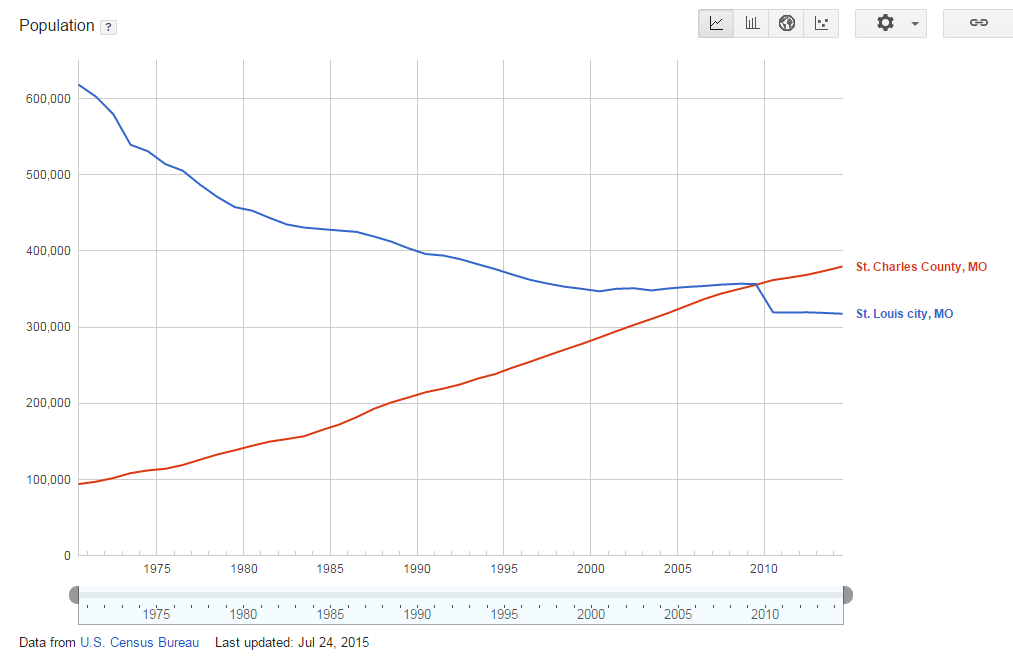
At that point the city’s population went into a steep decline that continues to this day. Since 1950, its population has dropped from close to 900,000 to a little more than 300,000—discarding almost two-thirds of its human body weight—and Saint Louis has gone from being the 8th-largest city in the country down to the 60th, behind such places as Tulsa, Oklahoma, and Wichita, Kansas.
It would be absurd to place all or even most the blame for this decline on the earnings tax. It would be equally absurd to deny that the earnings tax has made a significant contribution to the depopulation of the city and the growth of surrounding areas.
For one thing, we know that downtown Saint Louis no longer rules the roost as the unchallenged commercial center of the Saint Louis region. Clayton has become a strong second center, and other places around the county are also filled with offices and business enterprises. It is only in Saint Louis City that you find acres and acres of abandoned houses, deserted storefronts, and boarded-up factories.
Here’s a statistic that may surprise you: There are now more people who commute into Saint Louis County . . . both from the city and from Saint Charles and other counties . . . than there are people who commute into the city from the county or other jurisdictions. There are 236,000 people commuting into the county versus 172,000 commuting into the city, according to recent census data.
Somehow, Clayton and other municipalities receiving this great daily influx of commuters have been able to handle it . . . without instituting an earnings tax or having everything from the streets to public safety fall to pieces. Why is it any different for the city of Saint Louis? Why is the city unable to cope without taxing the earnings of people who come there to work?
Let’s turn then to the question of whether it is possible to phase out the earnings tax without throwing the city into bankruptcy and fulfilling the worst predictions.
Bear in mind that the proposal on Tuesday’s ballot in the city calls for phasing out the earnings tax over 10 years—whittling away at a $160 million funding gap that would occur in the year 2026 through spending cuts or revenue enhancements averaging $16 million a year between now and then.
Is $16 million a year too tall a mountain to climb? Somehow, in the city’s desperate efforts in recent months to persuade the Rams and the NFL to keep the team in Saint Louis, the city funneled $16 million through the Saint Louis Convention & Visitors Center Commission to pay legal fees and other expenses in what turned out to be a losing effort.
Before that, Mayor Slay and Missouri Gov. Jay Nixon were prepared to raise about $400 million to pay for a large portion of the cost of building a new downtown stadium for the Rams. That alone would have equaled the revenues from the earnings tax over a two-and-a-half-year period.
If almost any large business you can imagine were to lose customers year after year—eventually losing more than half of its business base—you would expect it to downsize drastically, if not go out of business.
Why is it—despite the steady, continuing loss in population—that the city’s budget continues to grow, if only slowly, from one year to the next, with few if any large reductions in its workforce?
Faced with such questions, city officials typically shift the focus to public safety, saying they need more rather than fewer police and firemen. Public safety accounts for a little over half of general funds expenditures. Why, then, is it so hard to trim the other expenditures that make up about 45 percent of the budget?
There are other ways that the city can either cut expenditures or raise revenues besides the shock of instituting sudden and drastic increases in property or sales taxes. It could raise hefty sums of money by privatizing assets such as the airport or the water system.
It could also make a serious effort to raise some revenue from its large nonprofit institutions. As Post-Dispatch business columnist David Nicklaus pointed out in a recent article:
These universities and hospitals depend on city service but don’t pay property taxes. Boston and other cities have negotiated payments from their big nonprofits; Saint Louis could try to do the same. Eliminating the 1 percent earnings tax should make it easier for these institutions to attract and retain employees; wouldn’t they pay something to make the tax go away?
But none of those things is going to happen without a fundamental change in thinking on the part of city officials who have come to look upon the earnings tax as the sine qua non of Saint Louis city governance.
Following the last election, when voters re-approved the earnings tax, city officials heaved a sigh of relief, agreed that the tax did indeed put the city at a competitive disadvantage, and promised to study alternatives. That was five years ago. And since then they have done nothing.
Maybe if the vote is closer this time, they will begin to think differently. But maybe not. Maybe they will just go on hoping for miracles while continuing to pursue policies that have contributed the city’s decline and fall from the heights it once occupied as a great American city.