Eminent Domain Puts St. Louis Homeowners in Jeopardy

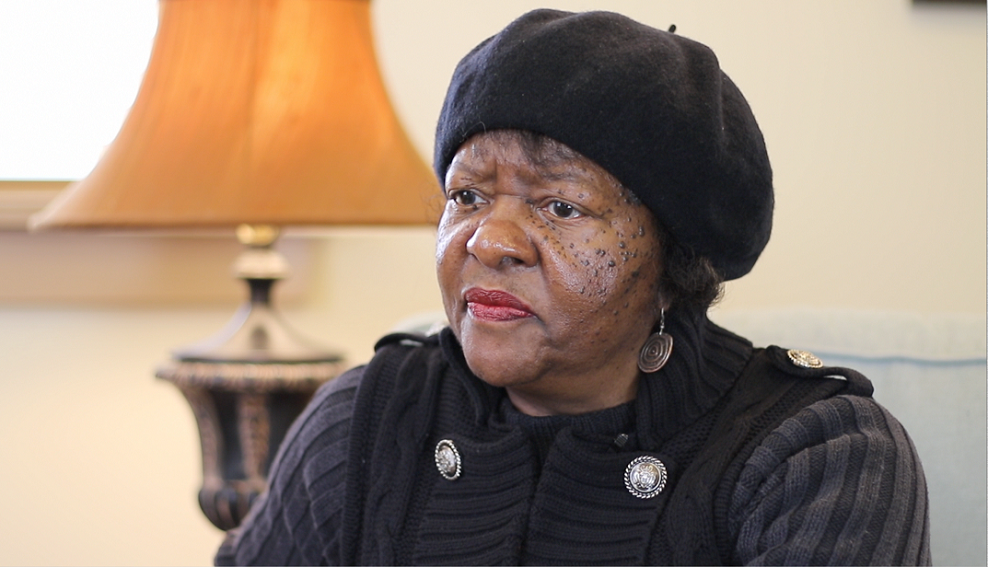
Joyce Cooks, an artist and former school teacher who has been in her house for decades, does not want to move. But if some city officials get their way, she could be forced out of her home as early as June.

The National Geospatial-Intelligence Agency, currently in South City, is considering moving to a new location in the region. In order to keep the NGA within St. Louis City, city officials are considering using eminent domain to clear out a neighborhood on the north side. It goes without saying that the people who would lose their homes in the deal are unhappy about it.

Joyce lives in a three-story brick Victorian house built in 1893. Her mother bought the house in the 1960s and she grew up in the neighborhood. “I love my home,” she tells me. If the city uses eminent domain, that home would be bulldozed.

One would hope that city leaders would resort to eminent domain—the power of government to remove a person from their land—only when there’s a very clear public benefit and no clear alternatives.

But in the case of the NGA, there are alternatives. In fact, there are three of them. One in particular, a parcel of land in St. Clair County, would have the advantage of being adjacent to an existing Department of Defense campus at Scott Air Force Base. Of the four proposals the NGA is considering, only the one in St. Louis City requires the use of eminent domain to raze an entire neighborhood.

When I asked Joyce what she’ll do if the city is successful in forcing her to move, she was despondent. “That’s my biggest fear,” she admitted. Joyce still has no idea where she’ll go if it comes to that. “What will I do?”

I have my own questions: Why is the city serving as an agent of the federal government and using eminent domain to clear a tract for a federal agency that may not even locate within the city of St. Louis? Is keeping the NGA within the city worth keeping property owners in limbo while the NGA decides where to relocate? And if the city does use eminent domain to clear out this neighborhood on the north side, where will its residents go?

Should Missouri Use Tolling to Pay for the I-70 Rebuild?

I-70 will need to be rebuilt in the near future, and it won't be cheap. This video explores tolling as a possible way to finance the upcoming expense. Click on the link above to watch.

For a thorough analysis of the current state of Missouri's highway system and the challenges it faces in the near future, check out Joseph Miller's new Policy Study, Funding the Missouri Department of Transportation and the State Highway System

Kansas City, Death and Taxes

At a recent gathering of religious leaders, one earnings-tax supporter told those gathered that if the earnings tax is defeated on April 5, "We're going to lose 800 cops over 10 years." Of course there is no way that any city leadership would allow that to happen, but this is the sort of scare tactic the city is relying on to get "yes" votes.

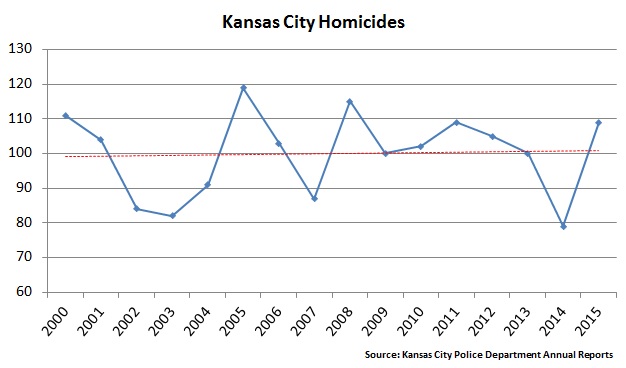
The speaker also talked about the history of the tax, claiming that it was promulgated to increase public safety spending in response to the high murder rates in the late 1960s. We looked up the murder statistics for Kansas City, and indeed there was an increase in the late 1960s, peaking at 134 homicides in 1970. The number decreased afterward, but never returned to its previous rate. The speaker offered no evidence to support the idea that the imposition of a regressive flat tax had anything to do with declining murder rates. He certainly offered nothing to suggest that phasing out the earnings tax now would lead to an increase in homicides. The tactic seems intent not on educating voters, but on frightening them.

Are things better now? Over the last few years, Kansas City has averaged 101 murders each year, and the trend is pretty flat since 2000. Overall, Kansas City has one of the highest murder rates in the United States, and while national data for 2015 are not yet available, the jump in homicides in 2014 may return us to the top ten, where we were in 2013

Back in the 1960s, Kansas City had a high murder rate. Today we have a high murder rate and an earnings tax. Is this the type of "progress" of which Kansas Citians can be proud?

Kansas City Streetcar Has First Crash

It was only a matter of time. During a test run, the Kansas City Streetcar collided with its first parked vehicle on March 1. Kansas City officials blamed the vehicle owner for parking beyond the white line denoting where it is safe to park along the streetcar’s route.

The city is correct to put the blame on the car owner for this accident. However, that doesn’t make it a good idea for a city to build a transportation system that relies on everyone studiously observing parking regulations. We put “all stops” in traffic signals, install high railings on bridges, and force McDonalds to serve cooler coffee, all because we correctly expect that some small percentage of people are just going to screw up.

Kansas City is not the only city dealing with these issues. Other metros, like Washington D.C., have had continuous problems with collisions on their recently opened streetcar line. Anecdotes aside, the federal government collects public transportation safety data, and from 2011 (when they started reporting streetcar data) to 2015, streetcars and their close cousins, cable cars, were by far the most collision-prone forms of public transportation. Streetcar revenue miles per collision were almost an order of magnitude lower than those for buses or other types of rail:

Transit Mode

Vehicle Revenue Miles (VRM)

Collisions

Miles Per Collision

Cable Car

1,472,949

23

64,041

Streetcar

28,114,830

303

92,788

Bus Rapid Transit

26,118,276

74

352,950

Light Rail

481,691,292

1,006

478,818

Motor Bus

9,057,322,042

16,810

538,806

Commuter Bus

458,816,768

140

3,277,263

Heavy Rail

3,184,358,401

546

5,832,158

Cities should expect collisions because of the streetcar’s very design. They share the road with other vehicles and, due to fixed rails, cannot maneuver around obstacles like buses can (or avoid obstacles completely, as separated rail lines do). An object in the path of the rails means either a collision or a delayed streetcar. This safety problem is one of the factors that pushed cities away from streetcars in the first place, and is something policymakers should consider as they plan to bring a small part of that system back. 

Working in Kansas City: The Rise of Johnson County

Living in a quaint, leafy suburb and commuting to a bustling downtown for work is an enduring image of American life. The image is the unacknowledged philosophical backbone of regional planning, as civic leaders promote radial transportation networks and suburban towns regulate out construction that offends “village” atmospheres. The only problem is that these efforts are increasingly detached from reality in places like Kansas City, where the idea of a central city and bedroom suburbs is, at best, nostalgic.

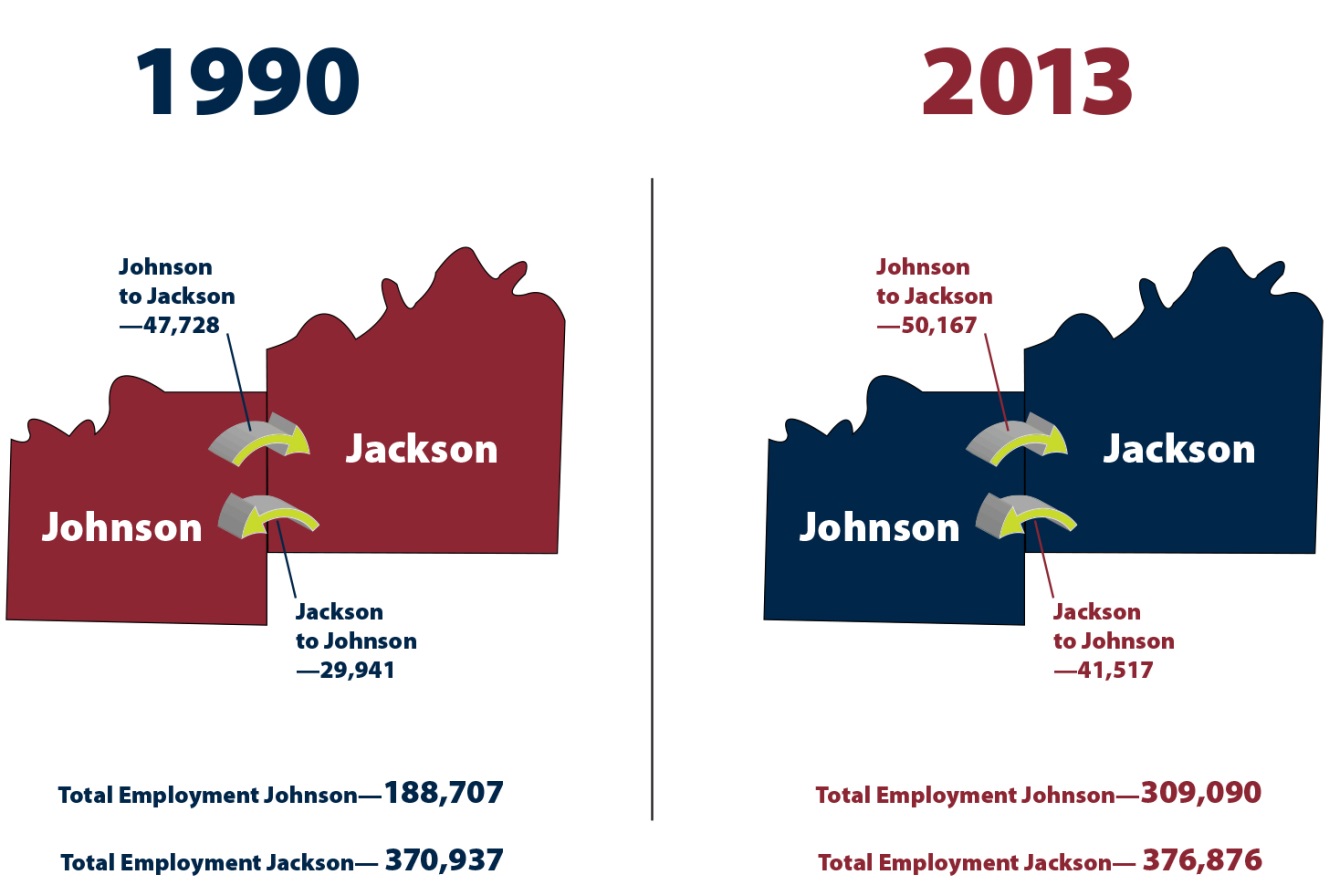
For instance, if we go back to 1990, Jackson County, which contains the Kansas City core, contained more than half of all employment in the Kansas City area’s most populous counties (Jackson, Johnson, Clay, and Wyandotte). Johnson County (KS) was a distant second, with about a quarter of the region’s employment. Johnson County could even have been considered a bedroom community, with more people commuting out of than commuting into the county.

Flash forward to 2013 and the situation had changed radically. While Jackson County still housed about the same number of workers as it did in 1990, Johnson County added nearly 120,000 jobs. More workers still commute from Johnson County to Jackson County than vice versa, but the gap narrowed significantly. Johnson County is also now a net importer of workers. Jackson County’s share of employment among Kansas City’s largest counties dropped from 52% to 44% in the period, while Johnson County’s share reached 36%.

Residents in the Kansas City region are more likely than ever to work in, and not just live in, the suburbs. Unfortunately, Kansas City officials still have a tendency to channel investment to the downtown area to a degree that is disproportionate to its actual economic importance and promote transportation plans (public and otherwise) that would be more appropriate to 1920 than to 2020. The region would be better off planning for the city it has rather than an outdated image of the past. 

Race-Based School Choice Policies May Be in Violation of the Equal Protection Clause

Sometimes we realize what we thought was a good idea at the time was really a terrible idea.  No, I’m not referring to mullets. I’m talking about the race-based policies of the voluntary inter-district school choice program in St. Louis.

In the 1970s, St. Louis Public Schools and the State of Missouri were sued for maintaining a segregated education system in the city. The U.S. Court of Appeals upheld the ruling and school districts in the area began working on a plan to fix the problem of segregated schools. The solution, from a 1983 settlement agreement, was to allow black students in the city to attend predominantly white schools in the county and to allow white students in county schools to attend predominantly black city magnet schools. This “voluntary” program was to improve integration in the city and county.

Although well-intentioned, this policy has become a roadblock for black students wanting to attend a high-quality school in the city. Take Edmund Lee, for example. As Fox 2 reports, Edmund is a bright African-American 3rd-grader at Gateway Science Academy in St. Louis. Gateway is one of many high-quality charter schools in the city. Edmund’s family will be moving soon to the county, but would like to utilize the transfer program to allow him to continue at the school he loves. There is just one problem—he’s black. Black county students cannot transfer into the city, because that wouldn't help integration efforts.

Of course, this problem is not new, and it goes both ways. White students in the city cannot transfer to Clayton, Kirkwood, or any of the high-performing county schools because they are white.

The case of Edmund Lee may not just be sad; it may also be illegal. In 2012, the United States District Court for the Western District of Arkansas found a similar policy to be in violation of the Equal Protection Clause of the 14th amendment to the U.S. Constitution. Arkansas allowed students to transfer to another public school, provided they improved the racial balance of the schools.  As in the transfer program in St. Louis, black students in predominantly black schools could transfer to predominantly white schools and white students in predominantly white schools could transfer to black schools.

The court wrote, “The legislation was no doubt properly motivated in its desire to end segregation, but the question that must be addressed is whether the legislation infringes on federally protected rights.” In the end, the court decided the law did violate the rights of individual under the 14th amendment.

A similar fate could be in store for the St. Louis transfer program. For those who believe that the goal of the program is a noble one, wouldn’t it make sense to expand the program so that all students, regardless of race, could choose to attend the schools that fit them best? Doing so would not only avert the danger of violating the 14th amendment, but it would also allow students like Edmund Lee to continue attending the schools they love.

After Melissa Click, Higher Ed Reforms Must Stay on Course

News broke late last week that embattled Mizzou professor Melissa Click has been fired from her job by the state's Board of Curators. You'll remember that Click was the teacher who demanded "muscle" against a student during last year's student protests, and who was caught in recently-released body cam footage verbally assaulting law enforcement earlier that fall. 

Click may appeal the Board's decision, but whatever the outcome there, Click's case was always very separate from the important policy issues her behavior brought into focus. Policymakers should recognize that Click is a symptom of the broken campus culture at Mizzou, not the cause of it. Accordingly, legislators should not take their eyes off the reform ball that's already started rolling this session. 

Melissa Click represented problems that have institutionally bedeviled the University for years, and her departure should signal not just the end of her tenure, but the beginning of a round of higher ed reforms that taxpayers can be proud of. After all of the embarrassments Mizzou brought to the state last year, that would be a welcome change of pace.

Bridge Tolls Ready for a Comeback?

Many of the bridges from Illinois into St. Louis were once toll bridges. Maybe Missouri should bring back bridge tolls to help fund its transportation needs. Click on the link above to see the video.

For a thorough analysis of the current state of Missouri's highway system and the challenges it faces in the near future, check out Joseph Miller's new Policy Study, Funding the Missouri Department of Transportation and the State Highway System.

Kansas City Prioritizes Transportation Few Use

Kansas City residents rely on well-functioning transportation for virtually every aspect of their lifestyle, from getting to work to spending a night on the town. But to keep the transportation system working, the Kansas City region needs to make regular investments. Unfortunately, the most recent plan for transportation spending in the Kansas City area shows a troubling disconnect between the infrastructure taxpayers actually use and where city leaders want to put taxpayers’ money.

Not all transportation modes are of equal importance in the Kansas City area. The region’s dispersed population and employment mean that most residents use highways and streets to commute. In Jackson, Clay, and Platte Counties, more than 90% of commuters drove to get to work (according to U.S. Census data from 2009 to 2013). The next most popular form of getting to work is actually just not going anywhere (that is, working at home). Aside from commuting, much of the metro area’s freight traffic uses the highways, and the region’s bus networks also make use of city streets.

Highways and streets are indisputably the most-used part of Kansas City’s transportation network. The only rival for importance may be the freight rail network, as Kansas City is the nation’s second largest freight rail hub. That might lead one to predict that most of the spending in the Kansas City area’s Transportation Improvement Program from 2016–2020, which includes, “. . . all federally funded surface transportation projects and all regionally significant surface transportation projects planned for the Kansas City metro area during federal fiscal years 2016–2020,” would be for highways and streets. That prediction would be wrong.

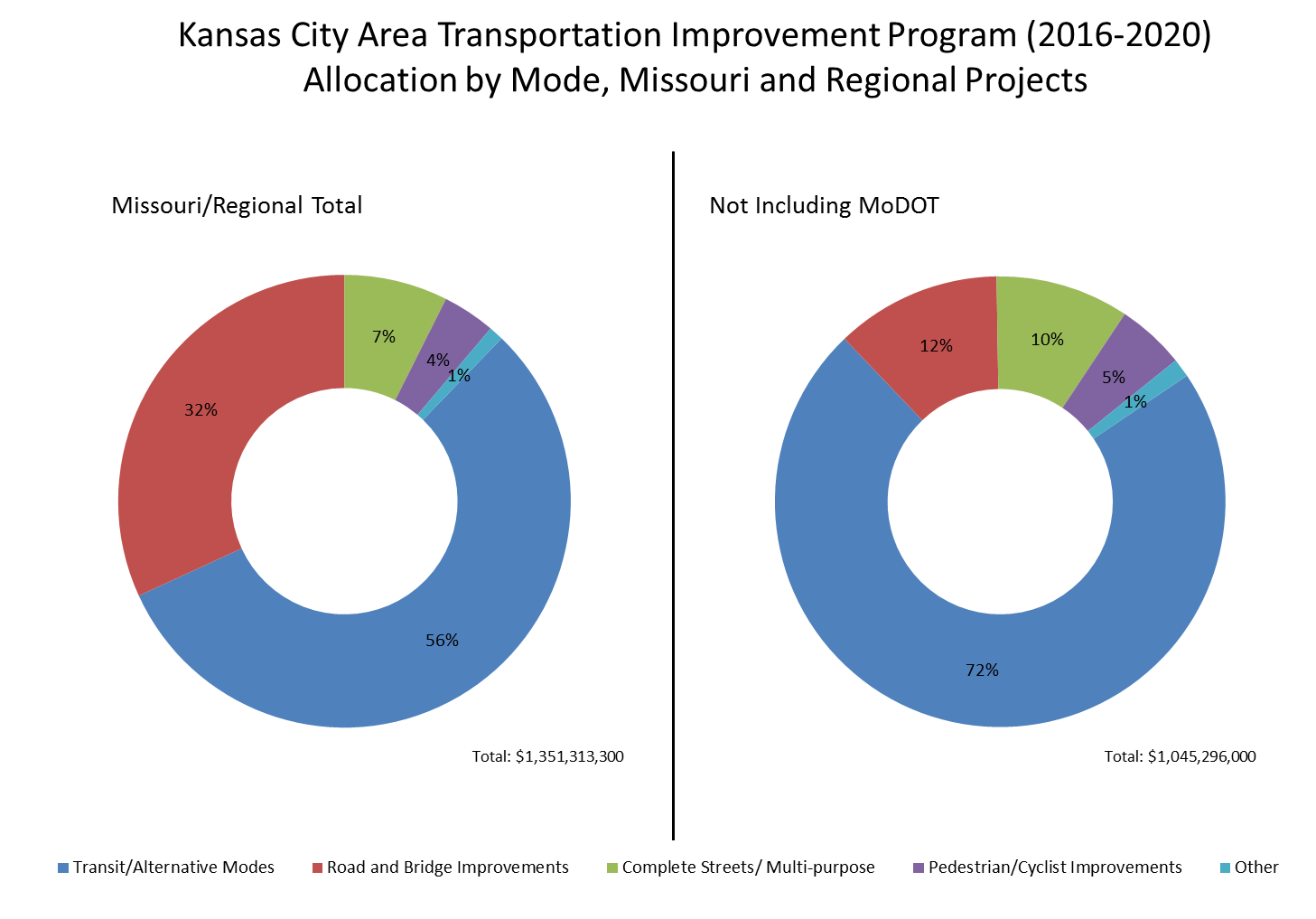
In reality, 56% of all regional and Missouri-side spending ($1.35 billion) will be for public transportation projects like the bus system and the streetcar. Road and bridge projects only get 32% of the pie, with “complete streets” and pedestrian/bike projects combining for around 11% of spending. These numbers, if anything, overestimate Kansas City’s commitment to road and bridge investments, because the vast majority of spending on roads comes from the Missouri Department of Transportation (MoDOT), which is tasked with maintaining the state network, whatever the ideological bent of Kansas City regional planners. MoDOT does not handle non-state highway projects. 

Spending allocation: KC area transportation improvement program

If we take MoDOT out of the equation, only about 12 percent of the region's spending ($124 million) is going to roads and bridges. That’s only slightly more than is going to the streetcar starter line, which supporters admit is not really about transportation at all. Seventy-two percent of non-MoDOT transportation spending is going to transit, which, as of 2014, accounted for less than 2 percent of the regions commuters.

How long can Kansas City leaders go on ignoring the transportation modes everyone relies on while lavishing funds on modes few people use if they still expect to have a functioning system? 

Support Us

The work of the Show-Me Institute would not be possible without the generous support of people who are inspired by the vision of liberty and free enterprise. We hope you will join our efforts and become a Show-Me Institute sponsor.

Donate
Man on Horse Charging