A Well Intentioned Disaster: A Presentation on the Merits of Common Core State Standards

The following is taken from a presentation given by Show-Me Institute Distinguished Fellow of Education Policy James Shuls on February 23, 2016, at a debate hosted by the Federalist Society and the Education Law and Policy Society at the University of Michigan.

In my remarks today, I hope to convince you of three things. First, the idea of the Common Core was noble, but misguided. Second, the Common Core State Standards will not significantly improve student achievement. And finally, the federal government created the controversy we have seen surrounding the Common Core over the past few years.

A Noble but Misguided Goal

The idea behind the Common Core is quite simple. Schools need standards because standards allow teachers to align the curriculum and allow teachers to see what they are to cover in each grade. I have been told many times that prior to schools adopting learning standards, it was not uncommon for students in the same grade in the same school to have radically different experiences depending on the teachers they had. Standards help alleviate that problem.

Following the infamous “A Nation at Risk Report” report of 1983, the standards movement was launched. This Reagan-administration report used alarming language to describe the nation’s education system. The authors of the report wrote:

If an unfriendly foreign power had attempted to impose on America the mediocre educational performance that exists today, we might well have viewed it as an act of war. As it stands, we have allowed this to happen to ourselves. . . . We have, in effect, been committing an act of unthinking, unilateral educational disarmament.

The report fueled a desire to improve the quality of our education system. State officials wanted to keep a watchful eye on how schools were performing. To do that they needed tests, and to have tests, they needed standards on which to base them.

Through the 1980s and 1990s, states began creating their own standards-based accountability systems. By 2000, 39 states had accountability systems in place. After the No Child Left Behind Act was passed in 2001, the remaining states were forced to follow suit. As a result, by the mid-2000s we had 50 different state standards and 50 different accountability systems.

These individual state standards created a problem. Students from families that moved from one state to another could miss entire topics if they were covered in one grade in one state and in a different grade in another. And, very importantly, the different tests did not allow us to compare one state to another because the accountability systems were different. In a state with very low standards a student might score “proficient,” but if he were in a state with very high standards he might score “basic.”

In reality, these were not problems created by having 50 state standards. They were problems that have always existed, and in many regards still exist. To be honest, these problems are relatively minor in the grand scheme of things. I mean, would you go through all of the effort that the Common Core designers went through just to improve transparency across states? I wouldn’t, especially when we have the National Assessment of Educational progress, known as the nation’s report card, which already allows us to compare one state to another. The most valid reason to support the Common Core comes from the thought that these standards could improve student achievement for all students. This is where the supporters for Common Core were misguided. This is where the logic for Common Core falters, and this is what brings me to my second point: that Common Core will not improve educational outcomes for students.

Common Core Will Not Improve Educational Outcomes

Let me ask: How might a system of new standards improve educational outcomes for all students? As far as I can tell, there are three options:

  • The standards could better align the curriculum.
  • The standards could be more rigorous.
  • Or, the standards could create a broader platform for collaboration.

Let’s examine each of these.

The standards could better align the curriculum

Remember, states have already developed standards and aligned curricula. We’d have to believe that the Common Core has somehow come up with a better way to do these things—that they have discovered the special sauce or that the designers have figured out the right progression of learning. Something tells me that is not the case. While the quality of education research is improving, there is simply not enough evidence to know if we should teach fractions in third grade or fourth, or whether we should introduce money in kindergarten or first grade. I recently sat on a committee to rewrite Missouri’s state standards. I can tell you, while the process is informed by research, it often comes down to educated guessing. The individuals making these guesses are indeed educated, but in the end, many of these decisions are completely subjective.

So what is the second option?

The standards could be simply be more rigorous

They could raise the level of expectations for students. After all, students rise to the level of expectation, don’t they? If this were true, we would expect students in states that previously had rigorous standards to perform better than students in states with weaker standards. In a study for the Brookings Institution, Tom Loveless examined this very issue. He found no relationship between the rigor of state standards and student performance on the NAEP. None. Another thing to consider is that ratings of the Common Core Standards by the Fordham Foundation, a group that has been very supportive of the effort, do not place Common Core at the top of the standards list. They are among the best according to Fordham, but in Math and Language arts, other standards were rated higher. If we believe that rigor or the quality of standards matter, then it puzzles me why supporters of national standards would be so willing to go to bat for Common Core. Why not simply adopt the superior Massachusetts standards?

The Common Core will not improve student achievement by better aligning curriculum, nor can we improve student learning simply by being more rigorous. What’s left?

A system of national standards could create a broader platform for collaboration

Before Common Core, textbook companies often designed curricula for more populous states like California and Texas. As a result, states found it difficult to get textbooks that aligned with their individual standards. Common Core helps alleviate this problem. Moreover, it allows teachers throughout the country to collaborate on lessons related to the standards. While this sounds great, planning on a substantial benefit from collaboration is misguided. If it were true that more opportunities for collaboration led to success, then we would expect to see more populous states—those that drive textbook production—to have an advantage. Not only would they have textbooks tailored to their curricula, but with a larger number of teachers, they would have greater opportunities for collaboration. Yet, we don’t see a California or Texas advantage.

In the face of the evidence, there is simply no logical model that can explain how a set of standards that simply tells teachers what to teach will improve student learning. At least not today.

To be clear: Standards are important, and evidence does show that the standards-based accountability movement has led to modest learning gains for students. It seems, however, that the low-hanging fruit has been picked. Schools have already aligned curricula, and we have already begun focusing on student outcomes. New standards may have some impact on the margins, but by themselves they cannot substantially improve student achievement.

This is not intended to be a comprehensive indictment of Common Core. I don’t believe Common Core will ruin our education system. I don’t believe it is some grand conspiracy to dumb down America. I simply believe it is bad policy.

But if Common Core is innocuous, then why are we devoting so much time to it? We are having this conversation today because promoters of Common Core oversold, and because the federal government overstepped. As is often the case, the actions of the federal government came with unintended consequences.

The Federal Government Created the Common Core Controversy

Common Core did not begin as a federal initiative. I hesitate to call this a “state-led” initiative, and it certainly wasn’t a grass roots initiative. It was instigated by the National Governors’ Association and the Council of Chief State School Officers. These two trade organizations began the process late in George W. Bush’s administration, but the idea of national standards goes back even further, to his father’s administration. Early on in the development of the Common Core standards, some thought that the standards would be adopted by a handful of states; it was hoped that other states would adopt them voluntarily over time. That changed with federal involvement.

In 2009, President Obama launched his Race to the Top initiative, a competitive grant program that was part of the stimulus plan. States could compete for $4.35 billion dollars in prize money by proposing a series of reforms. This came at a time when states were feeling the pressure of the recession and could ill afford to pass up an opportunity for additional federal funding. One of the reforms supported in Race to the Top was the adoption of learning standards that were common to a majority of states—what would become Common Core.

As part of the first round of the Race to the Top process, states had to submit their applications (including a commitment to the Common Core standards) by January 19, 2010. The second round was June 1. But the final draft of the standards was not even released until June of 2010. In other words, the federal government encouraged states to commit to common standards before those standards were even finalized. Still, states jumped at the opportunity. By 2013, 45 states had adopted the standards. President Obama took credit for this in his State of the Union address.

At the same time, the Obama administration doubled down on support of Common Core by offering to waive certain No Child Left Behind (NCLB) requirements to states that adopted Common Core. Schools and states were finding it increasingly difficult to comply with various aspects of NCLB; that is, they had failed to meet the mandated 100 percent proficiency marks. States could avoid penalties by promoting education reform policies championed by the administration, one of which was common standards.

Whether you support federal involvement or not, it is difficult to deny that the actions of the U.S. Department of Education caused or at least contributed to the controversy surrounding Common Core. What might have been a coalition of states that grew and developed over time was catapulted into the national stage as a new and radical reform that many states adopted, if not against their will, then at least under duress.

Conclusion

While the motivation behind the Common Core standards was good, the outcomes—at least in terms of liberty—are not. Common Core moves control of one of the most important aspects of education—what students learn—further from students and parents, and it concentrates power at the federal level. As Nobel-winning economist Milton Friedman once said, “Concentrated power is not rendered harmless by the good intentions of those who create it.” The Common Core standards reduce individual liberty and academic freedom for states, teachers, and students. They nullify the great advantage of individual states—the ability to act as laboratories that allow us to evaluate different systems to see what works best—in favor of a monolithic approach that stifles innovation. Ultimately, the Common Core movement is an expression of the flawed mindset that we can mandate and orchestrate improved student achievement through centralized control. 

Making Regulations Count

Recently, I found myself in the State Capitol building in Jefferson City, Missouri listening to a rousing debate about whether or not to require Missouri public schools to allocate time for the Pledge of Allegiance. I was there to testify during the hearing about another bill, but my ears perked up as the back and forth between the members of the education committee got more heated.

Now, I’m a big fan of the Pledge of Allegiance. If I had my druthers, American schoolchildren would recite the Pledge of Allegiance at the beginning of every school day. In fact, I wouldn’t mind hearing a rousing rendition of God Bless America every Monday morning, now that I think about it. But as the debate wore on, I started to question the wisdom of whether or not we should have a state law requiring it. I started to see this requirement less as a reasonable request from our elected officials and more as a part of a broader trend of regulatory creep.

Most regulations and requirements make sense when they’re looked at in isolation, but they add up. By my count, members of the Missouri legislature filed almost 300 bills related to education this session, all probably reasonable to the folks who drafted them. But if all were enacted, think of the new burdens they would place on teachers and administrators.

As my old friend Rick Hess often tells eager young policy wonks hoping to remake the American education system through new laws and regulation: Government can make schools do things, but it can’t make them do them well. At best, the state legislature can require that the Pledge be part of the schedule, and the state department of education can create a reporting form that requires all 520 of Missouri’s school districts to affirm to the appropriate functionary that they’ve provided time for it, and during audits maybe some bean counter will double check the form. But that’s about it. They certainly can’t make sure the kids hold their hands over their hearts and say the Pledge with pride.

That said, maybe saying the Pledge is so important that even with the limited power that the state legislature has to actually get schools to do what they want, they should still make the requirement and direct the state department of education to do their level best to make sure it is followed. If that is the case, though, how does it compare to all of the other things that the legislature wants schools to do? If there is some conflict between varying requirements, how should schools weigh them against each other?

Our Tory compatriots across the pond offer a way forward. In 2010, the Conservative government of the United Kingdom implemented what they called “one in, one out” (later revised to “one in, two out”) that required government to remove a regulation of equivalent compliance cost for every new regulation that they proposed. Want to require a new form to be submitted to the Department of Business, Innovation, and Skills tracking how businesses recruit new employees? Lovely, not a bother at all. You simply must find another form that takes the same amount of effort or another requirement that takes the same amount of time and eliminate it.

The same logic could be applied to government regulation of schools. If the legislature wants to require the Pledge of Allegiance, or extra time for reading, or for teachers to have CPR training, they simply have to remove a requirement that takes up the same amount of time or costs the same. The hope would be that this would make lawmakers think before adding new regulations, because for every new idea they have, they and their staff will have to dig around to find something to jettison. It would also give them the opportunity to revisit regulations that still exist in the education code but have outlived their usefulness. Rather than adding on a kludge with every new directive, new requirements that are worthwhile are made doubly so as they also help remove an unneeded requirement. It’s addition by subtraction, and a win-win.

Ultimately, a one in, one (or two) out scheme should be a part of a broader regulatory reform of public schooling in America. Looking at regulations through the lens of the burdens on time and money that they place on schools, we can remove regulations that offer little to no return and limit regulations to things that really matter. Like, perhaps, the Pledge of Allegiance.


Should MoDOT Be Bearing the Cost of Maintaining Rural Bridges?

Many of Missouri’s lightly traveled bridges are part of the state highway system. Turning these over to county and local governments would free up money for MoDOT to spend on our interstate highways.

For a thorough analysis of the current state of Missouri's highway system and the challenges it faces in the near future, check out Joseph Miller's new Policy Study, Funding the Missouri Department of Transportation and the State Highway System.

Springfield Taxpayers on the Hook for “Employee-Funded” Pension?

The union representing Springfield police officers is suing the city government in an attempt to force the city, and therefore taxpayers, to take responsibility for a troubled pension fund. Regardless of the merits of the police union’s case, it’s worth mentioning that this whole situation could’ve been avoided if the city offered defined contribution pension plans—where the city regularly contributes a set amount to a retirement fund controlled by each employee- instead of defined benefit pension plans—where the city promises to pay a set amount upon retirement.

Some background: When Springfield police and fire department employees won increases to their pension several years back, they agreed to pay for it themselves through employee contributions. However, the cost of the benefit has ballooned as the number of people paying into the pension fund has shrunk. Because the pension is a defined benefit plan, growing unfunded liabilities now put the entire pension fund at risk. In this case, taxpayers may end up paying for a benefit they were told they wouldn’t have to cover.

Springfield is not the only municipality facing a defined benefit pension with growing unfunded liabilities. According to SMI’s 2016 study on the funding of Missouri’s state and local pension liabilities, the average public pension could be between 48 and 59 percent underfunded. According to that same study, total unfunded liabilities for Missouri’s public pensions could be as high as $89 billion.

In theory, a defined benefit pension plan can be fully funded and operated in a sustainable way. But in practice, elected officials tend to promise more than they can deliver, and defined benefit pension systems can run into problems years or even decades after they were put into place.

For cities that want to avoid issues like the one facing Springfield, making the switch to a defined contribution plan might be the way to go. With a defined contribution pension, the city would make regular contributions into an employee-managed retirement account throughout the employee’s career. When the employee retires, he or she would draw from the money deposited into that account plus or minus any investment gains or losses. Underfunding situations like the one in Springfield would be impossible, because a defined contribution pension is necessarily and by definition fully funded.

A defined contribution pension benefit is not a cure-all, because benefits already accrued will have to be paid out pursuant to the older defined benefit plan. But switching to a more sustainable benefit system might keep a potential problem from becoming a catastrophe. 

Don’t Get Too Excited about Film Tax Subsidies

The City Council of Kansas City, Missouri, recently passed an ordinance establishing Kansas City’s first film development program. This program will provide up to $75,000 per fiscal year in tax rebates for film-makers that produce films in Kansas City.

While $75,000 may not seem like too imposing a number in terms of the city’s $1.53 billion planned budget for the 2016-2017 fiscal year, it illustrates the misguided focus the leaders of Kansas City have in allocating taxpayer money. In making this investment, the City is missing out on the opportunity to meaningfully invest this $75,000 of taxpayer money into other projects that have clear and constructive benefits and a return on investment. Films do not.

The Show-Me Institute has repeatedly documented the failings of film tax credits in Missouri, most recently in testimony against HB 803, a proposal to reinstate Missouri’s film tax credit program (which expired without renewal in November of 2013) (here), and on the local film tax subsidy experiment that was Gone Girl (here and here). Long story short, movies almost never live up to their promises when it comes to jobs, tax revenue, or long-term economic development.

But it’s not just us. In 2010 and 2012, the Missouri Tax Credit Review Commission called for the state’s film tax credit to be eliminated because they repeatedly found that it was promoting neither long-term economic development nor even simple return on the state’s investment.

In fact, as of 2016, thirteen states (including both Missouri and Kansas)  have recognized that film tax subsidies are not high-yielding, profitable ventures in terms of providing long-term sustainable jobs, increased economic development, or a return on investment (many studies have found these state programs generate less than 30 cents for every $1 spent), and have thus decided to not have statewide film tax incentives.

Past experience shows quite clearly that film subsidies do not work and are not a prudent investment. Instead of chasing after the next Gone Girl, the city should pursue programs that are practical for economic and social development, like good schools, safe streets, and functioning infrastructure. 

Missouri Moves One Step Closer to Liberalizing Liquor Laws

On March 3, the Missouri Senate passed SB919, a bill that would remove long-outdated restrictions on the sale of beer and other types of alcohol in the state. As currently written, the bill would:

1.       Remove alcohol level restrictions on malt liquor.

2.       Remove restrictions on the type of alcohol that can be sold at microbreweries and repeal some local taxing authority on such breweries.

3.       Allow beer companies to lease coolers to retail stores.

4.       Allow all beer sellers to sell growlers.

5.       Make it harder for the state to reject applications for liquor licenses.

6.       Allow for special permits for out-of-state manufacturers at festivals.

As we’ve written before, Missouri (along with all other states) have byzantine liquor laws dating back to prohibition. While public attitudes toward the responsible consumption of wine, beer, and other spirits has steadily become more permissive, Missouri and other states have only slowly updated their rules over the years (Alabama got rid of its last dry county on Super Tuesday). And most of changes SB919 presents, like allowing the sale of growlers, are common sense. As we pointed out in testimony over this issue,

“Beer in containers larger than growlers is available for sale at retailers. Growlers are legal, and are sold at breweries and brew pubs. SB 919 would only allow a product that is legal to be sold in a quantity that is legal in a place that already sells the same product in much larger quantities.”

The only opposition to the bill is related to allowing beer companies to lease coolers to retail stores. Smaller producers fear that this will put them at a competitive disadvantage against large brewers. However, competition in the beer and spirits industry is intense, and there is little reason to fear monopolization of the market from cooler-leasing any more than we fear it in the consumer goods industry at large, where buying shelf space at local stores is a common practice.

Missouri’s alcohol laws are convoluted and antiquated. Alcohol regulations should have both a legitimate public purpose and, once enacted, a track record of success in achieving that purpose. If they do not, bills like SB919 may be a step forward for consumers in the state. Should provisions in the bill, such as cooler leasing, become problematic, Missouri can always revisit policy to correct clear and present market issues. 

Reaping the Whirlwind in Columbia

The Book of Hosea cautions us, “They that sow the wind shall reap the whirlwind.”  Student protests on The University of Missouri’s campus, and the administration’s reaction, sowed some serious wind.  News out this week that freshman enrollment is projected to be down 25%, creating a $32 million funding deficit for the campus, is the whirlwind. If the university does not clean up its act, who knows what will blow in next.

It should be noted that this shortfall is not a result of legislators in Jefferson City cutting funding. This is prospective students freely deciding that they don’t want to spend their college years as Missouri Tigers and taking their money somewhere else. That should terrify administrators in Columbia. Will Mizzou go the way of other brands scorned by the marketplace, like Kodak, Pontiac, or Ask Jeeves?

Mizzou desperately needs to get its house in order. Most importantly, it needs an administration that realizes that protests on university campuses have been happening for decades.  In most cases, there is some element of truth to the protestors’ grievances, but it soon gets wrapped up in the narcissism and self-righteousness of 18-22 year olds.  The job of administrators is to separate the wheat from the chaff. They must address the real issues that are affecting students without losing sight of the fact that it is college kids making the demands.

Mizzou’s administration completely failed in this regard. The kernel of truth in the protestors’ anger is that far too few students of color are meeting with success on Mizzou’s campus.  This is undeniably true.  While African-Americans make up around 12% of Missouri’s population, they make up only 7% of Mizzou’s.  They are disproportionally enrolled in remedial classes, and drop out at higher rates than other students.  This is cause for concern, and something that the administration needs to address.

That entirely appropriate issue got wrapped into a series of out-there “demands,” including requiring that the former University of Missouri system president pen a handwritten note admitting his white privilege, and calling for the hiring of legions of staff across a variety of departments to provide services for minority students, but providing absolutely zero advice on how to pay for all of it. That is the chaff.

If the university does not have leadership that knows the difference between the two, or is incapable of dealing with substantive issues without being derailed by ridiculous ones, a loss of 25% of enrollment is just the start. And they shouldn’t expect the state to bail them out.

It appears that nearly everyone involved in this imbroglio has lost sight of the fundamental fact that the University of Missouri is paid for in large part by the citizens of Missouri.  Many of these people did not attend, will never attend, nor will ever have any of their children or grandchildren attend the university. University students, faculty, and administrators are asking the single mom in Cape Girardeau who is struggling to get by working two jobs to pay for their wants and desires. Just because they go to, or work at, Mizzou does not mean that they have a claim to that woman’s money.

We support Mizzou (and all of our other state universities) because they provide a service to our state; they educate our citizens and do research that improves our world.  If they’re not doing either of those things, they aren’t entitled to a dime.

Hopefully this enrollment nosedive serves as a wakeup call to the Mizzou community.  A strong flagship university can be an asset to its state and citizens.  Mizzou has a long way to go in proving that it is ready to resume that role.

City’s “NGA for Millennials” Pitch Rings Hollow

Saint Louis is trying desperately to keep the National Geospatial Intelligence Agency (NGA) within city limits. The federal spy agency is looking for more space and is considering options in Saint Louis City, Saint Louis County, and Saint Clair County, Illinois. The sites in Saint Clair County (near Scott Airforce Base) and in North Saint Louis City are considered the strongest contenders.

We’ve talked before about how Saint Louis City’s attitudes toward non-city alternatives for the NGA expose local leadership’s fair-weather regionalism. After all, no matter what happens, NGA jobs are staying in the region and the area’s economy should remain unaffected. But in a bid to “redevelop” a part of North Saint Louis and keep the earnings tax revenue the NGA currently generates, Saint Louis City is preparing to pull out all the stops.

Saint Clair County is offering a low-cost, green field option on the north end of Scott Air Force base to the NGA, with the state of Illinois preparing to throw in $116 million in infrastructure improvements for the site. Saint Louis City’s original offer was a North City site at a cost $14 million, with $120 million in assistance from the state of Missouri. Now, Saint Louis will waive the $14-million cost, which was supposed to recoup the city’s expenses for preparing the site. Such costs will have to be pushed onto Missouri residents. Additionally, not to be outdone by Illinois’s infrastructure improvements, Saint Louis is throwing a MetroLink expansion into the deal as well. Strangely, Saint Louis has not put forward a solid plan for how it would fund a new billion-dollar-plus light rail line.

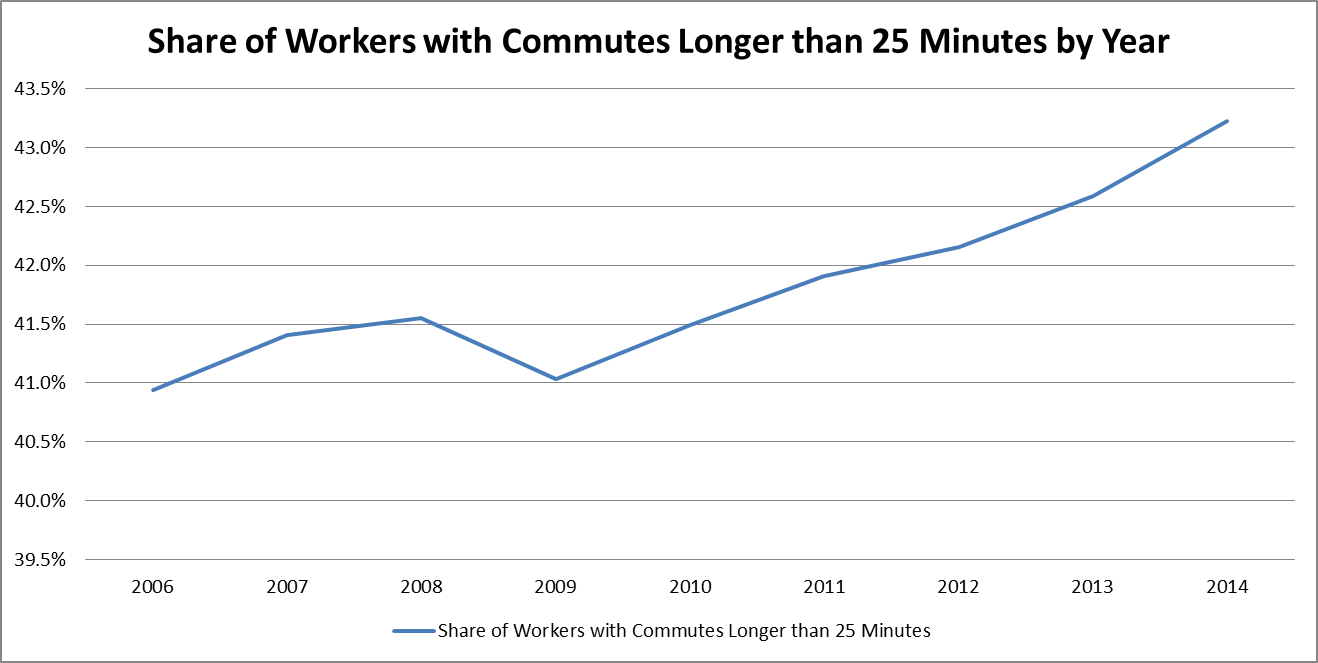
While city hall’s financial/infrastructure incentives may seem a little half-baked, they’re nothing compared to its rhetoric. Apparently, according to Saint Louis’s leadership, the city should get the NGA because millennials like to live and work downtown, among other lazy generalizations about an entire generation of Americans. One official stated that, “The days when talented young people wanted to commute 25, 35, 45 miles are over.” An interesting statement, because, since millennials have entered the workforce, the percentage of workers commuting longer than 25 minutes has regularly increased while the share of workers commuting less than 15 minutes has decreased:

Chart: Share of workers with commute times 25 min, by year

This is just another example of how the generation dubbed “millennials” is, largely, much like the generations that preceded them in terms of living, working, and commuting. And city hall’s statements appear to be typical of local government officials using generational stereotypes to justify the types of policies they (not millennials themselves) have pursued for decades.

What’s more, even if millennials are everything that Saint Louis City leaders hope they are (and want to live downtown and take public transportation to work), the existing MetroLink already goes to Scott Airforce Base, where the NGA could be. Millennials could, if the Illinois site were chosen, live on Washington Avenue and ride the train to work. That certainly sounds easier than flattening a large section of North Saint Louis and spending billions to expand the MetroLink. Given the fact the city’s plan would turn dozens of families out of their homes, wouldn’t that be a fairer solution as well?

Are Rural Highways a Burden on MoDOT?

Many of Missouri’s lightly traveled letter routes are managed as part of the state highway system. As this video explains, giving them to county or local governments would help alleviate MoDOT’s funding problems.

For a thorough analysis of the current state of Missouri's highway system and the challenges it faces in the near future, check out Joseph Miller's new Policy Study, Funding the Missouri Department of Transportation and the State Highway System.

Support Us

The work of the Show-Me Institute would not be possible without the generous support of people who are inspired by the vision of liberty and free enterprise. We hope you will join our efforts and become a Show-Me Institute sponsor.

Donate
Man on Horse Charging