

At a March 9 Policy Breakfast in Springfield, Show-Me Institute Education Policy Director Mike McShane laid out a 3-pronged approach to improving Missouri educational outcomes by giving families more choice in the schooling options for their children.
Evergreen Headline: Kansas City Needs More Good Schools

Over at the Star, Joe Robertson put together a heart-wrenching piece of journalism documenting the struggles of Kansas City families trying to figure out where to send their kids to school. Should they take a chance and participate in a charter school lottery? Should they move to Kansas or another school district?
Kansas City is home to several great public charter schools. As Robertson reports, Crossroads Academy has a waitlist 150 students long. Academie Lafayette has a 130-student waiting list. Scuola Vita Nuova has a waiting list of over 60 students, the Kauffman School has a waiting list ranging from 10 to 50 depending on the grade, and University Academy has a waiting list of 9 for kindergarten.
The problem in Kansas City is that there simply aren’t enough great schools to go around. Families with money can hedge their bets by entering the lottery to get into one of the schools I’ve mentioned, and if they lose they can move to a different district or pay for a private school. Parents without those resources cannot. Those less-fortunate families live within the Kansas City Missouri School District, but they also live in Raytown, Hickman Mills, Center, and in several of the other districts that overlap with the borders of Kansas City. Charter schools are functionally limited to the KCSD boundaries, so students zoned to attend low-performing schools anywhere else are simply out of luck.
Crossroads Academy has a promising expansion plan, and I’m particularly interested in watching the parent-led Citizens of the World charter school that is slated to open next year, but even with that growth, supply is nowhere close to meeting demand.
Here at the Show-Me Institute, we’ve documented the declining enrollment of the KCSD, and these families’ stories continue to make the case for the correct course of action moving forward. Rather than figuring out the best way to apportion a small number of good seats in schools across the city, why don’t we focus our efforts on creating new seats? Expand good charter schools. Help new schools get buildings. Allow charter schools to open outside of the narrow bounds of KCSD.
Until we take these steps, we can expect to see a constant stream of stories of families struggling to find places for their children.
Will Lawsuit Funding Regulation Limit Access to Justice?

Some Missouri lawmakers are considering legislation to regulate lawsuit funding companies. This regulation is pitched as consumer protection, or even tort reform, but it falls short on both accounts.
For background, a civil litigation funding company helps a person pay for the costs of a lawsuit before a reward is obtained. In return, the company gets a portion of the reward if the litigant is successful. Critics say that civil litigation funding companies often take an unreasonably large portion of the eventual reward. Critics are also hopeful that regulation will reduce the number of lawsuits brought against businesses, saving businesses money.
Defenders of civil litigation funding say that without these funding arrangements, many people with legitimate claims wouldn’t be able to access our justice system. In many instances people who’ve been injured or wronged would be forced to settle with an insurance company for a fraction of the compensation necessary to make them whole again. If you make it harder for people to fund lawsuits, you won’t necessarily decrease the number of frivolous claims—but you will limit access to justice for people who can’t afford to wait for resolution of their claim.
I’m most interested in whether regulating lawsuit funding companies is consistent with a free market. Shouldn’t a plaintiff be able to sell a portion of a legal claim at any freely agreed upon price? What business does the state have in regulating how people pay for a lawyer?
Professor Jeremy Kidd, a law professor at Mercer University, addressed the Alabama State Senate Judiciary Committee opposing a bill that would regulate lawsuit funding in Alabama. In doing so, he helped answer this question:
“This issue—and so many others—requires acknowledgement of a simple truth, that there is a fundamental difference between being pro-business and being pro-market. Free markets enable tremendous human flourishing, and protecting markets is essential to growth. Importantly, however, while protecting markets protects consumers and businesses, protecting businesses typically improves the businesses’ bottom line at the expense of markets and, by extension, every consumer. Senate Bill 67 is pro-business, rather than pro-market, because it is designed to protect businesses against lawsuits without inquiring as to whether those businesses are actually at fault.”
I see a great deal of truth in this statement. Real tort reform will address the problematic aspects of our tort system. Regulation of civil litigation funding appears to ignore the merits of individual lawsuits, making it even more difficult for poor Missourians to pursue legitimate legal claims.
How Would You Pivot From the Earnings Tax? Let Me Count the Ways

The Show-Me Institute has argued again and again that earnings taxes have hurt economic growth in St. Louis and Kansas City. That most American cities don't have a earnings taxes only makes pivoting away from them all the more reasonable, and while it may be news to the Kansas City Star, we've put forward a host of plans and proposals to phase it out over the last decade.
So, what would a better taxing system—one without earnings taxes—look like? And how would we get there? To my mind, there are three main policy changes to consider.
Element 1: Curb cronyism. Kansas City takes in a bit over $200 million every year from the earnings tax, and yet each year it also gives away nearly $100 million in special breaks to City Hall's favorite special interests. Giving tax incentives to crony capitalists is an admission that taxes in the city are too high; those rates should be lowered for everyone, not just for a select group of municipal insiders in the hope that the benefits will trickle down to everyone else.
Drawing down this cronyism could be accomplished several ways, including capping and, over time, ratcheting down how much property the city can abate each year, or by making blight determinations in TIF proposals dependant on poverty levels around the property in question. Whatever the reform, if a city were to reduce tax incentives as it reduced the earnings tax, pivoting away from the earnings tax entirely would become much easier.
Element 2: Reform city spending. Cities should reexamine how they spend money, both administratively and in their provisions of public services. That includes taking another look at how government pensions are structured and moving from defined benefit plans to defined contribution plans. Doing so would promote long-term budget predictability and employee retirement security. Spending reform also includes privatizing public departments like the water department that the city doesn't have to run and would actually profit from unloading. Getting a liability off the books would be an improvement, but turning a liability into a profitable opportunity makes more robust privatization of city services a no-brainer.
Element 3: Reorient taxes. After moving away from tax incentives and reforming city spending priorities, the rest of the earnings tax "pay for" could be made through systemic tax reforms. Income taxes are more destructive to growth than sales taxes, which are more destructive than property taxes. Moving from income taxes and toward property taxes would not only ensure that municipal tax collections are more stable, but also that they city's taxes would be less economically harmful to the city and the region as a whole.
To achieve this, however, will require fixes to the city's tax incentive practices either as a precursor or as a parallel reform. If earnings taxes fall, property taxes rise, but the cronies who don't pay the taxes now also don't pay them in the future, we'll be back where we started—with an inequitable taxing system. Kansas Citians and St. Louisans deserve better than that.
Overall, St. Louis and Kansas City have taken a wrongheaded approach to tax revenue for too many years, subsidizing cronies and passing the tax burden to everyone else through earnings taxes. Rather than shifting the burdens of bad policy, the city should pursue sound policies and stable tax revenue sources that promote growth rather than undercut it. By reforming tax incentives, adjusting spending, and readjusting taxes, Kansas City and St. Louis can help to ensure they remain the economic engines the state needs.
TIFs Fail to Meet Expectations

Steve Vockrodt over at The Pitch has an excellent column about how taxpayer subsidized development projects often underperform their goals. He writes in part:
Developers often win over politicians and the public by promising that TIF will help "create" a certain number of new jobs. But those projects often miss the mark, and at times by a wide margin.
Last month, the Missouri Department of Revenue released its annual report for all TIF projects in Missouri. The numbers were stark.
Among the 504 TIF districts across the state, developers estimated that 266,261 new jobs would be created. In fact, 89,485 were realized. That's 33 percent of the projection.
The annual report that Steve cites is here. Pages 258 and 259 show that now that the Power & Light District’s KC Live project is completed, only 1,003 of the projected 2,034 jobs have been realized. The reality, however, could be much worse than that.
Using data provided by Kansas City's Regulated Industries Division, we sought to see if there was any citywide increase in either liquor licenses issued to businesses or the liquor cards issued to individuals who work in bars and restaurants. The chart below shows that since the Power & Light District opened in 2008, these numbers have been flat.
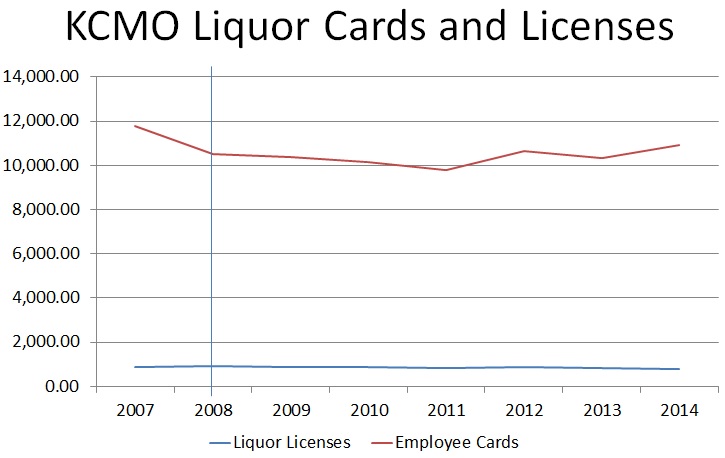
If KC Live created jobs as the TIF report suggests, yet citywide employee liquor cards remained flat, it means that the TIF didn’t so much create jobs as just move them from elsewhere in the city such as Westport or just outside the TIF area.
Yet the financial costs to the city and other taxing jurisdictions for this storefront shuffling are very real. In addition to the cost of foregone tax revenue, the city must pay about $15 million each year to cover the underperforming investment through 2040.
The question that responsible policymakers must consider is not merely how to move jobs and residents downtown, but at what cost? The city has shown that it can drive property development downtown by paying for it. That's hardly impressive. But it cannot show that there is any real net economic benefit citywide. Without that, we're just throwing good money after bad.
To Regulate the Sharing Economy, Let Users Choose Their Risk Level
In the last few years, technological innovation has facilitated the rise of the so-called “sharing economy,” where information technology allows owners of cars or homes to rent-out their property to interested customers. The most prominent examples of this are Uber, where people pick up passengers in their personal vehicles, and Airbnb, where property owners rent out their homes (or part of their homes) to travelers.
In Missouri and elsewhere the sharing economy has faced strong resistance from the regulatory state and existing businesses. Hotels and for-hire vehicle operations are traditional revenue sources for local governments (who treat hotels especially as piggy banks for pet projects), and dominant companies are geared toward a highly regulated status quo. When residents demand access to the sharing economy, regulatory bodies downplay the extensive web of regulations and high tax rates they have created, and instead fall back on appeals to public safety. Background checks, inspections, and in Saint Louis, fingerprinting, have become the motte to which regulators have fled, no doubt hoping to retake the entire regulatory bailey once their attackers have run out of steam.
While the claims of protecting health and safety make sense on their face, on closer inspection everything seems very arbitrary. Why does a vehicle need an inspection by a taxi commission; wouldn’t any auto-body shop do? If the vehicles need to be inspected anyway, why require an additional inspection at all? Why should background checks need to go seven years? What’s wrong with five? And so on.
The core problem is that a group of regulators, not the individuals actually using the services, are deciding what is safe enough. So instead of companies differentiating themselves and letting people make their own decisions, cities give an arbitrary, one-size-fits-all solution. And it is usually a conservative solution.
It does not have to be this way. In an innovative approach, Austin’s mayor has proposed a plan called “Thumbs Up Austin” as a compromise on fingerprinting for Uber and Lyft drivers. Instead of forcing all drivers to get fingerprint checks, those who chose to do so would get a “Thumbs Up” badge. Uber users would be able to see this badge before choosing a driver, and could decide whether they required their driver to have the badge. The mayor believes this could also work for other sharing economy services, like Airbnb.
If the idea proves successful, it would open the possibility of allowing those who are providing a service and those who are using the service to decide their level of regulation.
Eminent Domain and Uncertainty in North Saint Louis
The National Geospatial Intelligence Agency (NGA), currently located in South Saint Louis City, is planning to move to a new location. Saint Louis political leaders, including Mayor Francis Slay, want to keep the agency within the city limits. However, a site in Saint Clair County, Illinois, is also attempting to lure the NGA and may be a more attractive option. Meanwhile, Saint Louis may use eminent domain to remove dozens of residents from their homes in a North City neighborhood to clear land for construction of a new NGA headquarters, even though the NGA has yet to make a final decision on its new location. In this video, we hear from some area residents who want to stay in their homes, but are facing uncertainty over where they will be living a few months from now.
Pine Lawn Disbands Police Department
Last week, Pine Lawn, a small city in North Saint Louis County (population 3,425), disbanded its police department. Almost immediately, padlocks went on the police department’s doors. Responsibility for policing in Pine Lawn will now fall to the North County Police Cooperative, which also provides service to Vinita Park, Vinita Terrace, Wellston, and Charlack.
As we’ve discussed many times before, small municipalities in Saint Louis County (and especially North Saint Louis County) have too often relied on traffic fines to run their municipalities. Residents, the press, and the federal government have all accused cities in this region of using police to generate revenue rather than focusing solely on public safety. Since the 1990s, Missouri has capped the amount to which a city can benefit from traffic fees, but lack of enforcement meant the law (known as the Macks Creek Law) was often ignored. A prime offender was Pine Lawn, which, before events in Ferguson put a spotlight on the region, collected as much as half of its general revenue from fines.
Pine Lawn’s decision to disband its police force is just the latest domino to fall following the passage of SB 5 in the Missouri legislature last year. That piece of legislation both tightens restrictions from the old Macks Creek law and provides real teeth for that law’s enforcement. Failing to keep fines and fees below 12.5% of general revenue can now lead to disincorporation in Saint Louis County. More and more cities, and now Pine Lawn, are deciding to pool resources or contract out policing.
Combining police forces offers the prospect of saving money for a city, and it can mean better service too. Larger police forces can pay officers more and attract better talent. Their training is often more extensive. And that’s something Pine Lawn can use, as their police department has had its fair share of scandal in recent years.
Pine Lawn’s decision to turn policing over to the North County Police Cooperative, rather than Saint Louis County, may be a cause for concern. The Cooperative is very new, and is unproven as of now. However, Pine Lawn’s officials say that it was the best offer they received, and if the service does not work for them, they can end the contract in six months’ time. That flexibility—the option to get rid of an entire government department in six months if it is not functioning properly—is a situation residents in other cities can only envy.
How Healthy Is Missouri’s Charter School Movement?
The National Alliance for Public Charter Schools just released “Health of the Public Charter School Movement,” it’s annual state-by-state analysis of several charter school markets around the country. Missouri’s rank? 10th out of the 18 states reviewed.
Tenth out of 18 doesn’t seem like much to brag about, but if we look at the criteria used for the ranking, we see that Missouri’s charters are doing some impressive work to rank as highly as they do.
What are we doing well?
- We don’t cap the number of charter schools in the state
- Our charter schools enjoy a high degree of autonomy
- We’ve seen strong growth in our charter sector from 2010 to 2015; 25 new charter schools were opened during that period.
- Missouri charter schools offer diverse programs, with 36% of the state’s charters having a special focus like international/foreign language or Montessori.
- Best of all, students in Missouri’s charter schools achieved higher academic results in math and reading than their traditional school counterparts.
What’s holding us back?
- Missouri doesn’t fund charters as well as it does traditional schools.
- Missouri unique laws have limited charter schools to only operating within the Kansas City and Saint Louis school districts. As a result, 98% of charter schools are located in non-suburban areas and only 2% of students are enrolled in charters. Saint Louis and Kansas City are the only 2 communities in Missouri that had more than 10% of their students enrolled in charters.
It’s awfully hard to blame our charter schools for the factors pushing our rank down. A close look at the report shows that charter schools are simply doing more with a lot less. So why aren’t we giving them equal funding, and why are we keeping them from operating outside of Kansas City and St. Louis?
