Supreme Court Decision Deals a Blow to Union Reform

For decades, a teacher’s union has forced public school teacher Rebecca Friedrichs to subsidize union activities that run counter to her beliefs. When she finally sued the union to enforce her constitutional rights to free association and speech, her case made it all the way to the nation’s highest court. Her case comes to an end this week, with the Supreme Court’s 4-4 vote maintaining the status quo. Now that it’s clear that the first amendment rights at play in Rebecca’s case will not be recognized any time soon, it’s critical that all unionized government employees have access to fair union elections.

Kansas is taking a step in the right direction. The Kansas Senate just passed a bill that would give teachers the right to vote for their union on a regular basis. In most states, including Kansas and Missouri, once a union takes control of a group of public employees, such as teachers or firefighters, that union remains in power indefinitely. There is no election every two or four years whereby workers can hold their union accountable. If workers want to remove a union from power, they need to organize again and go through a difficult “decertification” process.

Some Missouri lawmakers have also explored the possibility of regular union elections for government workers. So far, these bills haven’t had a floor vote.

If individual employees of our public institutions are going to be forced to subsidize a union, we need to protect them from unaccountable union executives. Unions can force people to pay for their services on the theory that an individual’s rights can be curtailed for “workplace democracy.” So let’s ensure there’s democracy. Require unions to run for re-election every couple of years. This is how democracy works.


Sewer Infrastructure in Saint Louis May Get More Money

On April 5, voters in Saint Louis City and County will vote on two proposals for funding sewer infrastructure in the region. The first proposal, Proposition S, would impose a uniform taxing district for storm water service, with a tax (already in place) of $0.0197 per $100.00 of assessed valuation and an additional tax of $0.10 per $100.00 of assessed valuation. Should the proposal go into effect, some areas of the district would pay less in tax then they do now, while others (especially outside of I-270) would pay more. The second proposal, Proposition Y, would allow the Metropolitan St. Louis Sewer Division (MSD) to issue bonds to fund $900 million in sewer upgrades.

The fact that Saint Louis must make such costly repairs to its sewer system is the result of decades of putting capital improvements off into the future. Many of the pipes in Saint Louis City and County have long needed replacement, creating a safety hazard. For example, in 2014, a city street collapsed under the weight of fire truck due to aging sewer pipes. The region has been unwilling to raise water or sewer fees to the necessary level to make needed repairs, and too often there has been resistance to implementing pricing practices to better align the use of sewer services with what properties pay. For instance, MSD does not require water metering, and the region has been unable to implement an impervious surface tax.

While MSD’s policies may be questionable, the department must go forward with costly sewer upgrades, much of which is EPA mandated. Some critics of Proposition Y argue that Saint Louis should simply pay all the costs up front, instead of allowing MSD to take out bonds to make improvements. This, they argue, would eliminate any future financing costs. MSD claims that a pay-as-you-go model would require significant up-front sewer fee increases, while bonding would allow rates to slowly go up over time. That would allow those on a tight budget to adjust to the increased property taxes. In addition, interest rates are now at historic lows, meaning the cost of borrowing is at a minimum.

Whatever way residents vote on April 5, the region is going to pay more in return for long-overdue sewer upgrades.            

KC Fire Union Donates to Pro-Tax Campaign the Day after Winning Deal

The Kansas City government bowed to the fire fighters union last week, agreeing to a major increase in spending on fire protection. The very next day the union made a $50,000 donation to the city’s earnings tax campaign.

The agreement between the city council and the fire fighters union awards the fire department over $8 million more than the amount outlined in the city’s five-year plan. Even Yael Abouhalkah of the Kansas City Star, normally sympathetic to Kansas City government, blasted the city council in a scathing opinion piece.

The fact that the union donated to the city’s pro-tax campaign the day after winning a favorable deal from the city illustrates a larger point about what can happen when government employees unionize. Government unions have the ability to work through both the political process and the collective bargaining process. By playing the processes off of each other, a government union can do quite well for itself.

When a union works the political process it influences, donates to, and campaigns for political officials. Then when it comes time to negotiate a union contract, the union may end up bargaining with a friendly party who owes his or her success, at least in part, to the union’s previous support. This is very different from a traditional labor negotiation where union leaders bargain with business managers in an attempt to capture a worker’s fair share of the profits. In government there is no profit. Revenues come from taxpayers.

Taxpayer advocates often liken politicians negotiating with unions to a fox guarding a henhouse.  And for good reason: Politicians get powerful and reliable support in the form of government unions; unions get better deals for their members, usually in the form of more tax money directed to government payrolls. Everybody wins but the taxpayer.

To some readers this may just be how government works. But why does it have to work this way? 

Census Report: St. Louis City Continues to Shrink

The St. Louis Post-Dispatch reports today that while the St. Louis region grew marginally over the last year, St. Louis City nonetheless lost residents again and continued its decades-long downward trajectory in population. St. Louis City now sits at 315,700 people, down from 319,257 at the 2010 Census and a far cry from the its 1950 population of over 850,000.

But while the metropolitan area did see a net increase in population, the news in context isn't all that great. (Emphasis mine)

St. Louis, which held steady at about 2.81 million people, is now the 20th-largest region in the U.S., having been leapfrogged by the surging Denver metro area, which gained an estimated 58,000 residents just last year.

The St. Louis region has added an estimated 24,000 people since 2010. Among the 25 largest metro areas, only Detroit has added fewer people. More people have left the region than moved in during the past five years, but the population was pushed upward because of births.

We have written at length about the importance of strong cities to our local economies. When a region's economic anchor begins to sink, the rest of the region suffers as well, and that's where things stand in St. Louis. From taxes to incentives to education and everything in between, the ship of state that is St. Louis City is running ashore. Rather than stay the course, it's time for a course correction. It's time, finally, for reforms.

If “No Tax Increase Bonds” Sound Too Good To Be True, They Probably Are

Officials in the Washington and Hickman Mills school districts have proposed a seemingly lucrative deal to voters—a “no tax increase” bond. Schools get more money, and there is no tax increase. What’s not to love?  It’s actually a bit more complicated than that.

As SMI researchers explained in a blog post and video back in 2014, a no tax increase bond is similar to refinancing a home—it simply stretches debt out over a longer period of time. It looks like there isn’t a tax increase, because the levy itself isn’t being increased; only the length of the bond is. But what proponents often leave out (and anyone who has paid off their mortgage will tell you) is that if the district pays off the bond, it doesn’t have to keep charging the same levy. That is why SMI Fellow James Shuls called it a “No tax levy increase bond” and not a “no tax increase bond”

According to the district, the bond in Washington would help free up money needed to fund area schools that have faced over $2 million in budget cuts due to decreases in enrollment and assessed valuation. In Hickman Mills, the bond would help pay for facility upgrades and renovations. Superintendent Dennis Carpenter has scheduled a town-hall meeting open to the public on March 29 to elaborate on the District’s plans for the facility upgrades and other projects.  The proposal is on the April 5 ballot.

Whether or not these school districts need more money is an open question worth debating, but it is hard to have a productive discussion when the means of collecting that money are so opaque.  Leaders should be honest and transparent with citizens, and taxpayers have to remember that there is no such thing as a free lunch.

More Corporate Welfare for St. Louis Land Developer?

On Wednesday, land developer Paul McKee announced a plan to build a food market in St. Louis as part of the NorthSide Regeneration Project. The city could certainly use more businesses and jobs, but locals are skeptical about this plan. Paul McKee has promised a handful of big projects on the north side over the years. To date, he’s yet to lay a single brick.

McKee is asking the city for handouts to complete this new project: at least $5 million in new market tax credits. To date, the city has authorized McKee to take almost $400 million dollars in TIF handouts. McKee’s promises for the north side go back at least to 2009 and include plans to build a hospital, office buildings, retail stores, and homes.

Rather than start any of these projects, McKee’s regeneration project has stalled and held out for more and more tax incentives. In the past two years the regeneration project has been delinquent paying taxes and has had financial problems resulting in foreclosures.

Shelia Rendon, a homeowner who lives in the community Paul McKee has made so many promises to, questions why the city continues to work with Paul McKee. “The community lost faith in him a long time ago,” she told me. Sheila would like to see development in her neighborhood, but not at the expense of the people who already live there.

Unfortunately, the only north side development project associated with McKee that seems to have made any progress, relocating National Geospatial Intelligence Agency (NGA) to north St. Louis, would come at the expense of the existing community. Relocating the NGA to the north side would require using eminent domain to kick St. Louis residents like Sheila out of their homes. This is something members of the community strongly oppose.

The fact that the city government keeps awarding tax incentives to these development projects leaves residents like Sheila shaking their heads, “The city does not need to keep pouring money into projects for Paul McKee. It needs to invest in the existing community.”

Kansas City’s Economic Divide

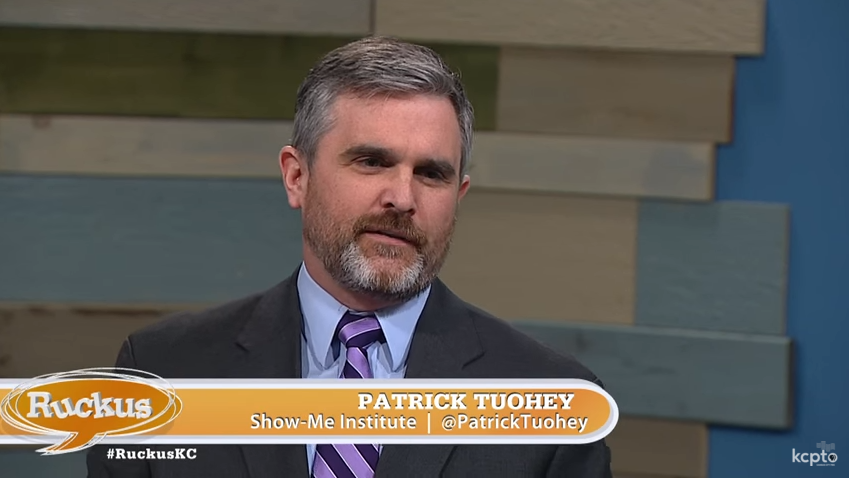
On a recent broadcast of KCPT’s Ruckus, former KC Chamber of Commerce head Jim Heeter said [starts at 11:02],

Greater Kansas City is on a roll—almost a week doesn’t go by when we’re not on a top ten list of one kind or another. Where we always lag is in creation of jobs and economic growth; we always lag our peer group cities.

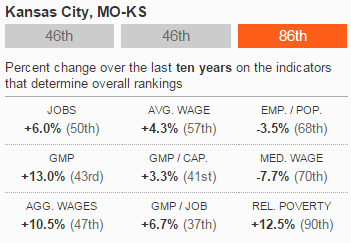
Not only is Kansas City lagging our peers overall, but city policy is seriously failing to help those who need it the most. According to the left-leaning Brookings Institution, while Kansas City is having middling success at growing the economy and building wealth relative to other metropolitan areas, it is performing poorly at spreading it around. Over the past ten years, Brookings ranked Kansas City 46th out of 100 at growth and prosperity. Yet we’re down by the bottom for inclusion—a combination of employment, median wage, and relative poverty.

In the chart below, Brookings calculates that over the past ten years the Kansas City region has seen a decrease in the median wage of 7.7%, an increase of 12.5% in relative poverty, and a regional decrease in employment by 3.5%. Despite claims about caring for every neighborhood and every socioeconomic level, civic leaders have failed to deliver to those in the most need.

Supporters of the status quo may like to gather like latter-day Gatsbys and tell us how swimmingly everything is going in Kansas City while they lay out their ambitious plans for the future. They direct us to all the shiny new things they’re building downtown with taxpayer dollars. But it’s worth remembering that far too many people are being left out of the party.

Even after Departure, Saint Louis’s Deal with Rams Gets Worse

Over the last couple of years, and especially in recent months, Saint Louis residents have gotten to know just how bad a deal regional leaders made to get the Rams to move to Saint Louis. The Rams got their moving expenses paid for, a brand-new stadium to play in, and a clause that said they could cut their lease short if Saint Louis did not spend a lot more in the future. There’s a reason the deal was described as the “worst lease ever.” When the Rams decided to use their escape clause and leave for Los Angeles, locals could be forgiven for thinking that, if nothing else, the city was at least done getting fleeced by Rams.

Sadly, the humiliation is not over yet. The St. Louis Regional Convention and Sports Complex Authority (RSA), the public authority that handled the leasing of the Edward Jones Dome, also owns the Ram’s former practice facilities in Earth City. They leased those facilities to the team for $25,000 a year. While it’s tempting, this blog will not discuss why the Rams were allowed to pay rent equivalent to that of a two-bedroom apartment for a complex valued at $19 million. Because that’s not the worst part. Apparently, the RSA signed a deal with the Rams giving them an option to buy this complex (again, valued at $19 million) for one dollar in 2024.

The RSA does not believe that the deal with Rams holds following the team’s departure. The authority is looking to sell the land to help cover the costs of the failed bid to keep the Rams. The dispute will now go to court, and residents can hope for a favorable outcome. But whichever way a judge rules, Saint Louis residents should be wary of the pitfalls of government deal-making.  

Support Us

The work of the Show-Me Institute would not be possible without the generous support of people who are inspired by the vision of liberty and free enterprise. We hope you will join our efforts and become a Show-Me Institute sponsor.

Donate
Man on Horse Charging