#Dropthesuit, Explained

If you follow the key players in the Saint Louis Charter School community on social media, you’ve probably seen the hashtag #dropthesuit recently. It refers to a recent action by the Saint Louis Public Schools, who are suing to get $42 million they believe was given erroneously to charter schools as part of the city’s desegregation plan.  Depending on the outcome, this case could financially cripple the city’s charter schools and jeopardize the education of the more than 10,000 students who attend them.

It is vitally important that our community know the facts of the case, because there’s more here than meets the eye.

Beginning at the beginning

Courts first heard the issue of school segregation in St. Louis in 1972. That year, Minnie Liddell, a parent in the Saint Louis Public Schools, and a group of 4 other parents filed a complaint in U.S. District Court arguing that the policies of the school district and the State of Missouri were promoting segregation in Saint Louis. The case was complicated and difficult, because segregation in the region involved much more than just school policy. Housing policy, history, and the free choices of individuals all contributed to the problem.

In 1983, after several iterations of the original lawsuit (you can see the whole timeline here), and under the gun of a court-mandated consolidation of the city and county school districts, the St. Louis Public Schools entered into a voluntary transfer program with the 23 districts in St. Louis County. At the same time, investments were made to create magnet schools, offer kindergarten, and make other improvements within St. Louis. The hope was that the magnets would bring white students in from the county, and black students who attended overwhelmingly black schools would be free to go to schools in the county.

While the program satisfied the demands of the courts, the crux of the plan was its cost.  Because the courts found the state at fault for the segregated conditions of schools, the state initially had to pay the lion’s share of the program. By the mid to late-1990s, the state argued that it had done what was asked of it and should therefore be released from its obligation to pay for the desegregation efforts.  The compromise that resulted is central to today’s lawsuit.

In 1999, voters in St. Louis City agreed to a dedicated two-thirds-cent sales tax to fund the desegregation program. The voluntary transfer program became a standalone entity, financed by this new tax, and still exists today. According to its website, this year about 4,500 students will transfer out of the city and into the county and 140 students will transfer from the county into city schools (charter and district). The rest of the money went to provide quality options within the city, both to attract white students and to provide minority students who remained as good an education as possible.

Starting in 2006, when charter schools became their own local education agencies, a portion of those funds started being sent to them directly (previously, the money had to funnel through the district). And therein lies the rub. The district thinks that only it should receive the money. The state says charters, which operate within the boundaries of the district as open-enrollment public schools, should get it as well. As the Post-Dispatch reports, the St. Louis Public Schools want the $42 million charters have received returned to them, and want the $8.8 million that is supposed to go to charter schools this school year to be remitted to the school district as well.

Should charter schools receive desegregation funds?

The purpose of the various desegregation lawsuits in St. Louis is clear. First, they were intended to provide an opportunity for black students to get out of the segregated schools in St. Louis City. Second, they wanted to promote schools that would attract white students from the suburbs to help integrate the schools. Finally, they worked to create quality school options for all students, regardless of race, in St. Louis.

With respect to interdistrict transfers, charters have little bearing on the first goal of these lawsuits. Most charter schools participate in the Voluntary Interdistrict Choice Corporation (VICC), but because such a small number of county students want to go into the city, they play a small role in it. Charter schools do not adversely affect the students who want to leave.

Charter Schools do affect the second goal. As my colleague James Shuls pointed out last week, charter schools attract white students to the school district. In fact, they have been singularly responsible for increasing white enrollment, helping integrate the schools.

Charter schools affect the third goal as well, by providing quality education options for students within St. Louis. According to the Department of Elementary and Secondary Education, City Garden Montessori, Northside Community School, and the St. Louis Language Immersion schools all earned at least 90% of the possible points in the state’s Annual Performance Rating. That places them in the top echelon of schools in the state and well exceeds the citywide average 76.1%. The three St. Louis Language Immersion Schools provide instruction in French, Spanish, and Chinese. These are the very types of diverse, quality options the desegregation money was levied to provide.

Now, I imagine there are numerous legal technicalities buried in the various motions related to this case, but the plain Jane, average-citizen understanding of the issues couldn’t be clearer. Charter schools help the city’s desegregation efforts. If those dollars are being levied to aid in desegregation, charter schools should have access to them.

What’s up with the timing? Didn’t charter folks just come out for the District’s property tax increase?

Why, yes. Yes they did. And that is what makes this very interesting.

If there is some kind of violation here, it has been happening since 2006. According to the Post-Dispatch article, concerns were first raised in 2008. Why is the lawsuit being filed now?

Well, on April 5 (a Tuesday) the district won its first property tax levy in 25 years. Charter school supporters backed the increase, as they are slated to get about a third of the money that it raises (because charters educate about a third of St. Louis’ public school students). The following Monday, April 11, the District filed the lawsuit. Was it just happenstance that the lawsuit wasn’t filed until after the property tax levy vote?

What will the impact of this lawsuit be?

This is the $42 million question. On one level, the increased revenue from the property tax vote is slated to provide about the same amount of money to charter schools on an annual basis that they would lose should they lose the lawsuit. If they lose, the best case scenario for charter schools would be for the state to pay the $42 million.  While the district would be able to have its cake and eat it too (with both a property tax increase and a huge windfall of desegregation money) the charter schools would be in about the same financial position as they are today.  That position is tenuous, however, as charter schools are funded at a level significantly below that of traditional public schools.

There is also a second, much more troubling scenario. Under the wording of the lawsuit, the plaintiffs are asking the state for the money that was allegedly improperly paid to charter schools. According to the Missouri Charter Public School Alliance, though, the State of Missouri could require schools to pay back the money the state gave them. I am not one for hyperbole, but this could very well end charter schooling in St. Louis. None of the schools has the money to pay back 10 years’ worth of desegregation payments.

Either way, losing this funding stream would harm charter schools and limit the kinds of programming they would be able to offer to students in Saint Louis.

Summing it all up

This lawsuit would hurt charter schools in Saint Louis, many of which are getting great results and providing a high-quality education for city children of all races. The average citizen may see the Saint Louis Public Schools attempting to claim money they believe they are entitled to, but to a more cynical observer this might look like an attempt to stifle competition at the expense of students. Providing a quality education in Saint Louis is the expressed purpose of the two-thirds-cent sales tax, and so long as charter schools are playing their part, they should have the city’s support. This suit is misguided, and my only hope is that when it is heard, the judge dismisses it on the spot.


House Passes Medicaid Audit Bill

Before it died amidst last year's Right to Work filibuster in the Senate, a bill requiring an independent audit of Medicaid's rolls appeared well on its way to passage. The legislation would have required that a third-party vendor be used to cross-reference residency, income, and other data about the state's Medicaid enrollees to ensure that those in program were, in fact, qualified for it. The concern here is that as the cost of Medicaid skyrockets in the state, other state spending priorities will be pushed aside. 

High among those jeopardized priorities: state benefits for some of Medicaid's very neediest beneficiaries. This video from the Foundation for Government Accountability provides an example from cash-strapped Illinois.

The good news is that this year both the House and Senate have passed legislation to implement these regular audits. Barring any legislative hiccups in the final mile, this could be good news for taxpayers, currently qualified Medicaid beneficiaries, and other state priorities. Stay tuned.

Leaving a Trillion Dollars on the Table

In recent years, Missouri’s economic growth has been anemic. While nationwide states have averaged 2.0% growth in GDP since 2009, Missouri has only averaged 0.7%.  Many forces affect economic growth, but a fascinating new article by Eric Hanushek, Jens Ruhose, and Ludger Woessmann shows just how large of a role education plays in the equation. What’s more, it shows the potential economic gains from improving Missouri’s education system.

Missouri currently sits near the middle of state rankings of educational achievement. According to Hanushek and colleagues, if Missouri improved its level of educational achievement to that of Minnesota, the top performing state, it would generate $1.065 trillion dollars in state GDP over the average life of a child born today. Yes, you read that right: Trillion with a “t.”

A key paragraph:

“The results of this exercise again suggest the importance of knowledge capital for state economic prosperity. We find that differences in achievement and attainment account for 20 to 35 percent of the current variation in per-capita GDP among states, with average years of schooling and achievement levels making roughly even contributions. In a sense, this estimate is surprisingly large, because both labor and capital are free to move across states—and thus tend to equalize rewards to workers with different skills. But our results are quite consistent with those obtained from similar analyses of the role of student-achievement levels in explaining differences in economic performance across countries (see “Education and Economic Growth,” research, Spring 2008).”

Missouri has serious fiscal crises looming on the horizon. Our pension systems are underfunded.  Our age-dependency ratio (the ratio of those who pay into our social services to those who receive them) is slated to grow from 61% in 2010 to 77% by 2030. If we don’t grow our economy, we are going to be forced to make some difficult and unpleasant financial choices. 

Improving our education system offers a way out. Rather than raising taxes or taking part in economic development shell games, we can actually help people become more productive and create more real, lasting wealth. And, if the authors of this article are right, our education system can be the engine of that economic growth.

If you’re interested in how we can improve Missouri’s schools, check out the education section of our 20 for 2020 document.

Film Tax Credits: The Campy-est Zombie Movie You Ever Did See

Are you a fan of director George Romero's Living Dead work? Then let me pitch you a movie.

The scene: Jefferson City, at the state capitol. Government officials want to give taxpayer money to wealthy business interests so that they'll produce movies in the Show-Me state, even though they know it's a waste of funds. And then there's the twist! Imagine that this proposal kept dying, and then kept coming back year after year after year

In other words, it's a zombie movie.

Scary, right? Well…

Missouri's film tax incentive program expired in 2013, but there are signs that film tax credits are coming back to life in the Show Me State. . . . HB 1645 has been introduced which would reinstate the film tax incentive program in Missouri. Under the bill, companies could get a credit of 20 percent for qualifying expenses, both in and out of the state. They would be able to get an additional 5 percent credit if at least 50 percent of the project were filmed in Missouri.

Our stance on economic development tax credits is pretty well-known; we would rather have market forces decide what a good investment is rather than have the government act as a sugar daddy for special interests. That rule of thumb for tax credits generally holds true for film tax credits, as well. Instead of paying for goodies for George Clooney, government should focus on, well, governing. Maintaining infrastructure. Protecting the public. Providing a stable and low-tax climate.

Also, not producing movies. Did I mention government shouldn't be producing movies? Good.

I appreciate that getting into the movie business sounds fun, but if Missouri policymakers want to act like directors, they should do it with their own money, not yours. Film tax credits are wasteful, and rather than be resurrected, they should stay dead in Missouri. Taxpayers don't need another terrible remake of this bad policy.


Kansas City’s Tech Inertia

In the State of the City speech in late March, Mayor Sly James outlined his vision for an innovation economy and boasted of the region’s “tech momentum,”

This new notoriety (from Google Fiber) and all the press and tweets that went with it gave us a new way to tell the Kansas City story, Tech entrepreneurs discovered that Kansas City was a great place to start up. They moved here just to plug in to Google Fiber and gigabit connectivity.

Well, maybe not. Google Fiber came to the Kansas City area in 2011, the same year Mayor James took office. Prior to that, information jobs in the region, according to the U.S. Census, had been sliding downward. The number of these jobs slipped from 52,000 in 2008 to 39,000 in 2011, a loss of one-quarter. Since then, the numbers through 2013 are pretty flat.

We don’t need to rely solely on Census data. The Show-Me Institute’s Joe Miller recently reviewed a study by the San Diego Economic Development Corporation that ranked cities based on the health of their tech scenes. Miller concluded that the tech industry in Saint Louis is “not a large player nationally, nor is it a terribly significant driver of,” the economy. The outlook for Kansas City is even worse. Of the country’s 50 largest metros, Kansas City ranked 34th, behind peer cities St. Louis (28th) and Oklahoma City (24th) but ahead of Louisville (39th).

Kansas City ranked even lower (42nd) for tech talent, a measure based on tech employee retention rates, percent of population with computer or math degrees, and the number of computer science degrees being awarded. The Mayor recognized as much in his remarks,

Our tech companies need more trained help—people who can manage the flow of information and data, write code, fix equipment and implement creative ideas. And lots of people in our city need jobs, or better-paying jobs to support their families.

While more recent Census data may show an uptick in information jobs and employers in the Kansas City region, for all the spending and talk of momentum and people moving to Kansas City “just to plug in,” the data suggest otherwise. 

Are Charter Schools Improving Integration in Saint Louis?

Saint Louis Public School district (SLPS) made news this week when it announced that it was suing the Missouri Board of Education for $42 million in desegregation sales tax money. Officials in the district believe this money was improperly given to public charter schools in Saint Louis. The district contends desegregation money is exclusively for the district and should not follow the student to the school of their choice.

Some history is important here.  The District was first sued for maintaining an illegally segregated school district in 1972. An initial settlement to that case was reached in 1983 and created a voluntary inter-district transfer program that allowed African-American students in the district to transfer to districts in the county and white students from the county to transfer into the city if they so chose. Desegregation efforts in the district were largely supported by state aid. This changed in 1999, when a desegregation sales tax was passed to replace state funding.  SLPS is suing over these tax dollars.

I am not a lawyer, so I cannot evaluate the claims made by SLPS officials.  I can, however, examine what has happened in terms of integration. Have charter schools helped or hurt efforts to desegregate public schools St. Louis?

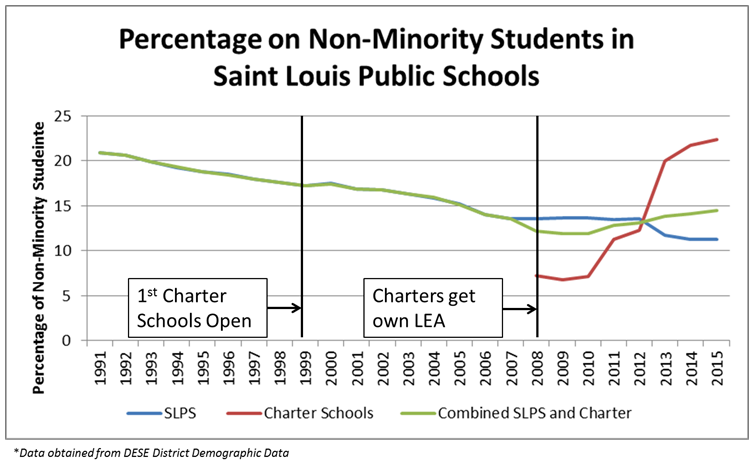
In 1991, 20.9 percent of all students in Saint Louis public schools were non-minority. That percentage has decreased steadily. In 1999, when the sales tax was passed, the first charter schools opened in Saint Louis. Charter schools are public schools and are financed by public dollars, but they are not operated by the district. In 2008, charter schools became their own local education agencies (LEAs). In essence, they became something like their own school districts at this point, though they are all located within the boundaries of the St. Louis Public School District and are open and free to all students in St. Louis.

Below, I highlight the percentage of non-minority students in Saint Louis public schools. The green line shows the percentage in all Saint Louis public schools, including public charter schools. The percentage was in decline for about 20 years, but has recently taken an upturn.   This upturn was caused by an increase in non-minority students in public charter schools.

Some might suggest that public charter schools are pulling white students away from the district because the district has continued to lose white students. The available data tracks district or school enrollment as a whole; without data on the individual student level, I cannot answer that question conclusively. We can see, however, that the large increase of non-minority students in charter schools far outpaces the decline of white students in the district post 2008. In other words, charter schools seem to be attracting white students who were not previously enrolled in the district.

The data here may not be able to answer the legal question regarding the desegregation sales tax, but they do suggest charter schools are actually helping, not hurting efforts to integrate public schools in the city of Saint Louis.


Shake-Up at KC Aviation Department

After first announcing that Kansas City’s Aviation Department Director Mark VanLoh was being “replaced,” The Kansas City Star reissued their story to say that he was retiring. This is surprising given that City officials may soon put before voters a billion-dollar proposal to build a new terminal. Suggesting that VanLoh was getting in the way of the plan, the story ended,

City officials have talked recently about trying to hold that election either in August or November of this year, and they said it was important to have airport leadership that the public trusts.

So in order to restore trust in the Aviation Department, city leaders have undertaken a nationwide search for a qualified and well-trusted airport administrator who will come in, clean house, and present to voters a new and more thoroughly considered airport plan. Right?

No. The Aviation Department will be led by Pat Klein, who, according to his LinkedIn page, has been a city employee for 20 years, but with no apparent experience leading an aviation department. According to that same Star piece, Klein will present to the Council and voters the same airport plan that VanLoh and Mayor James have been pushing.

If city leaders want to restore public trust in them and their policy proposals, they need to do more than merely swap out department heads.

Support Us

The work of the Show-Me Institute would not be possible without the generous support of people who are inspired by the vision of liberty and free enterprise. We hope you will join our efforts and become a Show-Me Institute sponsor.

Donate
Man on Horse Charging