The Crown Center Blight Expansion Is Bad Policy. Period.

The City Council of Kansas City just voted 10 to 1 to declare some asphalt parking lots and grass fields just south of Crown Center as blighted so that the area can qualify for public subsidies. Even the Kansas City Business Journal’s headline was skeptical of the effort, declaring, “Officials hold noses and declare $80M Crown Center development site blighted.”

Council members Quinton Lucas and Heather Hall voiced reservations. Hall found it “really hard for me to swallow that pill.” But she did. Lucas said the blight claim “sure doesn’t seem to pass the smell test of what blight is.” Yet he voted to support it. Only Councilwoman Alissia Canady voted against the measure.

The Journal concluded, “What we are hearing from staff is that once something is blighted, it’s always blighted…” Hall added. “That’s got to stop.”

Then stop it. All the hand-wringing and nose-holding in the world doesn’t matter if councilmembers continually vote yes.

Moving Forward on MCI

Given the significant opposition from the public and likely from members of the City Council, Kansas City Mayor Sly James has suspended his pursuit of a new terminal for 2016. This is welcome news on a proposal that the Show-Me Institute has criticized from the beginning.

Just days ago the Mayor was calling a new terminal inevitable, echoing a similar claim in 2012 from former City Councilman Ed Ford (who subsequently apologized for the comment). Indeed there may someday be changes proposed for MCI—changes welcomed by airlines and voters alike—but how do we get there from here?

The first thing Kansas City needs to do is jettison anything having to do with this new terminal process. Despite years of hearings, presentations, and public forums on the matter, a large swath of voters remains skeptical. Second, Kansas City needs a new Aviation Department director with experience running an airport, perhaps even building a new terminal, and most importantly who possesses integrity, a commitment to transparency, and a respect for the airlines and the people they serve. That search should be nationwide and should begin immediately.

Once installed, that person needs to assess MCI’s condition and capabilities. (One can only imagine the state of Terminal A right now.) Where MCI needs maintenance, it should get it. Where it needs rehabilitation, it should get it. And perhaps, if it needs a major structural overhaul, it should get that too. That will only come once the public trust has been restored. The city manager and Council have an opportunity to rebuild that trust with a new Aviation Department director.

Wyoming Joins the Direct Primary Care Party

Over the last couple years I’ve talked a lot about direct primary care (DPC), a doctor practice model that largely cuts insurance out of the patient care equation. By assigning clear prices to care rather than “coverage” and guaranteeing access to patients, DPC doctors offer a market-based reform to our health care system that benefits doctors and patients alike.

The good news is that such arrangements are arguably promoted under the Affordable Care Act; the bad news is that many states could try to regulate these practices as insurance providers when they’re clearly not. Missouri fixed that problem last year by protecting DPC medical retainer arrangements from such insurance regulation, and it appears it won’t be the last state implementing these reforms, either. Enter Wyoming, last month:

Wyoming Gov. Matt Mead (R) has signed into law Senate File 49, which will exempt direct primary care practices from state insurance code regulations….

Dr. Hal Scherz, founder of Docs4PatientCare, says Wyoming’s protection of direct primary care providers will help bring relief to a health care system that has grown unreasonably expensive for patients and physicians.

“We’ve got a huge problem here that’s brewing in our health care system, and what direct primary care does is a win-win for all—patients, doctors, the system itself,” said Scherz. 

Dr. Scherz is exactly right. Direct primary care offers patients and doctors the opportunity to establish stable care relationships without the burdens of insurance and with the transparency of clear pricing. Taken together, less insurance paperwork and more doctor competition means better prices for patients and the opportunity for American consumers to finally see the cost curve for health care bent downward.

Nationally, sixteen states have passed retainer agreement reforms like those passed in Missouri and Wyoming, so the movement still has a long way to go to clear the way for more robust DPC availability. That said, it’s a great start, and one that doctors, patients, and free marketeers can be excited about.

Our Lady of Hope, Indeed

For the first time in 80 years, the Diocese of Kansas City-St. Joseph is opening a new Catholic school in urban Kansas City. According to the Star, around 200 students will enroll next school year and the school hopes to eventually increase enrollment to 625.  It will be known as Our Lady of Hope.

The school will occupy the building at 201 E. Armour, which was formerly used by the Derrick Thomas Academy Charter School. It will also house students from Our Lady of the Angels and Our Lady of Guadalupe, both of which are closing at the end of this year as part of a strategic restructuring.

I am incredibly excited to see the Diocese making strategic efforts to provide quality education to inner-city Kansas City students. But if I allow one shred of pessimism to enter my mind, I’m reminded of all of the great city Catholic schools that have closed over the years.  I’m confronted with the reality that the fight for school choice gets harder and harder as good private school options disappear. Voucher programs across the country have relied, at least at their beginning, on filling empty seats in existing schools. Only after they get that foothold have they been able to spur the creation of new schools.

The story of Our Lady of Hope should give us a greater sense of urgency. If there are no schools for students to attend, it won’t matter if the state passes a voucher program. School choice programs, and the tens of thousands of students they would benefit, need our fervent support now.

From a Kansas City Charter School to the Ivy League

For the first time in its history, University Academy (UA), a charter school in Kansas City, had a student accepted into an Ivy League school. The student’s name is Jazmyne Smith, and she will be attending the University of Pennsylvania.

As exciting and heartwarming as that is, the story of who helped her makes it even better. As KCUR reports, University Academy’s guidance counselor, Josh Burdette, had never helped a student get into an Ivy League school before. When he realized he had a student who had a good chance of being accepted, he reached out to David Burke. David is the guidance counselor at Pembroke Hill, one of the city’s most elite private schools, and he jumped at the chance to help. He guided Josh through the process of creating a compelling school profile to give to universities and even set up meetings with contacts at Ivy League schools and other prestigious colleges around the country.  University Academy has already reaped the benefits.

Schools have different ways of doing things, and that’s fine. The relationship that Pembroke Hill and UA have created shows that schools of all shapes and sizes can work together to help students.

What can we learn from all this? Cooperation and shared goals can help our students succeed. Because of Jazmyne’s hard work, Josh’s willingness to look outside his own school for help, and David’s willingness to lend his expertise, doors are being opened to UA students that seemed closed not long ago. The school is looking toward bigger and better things for their students—we won’t be surprised to see more UA graduates accepted into Ivy League schools in the future.

How Much Do Saint Louis Area Schools Really Spend?

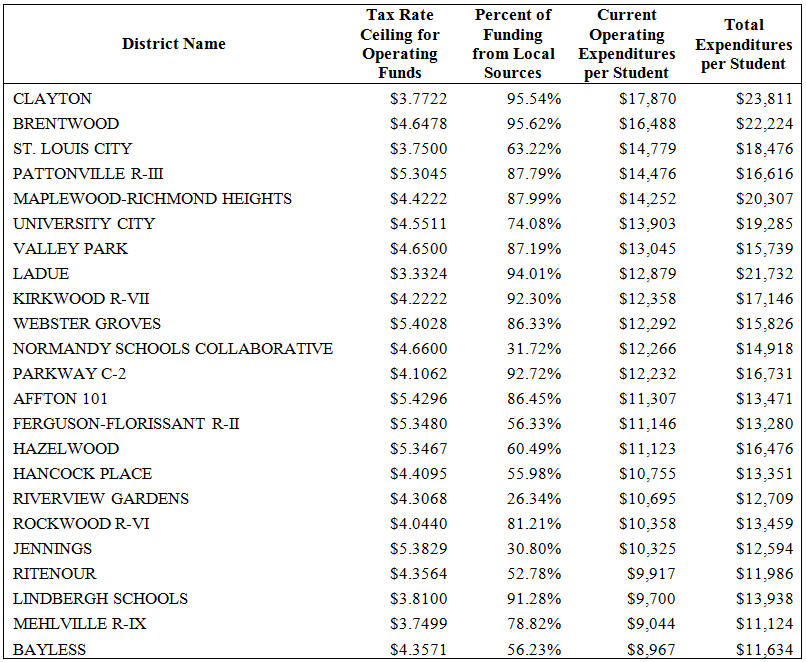
If you’ve been listening to Saint Louis Public Radio’s coverage of school finance in the region, you might have some serious questions about how we fund our schools. I’m going to go ahead and answer two of them: No, the Saint Louis Public School District does not spend only $9,826 per pupil; and no, there is not a “$15,000 gap in spending between the highest and lowest spending districts in the Saint Louis area.”

According to data from the Department of Elementary and Secondary Education (DESE), the Saint Louis Public School District spent $14,779 per pupil in 2015 in operating expenses and $18,476 per pupil when you include the cost of debt and capital projects. The table below (which uses DESE numbers) gathers the spending figures for all of the districts in the region. It shows that in real dollars the gap between the highest and lowest spending districts in the Saint Louis area was less than $9,000.

So how did Saint Louis Public Radio get such different numbers? It’s difficult to say. They state that their

analysis uses a cost of living index to calculate to calculate a national per student spending of almost $12,000 in 2013. The analysis applies that same formula to measure what individual districts are spending in relative dollars.

While adjustments like these could be helpful, especially if they have to account for differences in cost of living, it is important to realize just that—these figures are adjusted.

Unfortunately, this isn’t clear to the average reader. For example, St. Louis Public Radio states:

There are some obvious high points, the Clayton School District is [sic] spent $19,681 per student, according the analysis. That’s compared to Clayton’s neighbor, St. Louis Public Schools, which spent $9,826 per student.

The publication could have easily tacked on, “in cost-adjusted dollars” to the end of the last sentence. More importantly, they also could have explained how they adjusted the spending numbers, figures that vary so wildly from those reported by DESE deserves some serious scrutiny. As it is, readers and listeners have no way of evaluating for themselves the methods that were used to adjust the spending numbers.

We can and should have productive dialogue about school spending and inequities in education. But we can’t have fruitful conversations without a mutual understanding of the statistics that are being used.


Support Us

The work of the Show-Me Institute would not be possible without the generous support of people who are inspired by the vision of liberty and free enterprise. We hope you will join our efforts and become a Show-Me Institute sponsor.

Donate
Man on Horse Charging