MCI Is the Envy of its Peers

The effort to issue $1.25 billion in debt to tear down and rebuild Kansas City International Airport (MCI) is on hold, but it will be back eventually. As Americans take to the air for summer vacations, it’s worth considering all the things that make MCI such a great airport.

In fairness, my colleague Joe Miller recently wrote that there are some reasons why a city might rightfully consider building a new terminal. The cost of current maintenance may be more expensive than a modern replacement, or a new terminal may be needed to accommodate increased traffic. Neither of those apply to MCI. While our traffic is up moderately, no one is arguing that we need to build for increased capacity. In fact, the new terminal proposal from the Aviation Department would reduce the number of gates we have now.

No one is arguing that the costs of maintaining the current MCI are prohibitive, either. Supporters of a new terminal seem to have strictly cosmetic concerns.

As for doing what we want airports to do, MCI is serving admirably. Consider the recent developments.

In January, the Star catalogued some of MCI’s gains, including that annual traffic has grown each year since 2012 with the terminal we have now. Supporters of a rebuild point to possible (but by no means certain) increases in traffic as a result of a new terminal. But as Miller concluded in 2014:

To sum it up, the airlines (and common sense) say that building an expensive new terminal will not increase demand for air travel. Quite the contrary, the higher costs to airlines and passengers may mean fewer flights. Even if we agree with business leaders that MCI requires more amenities, certainly there is a cheaper way of providing these than a $1.2 billion new terminal plan. The cost is so much greater than the supposed benefits that the plan looks more like a vanity project than a sound investment.

In short, Kansas City’s airport is doing well. It has won high marks for its convenience; we’re unlikely to suffer the long waits seen at other airports because MCI does not use the TSA for security. Importantly, airlines seem eager to come and expand their service (despite their claims to the contrary). It is unlikely that Kansas City could improve on this. In fact, in taking on mountains of debt we risk losing the competitive advantage that many of us now take for granted. 

Films Can-and Do-Get Produced without Government Handouts

Unless you're an avid fan of independent films, you may not have heard about the premier of a movie titled Trust Fund. It was filmed and produced in Kansas City.

The romantic drama grossed about $37,000 over five weeks, which in the realm of independent filmmaking is a pretty good showing. Sure, it wasn't a multi-million dollar box-office hit, but it’s not every day that a movie produced by local filmmakers is good enough to be picked up by anyone, let alone given several weeks of screen time.

But the best part for taxpayers? The movie was filmed and produced without any kind of film tax incentive. It's sad that it has to be said, but filmmaking can, and should, happen without government money.

That fact may be lost on some local and state officials in Missouri.

The state’s own film tax credit program has been gone for a couple years—it expired in November, 2013—but like the creatures in a bad zombie movie, forms of it keep getting resurrected. As I've written before, the last successful attempt was in the form of a film incentive directly underwritten by Kansas City, passed earlier this year. And just this past legislative session, state legislators tried to get in on the act with HB 1645, which would raise the now-dead state film tax credit from the policy graveyard. Although it wasn’t passed this session, there is little doubt that it will reappear in next years’ term.

We have written many times before that film tax credits simply don’t work. Just last week, Tennessee taxpayers learned this lesson when ABC’s “Nashville” was unceremoniously canceled despite having received a taxpayer-funded subsidy to the tune of $45 million dollars.

Instead of relying on taxpayer funds, Missouri should let the opportunity to film in the many architecturally, historically, and scenery-rich cities across the state be the state's contribution to the film industry.

If Missouri officials want to be trusted with taxpayer funds, they should focus on better and smarter investments: promoting a low-tax culture, maintaining state and local infrastructure, and building up strong schools. Anything else is just a costly and misguided illusion that states can successfully play the role of movie producer.

Teacher Shortage Data from DESE Makes Great Case for Course Access Program

Yesterday, the state board of education saw a presentation from representatives from the Department of Elementary and Secondary education on efforts to ensure that every student in the state has access to a high-quality teacher.  It detailed efforts afoot to recruit teachers from within districts, to prepare teachers to serve across the state, and to create “equity labs” around the state to brainstorm solutions.

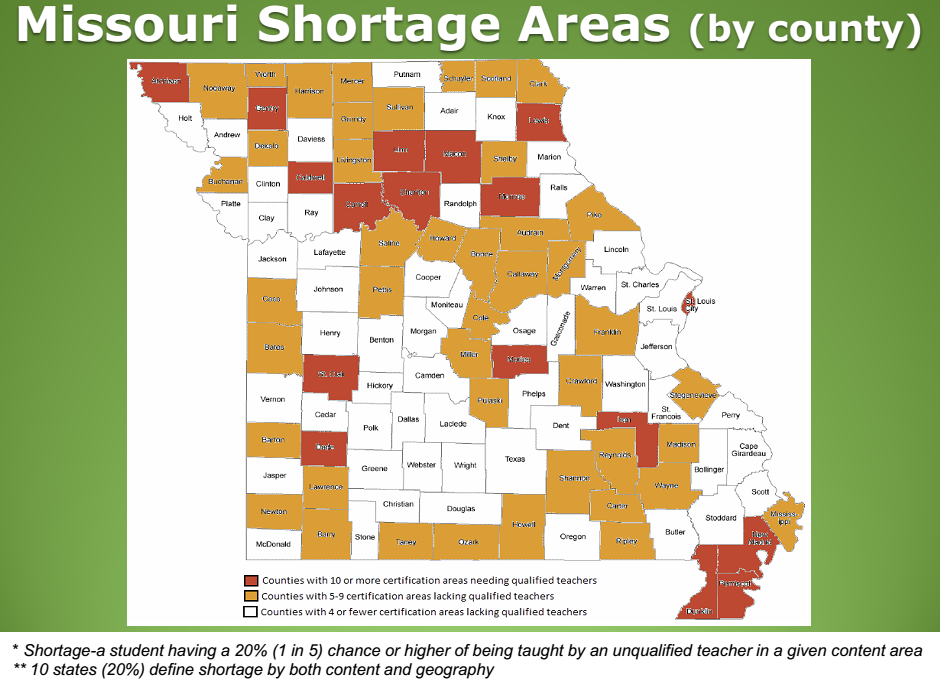
Two slides in the presentation jumped out at me. The first one is above.

Dovetailing nicely with the research I have done on rural schools in Missouri, DESE’s slide shows there are shortages in more than 10 teacher certification categories in 16 counties across the state, and shortages in 43 counties in 5 to 9 categories.

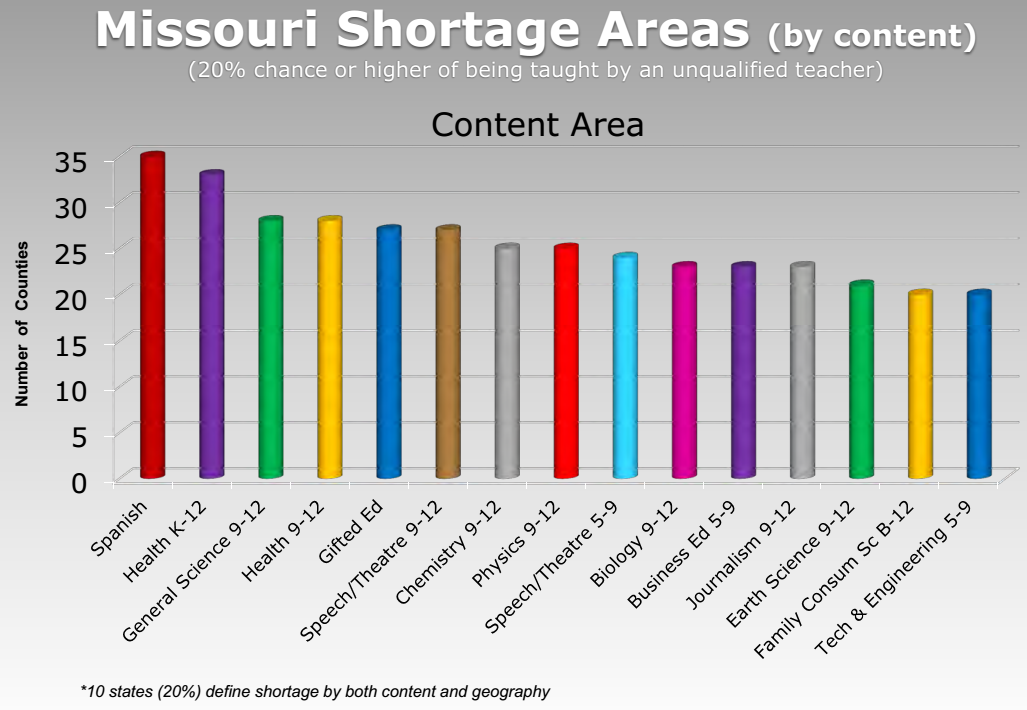
What are these categories, you ask? The next slide tells us.

Want to learn Spanish? Are you a gifted student? Interested in learning science? Live in one of these rural counties? Tough luck.

I commend the efforts that the state is taking to try and tackle this problem, but here at SMI we’ve been promoting a solution for quite some time now that would address these shortage issues—a course access program.

MOVIP has already certified courses in these subject areas. (Check out the list for just grades 6 to 8—its huge!) For $600 a year, students in these counties could take Spanish from a vetted source and get credit for it. All they need is the flexibility to reroute 600 of the dollars that the state sends their district to these alternative providers. Course access would do that. More than a dozen states around the country have figured this out.

The state’s current efforts, while laudable, seem to constitute a complicated and labor-intensive process with a high amount of uncertainty as to whether or not they will be effective. Every once in a while the simpler solution is the best one, and I think in this case Occam’s razor favors course access. If the state wants to solve these shortage issues, the state should seriously look into it.

Kansas City’s Food Desert Folly

We’ve already written in this blog that the evidence that new grocery stores affect consumer fruit and vegetable consumption is sparse if it exists at all. Even NPR and the Kansas City Star voiced skepticism of the impact of such subsidies.

In Kansas City, it’s full steam ahead for a bad idea that is getting worse. A year ago the Star reported on the city’s plan to redevelop the Linwood Shopping Center near 31st Street and Prospect Avenue. The new development is to include a Sun Fresh Market and was originally expected to cost the city just over $11 million. Last week the Star reported the project would cost $15 million. That’s more than a 35% increase in the cost of redevelopment over one year for a project that hasn’t even started and that few really think will do a bit of good.  And recall that this is all to build a grocery store in a place where the previous grocery store failed for lack of business!

Wait—its gets worse. Not only are costs ballooning, but The Business Journal reports that the funds generated by the TIF won’t come close to covering the expense of redeveloping the store. Rob Roberts reported that the $14.9 million bond will be repaid by a TIF only expected to generate $8.5 million over 23 years.

Where will the rest of the money come from? The city employees Roberts interviewed suggested that the city could just request a super TIF to redirect more taxes from the project to the bond payments. But that’s a false distinction; either way, the money to cover the loss is coming from city coffers.

In short, it appears that city leaders are planning to lose money investing in an already-failed venture in order to pursue a policy that has no evidence backing its effectiveness. 

The Saint Louis Convention Center: How Critical is it?

Just how much is the Saint Louis Convention Center costing Saint Louis, and what benefits would planned upgrades bring? These aren’t easy questions to answer, and even the Post-Dispatch published a semi-skeptical article examining them. Supporters of the Saint Louis’s Convention Center (the America’s Center) quickly struck back, releasing a statement on its importance. They argue that without a competitive center, Saint Louis would lose conventions and the money attendees bring to the local economy. Unfortunately, on close inspection their arguments don’t hold much water.

An important and rarely addressed point is that a city does not need to have a giant, publicly funded convention center with a dome in order to hold conventions. In fact, many (if not most) conventions are held at private hotels. For instance, the Chase Park Plaza Hotel (located in Saint Louis’s Central West End neighborhood) has rooms that can host conventions and conferences. Some of its spaces can handle up to 2,500 people. Other hotels in the area offer to host conferences and small conventions as well.

For very large groups (with tens of thousands of visitors), a space like the America’s Center is necessary. The only problem is that Saint Louis does not attract many of those events, despite abundant available space. For instance, in 2014 the Saint Louis Convention and Visitors Commission (CVC) hosted 393 events for a total of 425,411 room nights. However, only 14 of those events had more than 2,000 attendees, meaning that about 96% of all events held by the CVC in 2014 could have fit comfortably in hotel spaces. Those small events also account for most of the room nights and attendees that supposedly prop up the downtown economy. Of course, if the Saint Louis government wasn't able and willing to rent extensive convention space at unprofitable rates, groups of various sizes might well be discouraged from holding their events in the city. But on the other hand, without its convention center spending, St. Louis City could afford to cut its hotel taxes in half, remove part of its restaurant tax, and retire much of its civic debt.

The bottom line is that while it is easy to claim that conventions contribute to the local economy (although not as much as supporters might have us believe), that’s not the same thing as saying that publicly funding a massive convention center designed to handle tens of thousands of visitors (and a dome that can seat many more) is of significant benefit to the local economy. And that is even further from proving that the next big upgrade will finally draw the big conventions that are currently bypassing Saint Louis.

St Louis Rolls Out Mow to Own Program

St. Louis Mayor Francis Slay recently announced a “Mow to Own” program to help the city rid itself of vacant land held by the Land Reutilization Authority's (LRA). The program, similar to programs in Baton Rouge, Memphis and Columbus,

allows City residents to take immediate ownership of LRA-owned parcels adjacent to their property for just $125 if the resident agrees to continually maintain the lot. The City will give away the land itself for free. The $125 covers the title transfer and lien, should the new owner fail to maintain his/her new property. After 24 months of regular maintenance, the lien will be lifted and the property granted free and clear to the new owner.

The city has no interest in paying to maintain these lots. Why not do whatever it takes to get them off the books and into private hands? This effort is similar to the Kansas City’s Land Bank Side Lot Program, where resident landowners may purchase adjacent vacant lots from the city for prices ranging from as little as $1 for lots under 2,500 square feet, to $.08 per square foot for lots between 6,000 and 6,500 square feet. The program has had some success. The city sold 50 side lots in 2014, 63 in 2015, and 9 so far in 2016.

The comparative strengths of the KC program, according to the Land Bank’s executive director, Ted Anderson, are that it does not require the program management of Mow to Own, and that liability insurance is less of an issue for the city because the buyers own the land outright. Furthermore, selling the land outright means there is less need to oversee the diligence of dozens of different people mowing city land.

The incentive to buy city land will still be affected by the distortionary effect taxes have on behavior. I know of one landowner in Kansas City whose office building, due to street layout, abuts a sizeable greenspace that is otherwise inaccessible. He maintains the space by cutting the grass. He’s aware of the Side Lot program, but he has no interest in assuming the additional property tax, especially when he currently has the option of enjoying the green space without being taxed on it. Saint Louis should expect to see cases like this on occasion, but to the extent that the Mow to Own program can relieve the city of unproductive property, it will be a step in the right direction. 

Did the Missouri Senate Sacrifice the Rights of Minorities for Union Executives?

The legislature failed to override the Governor’s veto of paycheck protection. The bill will not become law. The override came down to just one vote. As the Kansas City Star reported, this senator:

kicked off debate Thursday with a speech listing off a “litany of issues with unions,” including several run-ins that … involved racist comments by union members.

The senator promised to continue supporting “rank and file” union members, but added that “labor unions can’t expect carte blanche support anymore.”

The senator has a point here. The interests of the African American community and union leaders are not always aligned, and the rights of minorities are sometimes sacrificed for the good of the politically stronger labor movement.

Ironically, labor reforms such as paycheck protection are about protecting the rights of a minority from the will of a majority. Paycheck protection allows a worker to opt out of the campaign contributions and expenditures of a government labor union. Paycheck protection recognizes the fact that not everyone has the same political views as their union and that this difference of opinion should be respected.

The other labor reforms we’ve discussed, transparency and union elections, are also aimed at protecting a minority from the majority. Financial transparency would allow workers and taxpayers to see how government unions spend taxpayer-funded union dues. Union elections would give workers the chance to de-unionize their workplace every few years. All of these reforms make unions more responsive to all of their constituents, not just the majority. And all of these reforms lead to greater worker freedom.

The next time our elected officials want to take a stand on protecting minority rights, they might consider endorsing public policies that actually protect minority rights.

Support Us

The work of the Show-Me Institute would not be possible without the generous support of people who are inspired by the vision of liberty and free enterprise. We hope you will join our efforts and become a Show-Me Institute sponsor.

Donate
Man on Horse Charging