Kansas City Plans for Autonomous Buses

According to Startland, “Kansas City’s Home for Innovation News,” city leaders proposed a few ideas they would pursue if they received a $50 million transportation award from the federal government. One of them, interestingly, is an autonomous shuttle to the airport.

We at the Show-Me Institute have been writing about the great potential of driverless cars for years, writing about their potential as the future of transit. We’ve also been critical of the city’s oversized spending on the streetcar, exactly because it is the opposite of the future of transit. As if to underscore that point, Startland writes of the city’s plan,

An autonomous shuttle system would be deployed along 11th, 12th and 18th streets, according to the plan. The shuttle system will connect the current 2.2-mile streetcar line and the downtown smart city project to the 18th and Vine Jazz District and the West Side community.

“The 20-mile corridor from KCI Airport to the downtown area will serve as a highway test corridor for connected and semi-autonomous vehicles in addition to connecting passenger terminals at KCI to the downtown area, and provide state-of-the-art transportation to visitors and residents,” the plan reads.

How ridiculous is this? New, state-of-the-art autonomous shuttles are going to pick people up from a 2.2-mile fixed-rail streetcar line and take them around town and to the airport. How much cheaper would it be to scrap the streetcar altogether and have those same autonomous buses run that same 2.2 mile streetcar route themselves?

Our fear is that Kansas City really isn’t serious about planning for its long-term transportation needs, but prefers instead to hop aboard the latest trend in an attempt to secure federal dollars. Streetcars just aren’t a forward-looking transit solution. By planning for autonomous buses, are city leaders admitting as much?

Light Rail a Losing Proposition for Saint Louis

As the Post-Dispatch recently reported, Mayor Slay is starting to throw his weight behind a long-awaited expansion of the MetroLink, Saint Louis’s light rail system. The expansion plan, dubbed the North–South line, would operate on a north–south axis from North Saint Louis County, through downtown, and into South Saint Louis County. The push for light rail expansion in Saint Louis began directly after the last expansion was completed in 2006, and the region is currently conducting multi-million dollar studies on how to construct such a project. But with project costs likely to be anywhere between one to two billion dollars, is more light rail worth it in Saint Louis?

Assuming other types of public transportation service (such as buses) are unaffected, the addition of a North–South MetroLink line could increase the speed and quantity of public transportation in the Saint Louis region.  Light rail is generally much faster than standard buses, so more rail can mean faster transit and more riders. However, light rail is not the only way to improve public transportation, and Saint Louis needs to consider light rail as just one option among many, perhaps not the most prudent one.

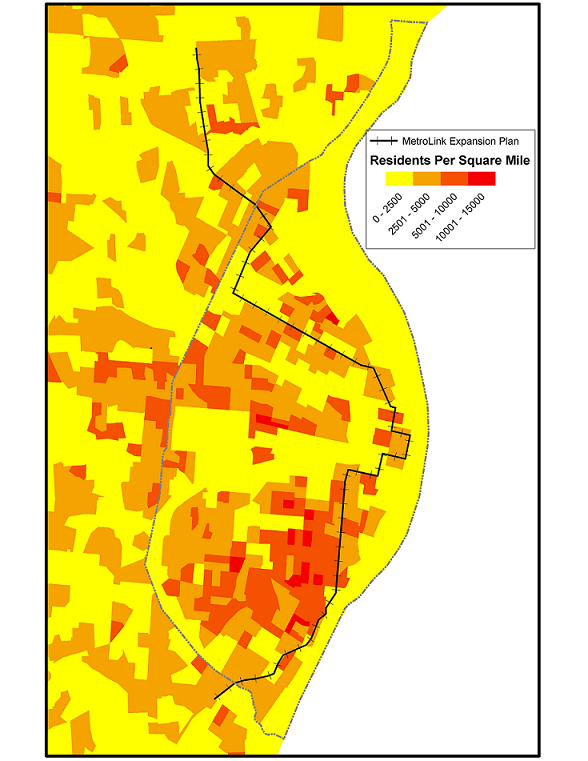
As we’ve discussed many times before, Saint Louis is a dispersed region, both in terms of where people work and where they live. Most residents live and work outside of Saint Louis City, and more people commute into Saint Louis County than Saint Louis City for work. The area in the region with the most employees and the highest payroll is not downtown, but West County. Nevertheless, the North–South MetroLink plan would route riders in and out of downtown Saint Louis, as if the year were 1904. In terms of population density, most of Saint Louis City (and nearly the entire planned route of North-South MetroLink) has less than 5,000 residents per square mile. Cost-effective light rail systems generally have population densities nearing 20,000 people per square mile around stops.

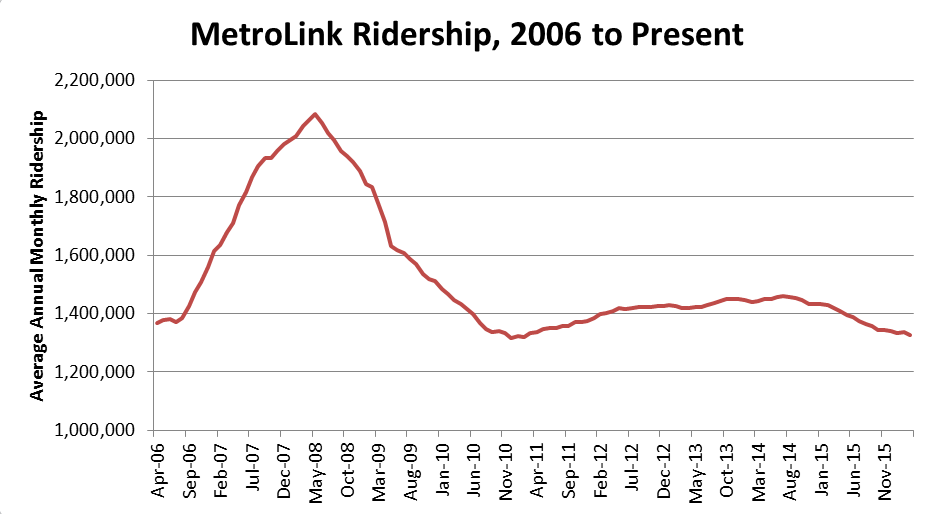
Saint Louis’s existing MetroLink lines already encounter ridership problems, despite serving areas with more employment and population than the proposed North-South line would. After spending more than $2 billion building the current system, a lower percentage of Saint Louisans use transit now than did in 1990. And, despite the hopes of transit activists, the situation is not getting any better. Both MetroLink and MetroBus ridership peaked in 2008, and even as better economic times have come to Saint Louis in the last few years, MetroLink ridership continues to stagnate. The result of this failure to draw more riders is that, accounting for all light rail costs since 1992, the MetroLink has cost Saint Louis nearly $10 for every passenger that has ever stepped on board, with a one-way fare of only $2.50. The bottom line is that the existing MetroLink has, despite the investment, failed to achieve meaningful progress toward promoting transit ridership or generating urban development. There is little reason to believe that an expansion will yield better results.

Fortunately for the region, adding more rail is not the only way to improve public transportation. Saint Louis could, for far less than a billion dollars, improve its poorly managed bus system or implement bus rapid transit, both options made much easier by the incredibly low traffic levels on Saint Louis’s highways and arterial roads.

However Saint Louis officials move forward, they would do best to consider public transportation plans that take the city as it is, and not how transit activists want it to be. If they don't the system will continue to operate as it does today: expansive yet inefficient, expensive yet resource-poor, overbuilt yet under-ridden. 


Who’s Paying for $160 Million in Blues Upgrades?

The Saint Louis Blues had a very successful season, making it deep into the playoffs and just two wins short of the Stanley Cup finals. And the team is likely to remain in the news during the offseason, even if it isn’t for their play on the ice. Instead, the topic will be stadium financing, as Blues ownership seeks $160 million in upgrades to the Scottrade Center. How much of that Saint Louis residents, rather than the Blues themselves, will cover is a troublingly open question.

The Scottrade Center, originally Kiel Auditorium, cost $135 million to build and first opened its doors in 1994. While private interests covered most of the price tag, the city of Saint Louis provided $15 million in construction subsidies (the city also built the stadium’s western parking lot at a cost of nearly $10 million). Aside from direct handouts, Saint Louis worked to reduce the stadium’s tax liabilities. Like Busch Stadium and the Dome formerly known as Edward Jones, the Scottrade Center sits on public land, shielding the Blues’ ownership from standard tax rates. In addition, the LCRA (a city body), and not the stadium’s owners, issued all the bonds for the stadium’s construction, making those bonds tax-exempt.

Now, a little over two decades after the Scottrade Center opened, the Blues no longer find their accommodations adequate. They want a larger scoreboard, better seating, and an expanded team store. Perhaps with a jealous eye toward Ballpark Village, the Blues hope to build a year-round beer garden at the stadium. They estimate that these upgrades will cost $160 million, which, adjusting for inflation, is slightly more than the original cost estimate of the Scottrade Center when financing got underway in 1990 (yet more evidence that cities should only expect about 20 years out of their stadiums before they have to pay for them all over again). But who will pay this time around?

All we know right now is that, like in the ‘90s, the Blues expect the city to issue the bonds for the stadium’s construction so they can avoid taxation. But for the city’s bottom line, who will pay those bonds back is the most important question. Last time around, the city covered about 10% of those costs and stadium owners paid 90%. There’s no guarantee that the Blues won’t ask for more support this time, especially after the city last year showed itself willing to spend well over $100 million to keep the Rams in town. Of course the Blues could pay the whole cost themselves, although the fact they are negotiating with the city to come up with a financing deal likely means that’s out of the question.

Still, it will be better for Saint Louis residents if the Blues pay for the costly upgrades themselves. The proposed improvements, from a larger team store to a “Blues-park Village,” are clear examples of nice-to-have amenities that would greatly add to the Blue’s assets. The impact of the improvements on city’s bottom line or its economy is difficult to determine, but given the evidence, it’s likely negligible.  It’s time the city focused on getting the basics of civic governance right instead of involving itself once more in how Saint Louisans spend their spare time.

Taxpayer Dollars and All That Jazz

The Kansas City Star reported over the weekend that the City Council will soon decide whether to spend more on the 18th and Vine District. The amount was originally $7 million in December, then quickly grew to $18 million before reaching the current $27 million mark. The Star’s piece tells us that that this last investment would allow the city to “declare victory once and for all,” but doesn’t specify how victory will be achieved.

This is the latest effort to spend millions of taxpayer dollars on a problem that stubbornly refuses to be solved. The original effort to build something at 18th and Vine corresponded to the release of Robert Altman’s 1996 movie, “Kansas City.” The movie was a flop, and the efforts since to return life to the so-called district haven’t been any more successful. As KCUR pointed out in 2011, the effort to return the area to its Pendergastian heyday has lasted longer than the heyday itself.

This is what we should expect when the government pushes something that the people do not want. Even former City Councilman Ed Ford recognized that no one supports the District. “The marketplace has not embraced 18th and Vine,” he told KCUR before saying that the city is committed to its success. “Committed to success” likely means that city leaders will continue throwing good money after bad. The Council voted Thursday to direct the City Manager to find a way to give the district $18 million more.

In two pieces for CityLab, a publication of The Atlantic, Brandon Reynolds argues that government will never succeed at propping up jazz, and he points to the success of Memphis’ Beale Street as an example. The man who made Beale Street a success, John Elkington, argued that only private investment will work. A 1998 Los Angeles Times piece compared Elkington’s reliance on private investment to former Kansas City Mayor Emmanuel Cleaver’s desire for public dollars:

Some black leaders point to Kansas City’s revival of its jazz district as a preferable alternative to Elkington’s Beale project—a community renovation project overseen by a black mayor and tied to public funding that guarantees a role for black businesses and opportunity for neighborhood residents. In fact, Elkington and Kansas City Mayor Cleaver have toured each others’ projects—and both men argue that theirs is the only way to restore blighted black business sectors.

Twenty years later, we have a clear and irrefutable conclusion: Cleaver was wrong. Beale Street is a success, and 18th and Vine is a failure. While some may point to past mismanagement or insufficient funding for 18th and Vine, the point is that jazz is not as popular today in Kansas City as we want to believe. Kansas City was the top market for the Women’s World Cup in 2015, but it didn’t make it into the top 10 markets for the PBS documentary “Jazz” by Ken Burns. We’re just not that into it. Kansas City isn’t alone. Jazz pianist and blogger Bill Anschell wrote that, “People who want to play jazz actually outnumber those who enjoy or even tolerate it, let alone pay to hear it.” The plan in Kansas City is to force people to pay for it.

The jazz heyday was a product of seedy bars, corrupt politics, segregation, and prohibition. Jazz musician and band leader David Basse said

You can’t start a string of bars and have them owned by the city or corporations and make them fun. You can’t do that. You’ll open one little corner dirty place and you sweep the floor and you start selling booze.

Despite the best intentions, it’s unlikely that the same city government that banned smoking in bars and restaurants, raised the age to buy tobacco products, and regularly closes down bars and restaurants for small violations is going to be able to fund a resurgence in speakeasy-era entertainment. We have 20 years of failure to make that point.

Pensions Are Taking on Riskier Investments and Putting Retirees’ Money In Jeopardy

A year ago, the Show-Me Institute released “Betting on the Big Returns: How Missouri Teacher Pension Plans Have Shifted to Riskier Assets,” which I co-authored with Michael Rathbone. In the paper, we examined the investments of Missouri’s three teacher pension funds from 1992 to 2014. We saw a remarkable shift in pension investments. Over the fourteen-year period, all three pension funds have shifted to riskier investments. A piece in the Wall Street Journal this week helps explain why this shift is occurring.

Interest rates for bonds, which are considered low-risk investments, have dropped considerably. Pension systems set investment return goals. For the Public School Retirement System of Missouri (PSRS), the assumed rate of return is 8 percent. The low interest rate on bonds has forced PSRS and other pension systems to chase higher returns by taking on greater investment risk.  Timothy Martin of the Journal writes:

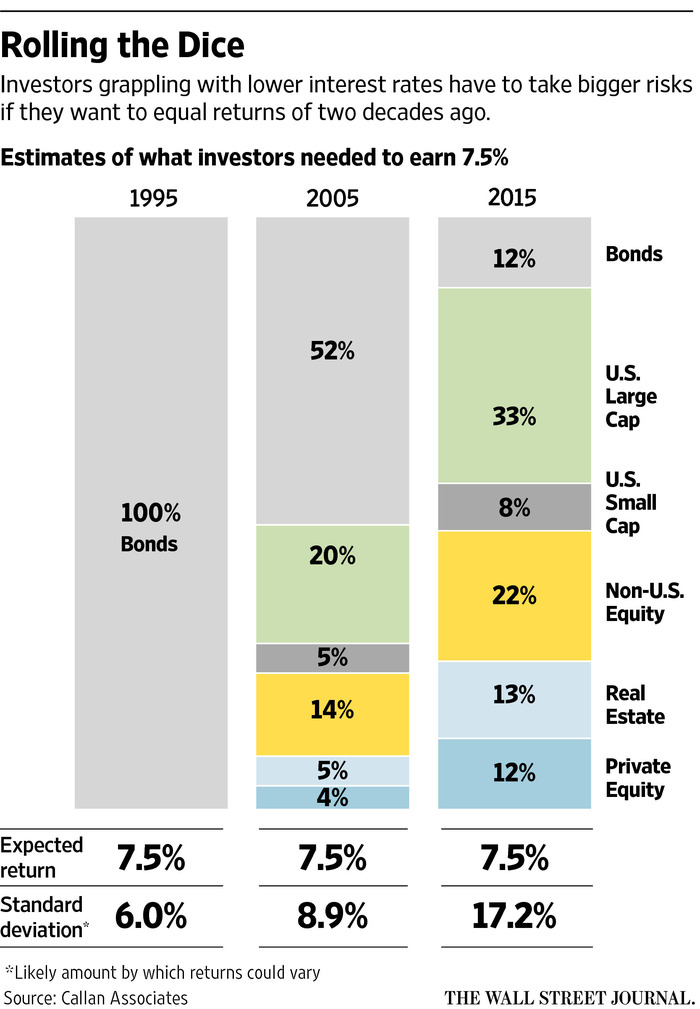
Thanks to rock-bottom interest rates in the U.S., negative rates in other parts of the world, and lackluster growth, investors are becoming increasingly creative—and embracing increasing risk—to bolster their performances.

To even come close these days to what is considered a reasonably strong return of 7.5%, pension funds and other large endowments are reaching ever further into riskier investments: adding big dollops of global stocks, real estate and private-equity investments to the once-standard investment of high-grade bonds. Two decades ago, it was possible to make that kind of return just by buying and holding investment-grade bonds, according to new research.

As Michael and I noted in our report, it doesn’t really matter why pension plans are taking on riskier assets; it simply matters that they are. The changing nature of investments has made pension plans riskier. It is incredibly important for pensioners and policymakers to be aware of this. As a safeguard, we suggest policymakers should increase transparency:

To improve transparency, lawmakers could require pension plans to forecast assets using multiple assumptions on investment returns. What would the funding ratio for each of these plans be if returns are 4 percent or 6 percent instead of 8 percent? This is something policymakers should know as it would allow them to choose the best way to structure contributions so that downside is minimized and that these plans can be adjusted to adapt to any unexpected downturns that may occur.

It is time to prepare ourselves for what might happen as a result of taking riskier assets. After all, it is the teachers and eventually the taxpayers who will be held responsible if these plans do not meet their expected rates of return.


The Streetcar’s Future Ridership

Almost every story about the newly opened Kansas City streetcar tells us that ridership is higher than expected, and indeed it appears to be. Daily ridership estimates have ranged from 2,700 to 3,500 before the system was opened, and the Star recently reported that daily averages have been over 6,400. Expect these ridership numbers to be featured in the inevitable campaign to extend the streetcar to UMKC.

Why is ridership so high? The Star has at least twice ascribed it to the “novelty” of the new system, both in the story linked above and here. The Star is likely correct, considering the experiences in two other new streetcar markets. Atlanta, for example, was crowing about its better-than-expected ridership numbers last year, and proponents were urging the city to consider expansion,

With this early success and ridership exceeding expectations by more than 20 percent, it’s never too soon to look ahead to Atlanta’s future.

Yet a year later, the system is being threatened with closure due to a list of problems, not the least of which being a decline in ridership,

After offering free fares for a year, the streetcar started charging $1 in January. Ridership plummeted. About 91,000 people rode the street in the first three months of this year48 percent less than the same period in 2015.

The same plight has befallen the streetcar system in Tucson, Arizona. Last March, the system was said to be carrying more riders than forecast 7 months after its launch. Yet last week, the Tucson streetcar announced it was curtailing its late night service in the name of “passenger efficiency.” The Tucson system is not free to ride either, charging $1.50 for a one-way fare.

The streetcar in Kansas City is free to ride, and for now it's a novelty. It may be months before ridership levels settle into their long-term levels as they have with older systems. Only once those numbers are known, and the impact of a fare is included, should policymakers decide if this is something worth extending to UMKC or beyond. Otherwise, the city risks wasting millions of dollars that could be better spent elsewhere.

The Negative Impacts of Development Subsidies

The Kansas City Star’s Joe Robertson has written recently about the closure of the Kansas City office of the National Alliance on Mental Illness. Earlier in the month, Robertson had written about the support NAMI has provided KCPD’s Crisis Intervention Teams that often dealt with those afflicted with mental illness. But NAMI-KC has since closed its doors. Robertson writes:

The Kansas City office had been struggling with its finances, a difficult time made worse because key members of its small administrative staff were in ill physical health.

Nearly 30 percent of NAMI-KC’s revenue came from a share of the Jackson County Community Mental Health Fund tax levy.

Robertson does not mention that due to an extension of The Kansas City Star’s property tax abatement, the paper of record does not pay into the mental health fund levy. Nor does he mention that the Community Mental Health Fund did not receive over $891,000 in 2015 alone due to Tax Increment Financing (TIF) and tax abatements in Jackson County. (The Star’s 15-year extension is worth $245,000 alone!) Those funds are kept by property owners or diverted back to developers.

Defenders of Kansas City’s development policies respond that this money was never being collected in the first place, so it isn’t fair to say that it’s being taken away from schools, libraries, or the mental health fund. Once the TIF or abatement is ended, they say, those funds will be better off than before. But this ignores the specifics of the Star, which sought to extend a 10-year abatement for another 15 years.

Supporters of such subsidies also give too much credit to TIF policy for driving up property values. A study by the University of North Carolina at Chapel Hill looked at TIF policy in Chicago and found that

After controlling for potential selection bias in TIF assignment, this paper shows that TIF ultimately fails the “but-for” test and shows no evidence of increasing tangible economic development benefits for local residents.

Developers are reaping a windfall from development subsidies in Kansas City. That money is diverted from other worthy causes, notably schools and mental health services. When publicly funded organizations like NAMI-KC are forced to shut their doors, the blame lies largely at the feet of pro-development policymakers.

Making Sure Municipal Courts Are Not Tax Collectors

In recent sessions, the Missouri State Legislature has made great strides toward reducing the perverse incentives and effects of taxation by citation—the practice of using court-assessed fines and fees as a source of municipal operating revenue. Just last year the legislature passed, and Governor Nixon signed, SB 5, which strengthened and expanded protections against such practices.

However, last March a Cole County judge invalidated much of SB5, ruling that several of its most important provisions were unconstitutional. Although the decision will be appealed, it has jeopardized the protections that SB 5 had provided to Missourians.

Regardless of the fate of SB5, concern about court fines and fees should extend beyond traffic tickets and percentages of budgets. State Senator Eric Schmitt (the sponsor of SB5) sponsored legislation in the recently completed session to extend the protections against taxation by citation.

SB 572 (passed by the legislature this session) lowers and caps fines applicable to both municipal traffic and ordinance violations and adds municipal ordinance violations to the calculation of the 20% municipal revenue cap allowed to come from municipal fines and fees.

The use of taxation by citation in any form invites unpredictability and conflicts of interest among the courts and law enforcers. For the benefit of government and the people of Missouri, tax policies should be set so that revenue is reasonably stable and predictable.

The first step to solving any problem is admitting that one could exist. The legislature has recognized that funding municipalities using traffic fine collections, and now municipal ordinance violations, is bad policy—and that’s a great start. The next step is to fully address taxation by citation in all its forms.

Saint Louis’s Central Business District: The Heart of What?

Last week, a murder a few blocks from the Saint Louis Convention Center turned attention toward both the safety and overall vitality of Saint Louis’s Central Business District (CBD), the borders of which can be found here. The public outcry against crime was immediate. Missy Kelly, head of Downtown STL (a quasi-governmental body that promotes the CBD), released a statement saying:

“The entire region should be outraged by this because what happens in the central business district, the economic engine and heart of the St. Louis region affects us all. It affects our national reputation. It affects what businesses consider St. Louis when exploring options for their headquarters. Most importantly, it affects each of our families. Downtown St. Louis is the region’s Downtown. We all own it. We all deserve to feel safe visiting the many assets that can only be found in the heart of our city.”

Of course, violent crime is nothing new to Saint Louis, and downtown is far from the most dangerous neighborhood in the city. However, safety problems in the CBD tend to generate much more response than similar crimes in other areas do. Saint Louis leaders are eager to defend the “heart” of Saint Louis, and to call on the whole region to support the downtown.

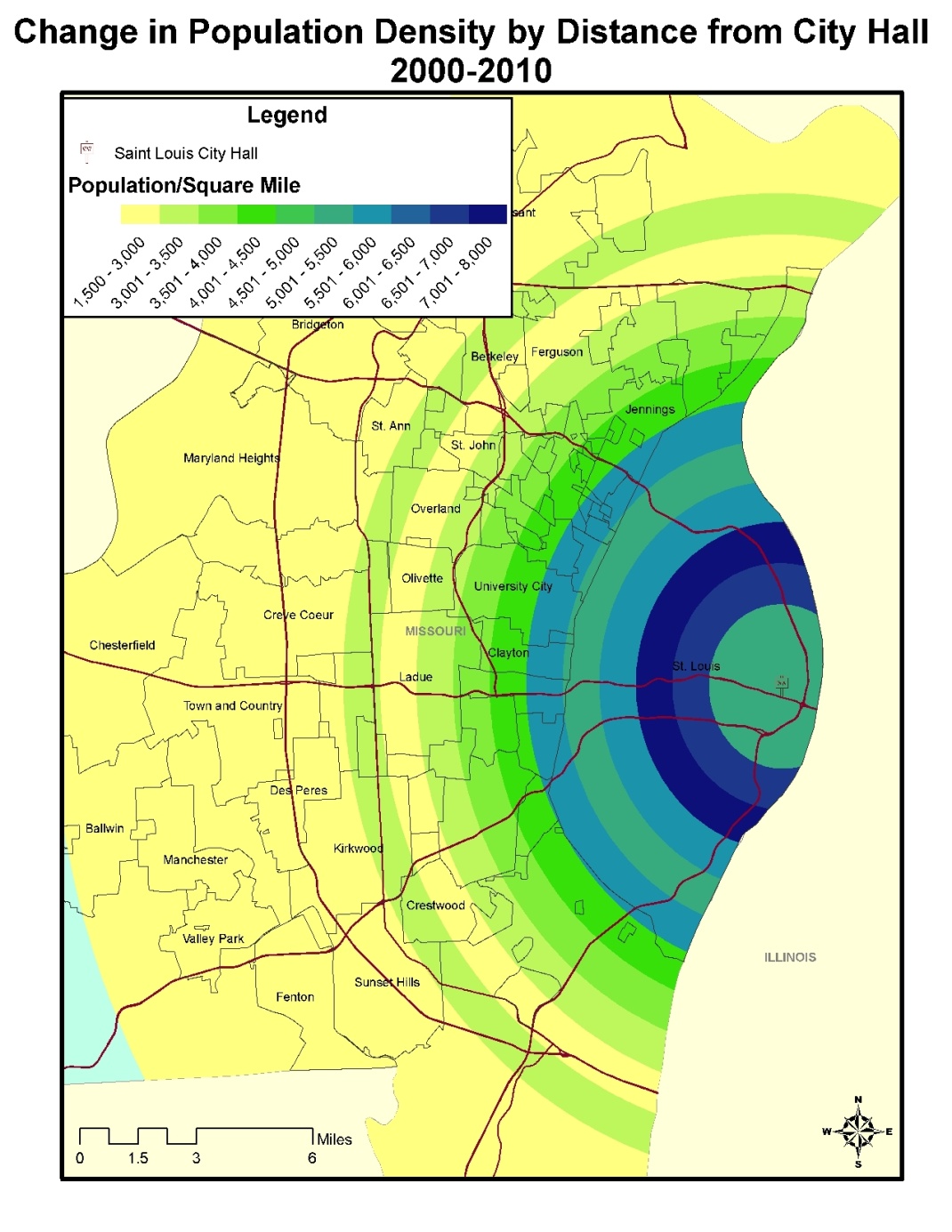
But what exactly is Saint Louis’s CBD the heart of? Certainly not the region’s population. As we’ve written before, Saint Louis’s downtown actually has a lower population density than areas farther away from the core, like the Central West End. Furthermore, the region’s population is extremely dispersed, with large sections of the population living more than 20 miles from city hall. The Saint Louis metropolitan area is region with more than 2.8 million residents, only a few thousand of whom live downtown:

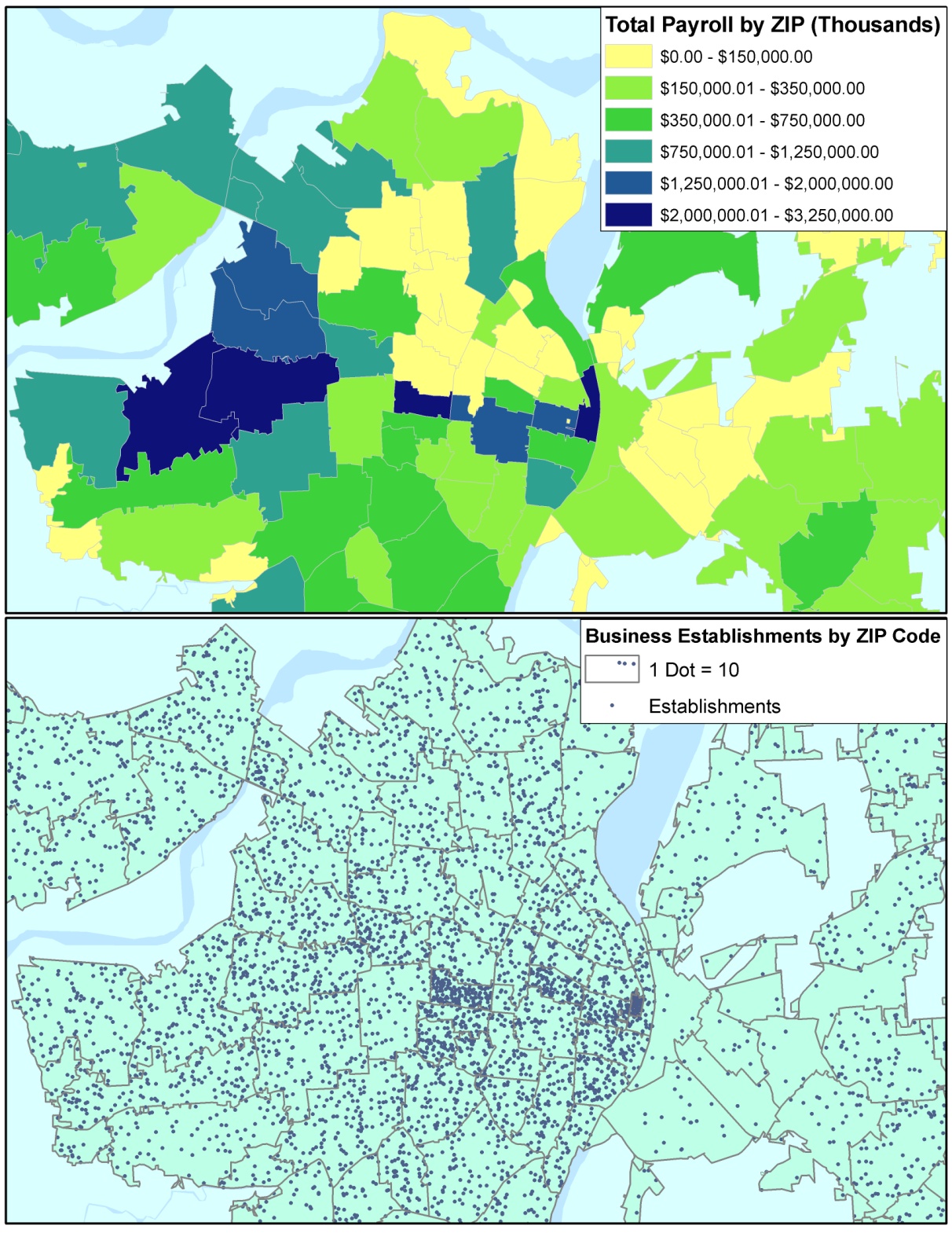
What of the CBD’s status as the business heart, or the economic engine, of Saint Louis? Today, less than 1% of the region’s annual payroll comes from businesses in the CBD. If we look at the zip codes that contain Saint Louis’s CBD, we find that areas in Saint Louis County, specifically Chesterfield and Creve Coeur, contain more businesses, contain more employees, and generate higher payroll than downtown. Looking at the maps below, we don’t see an economically dominant CBD surrounded by bedroom communities; instead we find dispersed areas of high employment. These areas include a broad central corridor that contains the CBD (but also Clayton and the Central West End) and a highly productive corridor in West County along I-270 that has more businesses and higher payrolls. The Saint Louis economy is so geographically dispersed that it might be difficult for a person not familiar with the region to locate downtown from economic data alone:

What of culture? The Saint Louis CBD has the Arch grounds. It also has the Scottrade Center, museums, libraries, theatres, and a sculpture garden. And of course, it has Busch Stadium, home to the Saint Louis Cardinals. For decades, the Saint Louis region as whole has poured tax money into amenities downtown, from the Dome formerly known as Edward Jones to the Arch grounds. Even as population and business activity left downtown, very few publicly funded civic projects were considered for any area but downtown (Forest Park being a notable exception). If public monuments, sports stadiums, and astro-turfed urbanism are all there is to culture, certainly downtown is unrivaled.

Whether or not Saint Louis’s downtown is truly its cultural heart, the region is undeniably diverse and dispersed. People live all over and work all over the map. To look at the region realistically (and plan for it effectively), we have to understand that St. Louis’s CBD is just one neighborhood among many, and we need to stop pretending that it has the economic and demographic dominance it did at the turn of the 20th century. Whether the problem is crime or economic growth, we’re unlikely to find a way forward when we can’t admit where we are.


Support Us

The work of the Show-Me Institute would not be possible without the generous support of people who are inspired by the vision of liberty and free enterprise. We hope you will join our efforts and become a Show-Me Institute sponsor.

Donate
Man on Horse Charging