Back to the Future (Taxpayers)

This Thursday, representatives of the Missouri State Employees Retirement System (MOSERS) and the Public School Retirement System (PSRS) will meet to decide whether or not to lower expected pension investment return rates. In the past they have assumed a long-term return rate of 8% on pension investments, but due to current underperforming investments, the systems are being forced to reassess that assumption. 

For those unfamiliar with how public pensions work, these meetings may not seem particularly noteworthy, but the decisions made by MOSERS and PSRS will ultimately have a significant impact on taxpayers across the state. Overestimating the rate of return will result in lower initial payments into funds, higher total unfunded liabilities, and higher tax burdens down the road. A lower assumed return requires higher initial payments, but it helps ensure pensioners and taxpayers alike that the pensions can be funded solely out of those payments in the future.

Missouri Treasurer Clint Zweifel hopes to lower the current 8% assumption MOSERS uses to 7.4% this year and drop it to 7% over the next four years.  He predicts that the lower rate would cost Missouri taxpayers tens of millions of dollars, but states “This is the fiscally responsible thing to do, not only for the fund and for its beneficiaries but also for taxpayers in the state.” In the past the Show-Me Institute has written about how pension discount rates should be evaluated in a more realistic manner in order to reduce unwanted future risks.

And we are by no means on the ideological fringe on this question.  In 2014, the University of Chicago’s Business School surveyed professional economists and found that 96% agreed that assuming higher rates of return understates pension liabilities and the costs of providing pensions to public sector workers. That finding underscores the importance of these pension meetings.

Of course, one way to avoid burdening taxpayers with future pension liabilities, which we've also talked about, is to explore defined-contribution plans that consist of employer/employee contributions and investment gains as the final payout. In a defined-contribution plan, taxpayers won’t be held accountable when a retirement plan is underfunded because, by definition, the plan cannot incur liabilities.

But to be clear, pension liabilities are legally binding, so if the state is going to have defined-benefit pensions, it only makes sense that those pensions should be managed in a way that guarantees that employee pensions can be paid. 

A truly fully funded pension plan would ensure that unfunded liabilities do not rise and that pensions are sufficiently funded today rather than shifting the burden to future generations. Let's hope MOSERS and PSRS seize the opportunity to protect pensioners and taxpayers.


Free Speech Under Fire at Colleges and Universities

Churchill called courage the “first” of the virtues.  In the garden of good and evil, it is the one virtue that allows all of the others to flourish—from humility to wisdom and from charity to a genuine respect for the rights of others.

Courage does not tremble in the face of coercion. It does not beg for forgiveness for non-existent crimes.  It stands tall in the defense of freedom . . . and in opposition to the dangers of mob rule or jackbooted tyranny.

All of which brings us to the wave of student protests that hit colleges and universities across the country in the fall of 2015. In one college after another, college presidents and administrators capitulated to unreasonable demands and went out of their way to curry favor with unruly protestors. In doing so, the titular leaders of these citadels of higher education acted both unwisely and with a shameful lack of courage.

The wave of protests began at the University of Missouri in Columbia, and it was here that assault on free speech became crystallized in the now-infamous picture of an MU communications professor calling for “some muscle” to bar campus journalists from a public area occupied by protestors.

Showing real courage in the face of taunts and physical intimidation, Tim Tai, a student photographer on assignment from ESPN, refused to leave the scene and asserted his First Amendment right to videotape in a public place—telling the protestors that his desire was to protect free speech for them no less than for himself.

In a quick succession of events in early November, protesters toppled University of Missouri system President Tim Wolfe, who was unpopular for reasons that had little or nothing to do with race. It began when a black graduate student (the son of a wealthy business executive) went on a hunger strike demanding Wolfe’s resignation. A few days later, black football players (coming to the end of a losing season) joined in a sympathy strike—refusing to play and  exposing the university to a $1 million fine if it were forced to forfeit an upcoming game against Brigham Young University. Then head football coach Gary Pinkel (only days before announcing his retirement for health reasons) chose to play Fletcher Christian to Wolfe’s Captain Bligh – supporting his players in the mutiny against a sitting university president. On the very next day, Wolfe resigned—and black football players agreed to end their strike.

Lessons learned?

We are all limited to our own experience, so no one can tell how prevalent bias and racism may be at an institution the size of the University of Missouri (with 35,000 students).  However, putting aside undocumented claims of deep and widespread bias by a few protestors (including a much-trumpeted but spurious report of a large Ku Klux Klan presence on the MU campus), we will cite three lessons.

First, there is a clear free-speech problem at the University of Missouri and other campuses. People are not allowed to express certain opinions, and even media coverage of protesting students is prohibited by those whose self-righteousness is overwhelming.

Second, you can tell that the values of the university have been misplaced—and indeed corrupted—when the football team and its coach play a decisive role in the resolution of a major conflict. 

Third, it seems to us that the obsessive insistence by protest leaders (not just at MU but within the larger Black Lives Matter movement) that almost everything that is wrong in our society reduces to a single problem—white racism and supremacy in an ongoing saga that casts blacks in the role of victims—is not only unfair but truly unhelpful. More than anything else, it is a major distraction in the way of any serious attempt to come to grips with problems that disproportionately affect black people living in poorer neighborhoods—everything from low rates of K-12 educational achievement to high rates of unemployment and crime among black youth, and from government programs that discourage work to the sharp decline in recent decades of intact two-parent families.

At the end of the day, it may be that what happened at Mizzou last November will serve a useful purpose—alerting many people to the danger of falling into an intellectual trap: supporting calls for greater “diversity” that are more realistically described as an attempt to enforce an unquestioning and frightened conformity.

We hope that the new leaders of the university will have the wisdom and courage to reject an anti-free speech conformity that masquerades as a paradigm-busting “diversity.”

Unions’ Orwellian “Takings Clause” Argument

Unions in Idaho and Wisconsin have filed federal lawsuits claiming that employees who don't want to be in their unions are violating the Fifth Amendment's Takings Clause by not paying for union representation. For those unfamiliar with the section, the Takings Clause says that "private property (shall not) be taken for public use, without just compensation." The unions' claim is that the act of collective bargaining is a union's "private property," and that employees who are subject to the union's agreements but reject the union are not compensating these unions for that property interest. 

The irony is that a straightforward reading of the Takings Clause should actually protect individual employees from having their paychecks bitten into without consent. These lawsuits use the reverse argument—requiring the Court to believe that the paychecks of employees are fundamentally union property to begin with, and that nonunion employees are “taking” money away from them by withholding their support.

In the past the Supreme Court has found that "unions have no constitutional entitlement to the fees of non-member employees," so the odds of success in these lawsuits do not appear high. But even if the law wasn't in favor of the rights of individual workers, the idea that unions have a constitutional right to the paychecks of laborers who reject them seems not only undemocratic but also, frankly, immoral.

Workers – whether union members and not – deserve better than that.

Saint Louis Should Learn from MetroLink’s Disappointing Past

Mayor Slay is talking up plans for a billion-dollar-plus expansion of Saint Louis’s light rail system, the MetroLink. This means that the region’s residents will soon, in all likelihood, be asked whether they're willing to pay for it. In convincing Saint Louisans to vote yes, rail backers will (as they have in the past) promote the supposed benefits of light rail, including everything from getting people out of their cars to boosting urban development. But before residents buy into the claims of train enthusiasts, they should consider the disappointing performance of the existing MetroLink routes.

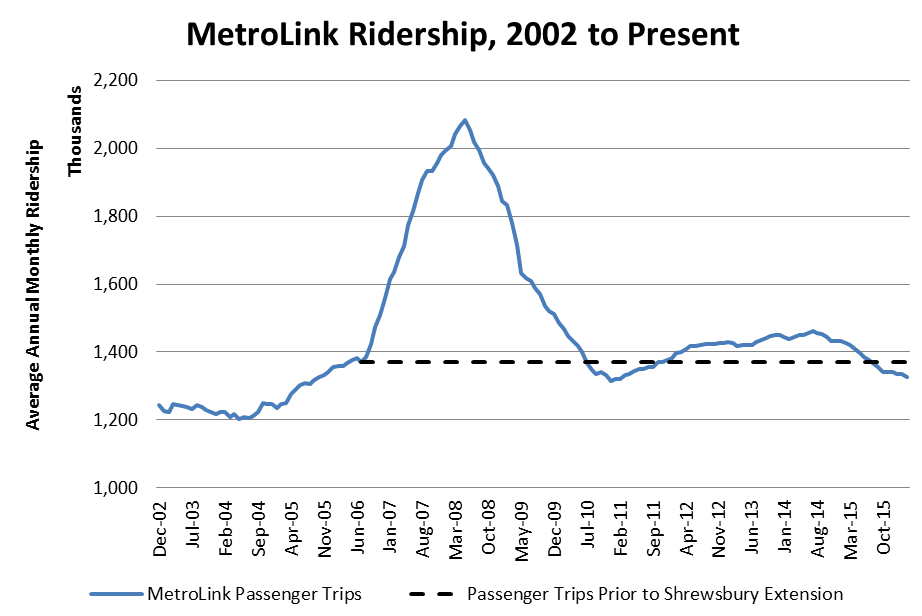
First, let’s analyze MetroLink’s effect on public transportation usage. It is true that people (including myself) use the MetroLink; the system handles an average of about 44,000 trips per day. However, MetroLink’s effect on total transit ridership has been modest. Despite the immense expenditures (around $3 billion) and multiple expansions, total bus and rail ridership today is lower than bus ridership alone was in 1991, three years before the MetroLink opened. Even worse, not all MetroLink expansions have even resulted in sustained higher MetroLink ridership. Take the case of latest expansion, from Forest Park to Shrewsbury, which opened in 2006. While the addition initially pushed rail ridership to new heights, ten years later total MetroLink ridership is lower than it was the year before the expansion opened.

The increasing supply of light rail, along with flagging enthusiasm for its use, has meant that in terms of passengers, MetroLink now has the lowest rate of use it has ever had, with only 2.55 riders per vehicle revenue mile.

Next let’s evaluate the MetroLink’s impact on development in Saint Louis. Consider the expectations of MetroLink’s proponents when the initial line opened in 1994. They hoped rail would generate urban renewal, with specific hopes that it would save Saint Louis Centre and bring life (and even a golf course) to East Saint Louis. Far from rejuvenating areas that were down on their luck, the MetroLink failed to prevent decline in areas of its route that appeared on the ascendency in 1994, like Union Station and Laclede’s Landing. Some areas near MetroLink stations have done well, like the Central West End or the Loop, but in these places development seems to be happening near the MetroLink, not radiating from it. With few exceptions, MetroLink platforms remain areas of quiet repose, far from businesses, residences, and crowds. It’s ironic, given the claims of rail advocates, that the true success stories of urban renewal in Saint Louis City are places like Soulard, South Grand, the Grove, and now Cherokee Street, located far away from any MetroLink station.

With regard to increasing transit usage in Saint Louis and spurring urban revitalization, the MetroLink has, to this point, been an expensive disappointment. There is no reason to think any MetroLink expansion will create different results. It’s time for the region to start looking for better, more cost-effective ways to achieve progress toward public transportation and development goals. 

Waiting for VanLoh

The last three years of Kansas City aviation policy is much like Samuel Becket’s play, “Waiting for Godot.” We the audience sit and watch the characters who, according to one synopsis,

quarrel, make up, contemplate suicide, try to sleep, eat a carrot and gnaw on some chicken bones. Two other characters appear, a master and a slave, who perform a grotesque scene in the middle of the play. A young boy arrives to say that M. Godot will not come today, but that he will come tomorrow.

One doesn’t need too much encouragement to see the parallels. We’ve seen a petition to require a public vote on a new terminal, a show trial of advisory group meetings, a group of airlines who seem to change their views, an ineffective public relations campaign, and then finally we are told that the VanLoh Plan will not come this year. Maybe next year.

The former Aviation Department director and architect of the new terminal plan, Mark VanLoh, did not survive this effort. His career ended as a result of the mismanaged new terminal campaign. Mayor Sly James said in a tweet recently , “VanLoh is not here to kick anymore.” But make no mistake, even with a new department director, the $1.2 billion new terminal plan before us is very much the VanLoh plan. And despite claims that supporters have put the matter on the back burner, the Mayor and City Manager are still active in pushing for a new terminal. It even has its own hashtag: #NewKCI.

Architectural design company Crawford and Associates have their own solution for the airport. While they have not been permitted to present to the City’s Airport Committee, they did present to a meeting of the Urban Summit with several members of the committee in attendance. The Crawford Plan is compelling; it would preserve much of Terminal A while providing the amenities that VanLoh Plan proponents demand. Importantly, it is one-third of the cost of the VanLoh plan. Yet it allows for the same renovation to be done to a second terminal if air traffic continues to increase.

That last part may be why fans of the VanLoh plan don’t like it. Where they seem to prefer one big billion-dollar bet, the Crawford Plan is measured. One might even call it fiscally responsible.

In the meantime, supporters who loudly declared that, “doing nothing is not an option,” have themselves opted to do nothing; not even renovation. They just want a new terminal, and so we’re all still waiting for VanLoh.

Support Us

The work of the Show-Me Institute would not be possible without the generous support of people who are inspired by the vision of liberty and free enterprise. We hope you will join our efforts and become a Show-Me Institute sponsor.

Donate
Man on Horse Charging