Entrepreneurship in Missouri, Part 3: The Startup Environment

This series on entrepreneurship has highlighted the fact that the percentage of workers  in startups is at its lowest level in Missouri in 20 years. In fact, job growth from startups has been floundering throughout the seven years since the recession ended.  In this last blog in the series, we will review two partial but significant explanations of declining startup growth in Missouri, Kansas City, and Saint Louis: net population flows and business consolidations. The research on the relationship between these two factors and entrepreneurship comes from Ian Hathaway from Ennsyte Economics and Robert E. Litan from the Brookings Institution.

Hathaway and Litan found that the more population growth an area experiences, the more likely the area is to see startup activity. Tax migration flows show that Missouri has seen a net outflow of people since 2011, driven by larger outflows from Kansas City and Saint Louis. While it is still possible for Missouri, Kansas City, and Saint Louis to grow in entrepreneurial activity despite a net migration loss, Hathaway and Litan find that those areas with fast and positive migration have more entrepreneurial activity. Unfortunately, that migration isn't really happening in the Show-Me State.

The business consolidation rate that Hathaway and Litan use is calculated by dividing the number of firms (e.g., Home Depot) by the number of establishments (individual Home Depot stores) within an area. Business consolidation can be a good indicator of business cost pressures, because as the costs of maintaining a firm’s establishments increase, business owners may decide to close or consolidate establishments. Therefore, a falling business consolidation ratio (i.e., each firm operates more establishments) indicates that overall, firms are expanding. On the other hand, a rising ratio indicates that firms are contracting their business operations.

The business consolidation ratio for older firms in Missouri seems to be declining over time, which may suggest that, on aggregate, these businesses are able to manage their costs of doing business and are expanding. For startups, however, business consolidation has remained flat, suggesting cost pressures may continue to be a problem for these new or relatively new companies. The chart below captures these trends.
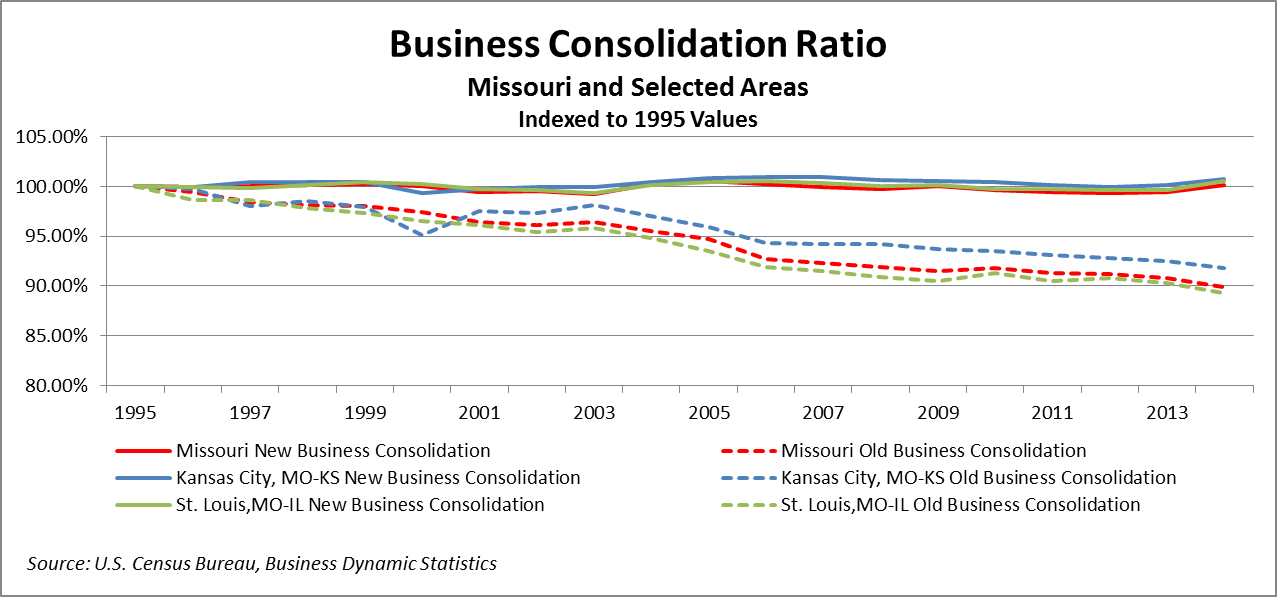
Remember: the downward slope of a line is a good thing, and reflects better conditions for a firm’s expansion. Policymakers should take a closer look into the startup environment, because review of Missouri, Kansas City, and Saint Louis shows that startups aren’t doing nearly as well as older and more established firms in terms of expansion. Over the last 10 years or so, the gap between established firms and startups has grown without pause.

How can Missouri policy help foster an environment in which entrepreneurs not only want to operate here, but also enjoy enough success that they are able to expand their operations? My first post in this series outlined how Kansas City businesses are enticed to move to lower-tax environments, indicating that tax policy might be a good place for policymakers to start. In addition, with Missouri ranked 29th in least-burdensome regulations for startups, (see page 49)., regulatory reform is another area where improvement would be welcome. 

Creating a Field of Dreams for the American Royal

With the World Series in full swing, I’m reminded of a quote from one of my favorite sports movies, Field of Dreams: “If you build it, he will come.” I wouldn’t be surprised if these same words were in the minds of Kansas economic development officials when they successfully recruited the 117-year old American Royal from Missouri to Kansas earlier this week. But the Royal’s move isn’t just bad news for Missourians; it’s also terrible policy for Kansans.

The Royal is a Kansas City institution, one whose fall catalog of rodeos, barbeque, and livestock competitions herald the start of winter and the region’s holiday season. Thanks to tens of millions in sales tax revenue STAR Bonds, those traditions will soon move away from the Royal’s current digs in Kansas City, Missouri, to nearby Kansas City, Kansas. Kansas’s $80 million contribution to the project is about double what American Royal was publicly trying to get out of Kansas City, Missouri, officials just two years ago to keep the Royal in the city’s West Bottoms.

But did Kansas even have to “build it” with taxpayer money to entice the American Royal to move? The Royal’s brand is defined by its history in the Kansas City area—even Kansas City’s baseball team is named after the organization—so it’s safe to say that American Royal wasn’t going to move its operations to Texas or Florida.

But setting aside for now the important question of whether this is an appropriate role of government (it isn’t), Wyandotte County has been seeing significant economic growth that would have made it an attractive landing spot for the Royal anyway. More families are moving there today than were coming 10 years ago. In 2004, 1,871 tax filers—bringing more than $57.6 million dollars of income—moved to Wyandotte; fast-forward to 2014, and tax filers were pouring in 25% faster, bringing in around $74 million with them.

Wyandotte County was “building it”—a functioning economy that has, in contrast to its basket-case reputation, attracted investments from Google, Amazon and others in recent years—before Kansas’s $80 million incentive was ever put on the table.

But Wyandotte’s recent successes don’t justify Kansas’s decision to subsidize the American Royal move. Indeed, the state’s $80 million giveaway has all the hallmarks of bad policy and poor judgement from Kansas’s political class. The American Royal was already getting cheaper land and a prime location close to its support bases in Johnson County, Kansas, and Kansas City, Missouri. The tens of millions in taxpayer support is just the KC Strip on top of this gravy train sundae.

Kansas? Sure, it gets a talking point in the battle for the economic soul of the region, but it’s a point that is likely to be eclipsed by the next round of billion-dollar business-poaching that’s certain to come.

While the Royal’s decision could be seen as a slap in the face of its historical roots, Kansas City, Missouri isn’t exactly a victim in the matter, either. The city has a terrible track record of poaching Kansas businesses in precisely the same way and is an equally bad actor in the billion-dollar tax-incentive border war that has bedeviled the region, creating no strategic advantages on either side of the border.

To put it delicately, the bull manure is blowing onto taxpayers from both sides of State Line Road. It’s time to end this tax incentive rodeo and finally pursue a mature economic development policy—one that doesn’t force taxpayers to build the fields of their politicians’ dreams.

Maps: Average Insurance Exchange Rates in Missouri, By County

Yesterday I published the full list of ACA monthly insurance rates by county in Missouri, as compiled by the federal government. Today I'm sharing a map of each type of plan for one demographic, 40-yearold individuals, since it pretty well reflects the geographic differences in prices that we're seeing across the state. A few quick notes on using the interactive features:

  • Mouse over individual counties to see their prices.
  • There are tabs in the upper left corner that let you scroll through the different plans—Gold, Silver, Bronze and Catastrophic—and their prices. I encourage you to cycle through them, because the maps for each plan level are different.
  • For easier viewing you'll also find in the lower right hand corner a "full screen mode."
  • Where counties are blue and have no prices, that means that, according to the data released, there will be no plan of that type available in that county in 2017. 


The NAACP’s Misguided Opposition to Charter Schools

The National Association for the Advancement of Colored People (NAACP) passed a resolution on October 15 calling for a nationwide end to charter school expansion. This resolution has been controversial because many African-American parents have become strong advocates for charter schools after seeing their benefits.

In Missouri, Charter Schools overwhelmingly serve African-American students. According to DESE, the 72 charter schools in Kansas City and Saint Louis enrolled over 21,000 students in 2016, two-thirds of whom were African-American.

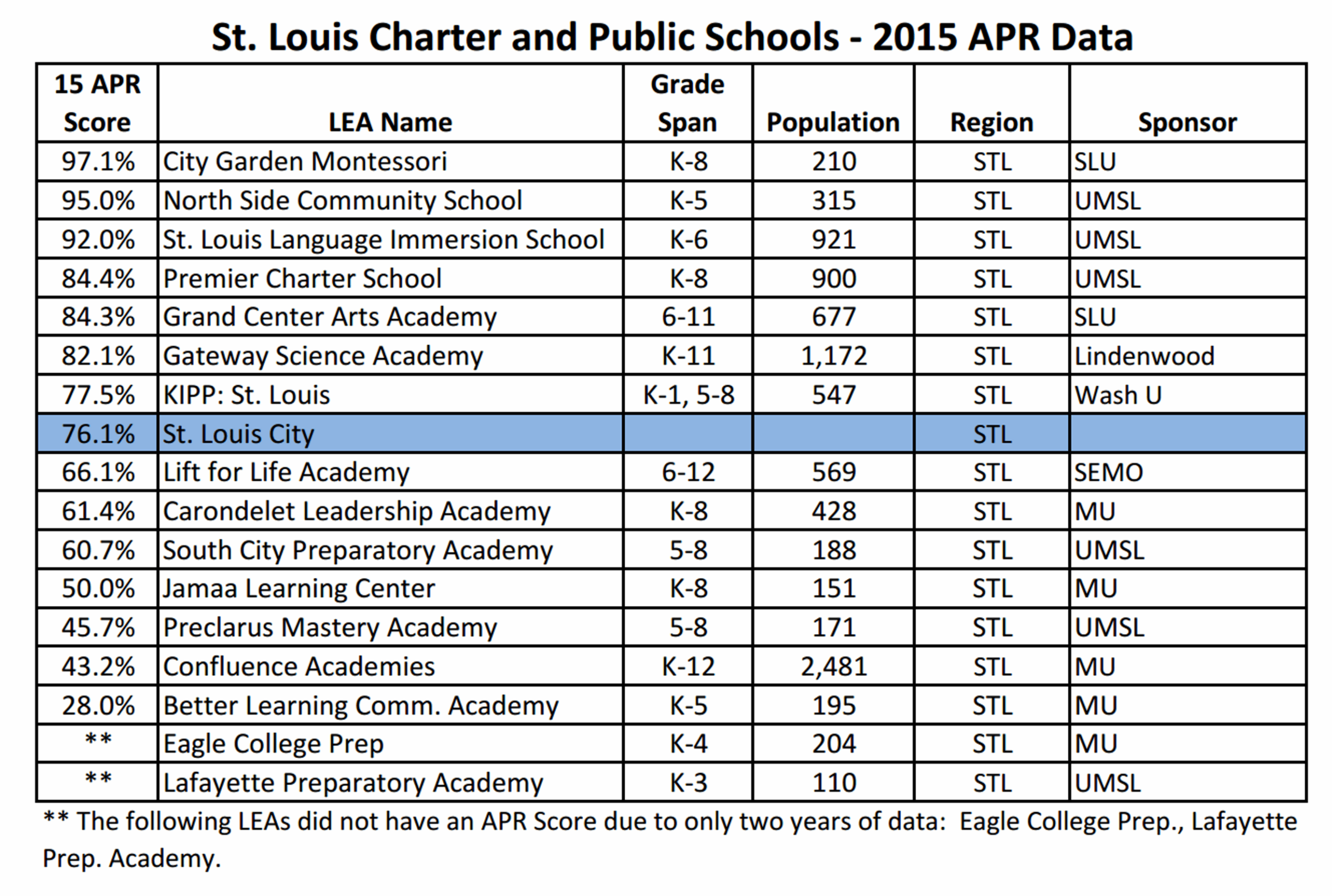
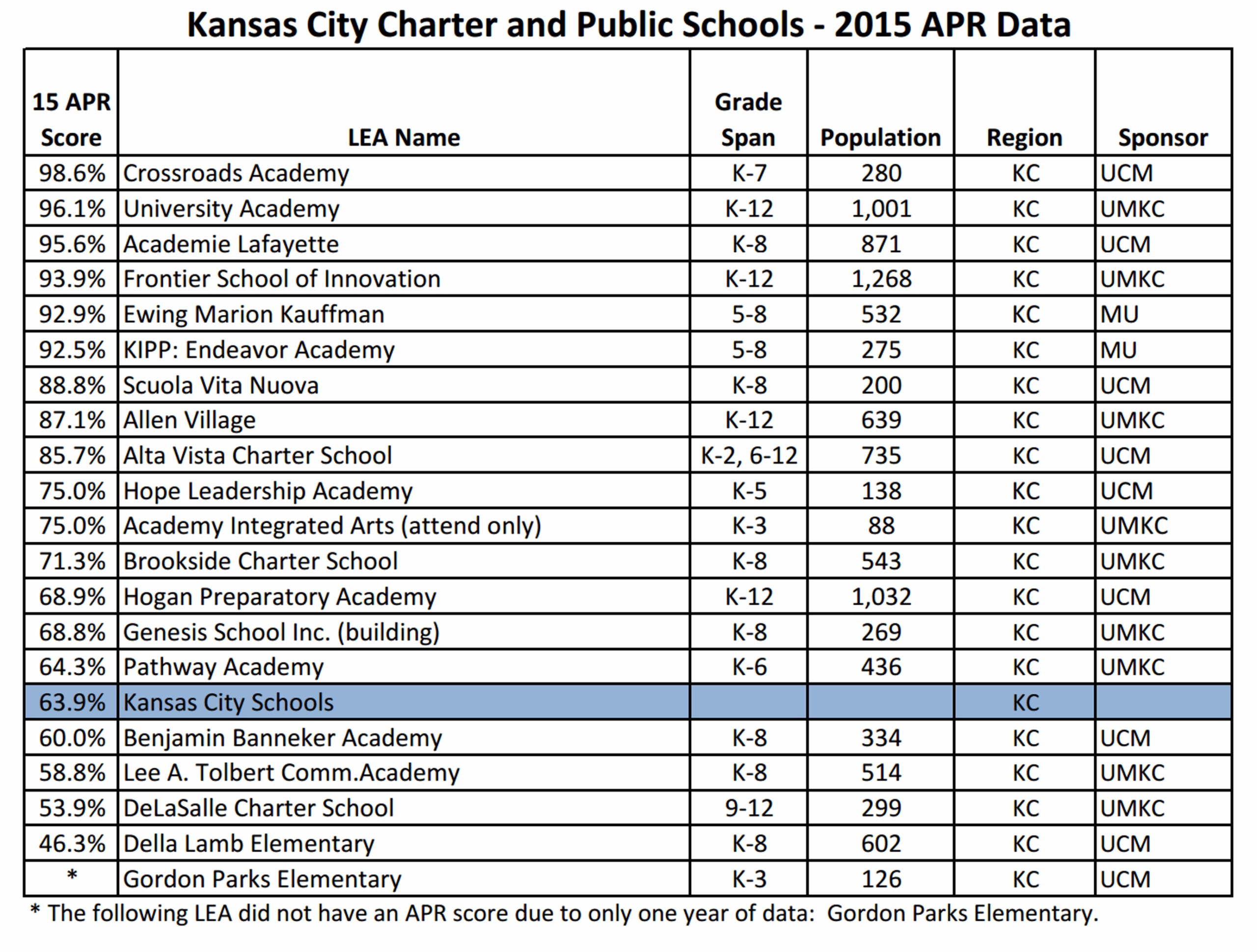
How well did these schools perform? Take a look below at the 2015 Annual Performance Report scores for charter schools compared to traditional public schools (for context, 70 percent is required for full accreditation):

Sources: DESE St. Louis Academic Performance Data, DESE Kansas City Academic Performance Data

On average, charter schools in Kansas City tend to be higher-performing options than the traditional public school district. In Saint Louis, the results are more varied, but there are several charter options that perform as well as any school in the state.

The following tables show demographic characteristics of students in the top 5 schools in Saint Louis and Kansas City.

Saint Louis's Top 5 Charter Schools

% Asian % Black % Hispanic % Multiracial % White
City Garden Montessori 0 40.3 5 4.1 49.8
North Side Community School 0 98.6 0 0 0
St. Louis Language Immersion School 1 55.1 8 3 32.4
Premier Charter School 7.8 27.1 13.8 7 44
Grand Center Arts Academy 1 61.5 3.2 4.5 29.4
Kansas City's Top 5 Charter Schools % Asian % Black % Hispanic % Multiracial % White
Crossroads Academy 2 40.7 18.9 0 32.7
University Academy 0 97.4 0.7 0 0.8
Academie Lafayette 2.9 16.2 4.7 7.8 68.1
Frontier School of Innovation 1.4 15.8 74 0.5 8
Ewing Marion Kauffman 1.4 84 5.4 3 5.1

As you can see, several of the top-performing charter schools in the state (Northside Community School, Saint Louis Language Immersion, and Grand Center Arts Academy in Saint Louis and University Academy and the Ewing Marion Kauffman School in Kansas City) serve student populations that are more than 50% African-American. Does the NAACP really want to deny students the opportunity to attend schools like these?

Of course, charter schools should be monitored closely for their performance and closed if they are failing. Such was the case of Better Learning Community Academy, which had an APR score of 28%; it is now closed.

If new and better charter schools are not allowed to take its place, however, then parents are left with fewer quality alternatives to their neighborhood public schools. Instead of taking away future opportunities, isn’t it better to enhance the education of students, regardless of race, to give parents more choices and more control over their children’s education? The evidence would say so.

The Dismal Recovery

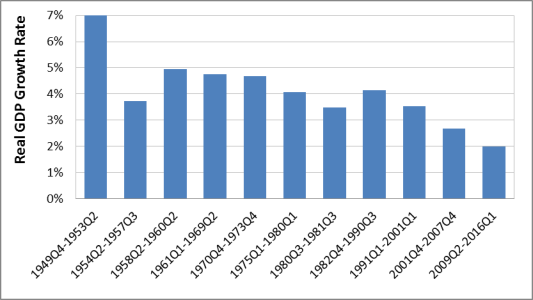
The “recovery” of the last seven years remains the worst in postwar American history. Average gross domestic product (GDP) growth since the bottom of the recession in 2009 was barely above 2.1% per year. The average since 1949 is well above 4% per year during the previous 10 expansions.


GDP Growth during the Expansions of the Post-WWII Period

Source: CRS calculations based on data from the Bureau of Economic Analysis (BEA).

Note: Economic expansions as identified by the National Bureau of Economic Research.


This result is not just bad—it is catastrophic. The average American should not be wondering if his income is a bit above or below 2007 levels. Just by historical averages, the average American should be 20% better off than in 2007. And this slow growth is settling in as a permanent new-abnormal.

I believe the root cause of abysmal growth is the huge tax increases imposed by President Obama and Congress since 2008. The most harmful were the increase in the capital gains tax from 15 to 20 percent, the increase in top bracket income from 35 to 39.6 percent, and the new tax of 3.8 percent on investment income in the Affordable Care Act (ACA). The massive increase in regulatory burden through the ACA and Dodd-Frank bills are also crushing, but unfortunately are harder to measure.

The three tax increases mentioned above (plus higher state and local taxes) directly lower expected returns on all investments. Our government grabs the fruits of investment and then is puzzled when businesses do not invest. This causes billions of dollars of investment projects to come off the table.

Weak investment is the signature feature and cause of the abysmal "recovery" under President Obama. The aggregate of all investments in the United States is Net Private Domestic Investment (NPDI), computed by the Bureau of Economic Analysis. Relative to GDP, NPDI averaged 7% per year from1960 to 2008. The average was 7 to 8 percent from 1960 to 1990, and 6.5 percent in the Clinton and George W. Bush years. However, for the Obama years NPDI was an astoundingly low 2% of GDP!

In every year of Obama’s presidency but 2015, NPDI was worse than in any year from 1960 to his inauguration. This isn't bad luck. If nothing changed in the economy, the likelihood of having a period as bad as Obama’s just by chance would be 1 in 1000.

The numbers for GDP and NPDI are interesting, but they’re still just lifeless statistics. The human toll is terrible, taking the form of millions of Americans who can’t find jobs or can’t make ends meet in the jobs they do have.

Dismal investment levels are the predictable result of taxing investment and income at high rates. This terrible economic performance will continue until income and investment taxes are slashed. The government can still raise needed revenue with a broad-base approach, eliminating all the special deductions and credits and allowing very low rates.

On the other hand, maintaining the current high rates will entrench lackluster investment and stagnant incomes and trap far too many Americans in a bleak economic future.

Regarding the American Royal’s Move to Kansas

On Tuesday, the American Royal Association announced that it would be moving from its longtime home in Kansas City, Missouri's West Bottoms, to Kansas City, Kansas. The decision follows several years of debate about the future of Kemper Arena and comes as little surprise to folks who have been following the issue. As I and others suggested might happen, the Royal's decision to jump to Wyandotte County came with a massive, $80-million financial assist from the state of Kansas. That sum will finance about half of what has grown into a roughly $160-million project.

There will be lots of analysis on the impact of the Royal project on Kansas from folks who follow their issues more closely. I'll punt those analyses to them, except to say that we continue to oppose the development culture, no matter the state, that treats taxpayers as cows to be milked for every big government idea that comes down the pike. Indeed, Kansas City's border war has cost both sides hundreds of millions of dollars over the past few years—money that won't be going to necessary public services in the region.

Meanwhile in Missouri, the rush appears to be on to dream up new ways to compensate for the Royal's departure from the West Bottoms, no doubt to be driven by more government largesse. Kemper Arena seems set to receive massive tax subsidies as it's turned into a youth recreation complex. What, if anything else, gets built around that remains anyone's guess, though chances are good that those projects will be subsidized by taxpayers, too. We continue to oppose such a development plan. Of the things the City could and should do in the West Bottoms, not letting the City's own sewage treatment plant continue to stink up the area and its surrounding neighborhoods would be a good start. We'll see what actually happens.

To many of us, the Royal represented one of the signature cultural events that made Kansas City unique. In a time where municipal me-tooism is all the rage, the Royal stood out as a sign that Kansas City, though changing, is still connected to her past. Its departure is a loss for Kansas City, Mo., and serves as a sad commentary on a tax-incentivized development culture run amuck in this region. 


Chart: 2017 Obamacare Premiums in Your County

Earlier this week the Department of Health and Human Services released next year's Obamacare insurance exchange prices. You can find the full data set here; I have set aside Missouri's rates in the spreadsheet embedded below. To find the range of rates and plans that will be available to you, press CTRL-F (or Open Apple-F on a Mac) to open the search function, and then input your county. As you scroll right, you'll find the range of prices in your county, sorted by demographic.

Kansas City’s Development Guru Admits He Was Wrong

Most Kansas Citians won’t recognize the name, but we owe much of the inspiration for our downtown development scheme to urbanist Richard Florida. According to The Houston Chronicle, through his book, “The Rise of the Creative Class,” Florida

popularized the early-aughts idea that faded cities could revitalize themselves by attracting the talented, intellectual types who made up what he called the "creative class." Lure some hip coffeeshops, create an "arts district," play up your gay friendliness, and watch the laptopping masses pour in.

Unfortunately for Kansas City, our leaders bit hard on the bait and haven’t yet let go. Witness the millions of dollars poured into failed downtown economic development schemes such as the Power & Light District and the H&R Block building. Note the rhetoric around the streetcar or the Smart Cities proposals. Note the Mayor’s focus on Kansas City’s startup mirage. We’re chasing a creative class dream spun by Florida. Show-Me Institute writers pointed out flaws in his ideas for years, and now, at last, Florida himself admits he was wrong:

I got wrong that the creative class could magically restore our cities, become a new middle class like my father's, and we were going to live happily forever after," he said. "I could not have anticipated among all this urban growth and revival that there was a dark side to the urban creative revolution, a very deep dark side.

For Kansas Citians, the dark side we are being saddled with now is an ever-more hollowed out tax base, a city that struggles to deliver basic services, and an east side made even more unattractive to developers due to the flow of subsidies to other neighborhoods that were already economically sound. Regular readers of this blog know we’ve argued against Florida for years.

Florida has admitted his error. Will those in Kansas City who followed his advice do the same?

A Skunk at the Pre-K Garden Party for Cigarette Taxes

The English language offers several beautiful idioms to describe someone unwelcome at a social gathering. The most common, “a skunk at a garden party,” paints the image quite nicely.

Look at all these glamorous people eating canapés and drinking champagne in their seersucker suits and sundresses! Oh, no—is that what I think it is? RUN!

If you think it’s not a great idea to fund educational programs via cigarette taxes, you can start to feel like a skunk at a garden party.

Here in the great state of Missouri, on November 8 we will vote on a constitutional amendment that would establish a 60-cent tax per pack of cigarettes to create a fund for pre-K education. Backers believe that it would generate as much at $300 million per year, which would pay for tens of thousands of Missouri children to attend pre-K. They have an impressive advertising campaign and a strong social media presence highlighting the bipartisan support they have assembled for their plan.

On one level, I am sympathetic to their cause. I understand that there are perfectly defensible reasons to support raising cigarette taxes. Smoking is terrible, and we want fewer people to do it. Raising taxes will deter them. If we can provide pre-K with the funds such a tax generates, we’re killing two birds with one stone.

But there is more to this plan than meets the eye.

The largest financial backers of the amendment campaign have been big tobacco companies. Why, you might ask, is an industry looking to increase taxes on itself? Well, paired with the 60-cent tax on all packs of cigarettes is a 67-cent surcharge on so-called “wholesale” cigarettes—cigarettes produced by “small tobacco” companies not party to the landmark tobacco settlement that required the big tobacco companies to pay states in exchange for protection against future lawsuits. Big tobacco pays right around 67 cents per pack into these funds, giving small tobacco an edge in the marketplace. This amendment would eliminate that advantage.

What’s more, many anti-smoking and cancer-fighting groups have decided to oppose the amendment. They argue that a 60-cent tax is not substantial enough to deter folks from smoking.

For those of you keeping score at home: We have a cigarette tax campaign that is funded by big tobacco companies and opposed by the American Cancer Society. If I’m a skunk at the garden party, at least I’m in good company.

Setting the parlor intrigue aside, it’s hard for me to not think that for many Missourians, the real draw here is getting something for nothing. I don’t smoke, so I would never pay this tax. Most Missourians, particularly educated and wealthy ones, don’t either, so they won’t have to pay. If the state generates enough funds, there is good reason to believe that many middle-class children of nonsmokers will get pre-K without their parents having to pay a dime.

If we think one step further though, we see the problem. Cigarette taxes are about the most regressive tax we could possibly institute. Poor people pay the brunt of them. If this tax was going to be passed in 1950, when nearly half the population smoked, it would be spread more evenly across the populace. But it is 2016, and only a specific subset of Missourians smoke. What’s worse, a lot of those people are addicted to cigarettes, and we are preying on that addiction to fund something that we want.

Look at what happened in Arkansas, which instituted a lottery in 2008 to provide scholarships for students to attend college in the state. Like cigarettes, lottery tickets are disproportionately purchased by poor people. In Arkansas, scholarship recipients are disproportionately middle- and upper-income, making the scholarship lottery a pretty clear upward transfer of wealth. Sure, it sounded great at the outset, as non—lottery ticket buying parents eyed scholarships for their kids, but on the backs of the poor? It just feels unseemly.

There are reasons to support providing scholarships to pre-K to students in the state, but the how matters. How we fund those services, how we determine who is eligible, and how we pay for them is critically important. These considerations can get lost in big promises to people with little skin in the game.

Support Us

The work of the Show-Me Institute would not be possible without the generous support of people who are inspired by the vision of liberty and free enterprise. We hope you will join our efforts and become a Show-Me Institute sponsor.

Donate
Man on Horse Charging