Course Access in Missouri, Updated

A little more than a year ago, Brittany Wagner and I published a paper titled “Course Access in Missouri: Diversity, Personalization, and Opportunity” wherein we looked at programs that allow flexibility in the funding that states send to local school districts to allow students to better customize their school schedule.

As part of that paper, we looked at the current state of course access in Missouri, and used Department of Elementary and Secondary Education (DESE) enrollment data to try and determine which districts did not have any students enroll in advanced classes like Calculus, Physics, or AP courses. We looked at this question because there is evidence that many rural districts struggle to offer these classes.

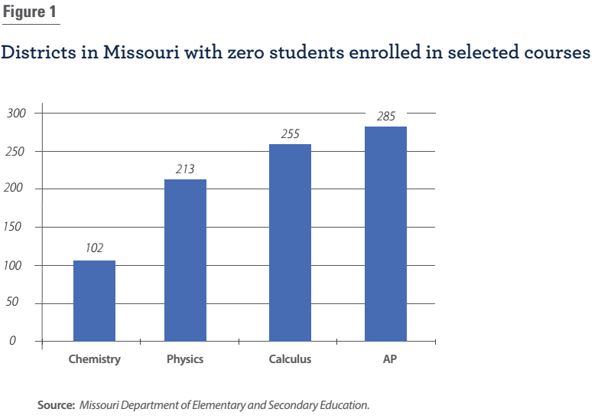
To investigate, we reached out to DESE and asked for enrollment data in Chemistry, Physics, Calculus, and AP courses from the 2014–15 school year. We counted up the number of districts that had zero students enrolled and then subtracted it from the total number of districts. Here is the figure from the report.
We wanted to update these data for the 2015–16 school year, so we again contacted DESE for the enrollment numbers.  This is what course access looks like in 2015–16:
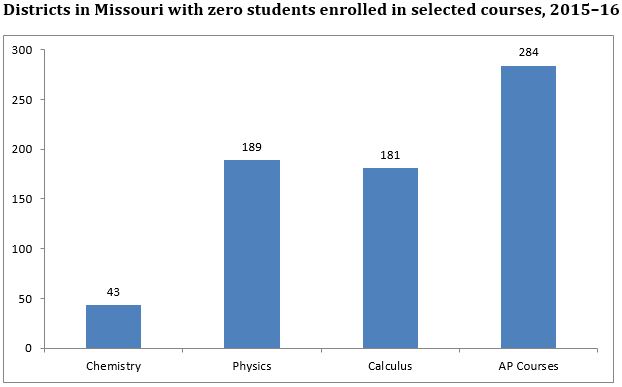
The numbers for the 2015–16 school year are still striking.  In percentage terms, 9 percent of districts that offer high school did not have a single student enrolled in Chemistry, 42 percent did not have a single student enrolled in Physics, 40 percent did not have a single student enrolled in Calculus, and 63 percent did not have a single student enrolled in an AP class.

In the process of updating these numbers, I realized that I made a coding error in the data set upon which the figure in the original paper was based. Careful readers of the paper will see that we subtracted our enrollment numbers from 507, even though there are 518 school districts in Missouri. We did this to try and exclude from our analysis school districts that didn’t offer high school because there is no way they could offer these advanced classes. According to DESE’s 2017 “Fast Facts” page, DESE lists 448 districts that offer high school, not 507.  After chatting with the good data folks at DESE, we confirmed that in the 2014–15 school year, Missouri also had 448 districts that offered high school.  Accordingly, Figure 1 from our Course Access essay (which is also Figure 5 in this essay), should look like this:
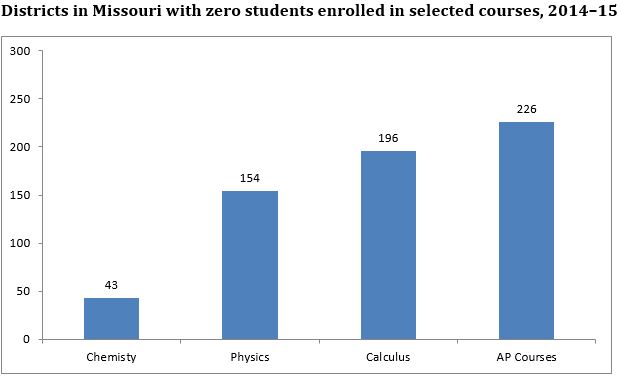
My apologies for our original miscalculation, but our argument still stands (the figure with 2015–16 numbers uses the correct total number of districts—448). In too many school districts across the state, too few students are enrolling in higher-level coursework, and course access programs can help fill that gap.

Two notes regarding the graphs above: When counting Physics courses, in both years, we excluded a class called “Physics First,” as this is a course for 9th-graders, not what we would consider an “advanced” course for high school upperclassmen. In calculating the 2015–16 figures, we counted any AP courses both for the AP column and for the respective subject matter column.


Pension Reform in Missouri

“The bottom line is this: Our state has a serious pension problem, and we need to start talking about how it can be fixed before it’s too late.”

With that statement, Missouri State Treasurer Eric Schmitt described our state’s severe underfunding of public employee retirement plans. To put an issue that Show-Me Institute writers have been highlighting for years in simple terms, when initial contributions to a retirement plan are too low or don’t grow as fast as projected, spending promises can’t be kept. Either retirees are hung out to dry, or taxpayers must step up and pay what a plan cannot.

Addressing our current spending issues is essential to improving our state’s fiscal health, but if we fail to consider Missouri’s long-term pension obligations the results could be disastrous.

As any savvy investor knows, the power of compounding can make a huge difference when it comes to saving. If our investment assumptions today are even slightly different from what actually happens in the market, this difference can grow rapidly over time. A widening gap between assumed and actual returns is especially troubling, because most economists agree that estimates for pension investment returns are often too rosy.

In 2015, Andrew Biggs of the American Enterprise Institute estimated that Missouri’s public pension plans had a total of $57.3 billion in unfunded liabilities (which are calculated as current assets minus the net present value of what will need to be paid). If plan investments fail to grow enough to cover promised benefits, then a bill much larger than even $57.3 billion will hang over the budget discussions Missourians have years from now.

So how can we fix this problem? Reforms that help Missouri transition away from plans that promise payments for life and toward plans that incur their costs up front can protect our state from investment risks. Schmitt illustrates this perfectly when he says “Our goal as a state should be to fully fund our obligations as they are incurred instead of putting the burden on the backs of our children and grandchildren.” Policymakers should consider adopting this goal—the sooner, the better. 

Where Are the Certificate of Need Bills?

Last month I had the opportunity to go back to my alma mater, Saint Louis University, and share with a crowd of medical students my thoughts on the future of health care in this country. We had a great conversation about where we’ve been when it comes to care provision, the failures of the system, and where we ought to go, but what I emphasized again and again was the importance of expanding health care supply. That can happen in a lot of ways, including through the reformation of licensing, scope of practice, and insurance laws. But I also emphasized the importance of a supply reform I view as low-hanging fruit for legislators—abolishing Certificate of Need (CON) laws for Missouri hospitals. 

CON laws create barriers to opening all sorts of medical facilities without undue interference, supposedly to protect health care access. The research says these laws do the opposite, which is why support has grown for their repeal nationwide. But in contrast to previous sessions, it doesn’t seem that there’s legislation moving to the forefront yet that would unwind Missouri’s CON law. Frankly, that’s mystifying.

Over the last few years we have talked a great deal about the importance of CON reforms. We even included it as an item in our Blueprint. But apart from our work on the subject, the potential impact of CON reform on patient care is made clear by events taking place right now in the Kansas City area. Kansas doesn’t have a certificate of need law; Missouri does. Unsurprisingly, and as reported by the Kansas City Star, a network of microhospitals is sprouting up all over the Kansas side of the metro area. And as the Star notes, the same sort of innovations aren’t happening in Missouri.

But the law cannot change unless there is legislation to change it and champions to see it through. There is still time for bills that can expand the supply of health care facilities, of physicians, of care, and all the rest. That said, time is running out. If CON reform is going to get done, it needs legislative champions. It remains an open question who those will be in 2017.

Most Teachers Lose in Current Pension System

Over the years, I and others at the Show-Me Institute have written about the need for public pension reform. Inevitably, we hear the following response from a pensioner or someone who works for a pension organization: They want to take your retirement money.  However, for those who are paying into Missouri’s teacher retirement fund, it’s much more likely that their money is being taken away by the pension fund itself.

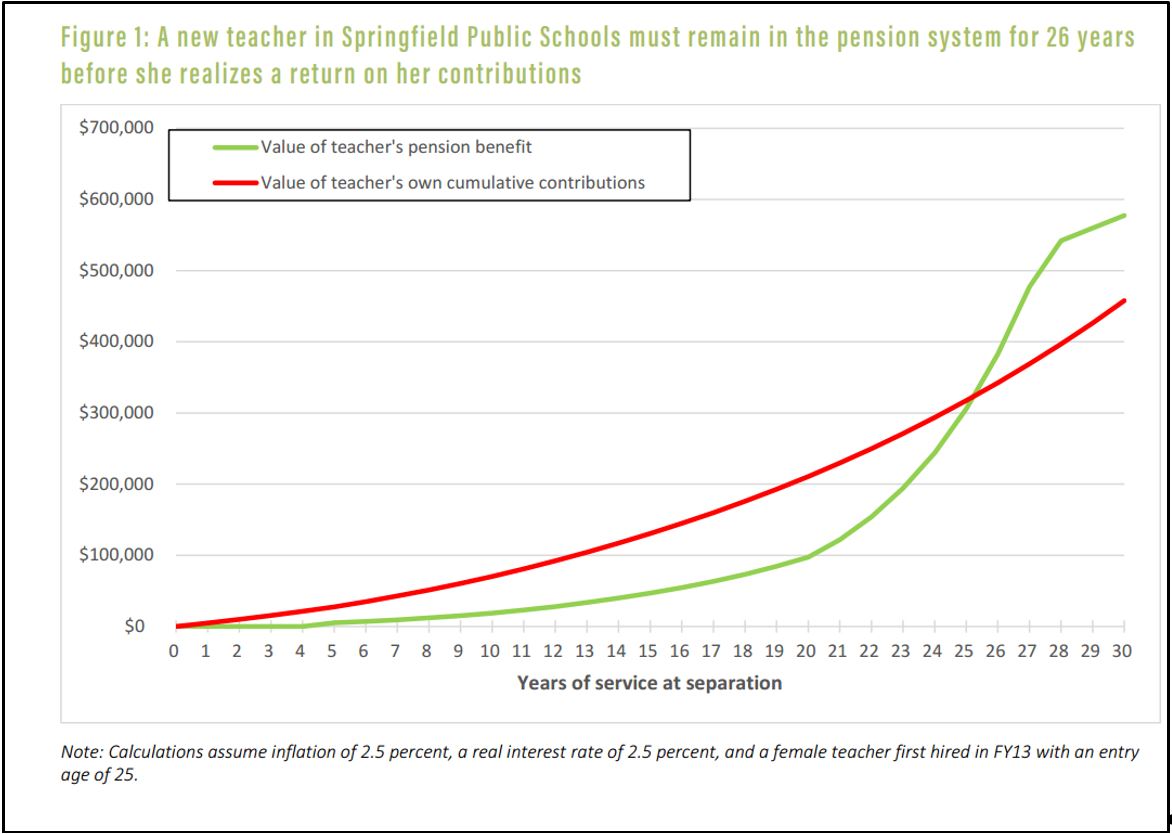
In a recently released report, “(No) Money in the Bank: Which Retirement Systems Penalize New Teachers?,” Marty Leuken, Ph.D. examines how many years an individual will have to pay into the retirement system before their benefits are worth more than their contributions. The study analyzed the largest public school district in each state. The results reiterate exactly what we have written before at the Show-Me Institute: Most teachers are paying more into the pension system than they are getting out of it.

Nationally, teachers with a defined-benefit pensions must work, on average, 27 years before their pension is worth more than their retirement contributions. This is incredible when you consider that 72 percent of teachers don’t even make it to 20 years of service. In other words, our pension systems benefit less than 30 percent of all teachers.  

In Missouri, the study included the Springfield Public School District. Teachers here must work 26 years before they finally break even. 

Missouri’s defined-benefit pension system for teachers is a good fit for those relatively few teachers who work their entire career in one pension system. Most Missouri teachers, however, would be better off if the state moved away from the current pension system. The current system punishes individuals who don’t stay in the system for a full career by transferring some of their retirement wealth to those who do stay.

Pension reform is not an effort to take someone’s retirement money away. Rather, it is an effort to allow individuals to actually keep their own retirement contributions.

Done: Missouri Becomes 28th Right to Work State

After years of trying, Missouri’s legislature has passed and our governor has signed SB19, Right to Work, into law—the product of countless hours of work and dedication from its supporters.

Its passage was also long overdue, as many of the state’s geographic peers have long crossed that bridge of worker choice. Before Governor Eric Greitens’ signed the bill into law, Missouri was surrounded on all sides by Right to Work states here in the Midwest, with the exception of Illinois. Or, if you view Missouri as a southern state, Missouri was the lone holdout among the members of the NCAA’s Southeastern Conference. Missouri becomes the 28th Right to Work state, joining the majority of states who have adopted this common-sense reform.

Right to Work is a victory that empowers workers, but legislators should not rest on their laurels while the list of other opportunities in labor reform remains long. I look forward to the upcoming debates about Paycheck Protection, prevailing wage, project labor agreements and union transparency. 

The GO Bonds Will Cost You Much More Than You’re Being Told

March 6, 2017: update

Everyone paying attention to Kansas City politics knows that we’re facing an $800 million bond vote on April 4. Previous blog posts here have made the case that the city’s representation of it as a 20-year bond is inaccurate. Now let’s consider the costs.

Anyone who has borrowed money understands that there is a cost to doing so—interest. This additional cost is a consideration in deciding whether to borrow in the first place.  So how much will it cost Kansas City taxpayers to borrow $800 million over 40 years? According to the city’s Finance Department, when the debt is finally settled in FY2055, taxpayers will have paid out over $1.28 billion. The city’s own spreadsheet is available at the link below.

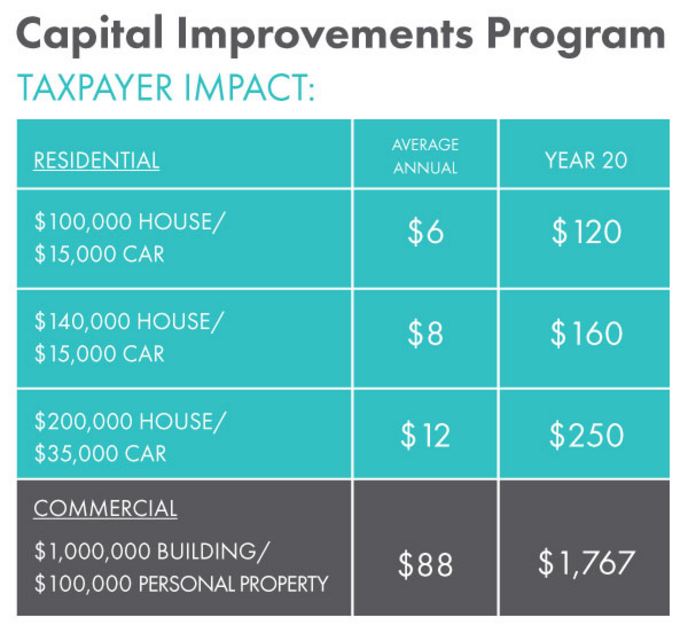
Kansas City’s own website also offers the following infographic, in which the “average annual” cost to someone who owns a $100,000 house is only $6. 

That seems like a bargain! However, the graphic is incomplete as it only represents the cost of a single 20-year, $40 million bond. The April 4 election would approve 20 such bonds, issued each year until FY 2036. Start stacking these per-bond costs and you’ll get an idea of the cost to taxpayers. After the last 20-year bond is retired in FY2056, the total amount of taxes paid would be $2,400, not $120.

The city’s infographic is telling 5 percent of the story. The timeframe of the debt is 20 times longer than what the graphic shows, and the cost to taxpayers is 20 times greater. Voters need to know this before being asked to hand over more than a billion dollars.

Policymakers Wisely Look Before They Leap

With a wave of new electric cars entering the auto market, policymakers in Missouri are faced with a decision about how the charging stations that power these cars will operate.

Last year, Ameren filed for approval to install six charging stations between St. Louis and Jefferson City along 1-70 in order to alleviate the “range anxiety” EV drivers suffer with the current number of stations available.  Instead of approving or denying the request, the Missouri Public Service Commission (PSC) postponed its decision on the matter because it was unsure of whether it even had jurisdiction to regulate the emerging technology.

Some background: utilities such as electricity are often delivered to consumers through monopolies because of how expensive competing delivery infrastructure would be—it is rarely feasible for a startup to lay new pipes or string new wires.  To keep current monopolies in check, regulatory bodies (like the PSC) monitor and approve the prices utilities can charge to cover expenses while still protecting consumers from exorbitant prices.

Many private citizens and businesses already own and operate charging stations, so approving Ameren’s expansion into the market is controversial.  Daniel Hall, the PSC’s chairman, said “. . . it’s unclear whether or not it should be a regulated industry or whether it should be an open, unregulated, competitive market. . . . Where there is a competitive market, I’m not sure that that is a role for the commission.”

Hall’s uncertainty about the PSC’s role makes sense.  If the PSC were to approve Ameren’s project, it’s possible that all of Ameren customers (whether they own an electric vehicle of not) would have to chip in to cover the cost of construction for the new stations. 

Communities around the nation are debating whether the public-utility model would stifle competition, or if it is a necessary kick-start to EV adoption. Kansas’ regulatory body recently denied Kansas City Power & Light’s request to charge ratepayers for a $5.6 million charging station initiative, arguing the proposal was anti-competitive and that it would be unfair to require all ratepayers to subsidize a handful of EV drivers.   Meanwhile, Oregon has ruled (see p. 8) that utilities may own charging stations and cover costs through all ratepayers if they prove an area is in need and would not otherwise receive investment.

Ameren is proposing to construct stations in an area that is currently underserved, but electric cars are relatively new, and technological improvements could soon make them more prevalent than they are today. Missouri’s PSC has been confronted with a difficult decision, and they deserve credit for not blindly jumping into the unknown.  If a free-market model could improve customer choice and spur innovation, then we should be wary of expanding a monopoly where it may not be necessary.

Regulatory Reform Emerges as Major Issue, Nationally and in Missouri

It’s been an active first few weeks for President Donald Trump, and the new Administration’s prompt engagement of the United States’ vast regulatory state gives free marketeers a lot to cheer about. In particular, an executive order that would attrition out burdensome and unnecessary regulations deserves particular attention.

The executive order calls for agencies to pinpoint “at least two” current regulations to be repealed for each new proposed regulation. And it says the net incremental cost for fiscal 2017 should “be no greater than zero,” meaning the cost of new regulations should be offset by existing rules that will be rescinded.

House Speaker Paul Ryan applauded the order in a statement Monday afternoon, noting that it builds on House Republicans’ “Better Way” agenda and comes as the lower chamber is set to repeal a number of Obama era regulations this week.

“The explosion of federal regulations has hamstrung small business growth and crippled our economy,” he said. “President Trump’s executive order helps bring the nation’s regulatory regime into the 21st century by putting regulators on a budget, and addressing the costs agencies can impose each year.”

After the President’s announcement, my colleague Mike McShane reminded me that, in fact, he has talked about precisely the same kind of regulatory reforms in the past. In his case, the context was education. From his US News and World Report piece from last year:

Our Tory compatriots across the pond offer a way forward. In 2010, the Conservative government of the United Kingdom implemented what they called “one in, one out” (later revised to “one in, two out“) that required government to remove a regulation of equivalent compliance cost for every new regulation that they proposed. Want to require a new form to be submitted to the Department of Business, Innovation, and Skills tracking how businesses recruit new employees? Lovely, not a bother at all. You simply must find another form that takes the same amount of effort or another requirement that takes the same amount of time and eliminate it.

But the regulatory push doesn’t end there, of course. Newly inaugurated governor Eric Greitens has established his own regulatory beach head to fight from, and while it may not be “one in, two out” quite yet, it’s reasonable to believe something similar is on the horizon. That regulatory freeze is important because it halts business as usual in the state bureaucracy and offers an opportunity for a clear-eyed reassessment of what the state is doing well, and doing wrong, in its rulemaking and regulatory processes.

Expect more about good-government regulatory reforms as this year’s session proceeds, but it is refreshing to see that our state and federal governments may soon be getting smaller, one rule at a time.


Criminal Justice Reform: Raising the Age

As Missourians consider the many ways to improve and reform the criminal justice system, at least one option appears to be relatively low-hanging fruit: raising the age at which offenders are automatically put into the adult criminal justice system from 17 to 18.

Under the so-called Raise the Age effort, introduced in the Missouri Senate as SB40, 17-year-olds will be prosecuted under the juvenile court system unless they have been certified as adults—often due to the nature or severity of their crimes. This would be a welcome change—only six other states presumptively treat 17-year-olds as adults.

Treating 17-year-olds as adults dramatically reduces the role of family in the criminal justice system. Police are not required to notify the parents if a 17-year-old, often a high school junior or senior, is arrested and detained. Children can be interrogated and even agree to plea bargains without a parent ever knowing of the arrest!

In addition, adult prisons are notoriously ill-equipped to deal with the needs of children and do little if anything to help them continue their education or offer rehabilitation services. Recent federal law requires that prisons adopt important—and expensive—protections for children, among them providing education resources and separating them from the adult population.

Raising the age by which an offender is automatically placed into courts of general jurisdiction mitigates much of the costly need to retrofit adult prisons to protect children, offers children important educational and rehabilitative services, and respects the role of family. As long as it does not conflict with the ability of courts to treat serious offenders as adults when necessary—such as when they have engaged in gang activites—this is a reform worthy of legislative support.

Support Us

The work of the Show-Me Institute would not be possible without the generous support of people who are inspired by the vision of liberty and free enterprise. We hope you will join our efforts and become a Show-Me Institute sponsor.

Donate
Man on Horse Charging