
We’ll Gladly Pay You On Tuesday for Teaching Today

J. Wellington Wimpy, the burger-eating cartoon character from the Popeye series, may have been best known for saying, “I’d gladly pay you Tuesday for a hamburger today.”  It may sound crazy, but in some ways we are saying the same thing about teachers—we’ll gladly pay you in retirement for teaching today. 

Nat Malkus, an education policy research fellow at the American Enterprise Institute, has a terrific piece this week in U.S News & World Report, “Beware the Cost of Teacher Benefits.” In it, he shows that school districts are increasingly spending money on benefits, such as teacher pensions, at the expense of teacher salaries. Nationally, benefits increased from 21 percent of total compensation in 2003 to 28 percent in 2014.

Because of what I know about the issues with Missouri’s teacher pension systems, Malkus’ analysis got me thinking about how much of a school district’s total current expenditures go to salary and benefits. Using data from the National Center for Education Statistics, I found out.

In 1998, nearly 80 percent of total current expenditures went to salary and benefits.  Sixteen years later, the percentage was hardly changed at 79 percent. The big difference, however, was the shift from salary to benefits. In 1998, salary comprised 66.8 percent of total current expenditures and benefits were 12.7 percent. In 2014, salary had dropped to 60.6 percent and benefits climbed to 18.2 percent. (See the figure below; note that the vertical axis begins at 50 percent.)
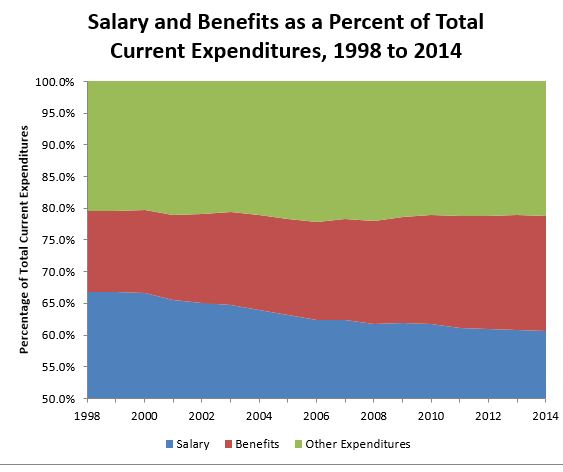
But this illustration doesn’t tell the whole story. During this period, Missouri’s largest teacher retirement system increased its contribution rates from 10.5 percent from the district and 10.5 percent from the teacher to 14.5 percent from the district and 14.5 percent from the teacher. Because the district’s contributions are accounted for in the benefits calculation above but the teachers’ contributions are not, this graph understates how dramatic the shift from salary to benefits has been.

In the graph below, I separate out teachers’ salaries from their pension contributions to show the trend. As you can see, the percentage of school district expenditures that goes to benefits has grown substantially during this period. 
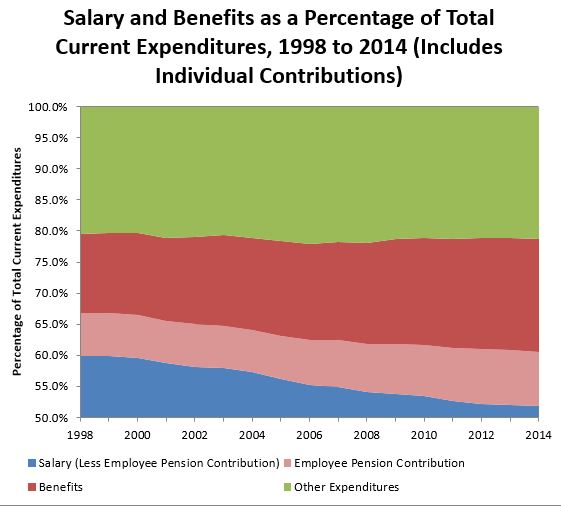
Once we account for teacher contributions to their pension system, teacher salaries in Missouri total less than 52 percent of Missouri school districts’ total current expenditures. Meanwhile, benefits (including employee pension contributions) account for 27 percent. And this doesn’t even take into account payments toward insurance premiums teachers are required to make or the 14.5 percent pension payment on the value of benefits they receive from their school district they are required to pay as well.

Pensions and benefits are consuming more and more of our state’s educational resources. What this means for teachers is that more of their compensation is delayed compensation. We’ll pay them on Tuesday for teaching today.

There is nothing wrong with having great benefits and a secure retirement. Yet this shift is alarming for two reasons. First, it helps perpetuate the idea that teachers are underpaid, because people rarely consider benefits when making wage comparisons. Second, this trend is a warning sign. Our pension liabilities are growing and they are diverting money from other important areas, such as salaries. If we want a competitive teacher labor market in the future, we have to address pension issues today. 
Hair Braiders Challenge Regulatory Requirements

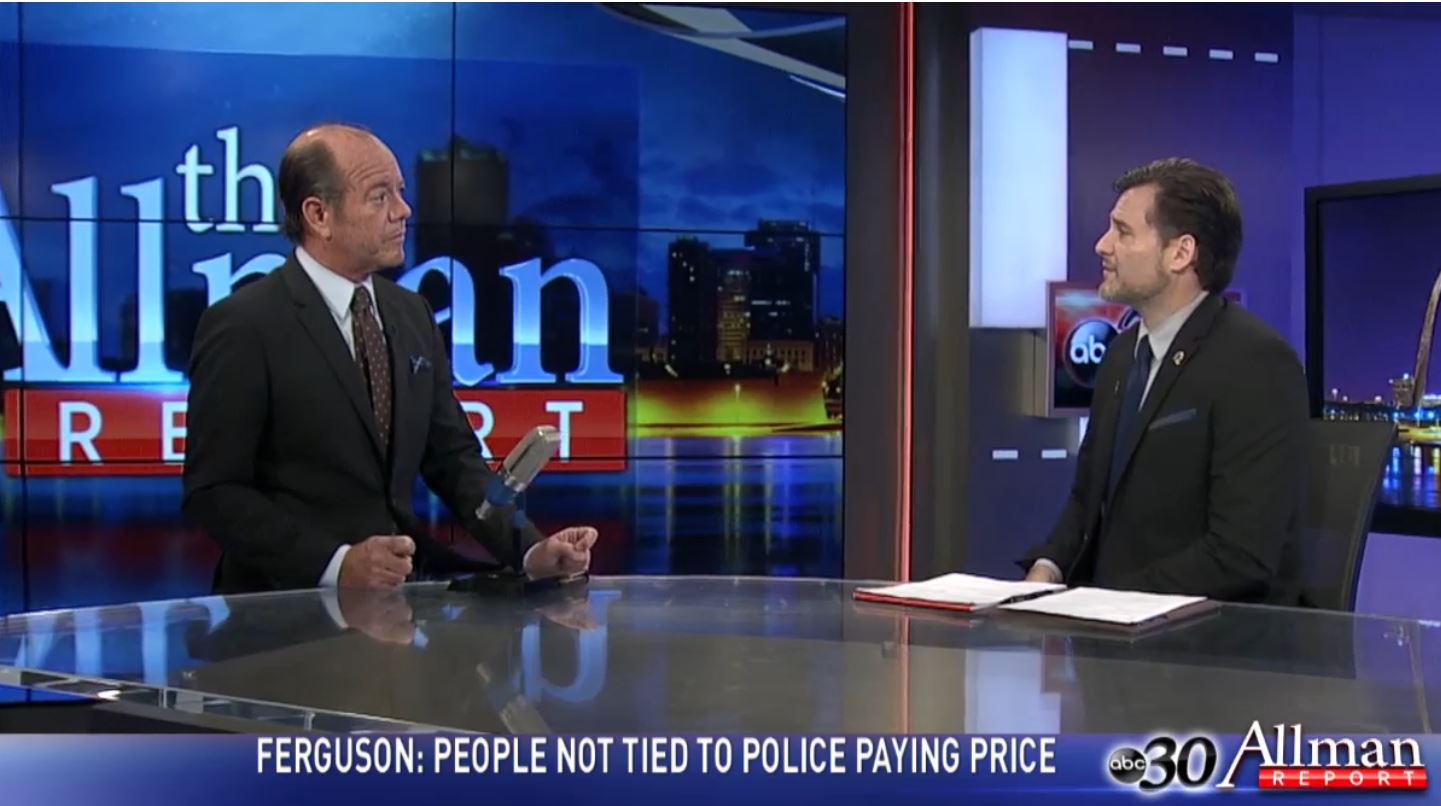
Should hair braiders have to go through the same expensive and rigorous training as cosmetologists?

A group of Missouri women who specialize in African-style hair braiding say “no.” On Wednesday their case was heard in federal court.

We’ve discussed the problems with Missouri’s occupational licensing policy before, and there’s no better example of the need for reform than the regulations that require hair braiders to undergo 1,500 hours of expensive training, most of it for services (manicures, facials) that have nothing to do with their work.

We caught up with Institute for Justice attorneys Dan Alban and Paul Avelar, who are representing the hair braiders, for a sit-down discussion on the case and on Wednesday’s hearing:

Education Department to Revisit Title IX Guidelines for Sexual Assault Investigations

On Friday, Secretary of Education Betsy DeVos rescinded a “Dear Colleague” letter that the Obama administration had issued in 2011 detailing how universities should handle accusations of sexual assault. The Department will open a period of public comment on the issue and draft new rules in the coming months.

The Obama administration’s guidelines had come under criticism as more and more individuals accused of sexual assault came forward to argue that their due process rights were being violated.

The “Dear Colleague” letter (and subsequent communications by the Department of Education) offered several bits of problematic guidance. First, the letter directed universities to follow what is called a “single investigator” model when pursuing these claims, meaning that a university employee would, as Emily Yoffe of the Atlantic wrote, act as “detective, prosecutor, judge, and jury” for the case. There is a reason why we separate those responsibilities in our court system.

Standard rules of evidence that we would expect any court of law to follow did not have to be followed. Because of the opaque nature of these investigations, those accused did not have a right to submit evidence on their own behalf or cross-examine witnesses or experts. In fact, those accused of these crimes did not even have to be notified of the specific complaint against them. It was a recipe for disaster.

At the core of all investigations is the balance between the rights of the accused and the rights of the accusers. As both Yoffe and Robby Soave of Reason.com have documented in heartbreaking detail, current processes have failed both of these groups. Due process helps to ensure that the guilty are punished and that the innocent are not. With an issue as serious as sexual assault, it is that much more important that fair and transparent procedures are followed. Let’s hope that this period of public comment brings them back into balance.

A Closer Look at Accreditation

In Missouri, it can be big news when a school district earns (or fails to earn) accreditation. Judging by the media coverage back in January, when the Saint Louis school district was fully accredited for the first time since 2007, the accreditation of a district sometimes seems to serve as a shorthand for the quality of the education that students in the district receive: An unaccredited school district is failing; an accredited district has at least crossed some threshold of adequacy.

But as usual, a closer look calls such clear distinctions into question. In her EducationNext article on accreditation and its possible role under the Every Student Succeeds Act (ESSA), Jennifer Oldham contacted the Show-Me Institute’s Emily Stahly for a better understanding of what the reinstatement of accredited status means for Saint Louis. Unfortunately, as Emily wrote back in January, in this case the news is hardly cause for celebration. The district was accredited even though most students scored below the “proficient” level in both math and English on standardized tests, because “higher scores in the attendance and graduation-rate categories made up for poor results in academic achievement.”

Oldham’s article examines accreditation from several angles, including the effect that loss of accreditation can have on districts and communities and also the incentives that accrediting agencies face. The entire article is worth reading, and offers some ideas to consider as Missouri adapts to the ESSA standards for accountability.

How Easy Is It to Get a Sunshine Request Fulfilled? It Depends.

Will Rogers once said, “I don’t make jokes. I just watch the government and report the facts.” And while government transparency is no joke, sometimes you have to laugh at how hard it can be to get information that should be readily available to the public. That continues to be the case with our “government checkbook” project, which my colleagues and I have been working on for several months now.

Let me re-set the stage. Missouri’s Sunshine Law (RSMo 610) requires municipalities and other public bodies to provide records of public interest, with some exceptions. It also states that if there is a charge billed to the requester, the municipality fulfilling the request should use employees of the public body that will result in the lowest amount of charges for search, research, and copying time.

Obtaining records of city expenses over the last five years is central to our project, and because there are so many cities in Missouri, it has been interesting to see the wide variety of reactions we have received from our uniform request (available below). As my colleague Scott Tuttle has noted before, responses to our inquiries have been uneven, with many cities promptly providing us the information we requested for reasonable fees, while others were less responsive and charged more.

For instance, the city of Festus took several days, waived their fees (as they are allowed to do) and gave a detailed Excel spreadsheet of their spending, which can be filtered and easily searched. Smithville took one day to fulfill the request and charged $20.00 for its records in PDF form. Meanwhile, Manchester—which to be fair is a city larger (population ~18,000) than either Festus (~12,000) or Smithville (~9,500)—told us it would cost approximately $1,200 and take up to four weeks for its staff to complete the response to my request.

Why the huge discrepancy in cost? The law does not specify the format in which information should be kept, or what a reasonable fee to charge is. To some degree this ambiguity makes sense, because the law has to be flexible enough to address situations and requests not considered when the statute was written. But should that gray area allow locales to drag their feet or (arguably) overcharge for documents that should be easy to access, while nonetheless complying with the law?

Although the responses from these three cities fulfilled statutory obligations, Festus and Smithville’s responses seemed to be most faithful not only to the law, but also to its spirit. As for Manchester’s response, you can judge for yourself.

It is puzzling with the technology available today why our cities and counties don’t simply publish their “checkbook” information online. There are plenty of free or low-cost platforms to keep these records up-to-date and accessible (look at what Manchester’s neighbor Ballwin is doing), and given the taxpayer interest and treasure involved, why should obstacles get in the way of accessing that information?

Click on the link below to see the request we sent out

Studies Show Benefits of School Choice Extend Beyond the Classroom

There’s an old joke often told by economists that goes something like this:

A policeman sees a man looking for something under a streetlight and asks what he has lost. He says he lost his keys and the policeman decides to lend a hand looking for them. After a few minutes, the policeman asks if he is sure he lost them there, and the man replies, no, he lost them on the other side of the street. The policeman asks why he is searching here, and the man replies, “well, this is where the light is.”

When education researchers want to measure the impact of a policy or program, they are forced to look where the light is. That usually means looking at student test scores, graduation rates, and a set of relatively limited short-term indicators.

Fortunately, school-choice researchers are starting to look at outcomes beyond just test scores, casting light into areas that were previously shrouded in darkness.

In fact, not only does new research show that school choice can boost test scores and increase the likelihood that low-income students finish college, but studies also suggest that students in school choice programs are less likely than their traditional school peers to commit crimes.

Researchers studying the high-performing Promise Academy in the Harlem Children’s Zone found promising results for students at that school, which uses a lottery system to place students in the limited number of available spots. Four percent of lottery “losers” were incarcerated compared to none of the lottery “winners.” In addition, charter school students were 17 percentage points more likely to enroll in college immediately after high school, and female lottery winners were 10.1 percentage points less likely to report having been pregnant as a teenager than lottery losers.

The Charlotte-Mecklenburg district in North Carolina used a lottery system to place students into schools that have a limited number of available seats. A study by David J. Deming at Harvard University shows that high school students who “won” the lottery and were placed into their first-choice school were arrested 70 percent less for drug charges and 45 percent less for other felony charges compared to students who entered the lottery but did not secure a spot in their first-choice school.

Schools that use lottery systems for admission are especially helpful for comparison studies because they allow researchers to compare two groups of students who both showed a desire to attend a school of their choosing. But even in situations where there is no lottery, researchers can use other techniques to help ensure the validity of their findings.

For example, researchers from the University of Arkansas found the following reduction in crime rates for male students, relative to incidence rates for their age among the general population: 79 percent for felony crimes, 93 for drug related crimes, and 87 percent for thefts. Because private school enrollment through a voucher program is not capped in Milwaukee, researchers couldn’t sort students into lottery-winner and lottery-loser groups. Instead they “used comparison groups constructed through an algorithm that matched [voucher] students with Milwaukee Public School (MPS) students based on grade, neighborhood, race, gender, English language learner (ELL) status and math and reading test scores” (see page 6 of the study).

These studies are encouraging, and suggest that school choice can not only enrich the lives of students, but also help make our cities and communities safer. No wonder school choice is becoming more popular.


Feds Find KC Streetcar Deficient

On July 24, the Federal Transit Administration issued a triennial review of Kansas City, Missouri, and its FTA-funded projects, namely the downtown streetcar. The report, available at the link below, found the city deficient in several areas, including maintenance.

A number of initial deficiencies were closed prior to the issuance of the final report, often because the city addressed the concerns after receiving a draft of the report. The city has until October 19 to address the remaining items. Of the seven initial deficiencies, one that remains concerns maintenance, including vehicle preventative maintenance, facility/equipment maintenance, and oversight of contracted maintenance.

It is a shame to learn that the city isn’t properly maintaining its streetcars—or at least is not complying with federal grant guidelines for reporting maintenance procedures. These are complicated machines, and cities such as Seattle, Atlanta, Charlotte, and Toronto have had maintenance and safety issues with their streetcars.

Cincinnati’s streetcars—which were manufactured by the same company as Kansas City’s—have had myriad maintenance problems. At one point late last year, several streetcars were offline at once.

[Southwest Ohio Regional Transit Authority spokeswoman Sallie] Hilvers cited “manufacturing defects” that caused the service issues that resulted, at one point Thursday night, in all but one of the city’s five streetcar vehicles being removed from city streets.

It is possible that Kansas City has had no significant streetcar maintenance problems—despite an embarrassing shut down on at least one occasion. And it is possible that the deficiencies cited by the FTA are easily addressed. We’ll know more when the city responds to the outstanding issues. 

Click below to see the entire FTA report

Support Us

The work of the Show-Me Institute would not be possible without the generous support of people who are inspired by the vision of liberty and free enterprise. We hope you will join our efforts and become a Show-Me Institute sponsor.

Donate
Man on Horse Charging