2018 Blueprint: Higher Education

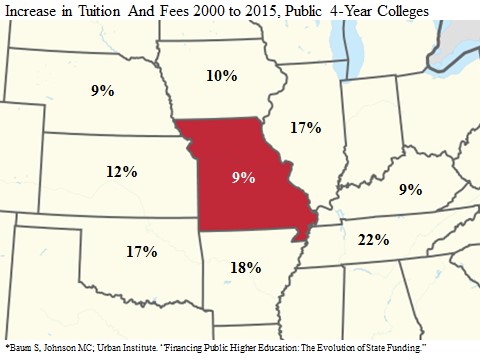
THE PROBLEM: The University of Missouri system, and higher education in the United States in general, are at a crossroads. Tuition is rising, resulting in over $1 trillion in student loan debt nationwide. At the same time, students who fail to secure high-paying jobs are facing serious financial problems. In the Show-Me State, enrollment at the University of MissouriColumbia continues to drop. The current freshman class is about 14 percent smaller than the previous year’s and is the smallest incoming class in almost 20 years.

THE SOLUTION: Higher education reform.

Reform in Missouri should focus on reduc­ing costs through innovation to attract more students. Universities could help reduce costs by encouraging competency-based education (CBE), which can reduce the time that students must spend in the classroom by granting ac­creditation when a student shows that she has mastered the subject matter. These programs allow students to pursue a degree while simul­taneously protecting them from excessive costs and loan defaults. At the same time, the state could promote income-share agreements (ISAs), which provide an alternative to student loans whereby a student agrees to pay a percentage of future income in exchange for present financial aid.

WHO ELSE DOES IT? Schools across the nation, such as Texas A&M, Purdue, University of Michigan, and University of Wisconsin, offer CBE degrees. Purdue has a self-funding ISA program in which it loans money to current students and then reinvests returns into future student borrowing.

THE OPPORTUNITY: Recent upheaval at Missouri’s largest university has given us a chance to step back and evaluate how best to improve the higher education environment and provide cost-effective options to students. The University of Missouri system made progress in protecting free speech this past summer; now it should focus on reducing costs to help draw more students to our public universities.

KEY POINTS

  • Higher education can greatly increase a student’s financial prospects, but not everyone who spends money at a university comes out in the black.
  • CBE programs can reduce tuition costs and the time a student must spend in class.
  • By reinvesting earnings, ISAs can fund future de­grees.

SHOW-ME INSTITUTE RESOURCES

Essay: Stuck in the Middle with Mizzou: Examining the Effectiveness and Efficiency of the University of Missouri

Case Study: Moving Mizzou Forward: Reform Ideas from Around the Nation

Op-Ed: Reaping the Whirlwind in Columbia

Blog Post: Mizzou Enrollment Shrinks to a New Low


For a printable version of this article, click on the link below. You can also view the entire 2018 Missouri Blueprint online.

2018 Blueprint: Highways/Transportation Infrastructure

THE PROBLEM: The Missouri Department of Transportation (MoDOT) will likely face funding shortfalls in the near future. New revenue will be needed, and it should be generated in a way that is both economically sound and fair to all Missourians.

THE SOLUTION: User fees.

User fees are about having the people who use things pay for them. That means the people driving on the roads are the ones who pay for the roads. Raising Missouri’s fuel taxes—which haven’t been raised since 1996—to account for inflation would raise hundreds of millions of dollars to help MoDOT maintain the state’s road system in the near term. But other, long-term solutions, such as tolling on major interstates and bridges, can help keep infrastructure funding sustainable. Public–private partnerships (P3s) could also help raise funds. Furthermore, expanding MoDOT’s use of design-build (a project delivery method in which a single contracter both designs and builds and improvement, reducing costs and time to completion) could save roughly 20% per project.

WHO ELSE DOES IT? Various forms of tolling are either planned or implemented in many states. Dozens of projects are funded by P3s in more than 10 states.

THE OPPORTUNITY: Missouri has the 3rd-lowest gas tax and the 3rd-lowest diesel fuel tax in the country. Adjusting these fuel taxes to inflation—raising them by less than 10 cents per gallon—would provide the funding necessary to keep Missouri’s infrastructure in good repair. With I-70 soon requiring a full rebuild, simple tolling infrastructure and a design-build workflow could be implemented to help increase available capital and reduce costs.

KEY POINTS

  • A robust and well-maintained transportation system is vital to a strong Missouri economy.
  • User fees are the most fair and economically sound way to fund major projects.
  • Design-build and public–private partnerships bring the strengths of the free market to public infrastructure investment.
  • User fees could prevent unfair special taxing districts from forming to fund wasteful projects.

SHOW-ME INSTITUTE RESOURCES

Policy Study: Funding the Missouri Department of Transportation and the State Highway System

Blog Post: With MoDOT’s Tank Nearly Empty, a Fuel-Tax Increase Might Be the Answer

For a printable version of this article, click on the link below. You can also view the entire 2018 Missouri Blueprint online.

2018 Blueprint: Income Tax Reform

THE PROBLEM: Missouri’s economy has been stalled for almost two decades, as startup growth has slowed and entrepreneurs and taxpayers are leaving the state. Missouri’s economy is shrinking relative to other states, ranking 48th out of 50 states in real GDP growth between 1997 and 2015, and 44th between the third quarter of 2009 and the second quarter of 2016. Individual and corporate income taxes are destructive to the state’s economic growth, productivity, and wealth, encouraging taxpayers to move their work or investments out of Missouri. This not only lowers economic output for the state, but also destabilizes revenue for state and local governments.

THE SOLUTION: Reduction or elimination of the individual income tax.

Lowering or eliminating individual income taxes allows Missourians to increase their take- home pay, increase business investments, and encourage population growth through in-migration.

WHO ELSE DOES IT? Seven states (Alaska, Florida, Nevada, South Dakota, Texas, Washington, and Wyoming) currently have no income tax. Two other states (New Hampshire and Tennessee) levy income tax only on dividends and income from investments.

THE OPPORTUNITY: Income tax reductions could be achieved in several ways. Reductions in tax incentives and spending can, for instance, provide the budgetary space to cut taxes. Whatever the pathway, reducing an obstacle to state and personal income growth should be a high priority if we want to jumpstart Missouri’s economy.

KEY POINTS

  • Missourians work hard for their money and deserve to keep what they earn.
  • Income taxes penalize and discourage work.
  • If you include the 1 percent earnings tax in our two biggest cities, Missouri has a top income tax rate of 7 percent, which is more than all but 17 states. Our top income tax rate equals or exceeds those of all but one of eight neighboring states.
  • A real reduction in individual income taxes raises take-home pay and encourages more consumption of Missouri goods and services, making Missouri more competitive with other states in the nation.

SHOW-ME INSTITUTE RESOURCES

Essay: The 49th State: Revisiting Missouri’s GDP Sector by Sector

Essay: Taxes Matter and They’re Too High for Missouri


For a printable version of this article, click on the link below. You can also view the entire 2018 Missouri Blueprint online.

2018 Blueprint: Open Collective Bargaining

THE PROBLEM: Under current Sunshine Law in Missouri, government bodies may close meetings, records, and votes relating to contract negotiations until the contract is executed or rejected. This lack of transparency in negotiations between government unions and government officials can lead to contractual agreements that aren’t in the public’s best interest.

THE SOLUTION: Open collective bargaining.

Open collective bargaining would allow the public to attend meetings where government bodies are negotiating collective bargaining agreements with unions to ensure that tax dollars are being spent wisely. Openness in public affairs empowers citizens to hold their government representatives accountable. The public is directly affected by policies set during collective bargaining; citizens therefore have a right to be present during such meetings. An open collective bargaining rule would not prohibit the public agency from discussing and formulating its bargaining positions in executive session.

WHO ELSE DOES IT? Alaska, Colorado, Florida, Georgia, Idaho, Iowa, Kansas, Minnesota, Montana, Ohio, Oregon, Tennessee, and Texas all require contract negotiations to be open.

THE OPPORTUNITY: A transparent negotiating process will enable the public to hold government accountable in its dealings with public employee unions and help ensure that the agreements reached between the two parties are in the interest of everyone instead of just a select group of employees.

KEY POINTS

  • Open collective bargaining gives citizens the opportunity to attend union negotiations with government bodies and help ensure that tax dollars are spent responsibly.
  • Missouri’s Sunshine Law allows government bodies to close meetings to the public if they relate to a negotiated contract, even though there is no compelling reason why negotiations between a union and a public body should be held in secret.
  • Government unions can make campaign contributions and support candidates that they will potentially bargain with after election. This advantage makes it especially important that the public be aware of how the government and public employee unions interact.

SHOW-ME INSTITUTE RESOURCES

Policy Study: A Primer on Government Labor Relations in Missouri

Video: Government Unions: Restoring Accountability


For a printable version of this article, click on the link below. You can also view the entire 2018 Missouri Blueprint online.

2018 Blueprint: Prevailing Wage

THE PROBLEM: Many government construction contracts dictate what potential contractors must pay workers to get the job. These restrictions are bad news for taxpayers and laborers alike. Taxpayers may not be able to afford to start projects whose labor costs are inflated, and of course, laborers can’t get paid for projects that are never undertaken.

The prevailing wage sets a floor for pay, but it can actually hurt the workers it’s intended to help by denying employment to people who can do the job at a more competitive price. To make matters worse, making projects more expensive also means that less taxpayer money will be available for other priorities.

THE SOLUTION: Let the market set wages.

Rather than dictate wages, the government should have policies that support a healthy jobs environment where higher wages for all sorts of construction projects—including public construction—develop on their own without the harmful effects of wage floors.

Policymakers must keep in mind that project delays can hurt their communities over time. It would be better to let the market set wage rates for these projects and to begin delivering those public services sooner rather than later.

WHO ELSE DOES IT? States with no prevailing wage law include Alabama, Arizona, Arkansas, Colorado, Florida, Georgia, Idaho, Indiana, Iowa, Kansas, Kentucky, Louisiana, Mississippi, New Hampshire, North Carolina, North Dakota, Oklahoma, South Carolina, South Dakota, Utah, Virginia, and West Virginia.

THE OPPORTUNITY: Moving away from market-distorting policies like the prevailing wage will help the state promote job growth and spend taxpayer money efficiently.

KEY POINTS

  • These reforms would promote job growth and make public works projects more affordable.
  • Taxpayers get the most bang for their tax buck when their money is spent efficiently and effectively.

SHOW-ME INSTITUTE RESOURCES

Blog Post: Special Interests Inhibiting Joplin’s Recovery?

Blog Post: Playing Favorites on the Board of Aldermen?

Blog Post: The Race Is On: Wisconsin Pushes to End Project Labor Agreements and Prevailing Wage


For a printable version of this article, click on the link below. You can also view the entire 2018 Missouri Blueprint online.

2018 Blueprint: Public Pension Reform

THE PROBLEM: Defined benefit (DB) pension plans promise employees annual payments for life upon retirement, but if a public plan does not have enough money to make these payments, taxpayers are legally bound to fund the difference. Nationwide, state-run public pension funds are underfunded by nearly $1 trillion dollars.

THE SOLUTION: Defined contribution plans.

Defined contribution (DC) plans consist of employer/employee contributions into individual accounts—think 401(k)—which employees can manage as they see fit. Upon retirement, the funds are available to employees. DC plans fundamentally differ from DB plans in that they cannot incur unfunded liability (so taxpayers are not on the hook), they put investment decisions into the employee’s hands, and they are transferable from one job to another.

WHO ELSE DOES IT? Public DC plans exist across the nation; states such as Michigan and Alaska offer DC plans for new state employees, while others such as Florida offer both DC and DB plans.

THE OPPORTUNITY: Pension reform offers a chance to stop the bleeding. DB plans cannot (by definition) incur unfunded liabilities. DC plans also offer employees a retirement account that they can manage themselves and take with them if they change jobs in the future.

KEY POINTS

  • DC plans can protect Missouri from devastating budget shortfalls.
  • When a DB plan’s investment returns are below (sometimes unrealistic) assumptions, taxpayers can be forced to pay the cost.
  • DC plans put investment decisions in the employee’s hands and can be transferred from one job to another.
  • Shifting to DC plans reduces the political incentive to overpromise when impacts won’t be felt for years.

SHOW-ME INSTITUTE RESOURCES

Policy Study: Public Employee Pensions in Missouri: A Looming Crisis

Policy Study: Missouri Transition Costs and Public Pension Reform

Essay: The Funding Status of State and Local Government Pensions in Missouri


For a printable version of this article, click on the link below. You can also view the entire 2018 Missouri Blueprint online.

2018 Blueprint: Public Union Recertification

THE PROBLEM: Once a government union comes to power, it can stay in power indefinitely. No further elections are scheduled and no term limits are imposed. This means workers can do little to ensure their union truly represents their interests and is held accountable.

THE SOLUTION: Regular public union recertification elections.

Regular public union elections would give workers the right to elect union representation to fixed terms. Regular elections would help keep union actions in line with worker interests and lead to competition among unions. It would also help prevent backlash from union leadership in response to decertification petitions.1

WHO ELSE DOES IT? Currently, Wisconsin and Iowa require regular public union elections.

THE OPPORTUNITY: The Commonwealth Foundation recently gave Missouri a letter grade of ‘D’ regarding its public labor laws. Show-Me Institute research indicates that regular union elections need not be prohibitively expensive and offer a way to ensure that unions serve workers—not the other way around.

KEY POINTS

  • Public workers in Missouri should have the right to choose who represents them.
  • Regular elections would make unions more accountable to those they represent, just as regular government elections pressure politicians to be accountable to voters.
  • Regular elections can be held at a reasonable cost to taxpayers.

SHOW-ME INSTITUTE RESOURCES

Policy Study: A Primer on Government Labor Relations in Missouri

Essay: The Low Cost of Labor Reform


For a printable version of this article, click on the link below. You can also view the entire 2018 Missouri Blueprint online.

2018 Blueprint: Right to Work

THE PROBLEM: Until recently, many workers in Missouri could be forced to join unions. That was unfair not only to the employees affected by the law, but also to employers who had to operate under it.

THE SOLUTION: Right to work.

Right to work ends forced unionism and lets workers decide whether joining a union best serves their interests. This means that being a member of a union cannot be a requirement for employment, and gives employees the final decision about whether they want to give money to a union that may or may not have their best interests at heart.

In 2017, Missouri passed Right to Work, but in 2018, the state will hold a referendum on that law.

WHO ELSE DOES IT? Alabama, Arizona, Arkansas, Florida, Georgia, Guam, Idaho, Indiana, Iowa, Kansas, Kentucky, Louisiana, Michigan, Mississippi, Nebraska, Nevada, North Carolina, North Dakota, Oklahoma, South Carolina, South Dakota, Tennessee, Texas, Utah, Virginia, West Virginia, Wisconsin, and Wyoming.

THE OPPORTUNITY: If the state’s Right to Work law is put into full effect, Missouri will join the majority of American states that already have right to work laws, finally placing Missouri employers and employees on a level playing field with other states.

KEY POINTS

  • Missouri will be better able compete with neighboring right-to-work states in attracting businesses.
  • Existing unions will be more responsive to the concerns of members, thanks to the credible threat of members leaving the organization.
  • Employees will have greater control over their representation in negotiations with their employer.
  • Employers will have greater flexibility in managing their businesses and making their operations more successful.
  • Private employers are the focus, but similar laws in the public sector, like paycheck protection, should be pursued by policymakers as well.

SHOW-ME INSTITUTE RESOURCES

Policy Study: A Primer on Government Labor Relations in Missouri

Op-Ed: Rise of the Roosevelt Law: Is Reform in Government Unions Coming to Missouri?


For a printable version of this article, click on the link below. You can also view the entire 2018 Missouri Blueprint online.

2018 Blueprint: Special Taxing Districts

THE PROBLEM: Special taxing districts (SDs) are political subdivisions of the State of Missouri that fund specific services and improvements, such as neighborhood security, fire protection, and various kinds of infrastructure. In theory, SDs can help deliver services to taxpayers efficiently and effectively. But in practice, certain SDs—particularly transportation development districts (TDDs) and community improvement districts (CIDs)—may create more problems than they solve.

First, these districts allow narrow special interests to tax the public for their own private gain. For example, a luxurious hotel in Kansas City instituted a CID in order to charge a 1 percent sales tax that it will use to refurbish rooms and replace carpeting.

Second, the districts are often drawn tightly around businesses, such as shopping malls, so that no local residents have to vote for the tax increase. The ability to draw district boundaries gives business owners a great deal of power to charge local taxes without public oversight. Without that oversight, SD boards can extend the length of their tax increases well past the initial project need.

Lastly, the Missouri State Auditor has pointed out that SDs are not transparent and that taxpayers are often not consulted in their creation and have no idea of their existence. For example, customers often choose hotels based on room rates, but rarely by tax rate—in fact, many customers do not even know they are paying these additional sales taxes.

The number of SDs is growing rapidly, and the combined impact of these small districts is adding to the tax burden of Missourians across the state.

THE SOLUTION: Stricter requirements for the creation of SDs and stronger reporting requirements to ensure accountability.

Reforms that will provide greater taxpayer protection include (1) requiring that a minimum number of residential voters live in districts; (2) requiring that the State Auditor or Director of Revenue compile an annual report that details statewide SD spending, revenue, and debt; (3) requiring all SDs sunset unless explicitly approved by district voters, and (4) requiring more transparent public bodies, such as city or county councils or commissions, approve all SD bids. To truly curb abuse, the sales taxing authority of SDs could be revoked so that only property tax revenue could support district projects.

THE OPPORTUNITY: Reforming these districts could increase transparency and provide protection for taxpayers. It would also result in lower taxes in Missouri’s largest markets by making sure that special taxing districts only act with the informed consent of voters.

KEY POINTS:

  • In 2014 and 2015 alone, TDDs in Missouri collected more than $176 million in tax revenue—yet only 6% of those TDDs had residents within their boundaries. According to the State Auditor’s report, $125 million of that revenue was collected without residential voter approval.
  • Of the 34 TDD audits the State Auditor’s office has completed over the past 10 years, one-third concluded the TDDs under consideration were in bad financial shape. And nearly all audits indicated other issues, ranging from conflicts of interest and uncompetitive bidding practices to a failure to comply with basic accounting standards.
  • Requiring SDs to demonstrate they are meeting their job creation and tax revenue goals would keep them accountable to taxpayers.
  • SD board members voting for and approving contracts for themselves is a potential conflict of interest. Requiring that contracts be put out for bid would ensure a competitive process.

SHOW-ME INSTITUTE RESOURCES

Missouri State Auditor’s Report: Transportation Development Districts (Report No. 2017-20)

Blog Post: Auditor’s Report Sheds Light on Special Taxing Districts

Blog Post: Missouri’s Troubling Sales Tax Mosaic


For a printable version of this article, click on the link below. You can also view the entire 2018 Missouri Blueprint online.

Support Us

The work of the Show-Me Institute would not be possible without the generous support of people who are inspired by the vision of liberty and free enterprise. We hope you will join our efforts and become a Show-Me Institute sponsor.

Donate
Man on Horse Charging