Kansas City Dodged the #HQ2 Bullet

Richard Florida is an urban studies theorist who promoted the idea that the creative class would drive urban renewal and that smart cities should cater to them. He was wrong, and he admits it. But not before cities like Kansas City, Missouri jumped on board and spent “probably in excess of a billion” dollars trying to create a hipster paradise downtown.

More recently, Florida tweeted a warning to cities jockeying to play host to Amazon’s new headquarters. In responding to a Financial Times story on unpleasant working conditions in Amazon’s UK warehouses, Florida tweeted:

Psst HQ2 cities. You’re gonna subsidize this company to the tune of billions … Maybe think twice …

Florida is right. Amazon demanded lots of taxpayer subsidies from the cities lining up to woo them, including Kansas City. Show-Me Institute researchers have been warning cities about such subsidies for years, but I wonder if Florida offered this same warning to Kansas City, as the area development council paid him to assist on the Amazon bid.

Mercatus Study Affirms SMI Tax Credit Suggestion from 2012

Six years ago, Michael Rathbone and I coauthored a paper that looked at Missouri’s corporate income tax, assessed its problems and posited a way of eliminating it through tax credit reform. As we said at the time, 

Missouri issued more than $400 million in development tax credits in 2012 alone. That is a lot of wealth transference.
 
Yet the magnitude of Missouri’s tax credit problem brings with it a great opportunity. Missouri’s CIT recently has generated slightly more than $300 million per year for the state—nearly equivalent to what development tax credits cost Missouri each year. In a sense, the CIT could be seen as underwriting the state’s tax credit largesse, but as has been described before, both the CIT and these tax credits tend to hurt economic prosperity. It is a growth-busting double whammy.
 
Observing that tax credit spending exceeded corporate income tax revenue, we noted that “the CIT can likely be extinguished without raising other taxes or forcing any cuts to services.”
 
Enter our colleagues from Mercatus, who released a report this week on tax incentives nationally and their impact on state tax policies (emphasis mine):
 
Several states, including Missouri and New York, could reduce their corporate tax rates by more than 90 percent if policymakers eliminated corporate incentives. Michigan, Nebraska, and Oklahoma could completely eliminate corporate taxation and still have room for cuts in other taxes if they eliminated all corporate incentives.
 
Tax credit spending and corporate income tax revenues vary year-to-year, but the picture is the same; if legislators abandoned corporate tax incentives, they could effectively eliminate the corporate income tax. Mercatus’s verification of this circumstance in Missouri is gratifying. You can find some of the underlying data used in their analysis here.
 
Missouri’s decision this year to reform its corporate income tax and reduce it to 4% is certainly welcome. That said, the ultimate target should be the elimination of the tax entirely. It hurts growth. It hurts the state. But ultimately, it hurts people. It’s time to move past it.

Where Is That City Report on Economic Development?

Are economic development incentives worthwhile? Abundant research from all over the country says they are not. Kansas City leaders disagree, and the City commissioned its own study of the practice—but that report is already over a year late and counting.

On November 1, 2016, the Council of Development Finance Agencies (CDFA) signed a contract with Kansas City to study the city’s economic development practices. Show-Me was critical of the City for hiring CDFA,  because they are a trade association whose mission is “to promote the common interest of Development Finance Agencies with respect to public policies and programs.” In other words, this group is being hired to analyze the success of the programs they promote. That hardly sounds like an impartial researcher. (But then our TIF Commission staff is funded by fees collected from TIF recipients, so conflicts of interest seem to be the standard operating procedure.)

Nevertheless, a study such as this is warranted, because Kansas City spends or diverts a lot of tax money to private developers. Studies of TIF and other incentives have found they are largely a waste of taxpayer money. This includes a report recently completed in St. Louis for the very corporation that doles out these dollars. That study concluded that TIF does not spur investment or create jobs; that it is not used in the economically struggling areas that need it; and that the level of reporting on these subsidies is poor. Other studies by universities and research institutions have likewise found TIF policies greatly wanting. Kansas City is due such an examination.

The contract signed with CDFA set a maximum payment of $350,000 for the study and set a deadline of May 1, 2017 for the final report. In an October 2017 email, Kerrie Tyndall, the director of economic development for Kansas City, wrote that the report should be received by the end of 2017—seven months late. In a November 2017 Kansas City Star story, Steve Vockrodt wrote that the report should be released in January 2018—eight months late. Ms. Tyndall indicated to me in March that the report should be delivered in mid-April—11 months late. As of this writing, May 25, there still is no report.

It is noteworthy that Public Financial Management, Inc., the company retained to provide analysis of economic development subsidies in St. Louis completed its study in 15 months and for half the cost of what Kansas City authorized. The Show-Me Institute issued its own analysis of TIF use in Kansas City and St. Louis after less than a year of study and at no cost to taxpayers.

A pricey, publicly funded and repeatedly delayed report on subsidies—performed by a group that supports such spending—isn’t likely to build confidence among residents. Kansas Citians deserve better policy and better policymaking.

Like a Sore Thumb: Missouri’s Testing Standards Buck National Trend

Marching to the beat of your own drummer is all good and well as long as you know where you’re going. A recent study published in Education Next suggests that Missouri—alone out of all 50 states—is headed in the wrong direction with regard to state proficiency standards for students. The study compares how well students in each state do on their states’ proficiency tests to how well they do on the National Assessment of Educational Progress (NAEP). For example, if 25 percent of students in a state scored proficient on the state’s test, but 50 percent scored proficient on the NAEP, that would indicate that state’s proficiency standards are more rigorous than the national standards. Since states have different state assessments and the NAEP is administered in every state, the NAEP serves as a Rosetta stone and allows us to compare the standards of different states.  According to the analysis, every state in the nation increased the rigor of their proficiency standards from 2009 to 2017. . . except Missouri. This could have significant implications for Missouri students, especially students in Missouri’s most disadvantaged school districts.

When a school district in Missouri loses accreditation, students are allowed to transfer to a higher-performing school district. In recent years, thousands of students from the Normandy and Riverview Gardens School Districts used this provision in state statute to transfer to some of the highest-performing school districts in the state. But students lost the right to transfer when the state board of education voted to give the school districts provisional accreditation, based in part on improvements in student achievement-test scores. Based on the Education Next study, we have to wonder whether those learning gains were just an illusion caused by the state making the test easier.

It is important to understand this analysis is not comparing the rigor of the learning standards in each state. Standards say what students should learn in each grade. The relevant measure here is what students must score to be considered proficient by the state assessment. While the tests are developed based on the standards, setting the cut-score is a subjective process.  The lower the cut-score, the higher the percentage of students who will score proficient.

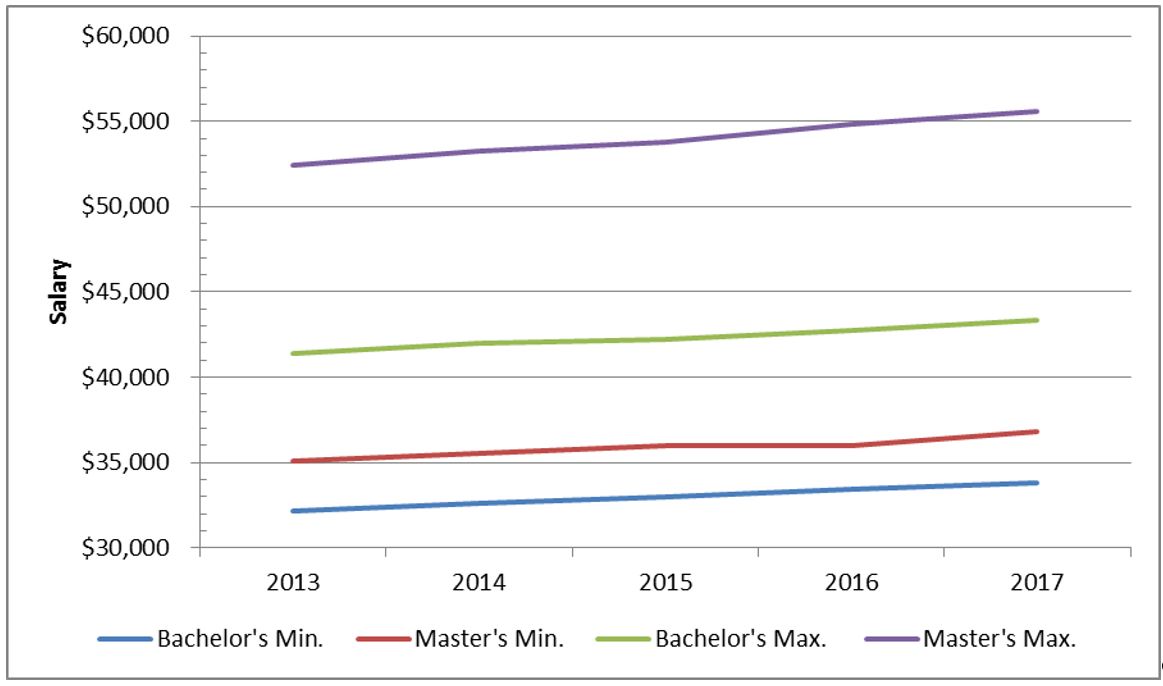
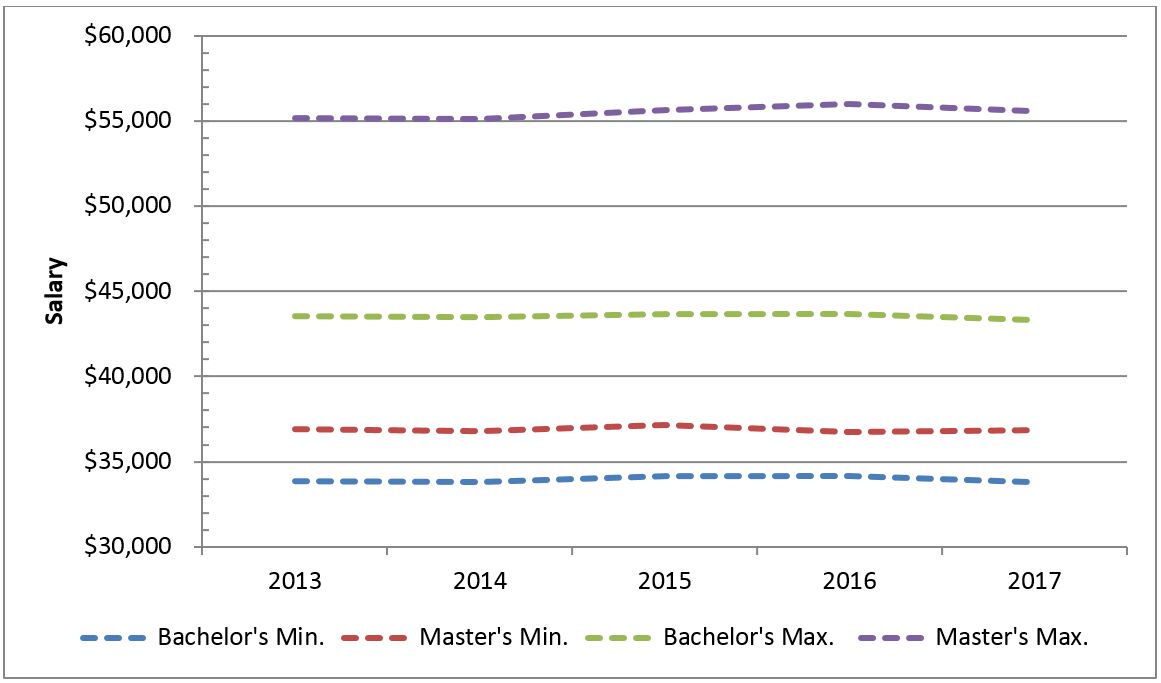
In 2009, Missouri had among the most rigorous assessments in the nation. The two images below come from a report from the U.S. Department of Education, “Mapping State Proficiency Standards Onto the NAEP Scales.” Look far to the right and you will notice that Missouri led the nation in rigor on the 8th grade reading assessment and had the third most rigorous state assessment in 8th grade mathematics.

Language Arts Standards Graph

Mathematics Assessment Graph

What followed 2009 was chaos. Missouri adopted the Common Core standards and ditched our rigorous state assessment. The state then went through turmoil as citizens pushed back against the Common Core, the legislature called for new standards to be written, and the state shuffled through four different state assessment systems. In the end, we wound up with an assessment that was easier than the one we had before.

Forget for a moment the overall message that lowering standards sends and the potential it has to impact all students. In the cases of Normandy and Riverview Gardens, lowering standards may have had a direct and detrimental impact on students. The year Normandy lost its accreditation, just 22 percent of the district’s students scored proficient or advanced in communication arts and 23 percent did so in math, according to the St. Louis Post-Dispatch. In 2017, the district regained provisional accreditation even though the performance of students in the district was not substantially better. That year, 34 percent of students scored proficient or advanced in communication arts and only 19 percent did so in math. Keep in mind these scores were with the easier tests.

Missouri’s state board of education voted to give provisional accreditation to the Riverview Gardens School District in 2016 and the Normandy Schools Collaborative in 2017. It seems those decisions may have been based on the faulty assumption that the student achievement in the districts was improving, when it seems the state was just giving easier tests. At the very least, we owe it to the students of these districts to investigate this further.

On Superintendents and Their Districts

Does it really matter who’s running a school district? Put another way, is paying top dollar for a superintendent a smart investment for a school? Recently, Show-Me Institute researchers sent out Sunshine requests to the 20 largest school districts in Missouri seeking their superintendent contracts dating back to the 2010–2011 school year. The purpose was to take a closer look at superintendent pay and compare it with school performance.

Sixteen districts responded with contracts showing superintendent salaries ranging from $125,000 to $294,000 per year. We also looked at an evaluation of those same school districts from the Stanford Center for Education Policy Analysis (CEPA), which measured the performance of 3rd-grade students in 2009 and then, five years later in 2014, measured the performance of the students in 8th-grade. The object of the CEPA study was to determine if students experienced a full five years of academic growth in five calendar years.

The table below shows superintendent salaries from 2011 to 2014 and student performance growth from 2009 to 2014 for each school district that responded to our sunshine request.

District Mean growth (in academic “years”), 2009–2014 Average superintendent salary, 2011–2014
Columbia 93 4.61 $182,095
Ferguson-Florissant R-II 4.28 $212,851
Fort Zumwalt R-II 5.59 $176,330
Francis Howell R-III 4.80 $191,797
Hazelwood 4.72 $228,247
Kansas City 33 4.33 $234,970
Independence-30 4.70 $210,820
Lee’s Summit R-VII 4.68 $238,553
Liberty 53 4.36 $164,000
Mehlville R-IX 4.64 $190.233
North Kansas City 74 4.56 $230,913
Parkway C-2 5.44 $229,406
Rockwood R-VI 4.37 $235,920
Springfield R-XII 4.55 $171,901
St. Joseph 4.39 $152,953
Wentzville R-IV 5.16 $198,326
Average 4.70 $203,082

The average academic growth between 3rd grade and 8th grade in these 16 districts is 4.7 years. Only three districts had five or more years of growth over the five-year period studied—Fort Zumwalt, Parkway, and Wentzville.

Because the time covered in the Stanford study (2009–2014) doesn’t align exactly with the superintendent salary information (which only goes back to 2011), we can’t make a perfect comparison of the salaries against performance. But based on the four years for which we have both sets of data, it’s difficult to see a direct connection between the two. Of the three districts with more than five years of growth in the table above, only Parkway paid its superintendent above the average rate from 2011 to 2014.

In fact, evidence of any connection between superintendents and student performance is hard to come by. One Brookings Institute study looked at the effect of superintendent turnover on student performance in North Carolina and Florida schools. It failed to find a significant connection. Nor did the study find a relationship between student performance and superintendent longevity.

Such studies make it appropriate to question why superintendent salaries are so high. There are certainly plenty of reasons why people think they should be high. Superintendents are like the CEOs of the school district. They oversee the management and budget of all the schools in the district. Perhaps most importantly, they hire principals and other administrators in the district, who in turn hire the teachers.

But with little evidence that superintendents are making a significant difference in student performance, it’s reasonable to ask why districts are paying them so much. The people in the school hierarchy who have the most effect on student achievement are teachers—and at an average salary of around $53,000, they earn around one-fourth of what superintendents earn. That’s not even considering the school pension system, which definitely favors the higher paid. All of which takes us back to a question that James Shuls raised in an April blog post: Is this really where we want to spend our money?

Did Easier Tests Cost Normandy Students the Right to Transfer?

On December 1, 2017, the Missouri State Board of Education went into a closed session and ousted Commissioner Margie Vandeven. Yet that wasn’t the only controversial decision that day. In a unanimous vote, the board decided to classify the Normandy Schools Collaborative as provisionally accredited. That move meant that thousands of students lost the right to transfer to higher performing schools. Now it seems that vote was made without all of the facts.

A recent study in Education Next by Daniel Hamlin and Paul Peterson of Harvard University shows that Missouri’s state assessments have gotten easier. In fact, Missouri was the only state in the nation to decrease the difficulty of state assessments from 2009 to 2017. As recently as 2009, Missouri’s state tests were given a grade of “A” by the publication and were ranked second in the nation, behind only Massachusetts. This meant we set a high bar for achieving proficiency. Since then, we’ve dramatically lowered our standards. Missouri’s assessments now receive a letter grade of “C” and rank us 48th in the nation.

 Keep in mind that test scores are a significant component of the score a school district receives on the state’s Annual Performance Report (APR). Normandy has made substantial improvement on the APR. The district scored just 7.1% in 2014. When the state board voted to reaccredit the district, the APR score was 62.5%. That score was just barely above the 60% threshold for provisional accreditation and was the district’s first year scoring in that range. At the time, 8.7 percent of the district’s 8th-graders scored proficient or advanced on the state’s easier assessment.

We shouldn’t dismiss the progress the Normandy Schools Collaborative has made. Under the steady leadership of Superintendent Charles Pearson and the oversight of the state, the district is clearly heading in the right direction. The question is whether the state’s easier assessments may have given the school district the extra 2.5 percentage points on the APR that put the district into the provisional accreditation range. More importantly, would the state board of education still have voted to reaccredit the school district if the members had known some portion of the district’s academic gains were illusory?

We won’t know the answer to that question for some time. Right now, the state board does not have a quorum as the five members who voted to fire the commissioner have been withdrawn. This means the board can take no action on this or any other issue. It also means that students in Normandy and other provisionally accredited school districts will be required to return to their home school districts next year. Students who transferred to Clayton, Kirkwood, and other high-performing school districts will be forced to go back to the schools they sought to escape. 

When the vacant state board seats are finally filled and the board reconvenes, they will have a lot of work to catch up on—including hiring a new education commissioner—so it will be easy for the members to overlook the situation in Normandy. That would be an injustice to the students there. At the very least, the board should thoroughly investigate the extent to which easier tests cost them the opportunity for a better education.

Legislature Passes Bill to Bring Transparency to Schools

If school districts can levy taxes, then taxpayers should be able to see exactly how the money is being spent. And with the passage of House Bill 1606, it would seem the Missouri legislature agrees. If it’s signed by the governor, the new law will help bring transparency to school district spending, an aspect of government that is the focus of the Show-Me Checkbook Project. Public school districts will be required to develop a searchable database to track their expenditures and revenue, and that database will be made available to the public. The law also directs the Department of Elementary and Secondary Education to create a template that a school may use if it does not have a website to host a database.

It is especially encouraging to see the legislature pass HB1606 at a time when audits show how schools can mismanage the money they receive.

I hope this legislation will serve as a template for the establishment of other databases to monitor how cities, counties, and special taxing districts spend the public’s money. Such databases are a 21st-century tool for the age-old task of keeping government accountable to taxpayers.


Support Us

The work of the Show-Me Institute would not be possible without the generous support of people who are inspired by the vision of liberty and free enterprise. We hope you will join our efforts and become a Show-Me Institute sponsor.

Donate
Man on Horse Charging