Missouri’s Making Improvements, but Still Trailing

The last few months have been good for the economy. The benefits of the recent federal tax cuts appear to be taking effect, resulting in a 4.1% national GDP growth for the second quarter of 2018—led by increased consumption and exports—and a 4.0% unemployment rate.

Based on the Bureau of Labor Statistics’ June data for Missouri, there is good news for our state, too. Our unemployment rate ticked down to 3.5% from 3.6% in May, which was already down from 3.7% in January. Missouri is now half a percentage point below the national unemployment rate. Additionally, Missouri’s labor force saw an increase of 8,000 people in just the last month. These data might suggest that an increasing number of Missourians are interested in working, and they are successfully finding jobs.

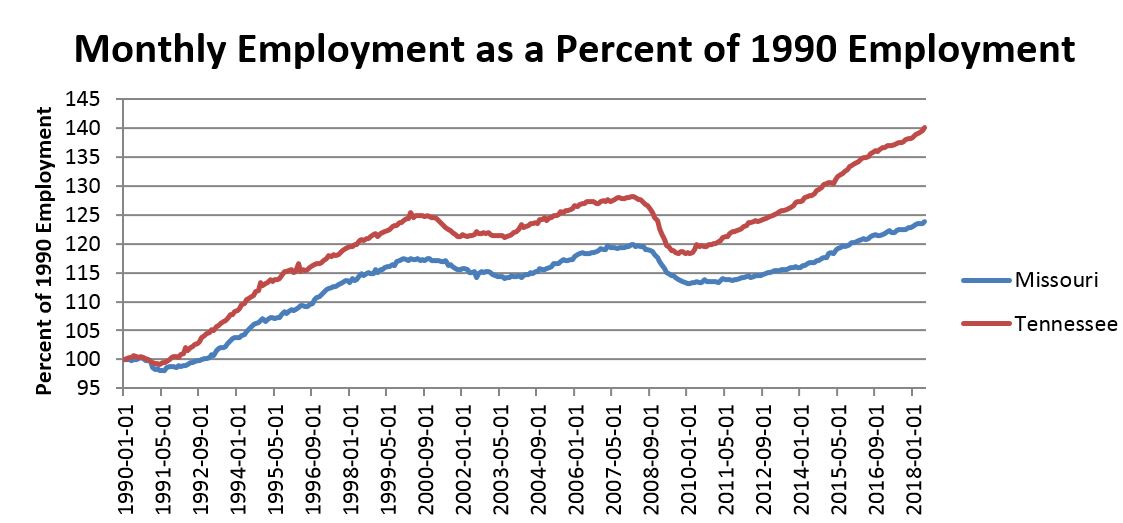
These statistics do not tell the whole story, however. Historically, Missouri is one of the slowest growing states in the nation. Compared to Tennessee, a demographically similar state, Missouri is still underperforming despite having similar unemployment rates. When looking at the growth in employment, Tennessee trumps Missouri. The figure below displays total employment as a percentage of 1990 employment. Even with a good last few months, Missouri lags behind Tennessee.

Chart: Employment as a percentage of 1990 employment

With similar demographics and access to resources, it should be possible for Missouri to experience Tennessee’s level of growth. As we discussed before, Tennessee’s improved performance might be related to its education and workforce development initiatives or lower tax burdens. Missouri has been heading in the right direction in recent months—but should we be content, or should we examine whether Missouri could benefit from adopting the policies that have helped Tennessee’s growth outpace ours?

Missouri Public Teachers, Take Note: Union Membership Is Optional

It’s back to school time, and new teachers have a little homework to do before the start of the school year. This summer the U.S. Supreme Court ruled that government unions, including local teachers’ unions, can no longer require non-members to pay fees to the union as a condition to employment. This had basically been the case in Missouri already, but for 22 other states, the ruling was a significant leap forward in workers’ rights, decades in the making.

But regardless of the extent to which the case affected a given state, the Court’s ruling highlights a pair of important questions that Missouri educators have to grapple with each year: namely, why might teachers join a union, and if they joined, what would their dues pay for?

Unionized teachers do receive some tangible benefits from their membership, such as legal services in the event they’re fired or sued, and liability insurance. The cost of union membership varies depending on location and the union involved; dues are typically either flat, such as the annual $219 for the Missouri State Teachers Association, or a percentage of salary, such as the one percent for the St. Louis chapter of the American Federation of Teachers (AFT). Of course, if a teacher doesn’t join, he or she is still covered by the salary schedule; not joining has no impact on things like health insurance, tenure, or seniority.

But if a teacher does join a union, a portion of their union dues often goes to advocacy work and to support political candidates. Given the diverse opinions of teachers, the funneling of dollars to particular causes often runs afoul of an individual teacher’s own personal beliefs. For example, at the national AFT conference just a few weeks ago, a resolution was passed that stipulated what policies a candidate must support to receive the union’s endorsement. These included, among other things, universal health care, universal and free child care, doubled per-pupil expenditures for low-income students, and free college

What a lot of teachers don’t know when faced with the decision of joining a union is that the vast majority of the benefits unions offer are also available through other vendors. For example, dues for Association of American Educators (AAE), a non-union professional organization for teachers, are just under $200 per year, and the benefits are similar to those offered by unions—disability insurance, legal protection—but without the politics. And if joining a group of any kind isn’t your style, teachers can always buy many of the benefits they want a la carte on the open market.

In short, Missouri teachers have a lot of options in determining how they’ll advance their professional interests—and they can do so with or without the political speech embedded in the operations of a government union. And especially after the passage of HB 1413, teachers in Missouri are particularly empowered to have a say in who represents them to their districts, and to see how unions spend the money they receive from members. Perhaps one day, public school teachers will even be able to negotiate their own employee contracts and have a freer hand to choose their health insurance and retirement plans, like many of the rest of us already have. But until then, Missouri teachers still have a lot of choices that they can make, and fortunately, subsidizing a union’s political speech doesn’t have to be one of them.


So Glad You Could Join Us . . .

It’s hard to see the chalkboard from the back of the class. When you’re not even in the room, it’s impossible. For too many students, chronic absenteeism—missing 15 days of school per year or more—is the norm. Not being in school makes it pretty hard to learn. And yet, in Missouri’s Department of Elementary and Secondary Education (DESE)’s Annual Performance Report (APR) system, schools with high rates of absenteeism often receive high or even perfect 10 out of 10 scores for the attendance component. How does this happen?

According to data from the U.S. Department of Education, in 2015–16 Missouri had 42 schools in which more than one-third of students were chronically absent. But a look at their APR scores would leave you thinking that attendance is fine. Only 11 of these schools received fewer than half of the 10 possible attendance points, and fourteen received 7.5 points or more. In one of the most egregious cases, Kansas City’s Central Middle School was accredited with 7.5 of its 10 attendance points, even though 54 percent of its student body was chronically absent.

Similarly, there were seven school districts in which 25 percent or more of the students were chronically absent, according to the federal government—and not one of these districts received fewer than 60 percent of their attendance points. Even Kansas City, where nearly 40 percent of students were chronically absent, received six out of ten possible APR attendance points.

Why is the rating system so generous with attendance points? Simply put, because there are actually 17.5 points available for a score that is based on a 10-point scale. Here’s how it works:

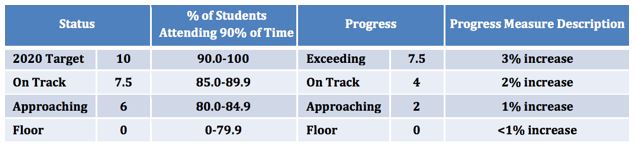
Two factors contribute to the attendance ratings. “Status” is based upon the percentage of students who attend at least 90 percent of school days, and “progress,” is the percentage change in this figure from the previous two-year average. Ten points are available for status and 7.5 additional points are available for progress, as shown in the table below. So, schools and districts only need to get just over half of the points to get the maximum score. For example, Kansas City’s Sunshine Elementary—where 39 percent of students are chronically absent—received 7.5 status points and 4.0 for progress, earning a perfect 10 out of 10 points.

DESE’s flawed attendance formula sets a low bar for public schools and obscures Missouri’s problem with chronic absenteeism. Granting APR points for attendance in the first place is questionable, as it lessens the weight of academic performance in the overall evaluation—a topic I’ll explore more in a future blog post. But if attendance is to be included in the APR formula, it should be measured in a way that alerts the public when absenteeism becomes a problem at a school.

Table: Attendance weight in APR score

Fall 2018 Internships

The Show-Me Institute is pleased to offer internship opportunities for Fall 2018.

  • Internships are open to current undergraduate and graduate students, as well as recent graduates.
  • Internships last approximately four months. The exact starting and ending dates are flexible, but we anticipate that each internship will run from September 17 until December 14.
  • Fall interns will work a part- or full-time schedule (9 a.m.-5 p.m.).
  • Interns will be involved in many aspects of the Institute’s operations. Interns will work closely with senior staff on a wide variety of projects. They can expect greater responsibility and personal attention than they would receive at larger organizations.
  • Interns will assist staff members with a variety of tasks. These may include researching public policy topics, organizing events, and writing and editing blog posts, newsletters, studies, and other documents. Some administrative and clerical tasks also will be required.
  • A Show-Me Institute policy internship is an excellent opportunity to improve your research and writing skills. Each intern will produce regular blog posts and an op-ed on a public policy topic of interest to him or her. Each intern will receive feedback and assistance from SMI staff members throughout the process.
  • Policy internships as well as communications and development internships are available.
  • Internships are available at the office in St. Louis or Kansas City.
  • Interns will be paid on an hourly basis.

Those wishing to be considered for an internship should submit the attached application and the requested supporting materials. The deadline for applications is August 24, 2018.However, we will begin conducting interviews as applications are received. Applicants can expect a decision in early September.

Not Bronze, or Silver, or Gold, or Platinum-Just Affordable

Paying crippling premiums for health insurance? There may be a solution. On August 1, the departments of Health and Human Services, Labor, and Treasury implemented new rules expanding short-term, limited-duration health insurance (STLDI) options by increasing the plans from a maximum of three months to twelve and permitting renewability for up to three years—thus making short-term plans, in essence, a long-term option.

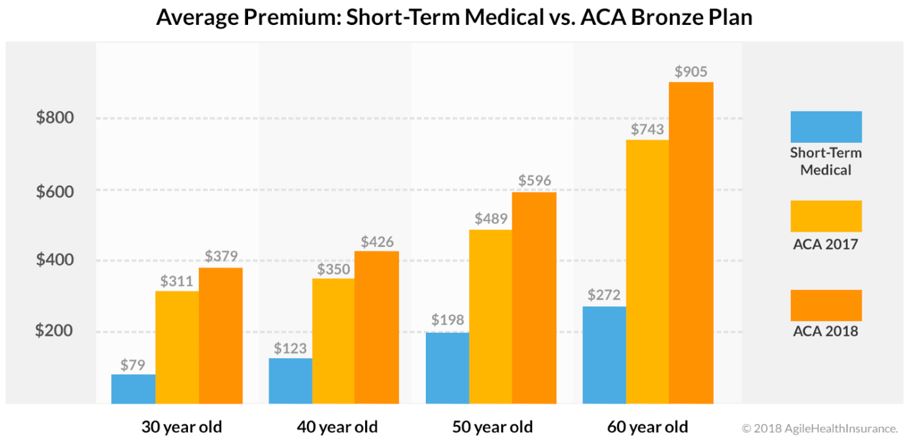
How do STLDI plans save their members money? For starters, short-term plans are not ACA-compliant. They do not offer all ACA required benefits, cover preexisting conditions, prohibit dollar limits on benefits, or insure dependents to the age of 26—some of the very provisions that drive up the cost of insurance. But because coverage is less comprehensive, individual monthly premiums for STLDI plans cost substantially less than unsubsidized ACA plans (see chart below). For many Missourians, these affordable plans are a welcomed option.

The rise of these STLDI plans will likely affect the ACA insurance markets. The departure of low-cost, younger and healthier customers could increase the volatility of ACA risk pools and stoke spiraling premiums further. And for those who choose an STLDI plan? Those customers may have made a bad bet if they get really sick, given STLDI’s comparatively skinnier benefits relative to the more expensive ACA plans. But considering that almost half of Missouri’s population is under the age of 34 and that many are being crushed by exorbitant premiums, a number of Missourians could benefit from an STLDI expansion.

Missouri currently limits its STLDI plans to six months, requires plans to cover some state-mandated benefits, and necessitates that customers have a 63-day gap in coverage before purchasing short-term plans. These regulations impede customers’ access to these plans, creating significant barriers to affordable insurance.

In the 2018 legislative session, Missouri considered House Bill 1685, which would have extended the six-month limit on plans to a full year. Though the measure did not pass before the session ended, it received support in both chambers, and a similar bill could appear in 2019. In light of the change in federal rules, isn’t it time for policymakers to consider expanding short-term plans for the sake of Missourians’ health—both physical and financial?

Health plan cost comparison

Film Tax Credits: Facts and Fiction

Over the weekend, the St. Louis Post Dispatch published a piece about yet another Missouri-based television program that is being filmed in Georgia. While some lament that Missouri has stopped offering tax credits to film makers, it remains the right decision.

The Post-Dispatch mentioned that many other states have also ended their film tax credit programs due to low returns on the investment. But the Post did manage to find one advocate in Kansas City:

Steph Scupham, director of the Kansas City Film Office, said the benefits of landing a project outweigh the costs.

“I don’t know what’s wrong with people coming in, doing business, spending money and leaving,” she said, “especially when it also educates the people in our industry and gives our industry that is here more experience.”

Indeed, nothing is wrong with “people coming in, doing business, spending money and leaving.” What is wrong is taking precious tax dollars intended to support basic services like police and schools and giving them to private film companies. Not only is it wrong, it doesn’t work.

A recent study from the Beacon Center of Tennessee found that “using available box office data, over 40 percent of films that receive grants made less at the box office than they received in incentives.” That is a stunningly bad track record. Missouri’s own Tax Credit Review Commission wrote in their 2010 report that the film tax credit should be cut because it “serves too narrow of an industry and fails to provide a positive return on investment to the state.”

My colleague Patrick Ishmael wrote exactly one year ago that to the degree Georgia is underwriting a piece about the Ozarks, Missouri is coming out ahead. Thankfully, the Post-Dispatch makes clear there is no danger of reinstating such a film tax credit regime statewide. Kansas City ought to scrap its effort, too.

Who’s to Blame for Stagnant Teacher Salaries?

Last spring, in what has been referred to as a “smoke ‘em if you’ve got ‘em” moment, teachers in four states staged walkouts to protest low wages and low spending on education. They did so just before an expected Supreme Court ruling that could cut into the power of teachers’ unions, so it made some sense that they would flex their muscles ahead of the ruling.

It’s not hard to understand why teachers are angry. In Missouri, the average teacher salary in 2000 was $51,100 (in 2016 dollars) and in 2016 it was $48,300. But the question is: Who should they be mad at? Can the folks in Jefferson City give raises to all Missouri teachers? They cannot. In most Missouri districts, school boards negotiate with the local teachers’ union to determine salary schedules. So somewhere along the line, even as spending per student increased from $8,900 to $10,500 (both in 2016 dollars), higher teacher salaries have gotten lost.

One important factor has been the growth in staff since 2000. Since that time Missouri’s public school enrollment had a net increase of  4,250 students, but public school staffing increased by 5,500 individuals, about half of whom were teachers. That’s right—there have been more adults hired to teach and run schools than there have been new students. I’ve written quite a bit about legacy costs (pensions and buildings) consuming more and more education dollars, but staffing increases are a huge driver of lower teacher salaries—the payroll money is being spread among more and more employees.

In 2015, the average pupil/teacher ratio in Missouri was about 14:1, and the average spent per student was $10,500. This means that about $150K was spent to run the average classroom. If I were a teacher and only about 30 percent of what was spent in my classroom went to my salary, I’d want to know where the rest went, and why. I’d also like the option to bump my class size up to 15 or 16 students if I were able to keep the increased funding.

I’m not second-guessing staffing decisions, but school districts have to make tradeoffs between hiring more staff or paying teachers more—and they seem to have chosen the former. If teachers don’t like that, they need to go to the actual decision makers—school boards and superintendents, maybe even those who represent them at the table–and demand something different. And if they’re paying dues to their local union to do their negotiating for them, they may want to consider how that’s working out for them.

[[{“fid”:”4907″,”view_mode”:”default”,”fields”:{“format”:”default”,”field_file_image_alt_text[und][0][value]”:”Teacher’s desk”,”field_file_image_title_text[und][0][value]”:”Teacher’s desk”},”type”:”media”,”field_deltas”:{“1”:{“format”:”default”,”field_file_image_alt_text[und][0][value]”:”Teacher’s desk”,”field_file_image_title_text[und][0][value]”:”Teacher’s desk”}},”attributes”:{“alt”:”Teacher’s desk”,”title”:”Teacher’s desk”,”class”:”media-element file-default”,”data-delta”:”1″}}]]

Support Us

The work of the Show-Me Institute would not be possible without the generous support of people who are inspired by the vision of liberty and free enterprise. We hope you will join our efforts and become a Show-Me Institute sponsor.

Donate
Man on Horse Charging