St. Louis Airport Privatization Documents

Last year, the City of St. Louis applied to the Federal Aviation Administration (FAA) to relinquish St. Louis Lambert Airport to a public–private partnership. The request for proposal sought to:

receive bona fide proposals from firms, partnerships, consortiums, etc., with the technical expertise and financial resources to enter into a public–private partnership for the long-term lease, management, operation, and development of the Airport. The Airport Lease RFP shall be in a format acceptable to the FAA and shall be appropriate for submission as part of the City’s final application document.

The Show-Me Institute filed an open records request for the request-for-proposal document (available here), the proposals the city received, and the resulting contract with the winning bid. Those 11 bids are listed below, with links to the full text of each. Note that in two cases the document we received was divided into two parts, perhaps to make electronic transmission easier. Note also that some bids contain redactions, perhaps to protect sensitive information.

The selection committee for the city chose the Moelis & Grow Missouri proposal. The resulting contract with the city is here. We note that Rex Sinquefield, the president of the Show-Me Institute, is associated with Grow Missouri.

Show-Me Institute researchers have not had the opportunity to go through the proposals, but the information is presented above for public review.

It Depends on What You Mean by “Accredited”

Parents: Read the fine print. A recent blog post on chronic student absenteeism was written under the assumption that a school that displays a “Fully Accredited” banner does so for the same reason that school districts claim full accreditation—because of the school’s score on the state’s Annual Performance Review (APR). Actually, there’s a difference. Missouri’s Department of Elementary and Secondary Education (DESE) accredits districts, not individual schools. And because accreditation is a district matter, any school in a qualifying district can fly a banner like the one shown above, even if the school’s APR score on its own wouldn’t pass muster.

In other words, the Department of Elementary and Secondary Education (DESE) has developed a system for evaluating school districts by evaluating schools, but the accreditation label is only applied at the district level. If you find this a bit confusing, you aren’t alone. On my commute to work, I drive by schools in St. Louis that proudly display “Fully Accredited” banners. Like any reasonable parent, I assumed that the banner and the status apply to the school. Apparently, the fine print at the bottom suggests that it’s actually the St. Louis Public School District that is fully accredited, and therefore any public school in the district can advertise under that blanket designation. Given that all but six of over 500 school districts in Missouri are fully accredited, one could assume that nearly every school in the state could fly the same banner. If public schools were subject to consumer protection laws, then a number of parents might be the victims of false advertising.

What does any of this tell parents? The Missouri School Improvement Program (MSIP) 5 system, in which schools and districts are rated on the percentage of possible points attained, is very confusing on its own. It’s unlikely that a parent would know that an APR score of 67 means that their child’s school got 50 out of 75 points on a scale with five sets of indicators. Why doesn’t DESE make information more easily available and understandable to parents? Why is DESE providing cover for low-performing schools.?

My colleagues and I try to be careful in our analysis; still, mistakes happen, and we need to own them. We also believe that those who serve the public need to own their mistakes. We will continue to press DESE to provide parents with accurate, complete, and usable information on each school in our state.

Rest in Peace, Stan Brock

This afternoon I received an email from Remote Area Medical (RAM), the volunteer health care organization that largely served as the basis for Missouri’s Volunteer Health Services Act of 2013. But rather than announce another one of their great public service events, this email had bad news. Stan Brock, RAM’s founder, has died.

From the email:

It is with great sadness that Remote Area Medical announces the passing of our Founder and President, Stan Brock. Mr. Brock passed away today in Knoxville, Tennessee at the age of 82. Since he began RAM in 1985, Mr. Brock has been a tireless advocate for those in need, and through his leadership, RAM has provided free care to more than 740,000 individuals.

Without Mr. Brock, RAM would not have been able to prevent pain and alleviate suffering for so many people. While Mr. Brock’s death is a great loss to the organization, RAM will continue championing his legacy and caring for those in need. Mr. Brock built a strong organization led by a dedicated 12-member Board of Directors, 34 staff members, and tens of thousands of volunteers and donors. Together, they will continue to fulfill the mission set by Mr. Brock so many years ago in the jungle of Guyana.

I met Stan for the first time at a Cato Institute conference some years ago, and I was struck by not only the quality of the organization itself, but by the effervescent attitude that Brock brought to providing high quality care, free of charge, to the nation’s poorest and most at-risk individuals. He was a force of nature who was not shy about offering help in a crisis.

But while his personality was larger than life, he always struck me as a humble man intent on finding ways to serve. I join thousands of others mourning his loss but am thankful that RAM, an organization he founded and led for so long, will continue doing the good work he started.

For those seeking more information about RAM, this 60 Minutes segment from 2008 summarizes it well.

Should Missouri Increase the Minimum Wage to Help the Working Poor?

In Missouri, a single parent employed full time at a minimum wage job will still be in poverty. Some see this as justification for raising the minimum wage, on the grounds that no one who works full-time should be in poverty. This argument has been part of the drive to raise the minimum wage, and that campaign has led to a minimum wage increase proposal on the statewide ballot for November.

While the situation for single parents working minimum wage jobs is undoubtedly difficult, increasing the minimum wage can harm people in that position, as well as those struggling to hold down a job. After Seattle increased its minimum wage, low-wage workers had their hours cut, and the number of minimum wage jobs decreased. In fact, it is the people without steady employment who are much more likely to be in poverty and who are hurt the most by the unintended consequences of a higher minimum wage.

In a working paper for the American Enterprise Institute, Angela Rachidi uses data from the Survey of Income and Program Participation (SIPP) to show that most families who have one adult consistently working are not in poverty—and if they are in poverty, it is likely to be for short periods of time. SIPP data give us unique insights because they follow the same families for 36 months and track their poverty and job status during that time. When measuring the federal poverty rate, on the other hand, the Census Bureau merely asks families if they have been in poverty at all in the past 12 months but nothing else about their situation.

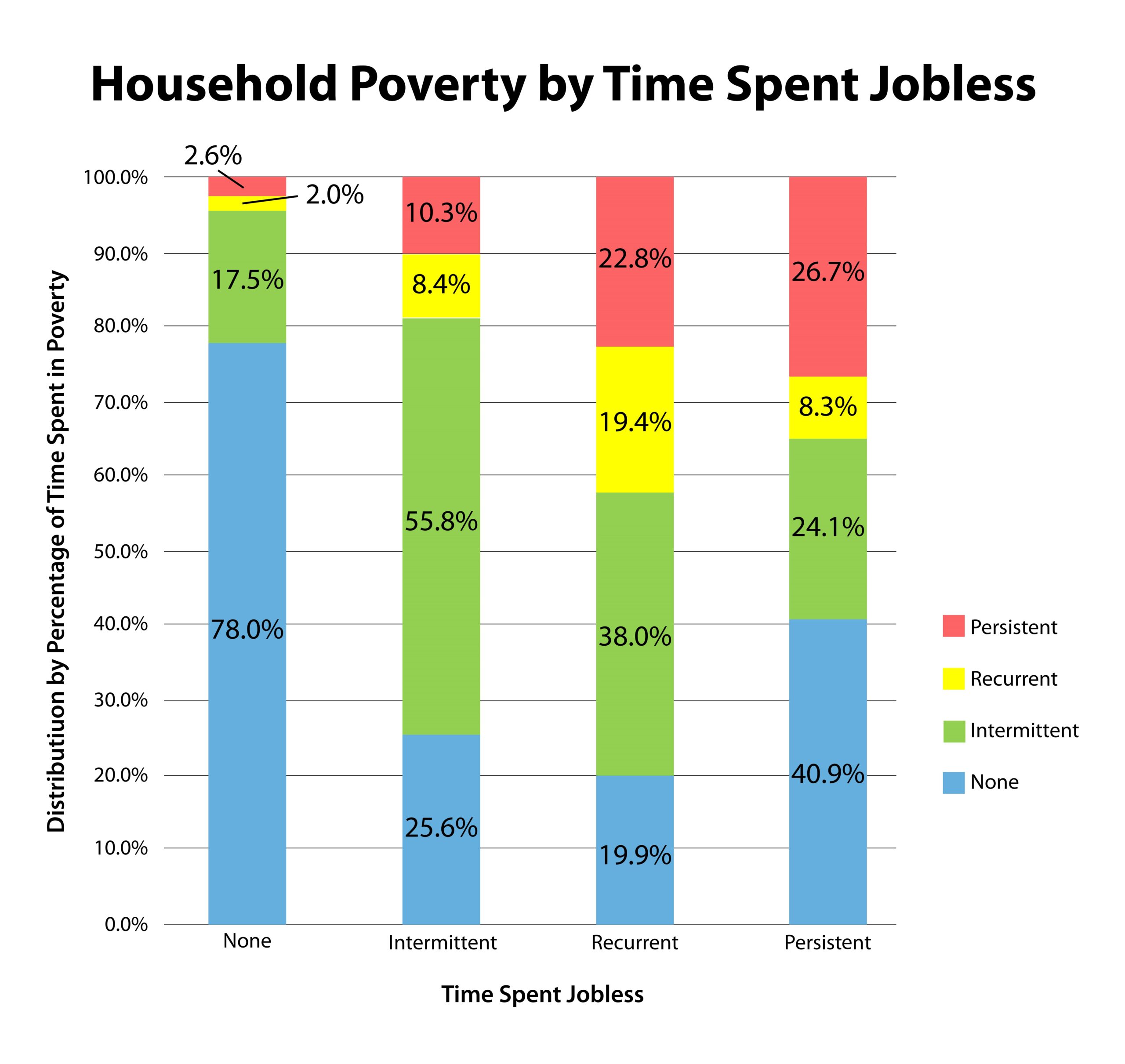
One chart (below) from the paper sheds light on the economic situation of American families and how often they were in poverty or unemployed. The far-left bar represents families where at least one person held a job for the entire 36-month survey period. In this group, 78 percent were not poor at any time, 17.5 percent were poor for 1 to 18 months, 2 percent were poor for 19 to 27 months, and 2.6 percent were poor more than 27 out of the 36 months they were surveyed.

Chart: Household Poverty by Time Spent Jobless

Intermittent = 1 to 18 months of the three-year period. Recurrent = 19 to 27 months of the three-year period. Persistent = more than 27 months of the three-year period.

Source: Rachidi, Angela; American Enterprise Institute. Persistence of Poverty and Joblessness in US Households. AEI Economics Working Paper. July 2018. Figure 5 (Author’s calculations using the Survey of Income and Program Participation, 2008 Panel, Years 2009–11, Waves 2–11).

Those who experienced intermittent and recurrent joblessness (two middle bars) were much more likely to be in poverty at some point during the survey period. These people are having difficulty getting hired at the current minimum wage. For those who are persistently jobless and do not have income from retirement or disability insurance to keep them out of poverty, the barriers to entering the job market are also high. Mandating that employers pay even more for their labor will only take away employment opportunities and make it even harder for them to get a foot in the door toward more stable employment.

A better solution would to be implement an earned income tax credit (EITC) here in Missouri so that those who are working can hold on to more of their paycheck. Instead of making low-wage workers pay a state income tax, a non-refundable EITC could reduce or even zero-out their state income tax bill and increase their take-home pay.

It’s understandable to want to do something for people who work hard but still can’t escape poverty. But just because a policy is intended to fix a problem doesn’t mean that it will actually work. Missourians risk creating a worse system with a higher minimum wage that benefits the few who consistently work while harming many more who face low earnings due to frequent unemployment or underemployment.


Video: An Ode to the “Ditch Diggers” Building Missouri

The video above—which you’ll notice was largely produced here in Kansas City—has been out for a few months, but “broke out” in construction circles on social media in the last week or so, which is how I came across it. The video is about workforce development, which I’ve written about before, and revolves around a poem titled “Ditch Diggers” by Eric Borden, a Drexel, Mo., resident. It focuses on the often-negative view that modern culture has for good blue-collar professions, and Borden uses the term “ditch diggers” as shorthand for a variety of professional vocations in construction and other blue-collar industries. In addition to being relevant to policy discussions, as a poem it’s a form of art as well. 

As I’ve said before, state workforce development policies have to encompass the spectrum of professions in Missouri rather than just prioritize college educations, and the “Ditch Diggers” poem and video help to give human faces to the argument.

State Auditor Calls for CID Reform

Having completed a soon-to-be-released paper on Missouri’s profligate special taxing districts such as transportation development districts (TDDs) and community improvement districts (CIDs) with Graham Renz, I was pleased to see this news from the office of the Missouri State Auditor.

CIDs are designed to meet local needs by giving businesses and individuals and opportunity to band together to collect an additional sales or property tax to fund specific projects. However, the statutory requirements are lax and oversight is wanting.

According to the August 22 news release,

“Taxpayers are on the hook for billions in project costs they did not approve and have little to no say in,” Auditor Galloway said. “Meanwhile, there is no law to ensure developers are accountable for the public dollars they receive and there are few requirements of the municipalities that approve these districts. State laws must be reformed to ensure taxpayers get the protection they deserve.”

The complete Auditor’s report is available here. We welcome the Auditor’s contribution and look forward to joining this important policy discussion with our own policy recommendations soon.

Marketing Water?

It might not surprise readers to learn that government bureaucrats overspend. But the Kansas City Water Services Department spent a great deal of money on a video promoting . . . water.

Back in the summer of 2013, the Water Department sought to “produce an educational video focused on the journey Kansas City’s water takes from river, to tap. [sic]” The resulting 1:44 video, embedded above, cost $24,541.28.

By way of comparison, the 25-minute Kansas City Public Television documentary, “Water Rates and Rivers,” which explored the steep increase in water rates and its serious impact on the poorest among us, cost about $40,000. Not only was the KCPT video nearly 15 times longer, but it required much more time and effort to produce.

About the time the contract to produce the Water Department video was signed, Mayor James declined a request by the Missouri Auditor to look into the department due to complaints his office received. Given ever-increasing water rates and this questionable expense, perhaps that decision should be revisited. In the meantime, I invite you to tap your toes to this bit of government-funded education.

State Checkbook Is Now Online

Yesterday marked a step forward for transparent government in Missouri. The Missouri Treasurer’s Office announced the creation of an online checkbook that tracks how and with whom the state is spending our tax dollars. The Show-Me Checkbook can be found at https://treasurer.mo.gov/showmecheckbook.

We are excited to see the state make transparency in spending a priority. Now that this tool is available, I hope that local governments and special taxing districts will join this initiative so that every tax dollar spent at all levels can be tracked by the taxpayers from whom the money comes (a goal SMI writers have championed with our Checkbook Project).

Government, no matter its size, should provide easy access to information about how it’s spending our money. Kudos to Missouri for taking a step toward greater transparency.

Support Us

The work of the Show-Me Institute would not be possible without the generous support of people who are inspired by the vision of liberty and free enterprise. We hope you will join our efforts and become a Show-Me Institute sponsor.

Donate
Man on Horse Charging