On May 9 the Show-Me Institute’s Crosby Kemper III and Patrick Tuohey appeared on KCPT’s Ruckus to discuss Kansas City’s underfunded pension programs, streetcar expansion, and other local issues. Click above to watch the entire program.
Cycling Down the Rabbit Hole
I did not intend to spend so much time looking into BikeWalkKC’s proposal to spend around $400 million in taxpayer money on bike lanes in Kansas City. But when so many of the assertions made by BikeWalkKC crumble under the most cursory examination, it’s troubling. Consider this:
- The plan will likely not save 36 lives a year, as claimed.
- The plan will likely not create 12,600 jobs, as claimed. In fact, the as yet unfinished paper on which they base this claim doesn’t even make that claim itself.
If the plan won’t deliver on those prominent promises, will it even increase cycling?
According to traffic counts conducted by the Kansas City Public Works Department, cyclists constitute a negligible amount of street traffic. One-day traffic counts at a few intersections along Armour Blvd. in 2016 show that cyclists account for between zero to 0.06 percent of road traffic. Counts at similar intersections along Armour in 2018 and 2019 show the percentage of cyclists ranging between 0.02 percent to 0.16 percent of traffic.
Nationwide, the percentage of people who bike to work fell over 3 percent from 2016 to 2017. In Kansas City it was never high to start with. In 2014, 0.1 percent of Kansas Citians in the metro area commuted to work by cycling, and these recent Public Works numbers suggest it is even lower than that today.
The director of community planning for BikeWalkKC indicated by email that the organization conducted manual bike traffic counts in October 2016, but lost them. The traffic counts must not have been impressive, because BikeWalkKC chose not to include them in the Bicycle Network Demand Analysis they published the very next month. In fact, despite the promise of the title, there was no analysis of bicycle demand in the report at all. Quite the contrary, the report argues on page 8 that traffic accounts aren’t valuable anyway:
Observations of where cyclists are riding today can provide valuable insight, but cyclists counts cannot be a direct proxy for latent demand because they have already internalized all of the physical barriers and constraints that impact a cylist’s [sic] decisions.
The following bicycie [sic] infrastructure demand analysis is not intended to be a trip projection like those described above. The goal of this analysis is to determine where people would ride bicycles if facilities made it convenient and comfortable to do so. Therefore, latent demand is considered separately from the barriers and constraints of the physical environment.
In other words, don’t bother conducting an assessment of demand, just build it and they will come. The bike activists just assign scores to routes they think people would travel if there were bike lanes.
Certainly cities should ensure the safety of cyclists and motorists alike, and be supportive of growth in new types of travel. But biking to work in Kansas City is not a significant form of commuting and does not appear to be growing. Spending hundreds of millions of dollars because a few people hope it may help increase cycling is not sound public policy—not when Kansas City has so many other more significant needs.
Restarting Missouri’s Low-Income Housing Tax Credit Program Is Still a Bad Idea
Ever hear the phrase “throwing good money after bad?” That’s what Missouri lawmakers are considering doing with the proposal to revive the state’s low-income housing tax credit (LIHTC) program. With little more than a week remaining in this year’s legislative session, and with so many policy priorities outstanding, it’s easy to wonder why time is being devoted to a program that has been shown to be a bad investment for Missouri taxpayers. Are lawmakers really trying to help low-income Missourians find affordable housing, or are they simply underwriting the interests of the state’s well-connected real estate developers?
Proponents of Missouri’s LIHTC program often cite the claim that there are an estimated 100,000 people on waiting lists for low-income housing as a rationale for reviving the program that was halted in 2017. I agree that affordable housing for low-income Missourians is important, but I disagree that the LIHTC is an effective way to address the problem. Missouri already receives over $160 million per year from the federal government for the same low-income housing projects.
The bottom line is that the program doesn’t work, and policymakers know it. Just last week, Missouri’s own state treasurer, who sits on the board responsible for issuing the low-income housing tax credits, criticized the program for being wasteful and inefficient. Missouri’s three previous state auditors have concluded that for each dollar of tax credit awarded, only a little more than $0.40 is spent on building affordable housing. The remainder goes to developers, investors, and government. It should go without saying that Missourians deserve a better investment of their tax dollars.
With so little of each state dollar going toward building more housing, it shouldn’t be surprising that the program doesn’t result in a significant increase in the amount of available affordable housing across the state. This result aligns with academic research on the federal program, which has illustrated why the structure of the LIHTC and surrounding regulations inflates building costs and results in poor returns on investment.
It is important to reiterate that the discussion in Jefferson City is only regarding whether Missouri should resume devoting funds on top of what the federal government already provides. Even without any new credits being authorized since 2017, as of last report, the state is potentially on the hook for around $1 billion in state low-income housing tax credits As lawmakers continue to struggle to balance the state’s budget each year as a result of the increasing cost of other spending priorities’ (education, Medicaid, public safety, etc.), shouldn’t all tax dollars go toward programs where they can be expected to stretch a little further?
Supporters offer a false choice when arguing that reauthorizing Missouri’s LIHTC program is the only way to address the state’s affordable housing needs. How could this be true when Missouri is one of only 15 states that even have programs matching the federal government’s LIHTC funds each year? Why don’t lawmakers look to the other 35 states to see how they address this issue?
The cost of restoring Missouri’s LIHTC program would be equivalent to $105 per month for each low-income individual currently on the waiting list. The value received by those individuals would be the equivalent to $44 per month. Deciding where to use taxpayer dollars is all about priorities; the question is whose priorities are more important: low-income Missourians in need of affordable housing or the developers who profit from that spending?
Are Mileage-Based User Fees Good For Missourians?
The Information Technology and Innovation Foundation (ITIF) just released a paper about “road user charges,” which would change the way governments fund roads. Instead of per-gallon fuel taxes, drivers would pay mileage-based user fees (MBUF). As Missouri policymakers wrestle with how to fund infrastructure, this report is a welcome read.
Bob Poole of the Reason Foundation, a libertarian free-market organization, wrote of the study in a recent newsletter and addressed two concerns likely to be raised in Missouri:
One of the most important is the idea that a system using GPS would “track” everywhere the vehicle goes. He [the author of the study] points out, correctly, that GPS is a one-way system: it enables the car to know where it is at all times, but the GPS satellite and its operators do not know. The basic concept is that an on-board unit on the vehicle would total up the miles driven (and which states those miles occurred in) and transmit the totals to the relevant jurisdictions (e.g., New York and New Jersey) so each can levy per-mile charges.
Another oft-heard concern is that because rural residents drive longer distances, they would be made worse off by a miles-charged system. Drawing on research from Rand Corporation and others, Rob’s report explains that rural residents tend to own older, gas-guzzling vehicles compared with urban residents, so most of them would be better off paying by the mile rather than by the gallon. Detailed TRB research papers bear this out. Similar data call into question the equity argument; Rob reminds us that lower-income households tend to drive older, less fuel-efficient vehicles compared with wealthier people. Like rural residents, most low-income urban-area residents would be better off paying by miles driven than by gallons used.
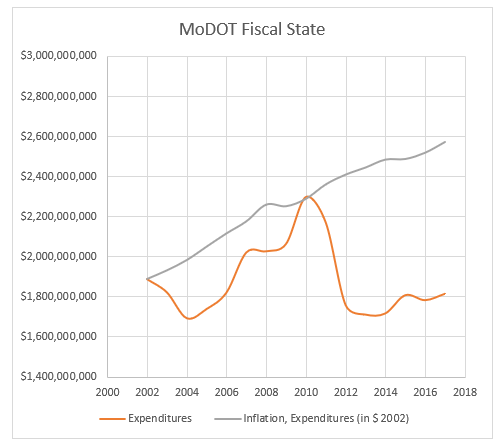
Former Show-Me Institute analyst Joe Miller addressed the issues facing the Missouri Department of Transportation in a 2016 paper, which included consideration of user fees such as mileage-based fees. As Poole points out, the ITIF policy paper is too heavy on top-down federal and state mandates. Instead, he urges states to experiment with ways for drivers to track their mileage and report it to private-sector service providers rather than state or federal agencies—as drivers will likely view it a violation of privacy.
Advances in technology such as more fuel-efficient cars pose a challenge to the old ways of raising infrastructure funds. Technology also permits us many more ways of addressing policy needs. It should be no surprise that there are likely more efficient ways for governments to collect the revenue necessary to provide for basic services. Policymakers should be open to considering those opportunities.
Is General Motors Going to Get a Tax Cut Instead of Missouri Taxpayers?
We’re in the twilight of the legislative session here in Missouri, and as tends to happen, it looks like there’s going to be a legislative twist at the end. General Motors, the American car conglomerate, is reportedly considering a $1 billion expansion at its Wentzville auto production facility in the suburbs of St. Louis. The first the public heard about the proposal was on May 1, meaning that if the legislature passes a tax incentive plan of any kind for the company, General Motors will have gone from nothing to likely millions of dollars in hand in the course of only about 18 days.
That’s absurd.
To be clear: the Missouri Senate has put the brakes on all manner of tax relief for Missouri taxpayers—while pulling out all the stops for corporate welfare like the Low-Income Housing Tax Credit—for the last five months. Now that another corporate crony has come with arms outstretched and “jobs” on its lips, the folks in Jefferson City have snapped back to life and are ready to let the money pour from public coffers like they just backed over a fire hydrant with a truck.
Here’s a proposal: Permanently end the Low-Income Housing Tax Credit and save $180 million per year. Dramatically reduce and reform the historic preservation tax credit and save tens of millions of dollars per year. Drastically reduce and eventually end the corporate income tax.
Stop being such an easy mark. Stop just giving away other peoples’ money. And if General Motors needs a tax break, perhaps the people who would be forced to subsidize the company need one too.
Good News-Criminal Justice Reform Headed in the Right Direction in Missouri
A few years ago, Missouri was on track to need two new prisons, potentially costing the state hundreds of millions in tax dollars. But not any longer. From 2017 to 2018, Missouri’s incarceration rate decreased by 7.1 percent, the largest drop in the country according to the Vera Institute for Justice.
This decrease follows some recent reforms, including improving parole and probation practices, expanding community-based treatment for mental health and substance abuse, and raising the age of criminal responsibility from 17 to 18 years. Now, the legislature is considering other reforms. One would amend sentencing guidelines to allow judges the discretion to give an alternative sentence to imprisonment for certain non-violent crimes when appropriate. Additionally, lawmakers are examining regulations regarding occupational licenses for ex-offenders that can shut them out of jobs and increase the likelihood they return to prison. Reforms like these can provide taxpayers with the best public safety return on their investment make a lot of sense.
It’s a Head-Scratcher
I just don’t get it. A recent article in The 74 describes how the vibrant charter school sector and strong authorizers have led to a rising tide for both charter public school students and traditional public school students in Washington, D.C. It makes me scratch my head. Why don’t we want that in Missouri?
The article, which cites the dramatic rise in scores on the National Assessment of Educational Progress (NAEP) for both groups of students, concludes with three takeaways that other cities can learn from DC:
- Cities should embrace charter schools while limiting authorizers to one or two “strong” ones.
- Cities should welcome the potential positive effects of competition. It’s been a force for positive change across the country.
- If cities allow that to happen, middle-class families will stay.
This dynamic of charters having a broad, positive impact for everyone is playing out in big cities—Chicago, Indianapolis, Denver, Nashville, Boston—and in small cities. While we haven’t seen dramatic results in St. Louis or Kansas City, we also haven’t embraced charter schools. There continues to be this odd notion in Missouri that charter schools are an intervention for low performance. Everywhere else they’re an option—often sponsored by local school boards—that parents across all types of communities and backgrounds are choosing.
Here’s the more important point—Missouri has a lot of other cities that would benefit from school choice. The school districts in Springfield, Joplin, Jefferson City, and Cape Girardeau are not exactly thriving. And yet, school boards and state legislators in these cities continue to fear public school choice. This year, the Missouri Senate filibustered a bill that would have made it much easier for charter schools to open in these cities. The Senate floor was held hostage for hours to ensure that the traditional public school monopoly wasn’t threatened by parents who want something else.
How long will Missouri continue to cross its arms and staunchly defend the status quo of thirty years ago? How long will the positive stories about what’s working when it comes to improving public education only be about other states?
Rural Families Don’t Have to Accept “One Size Fits All” When it Comes to Education
Anyone who grew up away from big cities knows that limited options are a fact of life, whether it’s restaurants, shops, or even schools. “You get what you get and you don’t throw a fit”—a phrase from a popular children’s book—is an acquired attitude if you live in a rural area.
But just up the road from my hometown in central Kansas, many parents and students are throwing a fit after two school districts rolled out a new, web-based curriculum from Silicon Valley. The New York Times recently profiled the Kansas towns of McPherson and Wellington and their school districts’ adoption of Summit Learning, a personalized learning platform where students go at their own pace on their computers and teachers act more like mentors.
While personalized learning has been embraced in some parts of the country as a great innovation, the reception in Kansas has been mixed—some love it, but some hate it enough that they are looking for other options for their kids. Leaving aside the merits of the program, the problem is not every student is well-suited to this method of learning, and not every parent is happy with their child spending most of the day in front of a computer screen. Unfortunately, alternatives in rural areas are scarce or unaffordable whether you are in Kansas or Missouri.
Private school tuition is expensive, and some do not have the time or money to homeschool. Picking up and moving to a new school district is not so simple either; unlike urban or suburban areas where a few miles in any direction will land you in a new district, rural areas are spotted with towns like islands in a sea of crops and pastures. Not to mention that for those that farm, moving is completely off the table. Interdistrict transfers can help, but the next nearest school may not be close enough to commute to and from every day.
Families living in rural areas should not have to accept limited opportunities for their children’s education. Education savings accounts (ESAs) could help families homeschool or enroll in a private school that’s just five miles away instead of transferring to another traditional public school 20 miles away. Charter schools can also provide another option if parents aren’t satisfied with what’s going on in their home district.
We should recognize that students, no matter where they live, have different needs and interests. We can also trust parents to make sound judgments about what kind of approach is best for their own kids. Rather than just accepting whatever the local school boards decides, parents and students from rural areas are right to throw a fit when it comes to accessing more opportunities in education.
Missouri’s Municipal Failure
According to the Brookings Institution Metro Monitor 2019, per data from 2016–2017, Kansas City ranked 78th in economic growth out of the 100 largest metro areas in the United States. St. Louis fared a little better at 69th. Kansas City ranked 84th in prosperity (measured by productivity, standard of living, and wage growth); St. Louis ranked 52nd. Missouri’s cities are underperforming.
The Kansas City metro area, despite all the talk about innovation and tech jobs, scored 81st in percentage change in jobs at young firms—one of the worst performances in the United States.
Missouri’s top cities spend hundreds of millions of dollars on incentives and subsidies each year in an effort to improve the economy. Exactly what have we gotten in return for all this spending?
Report after report details exactly how St. Louis and Kansas City have given away such a huge amount in incentives. We’ve rebuilt downtown Kansas City, yet haven’t grown or created jobs in any meaningful way. In fact, it appears we’ve actually overbuilt Kansas City. The population of St. Louis is actually shrinking despite all the investment.
Any reasonable person would look at this and conclude that while these incentives and subsidies may make wealthy developers wealthier, they aren’t actually creating very many jobs or doing much to increase investment. That is certainly what the research says.
So why are we still doing it?